 How to resolve AdBlock issue?
News
- Details
- Written by: Elizabeth Larson
LAKE COUNTY, Calif. — A week after the Board of Supervisors unanimously passed a resolution urging all community members to wear masks in indoor public settings, Lake County’s COVID-19 case rate has doubled and shows no sign of slowing.
“I know we would all like to believe that we’re through the COVID-19 pandemic and that it’s all behind us. But unfortunately it isn’t,” acting Public Health Officer Dr. Charlie Evans, an emergency room physician of 37 years from Sonoma County, told the Board of Supervisors during its Tuesday meeting.
Last week, Supervisor Jessica Pyska presented the indoor masking resolution to the board, prompted by a growing caseload of 17 per 100,000 over a seven-day average.
On Tuesday, the California Department of Public Health dashboard showed that the same metric had jumped to 35 per 100,000 over a seven-day average, remaining the highest such rate in the state.
Epidemiologist Sarah Marikos told the board Tuesday that the county’s caseload is even higher — 50 per 100,000 — when taking out the seven-day average.
Marikos also reported that Lake County’s testing positivity rate, which had fallen to a low of about 1% in June, has now risen to 17.4%, the highest the county has had during the pandemic so far. At the same time, the overall state testing positivity rate has grown from 1% to 6%.
Lake County also had its 65th COVID-19 death within the past week, Marikos said.
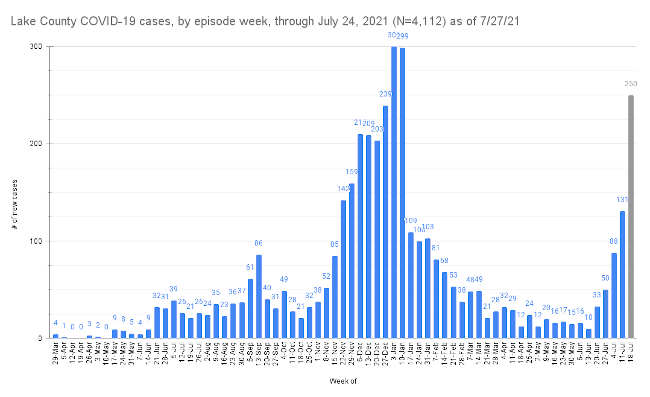
Marikos presented an epicurve graph showing that Lake County’s current case numbers now have surpassed December’s numbers and are approaching those recorded in January, when the surge hit its peak.
During the past week, there were 250 confirmed cases, the third-highest week for cases in Lake County since the pandemic began and nearly twice the cases reported the previous week. Marikos said she wouldn’t be surprised if by next week she’s reporting nearly 300 cases for the week.
The 20 to 44 age group continues to have the highest percentage of cases — 51%, Marikos said.
Of the Lake County residents who have been fully vaccinated — 28,548 — Marikos said 68, or 0.238%, have tested positive for COVID-19.
People who are unvaccinated are about seven times more likely to be infected, she said.
Marikos said the Delta variant is spreading and is present in every region of the state. In June, the Delta variant accounted for about 50% of sequenced specimens, while now it’s closer to 80%.
Statewide, in mid-June, Marikos said there were 150 hospitalizations a day in the state; that’s now climbed to 500.
She said recent studies in the United Kingdom, Canada, Scotland and the United States have looked at second dose vaccine effectiveness versus the Delta variant.
“This is really, really great news,” said Marikos, explaining that the vaccines are 96% effective in preventing hospitalization and 87 to 88% effective in preventing symptomatic disease.
Marikos said 51.7% of Lake County residents are fully vaccinated, compared to 63% of Californians. About 58% of people ages 18 to 49 are not vaccinated.
Lake County’s overall vaccination rate is only improving by about 1% a week, Marikos noted.
She said vaccinating will be critical in preventing new infections in late summer and early fall.
‘A house on fire’
Pointing to the information Marikos presented, Evans, making his first appearance at a board meeting, told the supervisors, “We really have a house on fire and it’s time that we all huddled together and put that fire out. Unlike a year ago, we now have the tools to do that.”
Evans said the United States has an abundance of vaccine and personal protective equipment, in contrast to Kenya, where only 2% of the population are vaccinated. He founded a clinic in Kenya 30 years ago and he’s going there next week to do some work.
As for why Lake County is leading the state in infection rates, Evans said he believes there are many factors. The surge started in the middle of June as the masking mandate was released for vaccinated individuals. Those who are not vaccinated are still requested to mask while indoors but he said that hasn’t been taking place, and Evans emphasized the value of masking.
Lake County’s vaccination rate also is impacting the case rate. Evans said the 18 to 49 age group is only 35% vaccinated, and those individuals are out and active in the community and getting infected.
He said they don’t know for sure how many infections are the Delta variant. “With time we will.”
Speaking about variants, Evans said the alpha variant from England, also known as B.1.1.7, which had caused havoc for parts of Europe as well as big infection rates in Michigan and Minnesota, didn’t impact the rest of the United States as severely as expected.
The alpha variant was 40 to 65% more aggressive than the mother virus. The Delta variant, Evans added, has 1,000 times the viral load of the mother virus.
As long as there are unvaccinated people, Evans said there will be variants.
“I know we’re all fed up with masking and children at home and isolating but in Lake County we’re facing one of the biggest surges we’ve yet seen. If we do nothing the situation will devolve and we will see additional unnecessary death,” Evans said.
To illustrate that point, he said last weekend both of Lake County’s hospitals were at capacity, including for ICU and med surg beds. “We’re already at that point of critical overload.”
He suggested businesses keep protective shields in place, continue to offer hand sanitizer and social distancing signage. Patrons should continue to mask until infection rates drop significantly.
“There is a clear path out of this pandemic and we all know what the answer is: It’s vaccination,” he said.
He addressed myths about vaccination as described in a statement this week from the Rural Association of Northern California Health Officers, and explained that the COVID-19 vaccine is more effective than that created for polio.
“COVID-19 is looking for hosts who are not yet vaccinated. And I'm sure if you’re not yet vaccinated, it will find you,” he said.
Pyska asked Evans about guidance on how to carry out large events that are planned in the coming months. Evans said he strongly discourages any large indoor functions, and said outdoor conditions are safer.
During public comment, Randall Cole, who acknowledged he was unvaccinated, recounted getting COVID-19 from an ill friend at the start of July. He ended up spending two weeks in the ICU.
“People have free will. They can choose whether they want to be vaccinated or not,” Cole said, adding masking should be required, whether people are vaccinated or not.
Leonardo Rodriguez, the student trustee on the Mendocino College board, said COVID-19 has completely thrown off so many students. In a county that’s only half vaccinated and with the surge, he suggested that maybe schools should not be reopened yet.
Rodriguez asked those who won’t get vaccinated to think of the community and others.
Evans also responded to statements from several community members questioning vaccines and testing, in particular, PCR tests.
The Centers for Disease Control and Prevention said last week that, after Dec. 31, it will withdraw the request to the U.S. Food and Drug Administration for emergency use of its own CDC 2019-Novel CoronavirusReal-Time RT-PCR Diagnostic Panel, first introduced in February 2020.
The CDC is encouraging labs to consider adopting methods that can test for both influenza and COVID-19 to save both time and money as the nation heads into flu season.
That change has been attributed to many other tests being available and, separately, FDA officials said that agency hasn’t issued a statement questioning PCR test result reliability in general.
Evans said PCR tests are used in many different modalities. “It’s an extremely sensitive test. It tests the DNA of the virus. The only time it falters is when the test is not administered correctly.”
He said it’s been a lifesaving test that has allowed them to detect COVID-19 in numerous individuals.
As for one speaker’s assertion that officials were urging people to rush into being vaccinated, Evans said it’s more than a year into the pandemic, with vaccines available for nine months.
He said he had a patient last week with respiratory failure due to COVID-19. As he prepared her for the ICU, she asked if she could be vaccinated. Evans said he told her it was too late.
“We’re not rushing into anything here with the vaccines,” he said, noting he’s lost a family member to the illness.
He urged people to be vaccinated, wear masks and wash their hands.
Email Elizabeth Larson at
- Details
- Written by: Lake County News reports
This draft legislation would expand the National Monument to include a federally owned land parcel known as the “Walker Ridge” tract.
This ridgeline in Lake County has cultural significance to Native Americans and is home to bald eagles and rare wildflowers.
The proposed National Monument expansion is supported by the Lake County Board of Supervisors, California Wilderness Coalition, California Native Plant Society, and the Woodland-based Tuleyome nonprofit.
In 2014, Congressman Garamendi championed bicameral legislation (H.R.761) to establish the Berryessa Snow Mountain National Monument, with then-Senator Barbara Boxer (D-CA) and Congressman Mike Thompson (D-CA05).
This legislation would have included the Walker Ridge tract in Lake and Colusa Counties administered by the federal Bureau of Land Management within the National Monument’s boundary.
Congressmen Garamendi and Thompson hosted a visit by then-Secretary of the Interior Sally Jewell in 2014 at Lake Berryessa Monument so she could view the landscape in person and hear from local community and tribal leaders about the need for a national monument designation.
Said Secretary Jewell at the time, “This is a beautiful area with cultural history and great opportunities for outdoor recreation and wildlife viewing, so it’s no surprise that the community wants to make sure that it is protected and passed on to the next generation.”
In July 2015, President Obama declared the federal land surrounding Lake Berryessa as a National Monument — Presidential Proclamation 9298 — at the Congressmen’s urging.
Congressman Garamendi’s new draft legislation would expand the Berryessa Snow Mountain National Monument to include Walker Ridge, an extinct volcanic mountain range with an unusual “serpentine” soil composition that has made it a trove of rare and beautiful plant species, including the adobe lily (Fritillaria pluriflora) found only in Northern California.
Other rare and protected animal species that make their home in this area include the bald eagle, golden eagle and tule elk.
The inclusion of Walker Ridge as a part of the Berryessa National Monument would not affect pre-existing water rights or impose new regulations on hunting, fishing, or motorized recreation that are important to the local economy.
A study by the Winters Chamber of Commerce indicated that outdoor recreation supports a $6 billion industry and 700,000 jobs in California alone.
“Conserving California’s special places has been a lifelong passion throughout my tenure in the state legislature, as Deputy Secretary of the Interior to President Clinton, and now as a member of Congress representing Lake County. Walker Ridge is one of those special places, and I welcome the public’s comments as we work to conserve this unique landscape for future generations of Californians to enjoy,” said Congressman Garamendi.
The “Berryessa Snow Mountain National Monument Expansion Act” would not impact privately owned, state, tribal, or non-federal land in any way. The proposed federal land parcel proposed for including the National Monument does not include acreage of the BLM’s Walker Ridge tract in Colusa County.
The draft legislation would also direct the federal Bureau of Land Management and the U.S. Forest Service to finally complete the management plan for the National Monument, which has remained unfinished since 2015.
Interested members of the public may submit their feedback on the discussion draft legislation to Congressman Garamendi’s office at: Tigran Agdaian, Legislative Assistant, Congressman John Garamendi (CA-03), 2368 Rayburn House Office Building, telephone 202-225-1880, email
Walker Ridge Addition Berryessa Snow Mountain National Monument 20210512 by LakeCoNews on Scribd
BSMNM Expansion Bill by LakeCoNews on Scribd
- Details
- Written by: Lake County News reports
Siyan Clinical Research of Santa Rosa was recently awarded a Lake County Mental Health Services grant through the California Community Reinvestment grants program, or CalCRG, in response to a health needs assessment provided by Hope Rising Lake County.
This assessment identified the county’s significant health needs, including mental health, alcoholism, poverty, drug use, unemployment and housing stability.
The CalCRG program was included in the Adult Use of Marijuana Act (Proposition 64), approved by California voters in 2016, and funded by the cannabis excise and cultivation taxes.
Siyan Clinical Research is the largest psychiatric research facility in Northwestern California.
The facility will be designing and implementing services in cooperation with Hope Rising Lake County, Lake County Family Resource Center, Lake County Behavioral Health, Lake County Probation, Lake County Public Health, Lakeport Police Department, California Human Development and the Mendocino Private Industry Council Inc.
“At Siyan Clinical Research we provide our patients with the highest quality psychiatric care in an atmosphere of respect, compassion, and a belief in the innate value of every individual, regardless of his or her accomplishments or failures,” said Dr. Anish Shah, president and CEO of Siyan Clinical Research. “Our mission is to improve care for people with mental disorders and their families through tailored treatment, professional education, and standard-setting clinical care.”
Siyan Clinical Research is the largest private behavioral health practice in Northern California, with a 4,000-patient database serving six counties. Find more information about Siyan Clinical Research at www.siyanresearch.org.
More information about the Lakeport Police Department’s participation in this program is available from Chief Brad Rasmussen at 707-263-5491.
- Details
- Written by: Lake County News reports
The Governor’s California Comeback Plan provides an unprecedented level of investment in the state’s world-class public higher education system, with $47.1 billion total for the University of California, California State University and California Community Colleges, or CCC, and student financial aid.
“The California Comeback Plan doubles down on our commitment to making college more affordable and accessible than ever before, boosting the state’s nation-leading recovery from the pandemic and driving our long-term economic prosperity,” said Gov. Newsom. “With massive increases in funding for our world-class colleges and universities, expanded college savings accounts, increased student financial aid and opportunities to gain work experience while learning, we are helping students reach their full potential and driving upward mobility across California.”
Making college more affordable, AB 132 implements the California Comeback Plan’s expansion of the Cal Grant program for community college students by eliminating age and time-out-of-high-school requirements, with awards that follow students to the UC and CSU upon transfer.
Starting in 2022-23, the bill also revises the Middle Class Scholarship program to provide scholarships intended to cover up to the difference between a student’s total cost of attendance and other sources of aid, including student and family contributions, depending upon available resources each year.
It also makes summer financial aid investments for UC and CSU students permanent and includes $115 million for Zero-Textbook-Cost Degree grant programs and open educational resources at CCCs, helping address the rising costs of textbooks.
Working to create more equitable and streamlined pathways from school to career, the budget trailer bill establishes a Learning-Aligned Employment program at the UC, CSU and CCC to help underrepresented students with financial need gain relevant work experience, promoting long-term employment opportunities.
It also establishes the Golden State Education and Training Grant Program to provide grants for education or high-quality training for workers displaced by the pandemic.
Improving access, AB 132 establishes a dual admissions program that provides eligible first-time freshman applicants the opportunity for guaranteed admission to the UC or CSU campus of their choice following completion of an associate degree for transfer or another transfer pathway at a CCC.
It also requires school districts and other educational agencies to confirm that high school seniors who have not opted out complete FAFSA or California Dream Act applications for financial aid.
In addition, the legislation expands the California Kids Investment and Development Savings Program to provide $500 base deposits to seed college savings accounts for public school students from low-income families, English learners and foster youth, with supplemental deposits for foster youth and homeless students.
AB 132 also establishes the governance and operational structure for the state’s Cradle to Career data system, which will connect education, workforce and social services data to better inform parents, educators and policymakers.
The California Comeback Plan will create more slots for in-state students who wish to attend a CSU or UC school; sets aside $2 billion to address housing and space needs at the UC, CSU and CCCs, contingent upon future legislation, which will help drive down the cost of student housing; provides $50 million for Guided Pathways programs to help community college students graduate on time; and includes investments to support equity-focused programs at community colleges and Student Academic Preparation and Educational Partnerships programs at UC campuses, helping to bridge equity gaps.
For full text of the bill signed today, visit: http://leginfo.legislature.ca.gov.