 How to resolve AdBlock issue?
News
- Details
- Written by: Elizabeth Larson
Board Chair Bruno Sabatier presented the urgency ordinance to the board.
It will require land use applicants — no matter what type of project — to provide hydrology reports.
Over the past month, the Lake County Planning Commission’s members — in particular, District 1 Commissioner John Hess — have stated at their meetings that they wanted more guidance from the Board of Supervisors about how to assess projects and water usage, especially as the drought situation has worsened.
Many of the projects they’ve been considering recently, the majority of them cannabis projects, use millions of gallons of water.
The commission and county staff raised issues about the need for more thorough water reporting, and earlier this month had put off a decision for two weeks on a proposed project at High Valley Ranch in Clearlake Oaks in order to seek more information from the applicant.
Sabatier and other board members noted during their discussion that they had heard the commission’s comments in recent months and wanted to respond to them, with a view to introducing long-term rules to analyze water usage.
In his written report on the item, Sabatier said the commission’s requests for guidance and direction came “during these hard and difficult times where economic development and the urgent need to conserve water seem to be clashing.”
During the discussion, explaining the importance of taking up the matter, board members referred to a report earlier in the meeting from the county’s Drought Task Force in which it was reported that the county expects to receive a total of 200 permit applications for new wells by year’s end. That’s compared to 148 last year, the highest number of permits applied for since 2015.
Sabatier said that one of the projects the commission had approved over the last two months and which was appealed to the board — an apparent reference to the WeGrow LLC project near Hidden Valley Lake — had estimated numbers for water usage but no accompanying report.
Similarly, commission agenda packets often don’t have water reports included in them, as Lake County News has reported.
Sabatier’s proposed urgency ordinance adds the requirement for a full hydrology report, explaining he’d like that to eventually be added as a permanent standard. Applicants also would be required to draft a drought management plan on how to conserve water.
Supervisor Jessica Pyska said the board had an opportunity to be proactive. “If we don’t have water, we don’t have anything,” she said, adding it was “eye-opening” to find out how many new wells are going in.
Pyska said it’s important to step back and make sure they are in a place where they can sustain this type of development.
Supervisor Tina Scott agreed with moving forward, saying she also wanted to see such hydrology reporting made permanent.
Supervisor Moke Simon — who appointed Hess as planning commissioner — said more conversations need to be had on a permanent solution.
“Fears are running rampant right now with what we’re doing with water use,” he said.
During public comment, several suggestions were made to fine-tune the document.
Consultant Richard Knoll said the ordinance seemed well-intended but wasn’t comprehensive enough. He said it needed to define who is to prepare the reports, suggesting a qualified hydrologist or engineer.
He said the reports also needed to account for other sources of water, beyond wells, including surface water, rainwater and catchment, and not look just at recharge of on-site wells but also the aquifer itself.
Knoll suggested the county should consult with a qualified hydrologist to develop the scope of work of what they’re looking for in the reports.
“We really need to do this as soon as possible,” said Peggie King, who recommended a state licensed hydrologist be required to conduct the reports.
King said there are cumulative impacts important to review so everyone has their fair share of the water in the basin. If the county starts to overdraft or impact low impact basins, that’s going to trigger state groundwater management rules, she said.
Fine-tuning language
After hearing the comments, Pyska said she was concerned that the ordinance required more work to be as strong and effective as needed. She wanted to take another week.
County Counsel Anita Grant agreed that it was important to add language requiring the reports be done by licensed hydrologists and said it could take longer than a week to find a hydrologist just to consult the county.
Simon also supported the hydrologist language and wanted to move forward with accepting the document on Tuesday in order to put one more tool in the hands of the Planning Commission.
Sabatier said that, currently, 95% of the time, the projects before the commission are for cannabis, with the typical water source being a well. When the commission asks for a hydrology report, it delays things further and people already have been waiting to get their projects through the process.
“The wait is exacerbated when it goes in front of the Planning Commission and the Planning Commission requests something else,” he said.
He agreed to add the language requiring a hydrologist and then asked Grant if adding language about a project’s type of water sources was too substantial of a change to do that same day.
“This is an urgency ordinance. There’s no such thing as too substantial of a change that you could make on the face of the document today,” said Grant.
The source of water included in the document may be a little vague but Grant said it’s better than limiting it to wells.
Grant also told the board during the discussion, “Application will give you a better understanding of the approach and the definitions for this urgency ordinance. And it’s not a one and done. You are fully capable of being able to come back and flesh it out.”
She said that if the board wants a permanent ordinance, the supervisors may want to have a hydrology expert consult with them on how best to craft that permanent ordinance. “You’re not without options.”
Water Resources and Public Works Director Scott De Leon suggested to the board that they add licensed civil engineers to the list of professionals who can do the hydrology reports.
Other commenters agreed with De Leon, noting the difficulty of finding qualified and available hydrologists.
Their suggestions would result in the board updating the urgency ordinance language to allow the hydrology reports to be prepared by civil engineers, hydrologists, hydrogeologists or geologists with experience in water resources.
At Grant’s suggestion, Sabatier also fine-tuned the ordinance language to require the approximate amount of water available for the project’s water identified source, the approximate recharge rate for that source and the cumulative impact of the project’s water use on surrounding areas.
“I’m not going to hold this up today, but I think this process is sloppy,” said Pyska.
She said she wants the county counsel to be involved in drafting urgency ordinances with adequate time to review them. “I think we can do better.”
Sabatier passed the gavel to Supervisor EJ Crandell so that he could offer the ordinance with the amendments.
The board passed ordinance 5-0; it needed at least a four-fifths vote.
The ordinance went into effect immediately upon the board’s approval.
Email Elizabeth Larson at
- Details
- Written by: Lake County News reports
On Wednesday, State Public Health Officer Tomás Aragón, MD, DrPH, and the California Department of Public Health, or CDPH, updated statewide face covering guidance.
“The Delta variant has caused a sharp increase in hospitalizations and case rates across the state. We are recommending masking in indoor public places to slow the spread while we continue efforts to get more Californians vaccinated,” said Aragón.
This update came in light of the Centers for Disease Control and Prevention’s Tuesday changes to its “Guidance for Fully Vaccinated People,” made in light of new evidence regarding the Delta Variant (B.1.617.2).
The CDC is now recommending all individuals in areas of “substantial or high transmission” wear a face covering in “public indoor settings.”
Under the CDC’s new guidance, more than 90% of California’s population is currently in areas designated as substantial or high transmission, CDPH reported.
Lake County, with the highest case rate in the state of California, is clearly in the “high transmission” category, confirmed by this CDC tracking tool.
CDPH has extended the recommendation to mask indoors to all Californians, regardless of vaccination status, “To achieve universal masking in indoor public settings.”
According to the CDC, getting vaccinated helps protect from the virus and the circulating variants, including the Delta variant that is now seen in the majority of California’s new cases.
California continues to work to increase vaccination rates across the state. This week, California took the nation-leading step of requiring state and health care employees to provide proof of vaccination or submit to regular testing.
California had also led with its K-12 school guidance, requiring universal masking and other prevention measures as schools fully open for the upcoming school year.
CDPH is continuing to motivate businesses and local communities to encourage vaccination to prevent new outbreaks in areas of substantial and high transmission.
Last week, the Board of Supervisors unanimously adopted a resolution urging the public to continue to wear masks in indoor public settings in Lake County.
The CDC, CDPH and Lake County Board of Supervisors all stopped short of mandating masking for vaccinated individuals, except in limited circumstances — e.g.: public transit; indoor K-12 schools and other child care settings; emergency shelters and formal cooling centers; all health care settings; correctional, detention and other congregate settings.
However, Lake County’s case rate continues to trend upward. On Wednesday, it was 52 cases per 100,000 (when removing the seven-day delay employed by state reporting).
The Delta variant is known to be present in Lake County, and reportedly carries 1,000 times the viral load of the “mother virus,” and has been described by CDC Director Rochelle Walensky as “hyper-transmissible,” and “one of the most infectious respiratory viruses we know of and that I have seen in my 20-year career.”
Hospitalizations and case rates are increasing across the state. Lake County has been more affected than most localities.
Community members are urged to do their part to protect immunocompromised individuals, for example, who “might be at increased risk for severe COVID,” even if they are vaccinated.
Health officials said Increasing the vaccination percentage is Lake County’s best known defense against COVID, and the proliferation of variants that pose threats previously unseen for generations. Some new options for vaccination are described here.
The county of Lake is asking residents to wear masks, wash their hands and maintain physical distancing.
“Do these things not merely out of obligation, but because we are a close-knit County that cares about helping each other out,” county health officials said in a Wednesday statement. “Your personally choosing to tolerate minor inconveniences now may make all the difference for someone you know and love.”
- Details
- Written by: Lake County News reports
The Walker Ridge tract, nearly 4,000 acres, was within the original Berryessa Snow Mountain National Monument boundary, but was excluded before President Obama signed the Presidential Proclamation on July 10, 2015.
Also included in the draft legislation is the requirement to complete a Monument
Management Plan within a year.
Located north of San Francisco and Sacramento, Berryessa Snow Mountain National Monument is a rugged and diverse landscape.
The region is culturally significant to numerous Native American tribes and is also notable for its variety of habitats including grasslands, old growth conifer forests, and woodlands.
It hosts imperiled wildlife such as northern spotted owls, Northern California steelhead, martens and fishers.
Walker Ridge, approximately 10 miles east of Clearlake, is considered a jewel of biodiversity.
The area hosts ancient blue oak woodlands, rugged rock outcrops, precious meadows, rolling hills of chaparral and extensive stands of McNab cypress. It is home to more than 30 species of rare plants.
“We have long fought for the appreciation and protection of this irreplaceable region, which is a mecca of botanical richness within the biodiversity hotspot that is California,” said Nick Jensen, conservation program director for the California Native Plant Society. “We are overjoyed that Congressman Garamendi has introduced draft legislation to expand Berryessa Snow National Monument to include the Lake County portion of Walker Ridge.”
“Permanent protection of this extraordinary place has been a personal priority since before the Berryessa Snow Mountain campaign began,” emphasized Lake County resident and Tuleyome board member, Victoria Brandon. “I’m thrilled that my own Congressman John Garamendi has stepped up to save it for posterity by adding it to the monument.”
Walker Ridge notably provides easy access to a variety of recreational users including mountain bikers, hikers, OHV riders and equestrians.
Don Amador, a long-time trail recreation and resource management professional, noted that, “As one of the OHV recreation partners that helped in the creation of the Berryessa Snow Mountain National Monument, I want to commend Congressman Garamendi for his proposal to adjust the Monument boundary to include Walker Ridge and the many trails that exist in that
area. The boundary adjustment also makes a lot of sense given the BLM has started its travel planning effort within the monument and this plan will make it easier for the agency to designate routes that provide connectivity to increase public access and enhance recreation opportunities for all user groups.”
By completing a management plan, all user groups will be able to enjoy the many wonders of this remarkable region, supporters said.
"The Berryessa Snow Mountain National Monument Expansion Act will safeguard Walker Ridge's natural beauty, wildlife, rare plants, and indigenous treasures,” said Tuleyome Executive Director Sandra Schubert. “It will also secure continued recreation opportunities in the area while providing a boost for the economy and local communities that have long called for permanent protection of the area. We support this legislation and commend Congressman Garamendi for protecting Walker Ridge and all of the Monument’s treasures.”
“Conservation Lands Foundation celebrates and supports Congressman Garamendi’s goal to expand the Berryessa Snow Mountain National Monument and ensure this special landscape has a robust management plan,” said Elyane Stefanick, California program director for the Conservation Lands Foundation. “The addition of Walker Ridge will help protect the area’s rich biodiversity and is a step toward helping the State of California and the Biden Administration meet the important goal of protecting 30% of U.S. lands and waters by the year 2030.”
“We're very grateful that Congressman Garamendi introduced this critically important bill,” stated Ryan Henson, senior policy director for the California Wilderness Coalition. “Walker Ridge is a natural extension of Berryessa Snow Mountain National Monument with its critical habitat, rare species and thousands of years of history in its lands. Walker Ridge belongs in the monument.”
Individuals are encouraged to submit feedback on the discussion draft legislation by contacting Legislative Assistant Tigran Agdaian, at
Walker Ridge Addition Berryessa Snow Mountain National Monument 20210512 by LakeCoNews on Scribd
Bipartisan infrastructure deal begins to address consequences of a warming planet: 3 essential reads
- Details
- Written by: Bryan Keogh, The Conversation and Stacy Morford, The Conversation
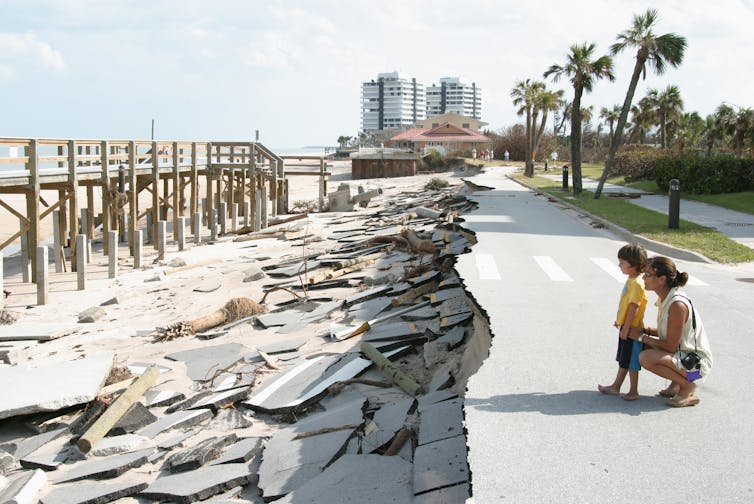
Congress appears close to a trillion-dollar infrastructure deal that recognizes the risks of climate change and the need to make America’s coasts more resilient.
On July 28, 2021, a bipartisan group of senators who have been working on the package for weeks announced an agreement on “major issues” of the plan. The Senate later voted 67 to 32 to move it forward in a procedural vote; it still faces major hurdles.
While many of the details have yet to be disclosed – or finalized – a few have emerged. The deal provides US$550 billion in new spending on roads, transit, electricity and other physical infrastructure, including about $47 billion for flooding and coastal resiliency and funds to help adapt ports and waterways to a changing climate.
The Conversation has been exploring how climate change is affecting U.S. infrastructure and ways Congress could make it more resilient as sea levels rise, storms become more destructive and temperatures become more extreme.
These three articles from our archive describe some innovations in resilient infrastructure.
1. Adaptive design lessons from the Dutch
The Dutch have been dealing with flood risks for generations in the Netherlands, where a large part of the country is below sea level. They’ve learned that one key to living with rising water levels is adaptive design – building infrastructure that can be expanded in the future.
In the U.S., adaptive design might mean building levees wider than usual so they can be easily raised in 20 years. Or it could mean leaving room for future water pumps in areas that will become more flood-prone, or installing floodgates that can be raised or lowered as needed.
“By starting with an adaptive design, the U.S. can save billions of dollars compared with having to build new systems decades down the road,” writes Jeremy Bricker, a hydraulic and coastal engineer at the University of Michigan.
He points to the cost of renovating California’s Folsom Dam, built in 1955. Adding a new spillway now to improve water control is costing about $900 million, close to the price of the original dam with inflation.
Read more: How to make sure Biden's infrastructure plan can hold up to climate change – and save money
2. Incorporating nature: Corals and mangroves
In several coastal cities, the Army Corps of Engineers is developing plans for giant flood walls to provide protection against storm surges. The instinct is to build big now to handle the worst-case scenario in the future.
But in Miami, that plan reveals two problems: While a large wall might lessen the damage of a hurricane storm surge, it would block the downtown area’s million-dollar water views. And a 6-mile wall would only protect the downtown Miami area, and only from the surge. Water would still come in, and everyone outside the wall would be vulnerable.
There are other ways to protect the coastline that are less obtrusive and draw on natural coastal storm control, write University of Miami engineer Landolf Rhode-Barbarigos and ocean scientist Brian Haus.
Rhode-Barbarigos and Haus have been involved in developing “green-gray” infrastructure that pairs the strength of specially designed concrete structures with the natural protection of corals and mangroves for effective, more natural-looking hybrid coastal protection.
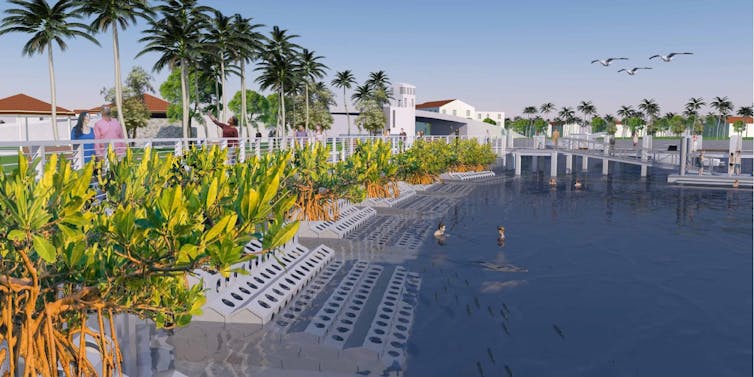
“Living with water today doesn’t look the same as it did 50 years ago, or even 20 years ago,” they write. “Parts of Miami now regularly see ‘sunny day’ flooding during high tides. Salt water infiltrates basements and high-rise parking garages, and tidal flooding is forecast to occur more frequently as sea level rises. When storms come through, the storm surge adds to that already high water.”
They add: “We don’t want to see Miami become Venice or a city walled off from the water. We think Miami can thrive by making use of the local ecosystem with novel green engineering solutions and an architecture that adapts.”
3. Climate-friendly concrete
Concrete is also evolving for the changing climate. Scientists are developing ways to minimize corrosion when concrete structures are subjected to sea water, and they’re making concrete itself more climate-friendly.
Cement, which binds concrete, is responsible for about 7% of global carbon dioxide emissions – greenhouse gases that are warming the environment and causing the oceans to rise. Some 26 billion tons are produced nationwide each year, and production is growing.
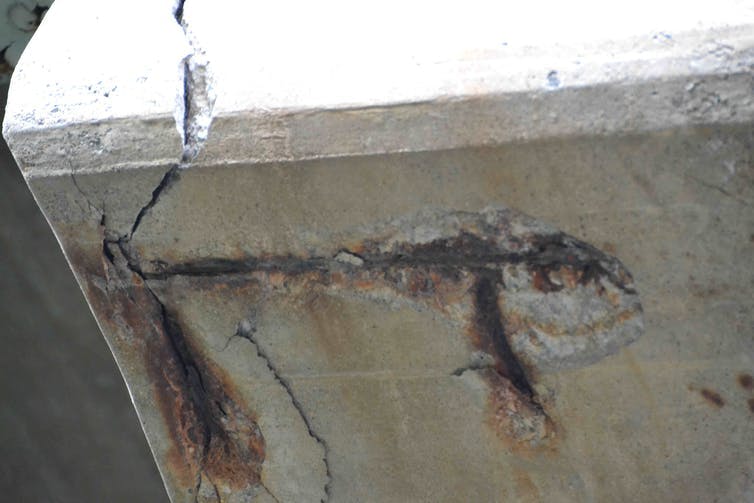

“Given the scale of the industry and its greenhouse gas emissions, technologies that can reinvent concrete could have profound impacts on climate change,” write University of Michigan engineers Lucca Henrion, Duo Zhang, Victor Li and Volker Sick.
Scientists are developing new types of concrete that reduce the amount of greenhouse gases released, including infusing it with carbon dioxide so future bridges and buildings lock away greenhouse gases that might otherwise be released into the atmosphere. The Michigan team has developed carbon dioxide-infused concrete that requires less steel, is stronger and more durable – and it’s bendable.
Read more: Bendable concrete and other CO2-infused cement mixes could dramatically cut global emissions
Editor’s note: This story is a roundup of articles from The Conversation’s archives.
Bryan Keogh, Senior Editor, Economy + Business, The Conversation and Stacy Morford, Environment and Climate Editor, The Conversation
This article is republished from The Conversation under a Creative Commons license. Read the original article.