 How to resolve AdBlock issue?
News
- Details
- Written by: Leejay Lockhart
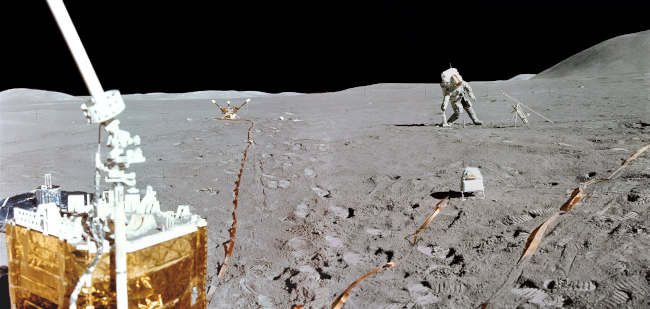
Fifty years ago, Apollo 15 lifted off from Kennedy Space Center, sending Commander David R. Scott, Command Module Pilot Alfred M. Worden, and Lunar Module Pilot James B. Irwin on the first of three Apollo “J” missions.
These missions gave astronauts the opportunity to explore the Moon for longer periods using upgraded and more plentiful scientific instruments than ever before. Apollo 15 was the first mission where astronauts used the Apollo Lunar Surface Drill, or ALSD, and the Lunar Roving Vehicle, or LRV.
Scott and Irwin would land on the Moon and use the ALSD at the site where they set up several scientific instruments during the nearly 67 hours they were on the surface of the Moon.
The tool was a rotary-percussive drill that used a combined motion that hammered a rotating drill bit into the surface to make a hole.
The overall purpose of gathering core samples was part of NASA’s lunar geology studies to learn more about the composition of the Moon and discover more about its history by looking at different kinds of rocks, including some from below the surface.
Now, NASA is going back to the Moon as part of the agency’s Artemis missions and has a new drill headed to the lunar surface as a commercially delivered payload via the Commercial Lunar Payload Services initiative.
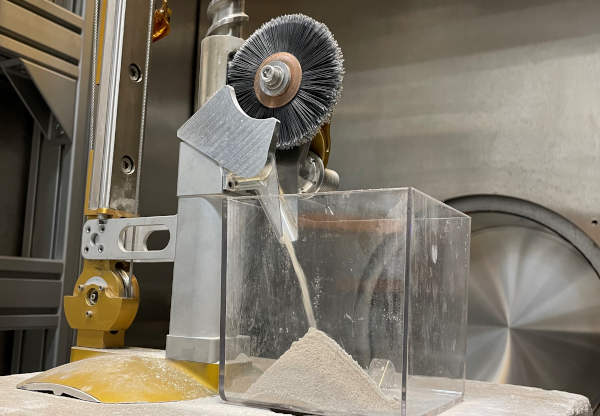
The Regolith and Ice Drill for Exploring New Terrain, or TRIDENT, is key to locating ice and other resources on the Moon.
“Honeybee Robotics designed the TRIDENT drill for NASA to sample lunar regolith,” said Amy Eichenbaum, the Polar Resources Ice Mining Experiment-1, or PRIME-1, deputy project manager. “TRIDENT will help understand the physical properties of the lunar regolith while also allowing analysis of the resources present in samples taken from various depths.”
TRIDENT is also a rotary-percussive drill, but one major difference between it and its Apollo counterpart is that TRIDENT does not need astronauts to operate it manually.
Honeybee Robotics originally partnered with NASA through the Small Business Innovation Research program, a highly competitive program that encourages small businesses to engage in federal research.
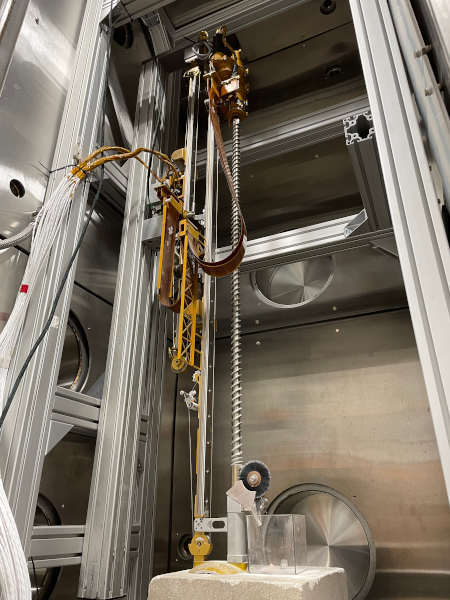
PRIME-1 will be the first in-situ resource utilization demonstration on the Moon. For the first time, NASA will robotically sample and analyze for ice from below the surface.
PRIME-1 will use TRIDENT to drill in a single location at a site with a high likelihood of having water – whether in liquid or ice form.
It will drill down about 3 feet below the surface, each time bringing up samples that NASA will analyze with a scientific instrument — the Mass Spectrometer observing lunar operations, or MSolo.
“MSolo will measure water ice and other volatiles released from the sample brought to the surface by the TRIDENT drill,” said Dr. Janine Captain, the principal investigator for MSolo. “These measurements will help us start to understand the distribution of resources on the lunar surface, a key to enabling a long-term presence on the Moon.”
Apollo 15 landed near the Hadley Rille, a long, deep channel-like gorge in the Moon’s surface, which was at the base of the Apennines Mountains to the north of the Moon’s equator.
PRIME-1’s destination is the Moon’s South Pole — new territory far from all the Apollo landing sites — a location very interesting because NASA has previously detected water there from space.
However, gathering more accurate data requires PRIME-1, like ALSD, to land and drill into the surface to examine what is there.
What PRIME-1 discovers will help to update resource models for where explorers are most likely to find water on the Moon.
About a year after the PRIME-1 mission, NASA will send an exploratory rover — Volatiles Investigating Polar Exploration Rover, or VIPER — to the surface.
VIPER is NASA’s first mobile robotic mission to the Moon, and will carry a TRIDENT drill and scientific instruments that enable it to directly analyze water ice on the surface and subsurface of the Moon at varying depths and temperature conditions. VIPER will explore multiple sites on the lunar South Pole for about 100 days.
PRIME-1 and VIPER will build upon the legacy of Apollo 15 by using drills and rovers, allowing NASA the chance to look below the surface and detect what is there.
Much like Apollo 15, NASA is preparing to send new capabilities to the Moon that will enable people to stay there for longer than ever before, because learning how to find and use water is a key to living and working on the Moon and other deep space destinations.
“The Apollo missions first introduced the concept of drilling to provide subsurface understanding of a foreign world,” said Dan Andrews, VIPER Project Manager. “PRIME-1 and VIPER will expand the state of the art as we look to a future of sustainable exploration and learning how to live off the land.”
Leejay Lockhart works for NASA's Kennedy Space Center.
- Details
- Written by: Lake County News reports
The Lake County Health Services Department has received reports that some people with mild symptoms that can be associated with COVID-19 have continued to utilize local emergency rooms for COVID testing. Others have sought vaccination at our hospitals.
“As a small, rural county, we have limited intensive care and emergency medicine resources. They must be reserved for those in medical distress; those in need of immediate care. Overutilization of these resources extends wait times, and delays care for those in the greatest need,” said Charlie Evans, MD, Lake County’s acting Public Health officer.
“At this time, we ask people with mild symptoms to please contact their medical providers and nursing advice lines, rather than going straight to the emergency room,” said Evans. “If you are in need of immediate medical care, go to the ER. However, if you are mildly ill, use alternative resources.”
Visit http://health.co.lake.ca.us/Coronavirus/Vaccines.htm and http://health.co.lake.ca.us/Coronavirus/Testing.htm to learn more about vaccination and testing resources available in Lake County.
COVID-19 testing resources in Lake County
OptumServe at Lower Lake Town Hall, 16195 Main St.: Mondays and Thursdays, 7 to 11 a.m. and noon to 4 p.m. Appointments are highly recommended, limited on-site registration is available.
Rite Aid is conducting drive-thru testing in Clearlake and Ukiah: Appointments can be made online at https://www.riteaid.com/pharmacy/services/covid-19-testing. Insurance is not required.
Labcorp offers home testing by mail. Visit https://www.pixel.labcorp.com/. Insurance is not required.
Lake County Tribal Health offers testing by appointment to established patients with or without symptoms. For appointments, call 707-263-8382.
Clearlake VA Clinic is offering COVID-19 tests to veterans experiencing symptoms or prior to procedures. Please call the TLC line at 800-733-0502 for information.
Quest Diagnostics offers home testing by mail. Visit https://questdirect.questdiagnostics.com/ for information and to see if you're eligible for $0 out-of-pocket-testing. (Quest Diagnostics in Lakeport is not offering in-lab testing for active COVID-19.)
Sutter Health (outpatient clinics) are offering testing to existing patients, if ordered by your provider. Please contact your provider's office for details.
Adventist Health is offering testing to existing pediatric patients (children) in limited circumstances. Please contact your provider's office for details.
Lake County Public Health will test by appointment on Tuesdays and Wednesdays from 8:30 to 11:30 a.m. Call 707-263-8174 to schedule or for information.
- Details
- Written by: Lake County News reports
While the Third Street launch will be closed, the Fifth Street launch will remain open and continue to be monitored, city officials reported.
Officials said the depth at the end of the Third Street ramp is -3.6 feet Rumsey, the special measure used for Clear Lake, while the Fifth Street launch is -5.3 feet Rumsey, making it the deepest public ramp in the county.
City Manager Kevin Ingram told Lake County News that this is the first time the Third Street ramp has been closed due to low water since it was built in 1984.
The city also reported that the Waterfront Parking Rehabilitation Project will begin on Monday.
Argonaut Constructors has contracted with the city to construct the project. Work includes water line replacement, storm drain upgrades, curb, gutter, sidewalk and the reconstruction and paving of the parking lot between Third and Fifth streets.
The first phase of construction will include utility and concrete work in sections of the parking lot for minimal disruptions to the parking areas.
Temporary lane closures, vehicle and pedestrian detours will be implemented at various stages of the project.
The parking area will be closed from Sept. 20 to Oct. 8 to allow for the complete reconstruction and paving of the parking lot.
Some portions of work will be completed at night to minimize the impact on traffic.
The project’s estimated completion date is Nov. 17.
For more information, contact the Lakeport Public Works Department at 707-263-3578.
- Details
- Written by: Lake County News reports
The event will serve as an opportunity to learn more about the student services and academic programs offered by the college.
The WCC-Lake County Campus is located at 15880 Dam Road Extension in the City of Clearlake.
Staff and faculty will host the event for the entire community.
Those in attendance will have the opportunity to meet program staff, enroll in classes for the fall semester, get information about financial aid and enjoy fun activities.
The event has no cost to attend and goodie bags will be available to participants, while supplies last.
“This event will serve as an opportunity to welcome back our students and community to our campuses in a safe manner, refocus on our future and get back on track to improving the lives of the communities we serve,” said WCC President Art Pimentel.
For those who can’t attend the event, the college invites the community to visit the website at http://woodland.edu or stop by the Lake County Campus in the City of Clearlake.
Campus office hours are scheduled, Monday through Friday, from 8 a.m. to 5 p.m.
In-person and virtual services are available.
The fall semester begins on Monday, Aug. 16.
For more information, contact Carid Servin at 530661-5711 or