 How to resolve AdBlock issue?
News
- Details
- Written by: Lake County News reports
These priorities boost local health care efforts, transportation and infrastructure investments and environmental upgrades.
The Fifth Congressional District includes all or part of Contra Costa, Lake, Napa, Solano and Sonoma counties.
“Across our district, there are critical local projects where investment is needed to improve access to health care, ensure we protect our environment and boost investment in infrastructure. That’s why I requested Federal funding in the Fiscal Year 2022 spending bills for local priorities identified by leaders in our district. I was glad to see these priorities funded in the bill and proud to vote to pass it today,” Thompson said Thursday.
He said the legislation passed Thursday boosts water infrastructure in Lake County through the county’s Full Circle Effluent Pipeline project and in Napa County through the St. Helena Water System project.
The bill also makes investments in the health care system, including the Accessing Coordinated Care and Empowering Self Sufficiency project and the renovation of the Rohnert Park Health Center site in Sonoma County, the rehabilitation of Truett Hall at Touro University Medical School in Solano County, and the Collaborative Care implementation project in Contra Costa County.
Finally, the legislation includes funding for a critical transportation upgrade in Lake County with the Kelseyville Sidewalk Project.
These funding priorities were included in H.R. 4502, the minibus legislation that includes funding for Interior, Transportation and Housing and Urban Development, and Labor, Health and Human Services.
Projects included for California’s Fifth Congressional District are:
— $1,840,000 for the Napa County Deer Park/St. Helena Water System. This project would improve water infrastructure and increase onsite water storage at Adventist Health St. Helena Hospital, which owns and operates water storage, treatment, and distribution facilities that provide potable water to approximately 660 residents and hospital facilities.
— $320,000 for the Lake County Full Circle Effluent Pipeline Preliminary Design Report Update. This project would evaluate which of the existing wastewater treatment facilities in the project area would provide source water for the effluent pipeline the planned project features. With technological advances made since the completion of the 2004 Preliminary Design Report, this project will review alternatives for the final use of the treated effluent including geothermal energy production and agriculture irrigation.
— $450,000 for the Lake County Kelseyville Sidewalk Project to create one continuous sidewalk along the south side of Konocti Road in Kelseyville in order to implement the county’s Safe Routes to School Program.
— $900,000 for the Contra Costa County Collaborative Care Implementation project to boost both primary and mental and behavioral health care across the county.
— $1 million for Touro University to make crucial investments in campus improvement that will boost class size, increase the number of health providers on campus and boost health care across the region.
— $1.6 million for the Accessing Coordinated Care and Empowering Self Sufficiency project in Santa Rosa that will allow Sonoma County to expand the existing ACCESS program so the team there can better help vulnerable residents after disasters and other local crises, such as Public Safety Power Shutoffs.
— $1 million for Petaluma Health Center, Inc to renovate the Rohnert Park Health Center site to boost access to care for 5,000 local residents.
- Details
- Written by: Elizabeth Larson
The heat advisory is in effect from 10 a.m. to 8 p.m. Friday.
The National Weather Service said there also is the potential for lightning across the region — including northern Lake County — on Friday.
Temperatures across the North Coast area forecast to range between 100 and 110 degrees on Friday afternoon.
That will be followed by a cooling trend this weekend into early next week, the forecast said.
The specific Lake County forecast calls for temperatures of up to 102 degrees on Friday, with light winds. On Friday night, temperatures will drop into the low 60s.
From Saturday into next week, daytime temperatures in Lake County are forecast to be in the mid to high 90s. Nighttime temperatures will hover in the high 50s to low 60s.
Email Elizabeth Larson at
- Details
- Written by: Elizabeth Larson
The newest dogs are at the top.

‘Blue Eyed Jack’
“Blue Eyed Jack” is a male German shepherd mix.
He is dog No. 5046.

‘Dash’
“Dash” is a male Chihuahua mix with a short tan coat.
He is dog No. 5040.

‘Petey’
“Petey” is a male American Staffordshire terrier mix with a black and white coat.
He is dog No. 4963.

‘Sissy’
“Sissy” is a female American Staffordshire terrier mix with a black coat.
She is dog No. 4964.

‘Bear’
“Bear” is a male American Staffordshire terrier mix with a short brown coat.
He has been neutered.
He is dog No. 3476.

‘Cleo’
“Cleo” is a female Doberman pinscher mix with a short gray coat who is new to the shelter.
She has been spayed.
She is dog No. 4865.

‘Dusty’
“Dusty” is a male American Pit Bull Terrier with a tan and white coat.
He is dog No. 4750.

‘Girly’
“Girly” is a senior female Chihuahua mix.
She has a short tan coat.
Girly is house-trained.
She is dog No. 4940.

‘Gizmo’
“Gizmo” is a senior male Chihuahua mix with a short tan and white coat.
He is dog No. 4902.

‘Ike’
“Ike” is a senior male Chihuahua.
He has a short tan coat.
He is dog No. 4942.

‘Jake’
“Jake” is a senior male Chihuahua mix.
He has a short tan and white coat.
He is dog No. 4941.

‘Lucky’
“Lucky” is a male Labrador retriever mix with a short yellow coat.
He is dog No. 4908.

‘Mara’
“Mara” is a female Rottweiler mix.
She has a short black and tan coat.
He is house-trained.
She is dog No. 4628.

‘Mary J’
“Mary J” is a female pit bull terrier mix.
She has a white and tan coat.
She is house-trained.
She is dog No. 4927.

‘Mitzy’
“Mitzy” is a female shepherd mix with a medium-length black and white coat.
She is dog No. 4648.

‘Mojo’
“Mojo” is a male Chihuahua mix with a short black and tan coat.
He has been neutered.
He is dog No. 4881.

‘Oakley’
“Oakley” is a male pit bull terrier mix.
He has a short red and white coat.
He is dog No. 4934.

‘Patches’
“Patches” is a male Chihuahua mix with a short tricolor coat.
He is dog No. 4903.

‘Sassy’
“Sassy” is a female American bully mix with a short black coat.
She has been spayed.
She is dog No. 4602.

‘Tanisha’
“Tanisha” is a female shepherd mix with a short orange and white coat.
She is dog No. 4647.

‘Terry’
“Terry” is a male Dutch shepherd mix with a smooth brindle coat.
He is dog No. 4880.

‘Tinsel’
“Tinsel” is a female American pit bull terrier mix with a short brindle and brown coat.
She is dog No. 4433.

‘Yule’
“Yule” is a male husky with a medium-length black and white coat.
He is dog No. 4432.
Call the Clearlake Animal Control shelter at 707-273-9440, or email
Visit Clearlake Animal Control on Facebook or on the city’s website.
Email Elizabeth Larson at
- Details
- Written by: Peter Chin-Hong, University of California, San Francisco

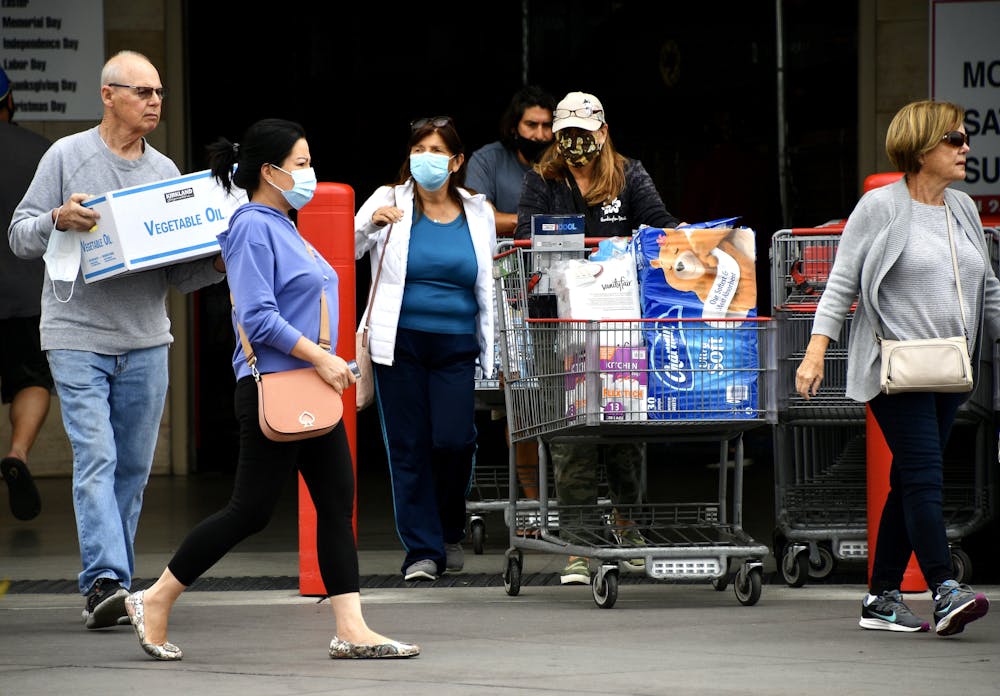
Vaccinated people need to mask up again, according to the U.S. Centers for Disease Control and Prevention. On July 27, 2021, the CDC recommended that everyone in areas with high COVID-19 infection rates wear masks in public indoor spaces, regardless of vaccination status.
It’s a reversal from the CDC’s May 2021 advice that the fully vaccinated could leave their masks at home and brought U.S. guidelines more in line with World Health Organization recommendations.
The Conversation asked Peter Chin-Hong, a physician who specializes in infectious diseases at the University of California, San Francisco, to help put into context the science behind the changing messages.
What science supports masking after vaccination?
Masks help stop the spread of the coronavirus. They’re a literal layer between you and any virus in the air and can help prevent infection.
The reason public health officials are calling for more mask-wearing is that there is clear and mounting evidence that – though rare – breakthrough COVID-19 infections can occur in people who are fully vaccinated. This is particularly true with emerging variants of concern. The good news is that COVID-19 infection, if it does happen, is much less likely to lead to serious illness or death in vaccinated people.
Some conditions make a breakthrough infection more likely in a vaccinated person: more virus circulating in the community, lower vaccination rates and more highly transmissible variants.
If vaccinated people can get infected with the coronavirus, they can also spread it. Hence the CDC recommendation that vaccinated people remain masked in indoor public spaces to help stop viral transmission.
Where will the guidelines apply?
The CDC mask recommendation targets areas in the U.S. with more than 50 new infections per 100,000 residents or that had more than 8% of tests come back positive during the previous week. By the CDC’s own definitions “substantial” community transmission is 50 to 99 cases of infection per 100,000 people per week, and “high” is 100 or more.
Los Angeles County, for example, far surpassed that mark in mid-July, with more than 10,000 coronavirus cases per week.
Using these criteria, the CDC guidance applied to 63% of U.S. counties on the day it was announced.

Who’s actually protected by masking recommendations?
The recommendation that fully vaccinated people continue wearing masks is primarily intended to protect the unvaccinated – which includes kids under age 12 who are not yet eligible for vaccines in the U.S. The CDC further recommends masking in public for vaccinated people with unvaccinated household members, regardless of local community transmission rates.
Unvaccinated people are at a substantially higher risk of getting infected with and transmitting SARS-CoV-2, and of developing complications from COVID-19.
How do new variants like delta change things?
Preliminary data suggests that the rise of variants like delta may increase the chance of breakthrough infections in people who received only their first vaccine dose. For instance, one study found that a single dose of the Pfizer vaccine had an effectiveness of just 34% against the delta variant, compared with 51% against the older alpha variant in terms of warding off symptomatic disease.
The data is more reassuring for those who have been fully vaccinated. After two doses, the Pfizer vaccine still provides strong protection against the delta variant, according to real-world data from Scotland and a variety of other countries; and in preliminary studies out of Canada and England, researchers noted only a “modest” decrease in effectiveness against symptomatic disease, from 93% for the alpha variant to 88% for delta.
Other recent preliminary reports from highly vaccinated countries like Israel and Singapore are sobering, however. Before the delta variant became widespread, from January to April 2021, Israel reported that the Pfizer vaccine was 97% effective in preventing symptomatic disease. Since June 20, 2021, with the delta variant circulating more widely, the Pfizer vaccine has been only 41% effective in preventing symptomatic disease, according to preliminary data reported by Israel’s Ministry of Health in late July. An analysis using government data from Singapore demonstrated that 75% of recent COVID-19 infections were in people who were at least partially vaccinated – though most of them were not severely ill.
In all reports and studies, however, vaccines remain very good at preventing hospitalizations and severe disease due to the delta variant – arguably the outcomes we most care about.
All of this emerging data supports the WHO’s global recommendation that even fully vaccinated individuals continue to wear masks. Most of the world still has low vaccination rates and uses a range of vaccines with variable efficacies, and countries have different burdens of circulating SARS-CoV-2 virus.
With U.S. case counts and breakthrough infection numbers headed in what public health officials consider the wrong direction, it makes sense that the CDC would modify its masking recommendations to be more conservative.
What conditions in the US warrant masking up (again)?
It makes sense that the CDC didn’t immediately change its recommendations to fall in line with the WHO’s June guidelines. With an overall high countrywide vaccination rate and a low overall COVID-19 hospitalization and death burden, the U.S. has a COVID-19 landscape very different from that in most of the world.
Additionally, some experts worried that an official message that the vaccinated should don masks might dissuade unvaccinated individuals from seeking vaccines.
But as President Joe Biden put it on July 27, “new research and concerns about the delta variant” are behind the CDC’s change in masking recommendations.
Some locations are seeing further increase in community transmission, even among vaccinated people. New preliminary research yet to be peer reviewed suggests the delta variant is associated with a viral load a thousand times higher in patients than seen with older strains. And early reports show infected vaccinated people with the delta variant can carry just as high an amount of virus as the unvaccinated that they can in turn spread to others.
The shifting recommendations don’t mean that the old ones were wrong, necessarily, only that conditions have changed. The bottom line? Masks do help cut down on coronavirus transmission, but it’s still vaccines that offer the best protection.
This is an updated version of an article originally published on July 22, 2021.
Peter Chin-Hong, Associate Dean for Regional Campuses, University of California, San Francisco
This article is republished from The Conversation under a Creative Commons license. Read the original article.