 How to resolve AdBlock issue?
News
- Details
- Written by: Elizabeth Larson
Tim Gill submitted his resignation as superintendent of Middletown Unified on Monday, with Tuesday being his last day, as Lake County News has reported.
On Wednesday, the Lake County Sheriff’s Office reported that it had become aware on Tuesday of an incident involving a parent upset about a school policy who allegedly recorded a private conversation between themselves and the school superintendent without the superintendent’s consent.
Lauren Berlinn, the sheriff’s public information officer, confirmed to Lake County News that the situation involved Middletown Unified.
Authorities said an investigation was initiated and resulted in the issuance of a search warrant that was served on Wednesday.
“Pursuant to the search warrant, several items were seized and will be examined to determine whether or not a crime has been committed,” the sheriff’s office said.
Under California law, “eavesdropping” — recording someone without their knowledge — is illegal, with exceptions for law enforcement investigations.
California Penal Code Section 632, which is part of the Invasion of Privacy Act, states: “A person who, intentionally and without the consent of all parties to a confidential communication, uses an electronic amplifying or recording device to eavesdrop upon or record the confidential communication, whether the communication is carried on among the parties in the presence of one another or by means of a telegraph, telephone, or other device, except a radio, shall be punished by a fine not exceeding two thousand five hundred dollars ($2,500) per violation, or imprisonment in a county jail not exceeding one year, or in the state prison, or by both that fine and imprisonment.”
Convictions for previous violations can result in a fine of up to $10,000 per violation, imprisonment in a county jail not exceeding one year, or in the state prison, or by both that fine and imprisonment, the Penal Code states.
Such cases may be prosecuted either as a misdemeanor or as a felony.
Gill, a veteran educator, had been with the district for only four months when he abruptly resigned this week.
At a special Tuesday night meeting — during which the Middletown Unified School Board voted to accept his resignation — community members and teachers were unanimous in lamenting his departure and lauding him for his work with the district.
While Gill has so far declined to explain why he left his job, speakers at the Tuesday night meeting attributed his resignation to a politically charged, divided and at times abusive environment that has developed in the district, focused primarily on mandates related to COVID-19.
The sheriff’s office said the investigation is ongoing, and, “as with any allegation of criminal activity, there is always a presumption of innocence until proven guilty.”
Anyone with information related to this investigation is asked to contact Deputy Nate Newton at
Email Elizabeth Larson at
- Details
- Written by: Elizabeth Larson
The agency said frost and freezing conditions are possible across Mendocino and Lake counties from Saturday through early next week.
Ahead of that, the forecast calls for chances of rain from Thursday through Friday. On Thursday, less than a tenth of an inch is anticipated, to be accompanied by light winds.
Winds are expected to continue on Thursday and increase to more than 25 miles per hour on Friday, with gusts of close to 40 miles per hour.
Temperatures from Thursday through Wednesday will range from the low 40s down into the low 30s at night, and the low 50s to high 60s during the day.
Email Elizabeth Larson at
- Details
- Written by: CALIFORNIA DEPARTMENT OF WATER RESOURCES
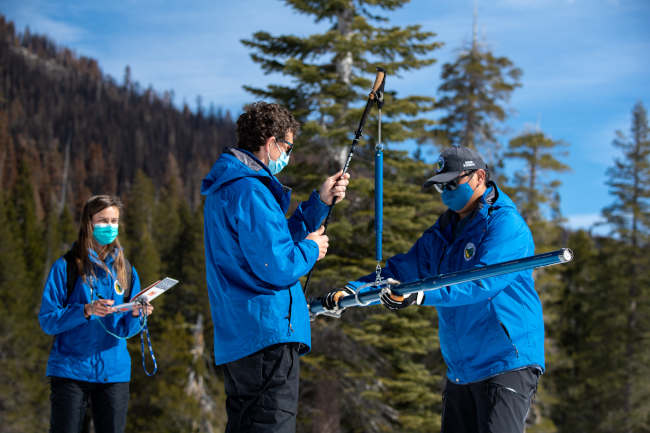
After a strong start to the water year, California’s snowpack has fallen well behind the seasonal average, state officials reported.
The Department of Water Resources conducted the third snow survey of the season at Phillips Station on Tuesday.
Following a January and February that will enter records as the driest documented in state history, the manual survey recorded 35 inches of snow depth and a snow water equivalent of 16 inches, which is 68% of average for this location for March.
The snow water equivalent measures the amount of water contained in the snowpack and is a key component of DWR’s water supply forecast. Statewide, the snowpack is 63% of average for this date.
“With only one month left in California’s wet season and no major storms in the forecast, Californians should plan for a third year of drought conditions,” said DWR Director Karla Nemeth. “A significantly below-average snowpack combined with already low reservoir levels make it critical that all Californians step up and conserve water every day to help the state meet the challenges of severe drought.”
Although early season storms helped alleviate some drought impacts, a lack of storms in January and February heightens the need for conservation.
The governor has asked all Californians to cut back water use at least 15% compared to 2020 levels.
Regionally, the Northern, Central and Southern Sierra snowpacks are all standing just above 59% to 66% of average for this date, impacting watersheds across the state.
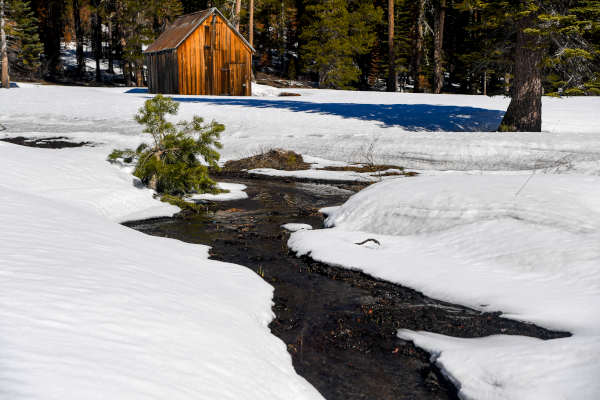
DWR has increased its efforts to improve climate and runoff forecasting by strengthening its collaborations with partner agencies investing in proven technologies to improve data collection and hydrologic modeling.
This includes efforts at the Central Sierra Snow Lab where DWR and its partners regularly test new equipment and sensors to maximize performance when measuring the state’s snowpack.
Forecast improvements and monitoring enhancements increase the reliability of data used to inform water managers about flood risks, allowing opportunities to create more storage in reservoirs ahead of big storms while also ensuring water supply reliability in periods of dry or drought conditions.
“As the world continues to warm, precipitation is pushing toward extremes. Even when we see large storms producing a lot of snow early in the season, all it takes is a few dry weeks to put us below average,” said Jeremy Hill, manager of DWR’s Hydrology and Flood Operations Branch. “This new pattern challenges forecasting efforts that have relied on historical patterns, so DWR has led the charge to adopt new technologies and utilize the best available science to manage water in real time and use forecasts that give us time to make decisions to get the most benefits and minimize the hazards.”
Current water conditions are now available in real time at California Water Watch, a new website launched by DWR.
This website will help Californians see their local hydrological conditions, forecasts, and water conditions down to their address or their local watershed. The site presents data from a variety of sources and allows the public to obtain a quick snapshot of local and statewide water conditions.
“With below average precipitation and snowpack up until this point, our latest statewide snowmelt forecasts are only 66% of average,” said Sean de Guzman, manager of DWR’s Snow Surveys and Water Supply Forecasting Unit. “That is not enough to fill up our reservoirs. Without any significant storms on the horizon, it’s safe to say we’ll end this year dry and extend this drought a third year.”
- Details
- Written by: LAKE COUNTY NEWS REPORTS
The California Public Utilities Commission has proposed to significantly cut the net metering rate and apply a new tax on solar panels, leading to an average of a $90 per month increase while decreasing the financial returns from selling excess energy.
“Climate change continues to be one of the most pressing issues our communities are facing, and many Californians have taken a smart step and installed solar panels on their homes to transition towards clean energy,” said Thompson. “However, the combination of decreasing the net metering rate and raising taxes on solar panels would disincentivize the installation of solar panels and penalize Californians who are doing the right thing for our climate. CPUC must reevaluate these proposed changes to protect the solar panel industry and ensure the financial benefits remain for those who transition to solar energy.”
Congressman Thompson led a letter to the CPUC that 25 members of the California delegation signed calling for a reevaluation of the proposed changes.
The text of the letter can be found below.
Dear President Reynolds:
We are writing to share the concerns we have heard from our constituents, small businesses, and many others, regarding the California Public Utilities Commission’s (CPUC) proposed decision to significantly reduce the financial benefits of rooftop solar in California. We applaud your decision to postpone this proposal and ask you to use the time to look at options that do not harm existing residential solar adopters while achieving an equitable solution for future adopters as well as all customers.
We are proud that California leads the nation in rooftop solar installations. Net energy metering has made it possible for Californians to plan for and install solar systems based on a known return on investment. One of our main concerns regards changing the rules of the program that many of our constituents planned on when committing to a solar system. The proposed decision would upend the fundamental calculations upon which contracts were presented to our constituents, which were based on regulations the state had in place at the time to incentivize clean energy adoption. Retroactively altering these assumptions would change the expected benefit of installing solar and represent a breach of trust between the state and residents who opted to do the right thing for the environment.
We appreciate that net metering should be updated to reflect new market conditions and state policy goals. However, imposing a tax on solar panels and reducing the rate of solar power exports by as much as 80 percent will label California as a climate straggler, not a climate leader.
We are making great strides in Congress to address the climate crisis by accelerating the deployment of renewable energy technologies. As you know, in November the House of Representatives passed legislation that included a 10-year extension of the federal tax credits for solar energy and storage to maximize deployment over the next decade. We are concerned that the proposed decision runs counter to this policy objective and would reportedly cut California’s rooftop solar market in half by 2024.
We do support the CPUC’s efforts to expand the benefits of solar to more Californians, especially those in disadvantaged communities and communities of color; however, any policy that severely impacts the rooftop solar market will not achieve that policy objective. We are confident that there are better policies to keep solar growing while making it more accessible to underserved communities.
We urge you to consider options that do not harm existing solar users while achieving a forward-looking solution for future adopters and all customers. We look forward to the CPUC issuing a dramatically revised policy that supports rapid renewable deployment and California’s continued climate leadership.