 How to resolve AdBlock issue?
News
- Details
- Written by: NORTH COAST OPPORTUNITIES
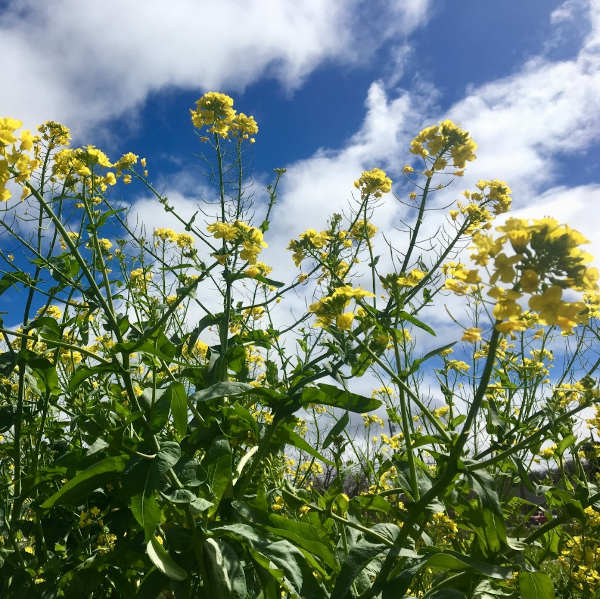
NORTH COAST, Calif. — Long-awaited buds are forming on flowering trees, poppies are peeking their heads out of the cold ground, and the sun is shining longer and longer with each passing day.
Spring’s imminent arrival is near. If you’re a gardener, you know this is the most exciting time to sow the seeds in planning for bountiful spring and summer harvests.
NCO Gardens Project’s free seed library has more than 230 varieties available to order for home delivery or pick up from North Coast Opportunities at 413 N. State St. in Ukiah. Visit bit.ly/ncoseeds to place your order today, or contact
This season, the seed library is stocked with more than 10,000 seed packets donated by local farmers, seed savers and businesses.
The bulk of the seeds were donated by a grange in Oregon and distributed to Gardens Project and other Mendocino County organizations by North American Organics.
For more than 10 years, Gardens Project has operated the free seed library, and has watched its popularity rise during the pandemic while seeds have been in short supply elsewhere.
“Expanding our seed library through an online order form at this critical time when food insecurity has peaked across the country has allowed us to reach far more community members than ever before,” said NCO Gardens Project Manager Sarah Marshall. “Since the start of the pandemic, we’ve distributed seeds to more than 1,200 home, school, and community gardeners, along with public health emergency preparedness information and resources to connect community members with pandemic food access programs.”
The seed library is made possible by the participation of many community volunteers. Each year volunteers at the Ford Street Project categorize and sort through the seeds under the direction of horticultural therapist and gardener Carolyn Brown.
Generous donations help Gardens Project keep the seed library free for all by covering costs of shipping and staff time for packing orders.
To donate in support of the free seed library, visit https://bit.ly/DonateSeedLibrary.
To learn how to save seeds for your personal use, or to contribute to the Gardens Project or Mendocino County Seed Libraries, view the series “Mendo Seed Talks” on the NCO Gardens Project YouTube Channel.
Local experts Jen Lyon and Carolyn Brown share tips on basic seed saving techniques, as well as detailed instructions on how to save garlic, bean, and corn seeds.
Stay up to date with NCO Gardens Project by following @NCOGardensProject on Facebook, or by emailing
If you’d like to donate recent seeds that have been tested for germination, contact Sarah Marshall 707-462-1958.
NCO is the Community Action Agency that serves Lake and Mendocino Counties, as well as parts of Humboldt, Sonoma, Del Norte, and Solano Counties. NCO reacts and adjusts to community needs, including disaster response and recovery.
For more information visit www.ncoinc.org or call 707-467-3200.
- Details
- Written by: Elizabeth Larson
Dogs available for adoption this week include mixes of Anatolian shepherd, Australian cattle dog, border collie, Catahoula leopard dog, Chihuahua, German shepherd, Great Pyrenees, husky, shepherd, Pomeranian and pit bull.
Dogs that are adopted from Lake County Animal Care and Control are either neutered or spayed, microchipped and, if old enough, given a rabies shot and county license before being released to their new owner. License fees do not apply to residents of the cities of Lakeport or Clearlake.
The following dogs at the Lake County Animal Care and Control shelter have been cleared for adoption (additional dogs on the animal control website not listed are still “on hold”).
Call Lake County Animal Care and Control at 707-263-0278 or visit the shelter online for information on visiting or adopting.
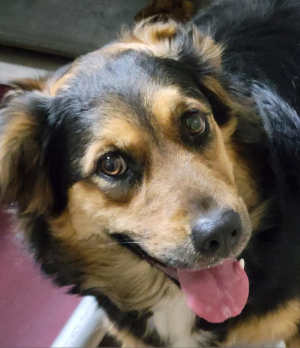
Female shepherd mix
This 5-year-old female shepherd mix has a tricolor coat.
She was in kennel No. 9, ID No. LCAC-A-2793.
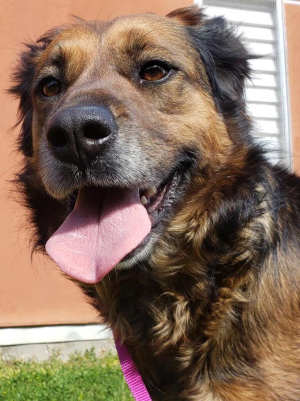
Female shepherd mix
This 7-year-old female shepherd mix has a tricolor coat.
She was in kennel No. 10, ID No. LCAC-A-2792.

Male pit bull
This 2-year-old male pit bull has a short black and white coat.
He is in kennel No. 14, ID No. LCAC-A-2473.

Female German shepherd mix
This 2-year-old female German shepherd mix has a short brown and white coat.
She is in kennel No. 15, ID No. LCAC-A-2812.
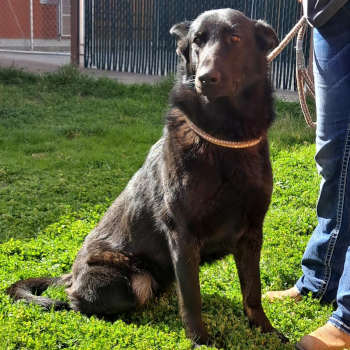
Female German shepherd
This 2-year-old female German shepherd has a black coat.
She is in kennel No. 19, ID No. LCAC-A-2844.
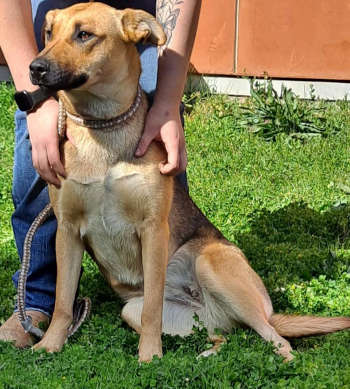
Female shepherd mix
This 1-year-old female shepherd mix has a short tricolor coat.
She is in kennel No. 20, ID No. LCAC-A-2843.

‘Blue’
“Blue” is a 4-year-old female husky with a gray and white coat, and blue eyes.
She is in kennel No. 25, ID No. LCAC-A-2816.
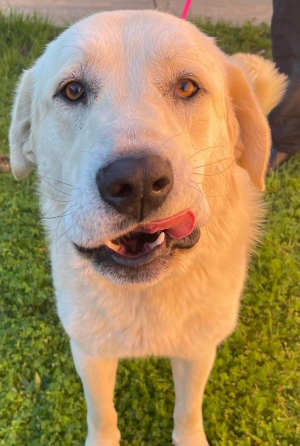
Anatolian shepherd-Great Pyrenees
This 2-year-old male Anatolian shepherd-Great Pyrenees has a short white coat.
He is in kennel No. 26, ID No. LCAC-A-2536.

Female pit bull
This 1-year-old female pit bull has a short black coat.
She is in kennel No. 27, ID No. LCAC-A-2824.
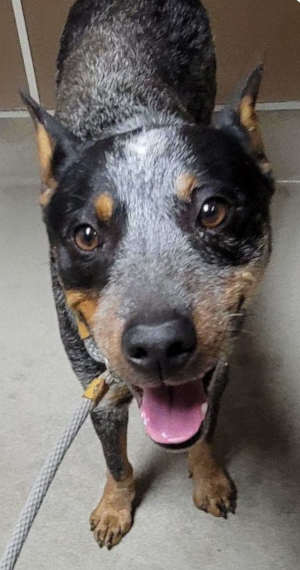
Australian cattle dog
This 1-year-old male Australian cattle dog has a short blue and black coat.
He is in kennel No. 28, ID No. LCAC-A-2754.
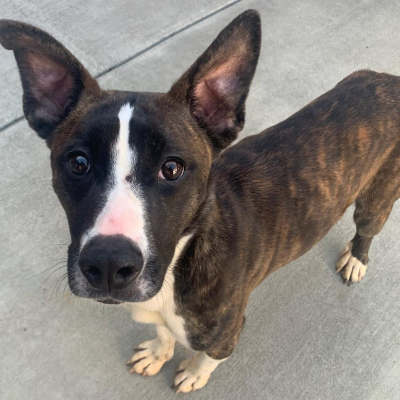
‘Marmalade’
“Marmalade” is a 1-year-old female Catahoula leopard dog with a brown brindle coat.
She is in kennel No. 30, ID No. LCAC-A-2823.
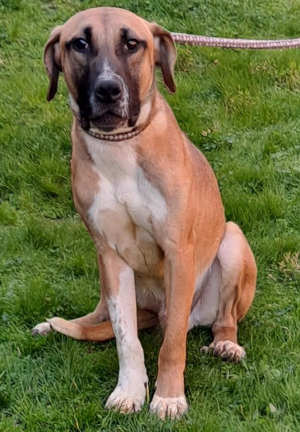
‘Bruno’
“Bruno” is a 2-year-old male Catahoula leopard dog with a brown and white coat.
He is in kennel No. 31, ID No. LCAC-A-2825.
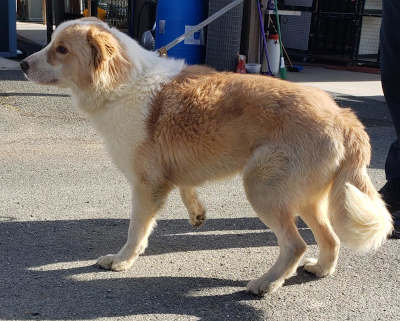
‘Zuko’
“Zuko” is a 1-year-old male border collie-cattle dog mix with a light reddish-brown and white coat.
He is in kennel No. 32, ID No. LCAC-A-2822.

‘Benji’
“Benji” is a 9-year-old male Pomeranian-Chihuahua mix with a brown and white coat.
He is in kennel No. 34, ID No. LCAC-A-2770.
Email Elizabeth Larson at
- Details
- Written by: Robert Sanders
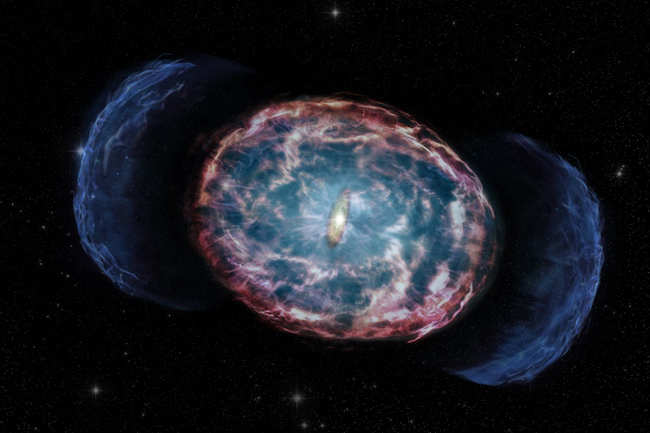
BERKELEY, Calif. — When two neutron stars spiral into one another and merge to form a black hole — an event recorded in 2017 by gravitational wave detectors and telescopes worldwide — does it immediately become a black hole? Or does it take a while to spin down before gravitationally collapsing past the event horizon into a black hole?
Ongoing observations of that 2017 merger by the Chandra X-ray Observatory, an orbiting telescope, suggests the latter: that the merged object stuck around, likely for a mere second, before undergoing ultimate collapse.
The evidence is in the form of an X-ray afterglow from the merger, dubbed GW170817, that would not be expected if the merged neutron stars collapsed immediately to a black hole.
The afterglow can be explained as a rebound of material off the merged neutron stars, which plowed through and heated the material around the binary neutron stars.
This hot material has now kept the remnant glowing steadily more than four years after the merger threw material outward in what's referred to as a kilonova. X-ray emissions from a jet of material that was detected by Chandra shortly after the merger would otherwise be dimming by now.
While the excess X-ray emissions observed by Chandra could come from debris in an accretion disk swirling around and eventually falling into the black hole, astrophysicist Raffaella Margutti of the University of California, Berkeley, favors the delayed collapse hypothesis, which is predicted theoretically.
"If the merged neutron stars were to collapse directly to a black hole with no intermediate stage, it would be very hard to explain this X-ray excess that we see right now, because there would be no hard surface for stuff to bounce off and fly out at high velocities to create this afterglow," said Margutti, UC Berkeley associate professor of astronomy and of physics. "It would just fall in. Done. The true reason why I'm excited scientifically is the possibility that we are seeing something more than the jet. We might finally get some information about the new compact object."
Margutti and her colleagues, including first author Aprajita Hajela, who was Margutti's graduate student when she was at Northwestern University before moving to UC Berkeley, report their analysis of the X-ray afterglow in a paper recently accepted for publication in The Astrophysical Journal Letters.
The radioactive glow of a kilonova
Gravitational waves from the merger were first detected on Aug. 17, 2017, by the Advanced Laser Interferometer Gravitational-wave Observatory, or LIGO, and the Virgo collaboration.
Satellite- and ground-based telescopes quickly followed up to record a burst of gamma rays and visible and infrared emissions that together confirmed the theory that many heavy elements are produced in the aftermath of such mergers inside hot ejecta that produces a bright kilonova.
The kilonova glows because of light emitted during the decay of radioactive elements, like platinum and gold, that are produced in the merger debris.
Chandra, too, pivoted to observe GW170817, but saw no X-rays until nine days later, suggesting that the merger also produced a narrow jet of material that, upon colliding with the material around the neutron stars, emitted a cone of X-rays that initially missed Earth. Only later did the head of the jet expand and begin emitting X-rays in a broader jet visible from Earth.
The X-ray emissions from the jet increased for 160 days after the merger, after which they steadily grew fainter as the jet slowed down and expanded. But Hajela and her team noticed that from March 2020 — about 900 days after the merger — until the end of 2020, the decline stopped, and the X-ray emissions remained approximately constant in brightness.
"The fact that the X-rays stopped fading quickly was our best evidence yet that something in addition to a jet is being detected in X-rays in this source,” Margutti said. “A completely different source of X-rays appears to be needed to explain what we’re seeing."
The researchers suggest that the excess X-rays are produced by a shock wave distinct from the jets produced by the merger. This shock was a result of the delayed collapse of the merged neutron stars, likely because its rapid spin very briefly counteracted the gravitational collapse.
By sticking around for an extra second, the material around the neutron stars got an extra bounce that produced a very fast tail of kilonova ejecta that created the shock.
"We think the kilonova afterglow emission is produced by shocked material in the circumbinary medium," Margutti said. "It is material that was in the environment of the two neutron stars that was shocked and heated up by the fastest edge of the kilonova ejecta, which is driving the shock wave."
The radiation is reaching us only now because it took time for the heavy kilonova ejecta to be decelerated in the low-density environment and for the kinetic energy of the ejecta to be converted into heat by shocks, she said.
This is the same process that produces radio and X-rays for the jet, but because the jet is much, much lighter, it is immediately decelerated by the environment and shines in the X-ray and radio from the very earliest times.
An alternative explanation, the researchers note, is that the X-rays come from material falling towards the black hole that formed after the neutron stars merged.
"This would either be the first time we've seen a kilonova afterglow or the first time we've seen material falling onto a black hole after a neutron star merger," said co-author Joe Bright, a UC Berkeley postdoctoral researcher. “Either outcome would be extremely exciting.”
Chandra is now the only observatory still able to detect light from this cosmic collision. Follow-up observations by Chandra and radio telescopes could distinguish between the alternative explanations, however.
If it is a kilonova afterglow, radio emission is expected to be detected again in the next few months or years. If the X-rays are being produced by matter falling onto a newly formed black hole, then the X-ray output should stay steady or decline rapidly, and no radio emission will be detected over time.
Margutti hopes that LIGO, Virgo and other telescopes will capture gravitational waves and electromagnetic waves from more neutron star mergers so that the series of events preceding and following the merger can be pinned down more precisely and help reveal the physics of black hole formation. Until then, GW170817 is the only example available for study.
“Further study of GW170817 could have far-reaching implications,” said co-author Kate Alexander, a postdoctoral researcher who also is from Northwestern University. “The detection of a kilonova afterglow would imply that the merger did not immediately produce a black hole. Alternatively, this object may offer astronomers a chance to study how matter falls onto a black hole a few years after its birth.”
Margutti and her team recently announced that the Chandra telescope had detected X-rays in observations of GW170817 performed in December 2021. Analysis of that data is ongoing. No radio detection associated with the X-rays has been reported.
Robert Sanders writes for the UC Berkeley News Center.
- Details
- Written by: Elizabeth Larson
In coordination with the State Water Resources Control Board, the Department of Water Resources, or DWR, said it has allotted $49 million in funding for 18 projects across the state.
The projects funded in this latest round include 15 that will directly support disadvantaged communities, including five tribes, with infrastructure repairs, well rehabilitation and hauled water, DWR reported.
“As California’s drought continues, we cannot let our guard down when it comes to preparing vulnerable communities for the dry months ahead,” said Kris Tjernell, DWR deputy director of Integrated Watershed Management. “We will continue working with the State Water Board to invest in long-term solutions to bolster drought resilience and help ensure that every Californian has access to safe, clean water.”
Among the grantees in this round is the Konocti County Water District, which is based in Clearlake.
Since the August Cache fire, the district has been supplying water to one of the mobile home parks hit by that fire, Cache Creek Mobile Home Park, with water through a temporary intertie.
DWR said Konocti County Water District will receive $4.3 million to replace existing leaky pipelines and expand the distribution system to consolidate the Cache Creek Mobile Home Estates and Creekside Mobile Home Park. Creekside also was heavily impacted by the Cache fire.
The project includes the construction of interties between Konocti County Water District, Lower Lake County Water District and Highlands Mutual Water Co., DWR said.
“Now that clean up is done we really need the water to be able to begin rebuilding,” Clearlake City Manager Alan Flora said.
Before the fire occurred the project had already been planned. Flora said the city let state Sen. Mike McGuire know about it in discussing Cache Fire recovery and he was able to speed up the funding approval.
“We are also trying to get funds included that will rebuild Dam Road after the waterline work is complete,” Flora said.
DWR said it coordinated with the State Water Resources Control Board to determine these funding commitments, which complement the board’s historical and ongoing financial assistance to small, economically disadvantaged communities for their water infrastructure needs.
In addition to Konocti County Water District, the recipients of the $49 million in phase six include:
• Lundy Mutual Water Co.: In Mono County, the Lundy Mutual Water Co. water system is struggling to meet demands due to leaks. The company will receive $2.6 million to repair leaks in its current water infrastructure.
• Kashia Band of Pomo Indians of the Stewarts Point Rancheria Kashaya Utility District: In Sonoma County, the Stewart’s Rancheria water supply is decreasing due to drought. The state will award $1.5 million to help drill a new well that will provide additional water supply for the community.
• California Environmental Indian Alliance (for Manchester Band of Pomo Indians, Round Valley Indian Tribe, Yokayo Tribe): In Mendocino County, the Manchester Band of Pomo Indians, Round Valley Indian Tribe and Yokayo Tribe are struggling to meet demands with their vulnerable water systems. The state will award $3.2 million to construct backup source connections and storage tanks.
• Redwood Valley County Water District: In Mendocino County, the Redwood Valley community does not have a reliable water source and must purchase surplus water from neighboring districts to meet demands. The district will receive $1.8 million to drill a new well.
• County of Santa Cruz: In Santa Cruz County, the community of Waterman Gap is struggling to meet daily demands due to its dwindling water supply. The county of Santa Cruz will receive $113,200 to improve its current water system and start a hauled water program.
• Yurok Tribe: In Del Norte County, the two water systems serving the Yurok Tribe are vulnerable to drought. The tribe will receive $12.6 million to consolidate with neighboring systems and construct 10 miles of pipelines and two booster pump stations.
DWR also announced funding for two emergency projects in Mendocino and Kings counties that were awarded in late December.
In Mendocino County, the Redwood Valley Little River Band of Pomo Indians received $104,523 to rehabilitate its existing well to provide the community with a stable water supply.
In Kings County, the Kettleman City Community Services District received $165,200 to purchase water for the health and safety needs of the community.
February marked six months since the Small Community Drought Relief program launched. In that time, the program has awarded over $142 million total in funding to 68 projects in 25 counties.
DWR said response to this grant program has been overwhelming with $374 million worth of projects submitted overall.
Following Friday’s announcement, DWR said the program has $48 million remaining in funds.
The program is one of several drought funding programs available through the state.
Email Elizabeth Larson at
- Middletown Unified School Board to finalize new superintendent’s hiring at March 9 meeting
- Women’s History Month: 5 groundbreaking researchers who mapped the ocean floor, tested atomic theories, vanquished malaria and more
- Nearly half of California's legislature signs on to move bill forward to divest state funds from Russia