 How to resolve AdBlock issue?
News
- Details
- Written by: LAKE COUNTY NEWS REPORTS
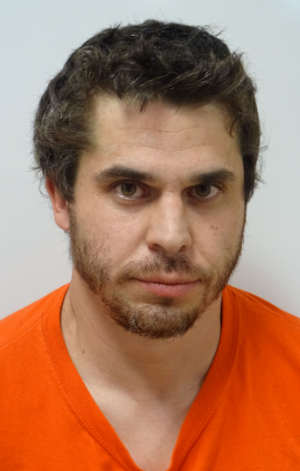
LAKE COUNTY, Calif. — An Upper Lake man has been convicted of the January 2021 murder of his stepmother.
Matthew Daniel Mora, 36, was convicted on Feb. 18 of the murder of 56-year-old Christine Mora of Upper Lake, said Chief Deputy District Attorney Richard Hinchcliff.
Hinchcliff said Judge Andrew Blum sentenced Matthew Mora to the statutorily required term of 15 years to life for second degree murder. He was also ordered to pay a $10,000 fine and the court reserved restitution for Christine Mora’s estate.
On Jan. 26, 2021, Lake County Sheriff’s deputies and investigators responded to a residence on Highway 20 in Upper Lake on the report of a shooting. When they arrived they found Christine Mora deceased on the floor of her living room with a single gunshot wound.
A few hours later, investigators were able to determine Matthew Mora had checked into the Super 8 Motel in Upper Lake, where they arrested him. At the time of his arrest it was determined that he was intoxicated.
During the subsequent interview of Mora, he claimed to have no memory of the shooting, even though he was able to remember events that had occurred earlier in the day before the shooting.
As the investigation into the shooting continued during the next several weeks, it was determined that Mora had had an ongoing alcohol abuse problem for several years, and had a fascination with firearms.
He purchased the handgun he used to kill Christine Mora in March of 2020. On April 14, 2020, while living with his mother in Santa Maria, Mora was in his bedroom, intoxicated, and handling his handgun when he accidentally discharged it into the bedroom wall. The Santa Maria Police Department responded and investigated, and seized the gun, but no criminal charges were ever filed and the firearm was eventually returned to Matthew Mora.
The investigation also revealed that before the shooting of Christine Mora, Matthew Mora had made several threats toward and negative comments about his father, Christine Mora’s husband.
A couple of months before the shooting, Matthew Mora had allegedly stolen a gun from a relative while in Colorado on a trip with his dad, and on the drive back to California had pointed it at his dad and threatened him with it.
At the time of the January 2021 shooting, Matthew Mora had been living with his dad and stepmother, who had let him move into their home to try to help him with his alcohol problem and get his life on a better path.
On the day of Christine Mora’s murder, Matthew Mora had been drinking at Running Creek Casino in Upper Lake. He got kicked out of the casino because he was intoxicated, was being belligerent and had threatened a bartender.
He walked home, where his dad told him to leave and get a motel room for the night, because Matthew Mora was intoxicated and his dad did not want him at the house when Christine Mora got home from work.
Matthew Mora was apparently angry and left the house with his backpack and his two loaded handguns in it. He walked down the road to a local store and bought some beer. When he left the store, witnesses saw him discharge one of his guns into the air as he was walking across the bridge on Highway 20 in Upper Lake.
Instead of getting a motel room, Matthew Mora returned to his dad’s house shortly after Christine Mora arrived home from work. His dad tried to convince him to leave again. Instead of leaving, Matthew Mora kicked open the gate to the residence and entered the front door and pointed the handgun at his dad.
When he saw his dad’s reaction he made a comment about his dad being scared. He then pointed the handgun at the face of Christine Mora, who was standing about 2 feet away from the gun.
The gun then discharged, killing Christine Mora. Matthew Mora’s father told investigators that when the gun discharged, Matthew Mora made a comment that indicated he might not have intended to discharge the firearm.
Whether or not Mathew Mora intended to discharge the gun, his conduct and actions before firing the gun were intentional and showed an extreme indifference toward human life and had the same deadly consequences, Hinchcliff said.
Hinchcliff, who prosecuted the case, said that on Jan. 19, Matthew Mora pleaded no contest to second degree murder. Dana Liberatore was the public defender appointed to represent Matthew Mora.
At Matthew Mora’s Feb. 18 sentencing — which lasted almost two hours — numerous friends and relatives gave victim impact statements to the judge about all the positive impacts Christine Mora had on their lives, and how devastating her loss was to the family.
Both Hinchcliff and Judge Blum stated at the sentencing that given Matthew Mora’s conduct and the impact the murder had on Christine Mora’s family, that he should never be granted parole.
If Mora ever has a parole hearing in the future, family members will be allowed to attend the hearing with the parole commissioners to argue against parole, Hinchcliff said.
- Details
- Written by: Elizabeth Larson
The board will meet beginning at 9 a.m. Tuesday, March 1, in the board chambers on the first floor of the Lake County Courthouse, 255 N. Forbes St., Lakeport.
The meeting can be watched live on Channel 8, online at https://countyoflake.legistar.com/Calendar.aspx and on the county’s Facebook page. Accompanying board documents, the agenda and archived board meeting videos also are available at that link.
To participate in real-time, join the Zoom meeting by clicking this link.
The meeting ID is 924 2066 8728, pass code 412740. The meeting also can be accessed via one tap mobile at +16699006833,,92420668728#,,,,*412740#.
All interested members of the public that do not have internet access or a Mediacom cable subscription are encouraged to call 669-900-6833, and enter the Zoom meeting ID and pass code information above.
To submit a written comment on any agenda item visit https://countyoflake.legistar.com/Calendar.aspx and click on the eComment feature linked to the meeting date. If a comment is submitted after the meeting begins, it may not be read during the meeting but will become a part of the record.
At 9:15 a.m., the board will present a proclamation appointing Georgina Marie Guardado as Lake County poet laureate for the years 2022 to 2024, to be followed by a proclamation designating March 2022 as Social Work Month.
The board will get an update from Public Health at 9:30 a.m. regarding the COVID-19 situation.
The Lake County Cannabis Alliance is scheduled to give the board a presentation at 10 a.m., and at 10:30 a.m. the board will get a presentation on the Central Valley Flood Protection 2022 update.
In untimed items, the board will consider a request from Supervisor Bruno Sabatier to approve a letter of intent for a regional skate park project that’s proposed to be located in Clearlake.
Also on Tuesday, the board will continue a discussion regarding possible renegotiations of certain provisions of an agreement between the county and the Rural Communities Housing Development Corp., along with a potential audit for financial activity regarding loan and loan forgiveness regarding a housing project on Collier Avenue in Nice.
The full agenda follows.
CONSENT AGENDA
5.1: (a) Waive the formal bidding process, pursuant to Lake County Code Section 38.1, as an extension of an annual agreement; and (b) approve agreement for provision of satellite imagery services by Planet Labs to the county of Lake.
5.2: Adopt resolution authorizing the county administrative officer on behalf of the Lake County Board of Supervisors to submit the Public Defense Pilot Program Grant proposal for funding and execute the grant agreement with the state of California, Board of State Community Corrections.
5.3: Approve memorandum of understanding between the county of Lake and Rural Communities Housing Development Corp. for the No Place Like Home Permanent Supportive Housing Project on Collier Avenue in Nice and authorize the board chair to sign.
5.4: Approve agreement between county of Lake — Behavioral Health Services as lead agency for the Lake County Continuum of Care and Elijah House Foundation for fiscal years 2021-26 in the amount of $232,500.00 and authorize the board chair to sign.
5.5: Approve amendment to the agreement between county of Lake and the Lake County Office of Education — Safe Schools Healthy Students Program for School-Based Specialty Mental Health Services to increase the contract maximum to $200,000.00 for FY 2021-22 and authorize the board chair to sign.
5.6: Approve amendment to the agreement between the county of Lake and Vista Pacifica Enterprises Inc. for adult residential support services and specialty mental health services for FY 2021-22 to decrease the total compensation payable under the agreement by $8,000.00 for a new contract maximum of $52,000.00 and authorize the board chair to sign.
5.7: Adopt proclamation appointing Georgina Marie Guardado as Lake County Poet Laureate for the years 2022-2024.
5.8: Approve Board of Supervisors meeting minutes for Feb. 8, 2022.
5.9: Consideration of resolution establishing a continuous records retention and destruction schedule and electronic storage for the Community Development Department.
5.10: Approve continuation of resolution authorizing teleconferenced meetings during a state of emergency to continue to exist.
5.11: Approve inspection agreement for integrated community development.
5.12: a) Waive the formal bidding process pursuant to county Ordinance 3109 Section 28.3 (A) due to the unique nature of services provided; and b) approve contract between Social Services and Evident Change for Safe Measure Internet Access in the amount of $27,330.67 for the Term of Oct. 1, 2021, to Sept. 30, 2023, and authorize the chair to sign.
5.13: Adopt proclamation designating March 2022 as Social Work Month.
TIMED ITEMS
6.2, 9:15 a.m.: Presentation of proclamation appointing Georgina Marie Guardado as Lake County Poet Laureate for the years 2022-2024.
6.3, 9:20 a.m.: Presentation of proclamation designating March 2022 as Social Work Month.
6.4, 9:25 a.m.: Sitting as the Lake County Housing Commission, consideration of Housing Choice Voucher Program Administrative Plan for 2022 and signing of the Annual Civil Rights Certification (HUD Form HUD-50077-CR).
6.5, 9:30 a.m.: Consideration of update on COVID-19.
6.6, 10 a.m.: Consideration of presentation from the Lake County Cannabis Alliance.
6.7, 10:30 a.m.: Presentation of Central Valley Flood Protection 2022 update.
UNTIMED ITEMS
7.2: Consideration of letter of intent for skate park regional project in District 2.
7.3: a) Discussion and possible renegotiations of certain provisions of agreement approved on September 28, 2021 with RCHDC b) discussion and direction on audit for financial activity regarding loan and loan forgiveness regarding Collier Avenue project.
7.4: Consideration of resolution authorizing the county administrative officer to execute a funding agreement with Pacific Forest and Watershed Lands Stewardship Council approving the county’s receipt of $824,583 in lieu of property taxes related to the transfer of 907 acres, located near the Eel River, Lower Trout Creek area, from the Pacific Gas & Electric Co. to the United States Forest Service.
7.5: Consideration of the following advisory board appointments: Glenbrook Cemetery District and Lake County Vector Control District.
7.6: Consideration of the county's participation with the Clear Lake Environmental Research Center in Cal Fire funding programs.
7.7: Consideration of continuation of a local health emergency by the Lake County Health officer for the Cache fire.
7.8: Consideration of continuation of a local health emergency related to the 2019 Coronavirus (COVID-19) as proclaimed by the Lake County Public Health officer.
7.9: Consideration of continuation of a local health emergency and order prohibiting the endangerment of the community through the unsafe removal, transport, and disposal of fire debris for the LNU Complex wildfire.
7.10: Consideration of continuation of a local emergency in Lake County in response to the LNU Lightning Complex wildfire event.
7.11: Consideration of continuation of a local emergency due to COVID-19.
7.12: Consideration of continuation of an emergency declaration for drought conditions.
7.13: Consideration of continuation of a local emergency by the Lake County sheriff/OES director for the Cache fire.
CLOSED SESSION
8.1: Public employee evaluation: Community Development director.
8.2: Conference with legal counsel: Existing litigation pursuant to Gov. Code section 54956.9 (d)(1) — City of Clearlake v. County of Lake, et al.
Email Elizabeth Larson at
- Details
- Written by: Elizabeth Larson
The council will meet at 6 p.m. Tuesday, March 1, in the council chambers at Lakeport City Hall, 225 Park St.
The agenda can be found here.
The council chambers will be open to the public for the meeting. In accordance with updated guidelines from the state of California, in-person attendees, regardless of vaccine status, are required to wear a face covering at this meeting.
If you cannot attend in person, and would like to speak on an agenda item, you can access the Zoom meeting remotely at this link or join by phone by calling toll-free 669-900-9128 or 346-248-7799.
The webinar ID is 973 6820 1787, access code is 477973; the audio pin will be shown after joining the webinar. Those phoning in without using the web link will be in “listen mode” only and will not be able to participate or comment.
Comments can be submitted by email to
Under council business, Public Works Superintendent Ron Ladd will ask the council to approve a local roadway safety plan and authorize the city manager, or designee, to implement the plan.
The council also will consider awarding a construction contract in the amount of $1,605,632 to Granite Construction Co. for the Hartley Street Pedestrian Improvement Project.
Ladd’s report to the council explains that the project will provide Americans with Disabilities Act-compliant access on Hartley Street from 20th Street to the east-side access of the
school complex. It will result in 1,550 feet of new sidewalk, curb and gutter, new retaining walls,
and flashing pedestrian warning signs near the school as part of this project.
In other business, City Manager Kevin Ingram will ask for the council’s approval of a memorandum of understanding to establish a cost sharing agreement with the county of Lake and city of Clearlake for community visioning forum facilitation.
The total agreement cost is $33,000, with the county of Lake to pay $22,500, the city of Clearlake $8,000 and the city of Lakeport $2,500.
On the consent agenda — items usually accepted as a slate on one vote — are ordinances; minutes of the council’s regular meeting on Feb. 1; adoption of a resolution authorizing continued remote teleconference meetings of the Lakeport City Council and its legislative bodies pursuant to Government Code section 54953(e); confirm the continuing existence of a local emergency for the COVID-19 Public Health Emergency; approval of event application 2022-009, with staff recommendations, for the 2022 Mental Health Matters Resource Fair; approval of event application 2022-010, with staff recommendations, for the 2022 Home Amateur Winemakers Winefest; and adoption of a resolution amending and adopting an updated Conflict of Interest Code.
Email Elizabeth Larson at
- Details
- Written by: Roger Bales, University of California, Merced
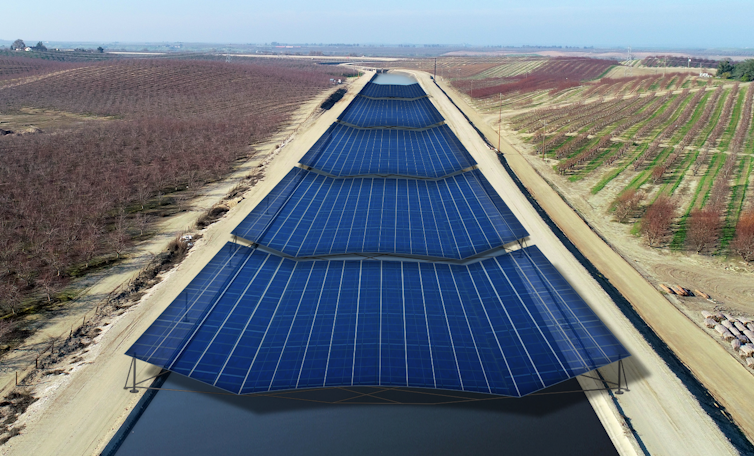
Mounting evidence suggests the western United States is now in its worst megadrought in at least 1,200 years. Groundwater supplies are being overpumped in many places, and the dryness, wildfires and shrinking water supplies are making climate change personal for millions of people.
As an engineer, I have been working with colleagues on a way to both protect water supplies and boost renewable energy to protect the climate.
We call it the solar-canal solution, and it’s about to be tested in California.
About 4,000 miles of canals transport water to some 35 million Californians and 5.7 million acres of farmland across the state. As we explained in a 2021 study, covering these canals with solar panels would reduce evaporation of precious water – one of California’s most critical resources – and help meet the state’s renewable energy goals, while also saving money.
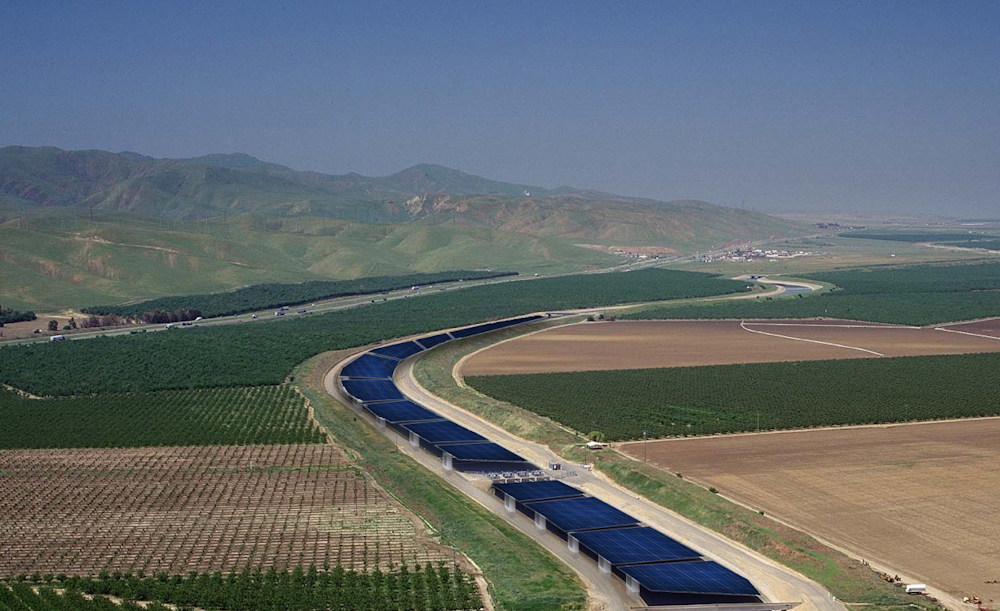
The first prototypes in the U.S. for both wide-span and narrow-span canals are now in development in California’s Central Valley. Researchers at the University of California, Merced, are involved in the project, and we will be trying to determine how this can become a large-scale solution.
Conserving water and land
California is prone to drought, and water is a constant concern. Now, the changing climate is bringing hotter, drier weather.
Severe droughts over the past 10 to 30 years dried up wells, caused officials to implement water restrictions and fueled massive wildfires.
At the same time, California has ambitious conservation goals. The state has a mandate to reduce groundwater pumping while maintaining reliable supplies to farms, cities, wildlife and ecosystems. As part of a broad climate change initiative, in October 2020 Gov. Gavin Newsom directed the California Natural Resources Agency to spearhead efforts to conserve 30% of land and coastal waters by 2030.
Most of California’s rain and snow falls north of Sacramento during the winter, while 80% of its water use occurs in Southern California, mostly in summer. That’s why canals snake across the state – it’s the largest such system in the world. We estimate that about 1%-2% of the water they carry is lost to evaporation under the hot California sun.
In a 2021 study, we showed that covering all 4,000 miles of California’s canals with solar panels would save more than 65 billion gallons of water annually by reducing evaporation. That’s enough to irrigate 50,000 acres of farmland or meet the residential water needs of more than 2 million people. By concentrating solar installations on land that is already being used, instead of building them on undeveloped land, this approach would help California meet its sustainable management goals for both water and land resources.
Climate-friendly power
Shading California’s canals with solar panels would generate substantial amounts of electricity. Our estimates show that it could provide some 13 gigawatts of renewable energy capacity, which is about half of the new sources the state needs to add to meet its clean electricity goals: 60% from carbon-free sources by 2030 and 100% renewable by 2045.
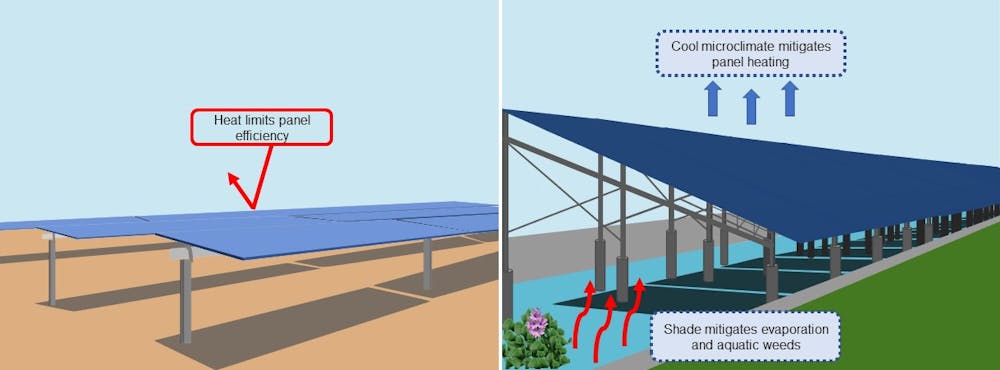
Installing solar panels over the canals makes both systems more efficient. The solar panels would reduce evaporation from the canals, especially during hot California summers. And because water heats up more slowly than land, the canal water flowing beneath the panels could cool them by 10 F, boosting production of electricity by up to 3%.
These canopies could also generate electricity locally in many parts of California, lowering both transmission losses and costs for consumers. Combining solar power with battery storage can help build microgrids in rural areas and underserved communities, making the power system more efficient and resilient. This would mitigate the risk of power losses due to extreme weather, human error and wildfires.
We estimate that the cost to span canals with solar panels will be higher than building ground-mounted systems. But when we added in some of the co-benefits, such as avoided land costs, water savings, aquatic weed mitigation and enhanced PV efficiency, we found that solar canals were a better investment and provided electricity that cost less over the life of the solar installations. And this is before factoring in the human health benefits of improved air quality and reduced greenhouse gas emissions.
Benefits to the land
To be clear, solar canals are about much more than just generating renewable energy and saving water. Building these long, thin solar arrays could prevent more than 80,000 acres of farmland or natural habitat from being converted for solar farms.
California grows food for an ever-increasing global population and produces more than 50% of the fruits, nuts and vegetables that U.S. consumers eat. However, up to 50% of new renewable energy capacity to meet decarbonization goals could be sited in agricultural areas, including large swaths of prime farmland.
Solar canal installations will also protect wildlife, ecosystems and culturally important land. Large-scale solar developments can result in habitat loss, degradation and fragmentation, which can harm threatened species such as the Mojave Desert tortoise.
They also can harm desert-scrub plant communities, including plants that are culturally important to Indigenous tribes. As an example, construction of the Genesis Solar Energy Center in the Sonoran and Mojave deserts in 2012-2014 destroyed trails and burial sites and damaged important cultural artifacts, spurring protracted legal conflict.
Clearing the air – and the weeds
By generating clean electricity, solar canals can improve air quality.
Another benefit is curbing aquatic weeds that choke canals. In India, where developers have been building solar canals since 2014, shade from the panels limits growth of weeds that block drains and restrict water flow.
Fighting these weeds is expensive, and herbicides threaten human health and the environment. For large, 100-foot-wide canals in California, we estimate that shading canals would save about US$40,000 per mile. Statewide, savings could reach $69 million per year.
Bringing solar canals to California
California’s aging power infrastructure has contributed to catastrophic wildfires and multiday outages. Building smart solar developments on canals and other disturbed land can make power and water infrastructure more resilient while saving water, reducing costs and helping to fight climate change.
[Over 150,000 readers rely on The Conversation’s newsletters to understand the world. Sign up today.]
Turlock Irrigation District, in California’s San Joaquin Valley, will build the first solar canal prototype in partnership with project developer Solar Aquagrid, researchers and others and supported by the state Department of Water Resources.
The prototypes in this mile-long demonstration project, along with future pilots, will help operators, developers and regulators refine designs, assess co-benefits and evaluate how these systems perform. With more data, we can map out strategies for extending solar canals statewide, and potentially across the West.
This is an update of an article originally published on May 3, 2021.
Roger Bales, Distinguished Professor of Engineering, University of California, Merced
This article is republished from The Conversation under a Creative Commons license. Read the original article.