 How to resolve AdBlock issue?
News
- Details
- Written by: Governor's Office

As Western states continue to experience intensifying drought conditions, Gov. Gavin Newsom on Tuesday visited Lake Oroville to highlight efforts to advance long-term water resilience and bolster the state’s drought response.
Though storms returned to Northern California this week, the small amounts of rain and snowfall expected will not make a significant dent in the water deficit the state faces.
“With the climate crisis threatening communities across the West, we must double down on our work to build water resilience in our communities for the long haul,” said Newsom. “All of us must do our part to tackle the intensifying drought conditions felt across the state. We’re investing critical resources to battle the drought’s impacts on our communities and ecosystems and finding innovative solutions to deal with these new realities.”
Dry conditions resulting from extreme weather impact multiple aspects of state operations, including increased fire risk and reduced energy production capacity.
On Tuesday, the governor visited Hyatt Powerplant at the Oroville facilities, which produces enough hydroelectric power to supply a city the size of San Francisco.
Last year, State Water Project operations managers took the powerplant offline due to falling lake levels, but the facility resumed hydropower operations again in January.
The governor and the Legislature have invested $5.2 billion over three years to support the immediate drought response and build water resilience statewide, and the governor is proposing $2 billion to spur clean energy projects across the state and bolster grid reliability.
The budget includes funding to secure and expand water supplies; bolster drought contingency planning and multi-benefit land repurposing projects; support drinking water and wastewater infrastructure, with a focus on small and disadvantaged communities; advance Sustainable Groundwater Management Act implementation to improve water supply security and quality; and support wildlife and habitat restoration efforts, among other nature-based solutions.
“As this drought persists into a third year, we are experiencing drier and hotter weather than ever before,” said California Natural Resources Agency Secretary Wade Crowfoot. “These conditions diminish our water supplies but also threaten energy reliability. We are adapting to these unprecedented conditions and working to find flexibilities where possible to safeguard both water supplies and grid reliability.”
“We are now in a third consecutive year of drought, driven by climate change. We’re seeing the realities of our warming climate on our water supply and our power supply as evident by conditions at Lake Oroville,” said California Department of Water Resources Director Karla Nemeth. “The state is taking action to balance the water supply needs of residents, businesses and agriculture, and the environment. We are stepping up our policy efforts and educating the public about the need to make water conservation a way of life to stretch our water supply as much as possible.”
The governor last week announced the expansion of the state’s Save Our Water campaign to encourage Californians to reduce water use as drought conditions worsen.
The campaign rolled out new multilingual ads across several media platforms as part of their ongoing efforts, and briefed more than a dozen influencers and content creators calling on them to support the statewide education campaign.
The state has also launched the California WATER WATCH website to inform Californians about hydrological conditions in their own communities and connect residents with local water suppliers to learn about available incentives and rebates that support water-saving upgrades in the home and yard.
Gov. Newsom, through an executive order last month, called on local water suppliers to move to, at a minimum, level two of their water shortage contingency plans, which require locally-appropriate actions that will conserve water across all sectors.
The executive order also directed the State Water Resources Control Board to consider a ban on the watering of decorative grass at businesses and institutions.
In March, the governor advanced an additional $22.5 million to bolster the state’s drought response.
Of this funding, $8.25 million will be used to increase educational and outreach efforts, including through the Save Our Water campaign, which is providing Californians with water-saving tips via social media and other digital advertising.
Gov. Newsom’s California Blueprint proposal includes $750 million in additional drought funding, $250 million of which was set aside as a drought reserve to be allocated in the spring, based on conditions and need.
In 2020, Newsom released the Water Resilience Portfolio, the administration’s blueprint for equipping California to cope with more extreme droughts and floods, rising temperatures, declining fish populations, over-reliance on groundwater, and other challenges. The administration released a progress report in January 2022.
For more tips on saving water, visit www.saveourwater.com. Learn more about current conditions, the state’s response and informational resources available to the public at the state’s drought preparedness website.

- Details
- Written by: Elizabeth Larson
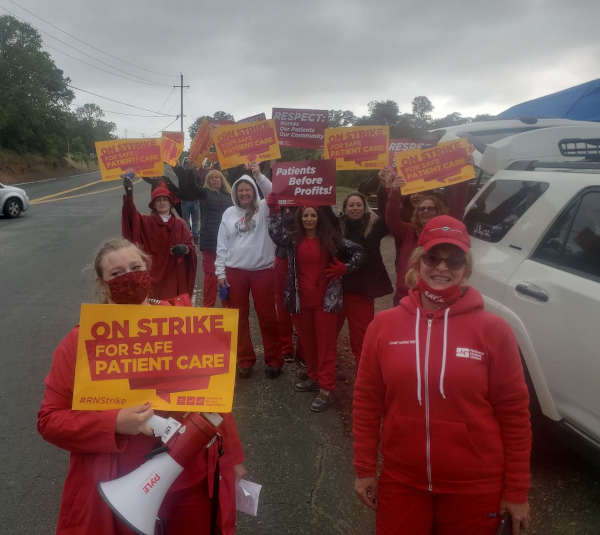
LAKE COUNTY, Calif. — Nurses and health care workers at Sutter Lakeside Hospital in Lakeport and 14 Sutter Health facilities across California held a one-day strike on Monday after last-minute contract negotiations late last week broke down.
The California Nurses Association and Sutter Health are at loggerheads in ongoing contract negotiations in which the union says the company is refusing to enforce nursing ratios and is not prioritizing patient safety.
“We’re striking for patients’ safety. Sutter is short staffing the nurses,” said Yvette Neil, who has worked for Sutter Lakeside for 18 years and is the union steward.
Neil — who is part of the nurses union’s bargaining team — said nurses have been working on an expired contract since June 2019. Negotiations started in June but have not made much headway.
She said corporations like Sutter Health are cutting labor costs by short-staffing hospitals, which is leading to a great exodus of nurses while increasing medical errors and poor patient outcomes.
“We remain focused on reaching a shared resolution,” Sutter Health said in a Monday morning statement. “Just as Sutter’s commitment to safe, compassionate care remains unchanged, so does our goal of reaching an agreement that reflects the good and important work of our nurses and maintains our strength and stability as an organization. As we continue with negotiations, our patients will continue to receive uninterrupted, quality care.”
The striking nurses had only planned to be off work for one day for the strike but they were informed of a five-day lockout by Sutter Health officials.
Sutter Health, in turn, said “lockout” was the wrong term.
“When the union threatens a strike we must make plans that our patients, teams and communities can rely on,” the company said in a written statement provided to Lake County News on Monday afternoon. “Part of that planning is securing staff to replace nurses who have chosen to strike, and those replacement contracts provide the assurance of 5 days of guaranteed staffing amid the uncertainty of a widespread work stoppage. As always, our top priority remains safe, high-quality patient care and nurses may be reinstated sooner based on operational and patient care needs.”
Neil said on Monday the hospital notified the nurses union of the “replacement period” — the term being used rather than a lockout.
“It’s totally retaliatory,” said Neil, explaining that the hospital is refusing to let nurses use their paid leave time to cover them while they are not being allowed to return to work.
“We’re completely willing to go to work tomorrow and the whole week,” Neil said.
The last strike held at Sutter Lakeside was in September 2011.
Neil, who said no one ever wants to strike, described a workplace at Sutter Lakeside with poor morale, where numerous nurses — including many who have been at the hospital for more than a decade — have left, and everyone is working 12-hour shifts and picking up additional work.
Neil said the nurses are exhausted. “It’s been this way for a year and a half.”
She said Sutter Lakeside has been short-staffed since the COVID-19 pandemic started.
“There wasn’t very much COVID in our hospital,” said Neil, noting about half a dozen nurses came down with the virus. The Delta variant, in particular, caused a lot of illness.
Staffing wasn’t an issue due to COVID-19, said Neil. Rather, she attributes it to Sutter putting skeleton crews on duty throughout its facilities statewide.
The situation led the union to hold an informational picket in March, which resulted in a good turnout, Neil said.
However, with no progress made on the negotiations, the union held a March strike vote at the hospitals it represents. Neil said union members had to go to the hospitals to vote in person.
At Sutter Lakeside, 61 of the 100 nurses came to vote; the others couldn’t get away due to work. She said all of those who came voted in favor of a strike. Similarly high percentages favoring the strike were reported at the other hospitals.
Neil pointed out that Sutter said the nurses union canceled further negotiations, “and that’s not true.”
The union gave Sutter Health and the federal government the required 10-day notice of a strike. She said they had until Sunday night to come to the bargaining table.
On Friday, a federal moderator came in and Neil said Sutter was forced to come to the table. Negotiations began at 5 p.m. and went until nearly midnight.
While it was unlikely a contract could have been settled after just one day of negotiating, “They failed to show us that they were serious in negotiating,” Neil said.
She added, “So we went forward with the strike.”
The striking nurses were stationed at the entrance to Sutter Lakeside, on Hill Road East, to hold their one-day picket during what turned out to be a rainy Monday.
Music and regular honking on the busy road created a festive mood. Some of the striking workers brought family members, such as their children. They were dressed in bright red, holding signs and waving to passersby.
Lakeport Fire Chief Jeff Thomas drove into the hospital flashing his lights and greeted the nurses on his way out of the facility.
Email Elizabeth Larson at
- Details
- Written by: Elizabeth Larson
Lake County’s March jobless rate was 5%, down from 5.9% in February and 9% in March 2021, the California Employment Development Department, or EDD, reported.
California’s unemployment rate in March was 4.9%, down from 5.3% in February and 8.4% in March of last year.
The report said California’s employers added 60,200 nonfarm payroll jobs, with the state now having regained nearly 90% — or 2,463,400 — of the 2,758,900 nonfarm jobs lost during March and April of 2020 due to the COVID-19 pandemic.
Of the 431,000 nonfarm jobs the nation gained in March, California accounted for 14% of those gains, surpassing the state's 11.5 percent share of employment in the U.S., the report said.
The EDD said California has enjoyed month-over gains in nonfarm jobs in 13 of the past 14 months totaling a 1,380,100 job gain over that time period.
Gov. Gavin Newsom said the report was “more good news for California’s continued economic recovery, representing thousands of new opportunities for workers throughout the state,” adding, “We’re committed to building on these gains and our progress toward creating a stronger, fairer and more prosperous state for all Californians to live and work.”
The Bureau of Labor Statistics said the nationwide unemployment rate in March was 3.6%, down from 3.8% in February and 6% in the year-over comparison. The March national jobless rate is the lowest it’s been since February 2020, when it was 3.5%.
California’s payroll jobs totaled 17,338,900, while the number of Californians employed in March was 18,197,600, an increase of 141,400 persons from February’s total of 18,056,200, and up 997,700 from the employment total in March 2021.
Total nonfarm jobs increased by 1,041,900, a 6.4% increase, from March 2021 to March 2022 compared to the U.S. annual gain of 6,494,000 jobs, a 4.5% increase.
The number of unemployed Californians was 933,700 in March, a decrease of 78,300 over the month and down 648,000 in comparison to March 2021. That’s the first time since February 2020 that there have been fewer than one million Californians unemployed.
Lake’s neighboring counties’ jobless rates and ranks in the latest report are Colusa, 12.5%, No. 58; Glenn, 5%, tied with Lake County for No. 36; Napa, 3.2%, No. 9; Sonoma, 3%, No. 7; and Yolo, 3.7%, No. 20.
Comparisons in industry sectors
The number of jobs in California’s agriculture industry decreased by 600 from February to 413,900 jobs in March. The agricultural industry has 3,600 more farm jobs in March 2022 than it did in March a year ago.
In Lake County, total farm jobs also were down by 4.3% in a month-over comparison, totaling an 80-job reduction.
Leisure and hospitality was once again the sector with the largest job increase statewide, with 14,800 jobs added. That growth had as its main driver limited-service eating places.
In Lake County, leisure and hospitality saw an 8% increase, totaling 90 new jobs in March.
Professional and business services also posted a good-sized gain of 10,400 jobs statewide thanks to strength in employment services, as well as accounting, tax preparation and bookkeeping services.
Lake County had a 5.7% increase in that sector in March, with 40 new jobs.
State and local numbers for other industry sectors are as follows:
• Education and health services: Statewide, increase of 9,000 jobs; Lake County, 20 new jobs, growth of 0.5%.
• Mining, logging and construction: Statewide, increase of 8,900 jobs; Lake County, loss of 10 jobs, reduction of 1.2%.
• Trade, transportation and utilities: Statewide, increase of 5,300 jobs; Lake County, 80 new jobs, increase of 2.6%.
• Other services: Statewide, increase of 4,900 jobs; Lake County, 10 new jobs, 1.9% increase.
• Financial activities: Statewide, increase of 3,600 jobs; Lake County, 10 new jobs, 3.1% increase.
• Manufacturing: Statewide, increase of 2,900 jobs; Lake County, 10 new jobs, 2.9% increase.
• Information: Statewide, increase of 200 jobs; Lake County, loss of 10 jobs, 11.1% reduction.
• Government: Statewide, increase of 200 jobs; Lake County, 40 new jobs, 1% increase.
In other employment news, the state said there were 398,638 people certifying for Unemployment Insurance benefits during the March 2022 sample week, compared to 425,221 people in February and 680,279 people in March 2021.
Concurrently, 39,185 initial claims were processed in the March 2022 sample week, which was a month-over decrease of 4,517 claims from February and a year-over decrease of 57,027 claims from March 2021, the EDD said.
Email Elizabeth Larson at
- Details
- Written by: KELSEYVILLE UNIFIED SCHOOL DISTRICT

KELSEYVILLE, Calif. — On March 17 and 18, Kelseyville High School student Diego Lopez joined other Native American basketball players from Lake County to represent their communities in the 21st annual American Indian Youth Conference and Basketball Tournament at the University of California, Los Angeles.
The event is one of many such events nationwide that allow Native American boys and girls between the ages of 12 and 18 to come together to share their love of sports while learning about each other’s cultural experiences and being exposed to different regions of the country.
“These tournaments expose our Lake County youth to city life,” said Kelseyville High Native American Club Advisor Katie Ray. “They have the experience of walking around college campuses and seeing what they’re up against, what it would be like to be on their own. They also get a feel for what it would be like to play [basketball] at a collegiate level.”
Lopez agreed and said he was certainly more interested in attending UCLA after touring the campus, attending conference workshops, and playing basketball there.
He was surprised and pleased to find that UCLA has resources to help Native American students with their studies and some of the other challenges associated with higher education.
Lopez and his teammates came together thanks to Kristin Amparo, education director and CEO of the Boys & Girls Club of Big Valley Rancheria, and advisor to the Native American Club at Clearlake High School.
“Our children shouldn’t miss out on opportunities because no one is willing to step up and take on the challenge of helping them,” Amparo said. “Every child deserves an opportunity, but it is up to them as an individual to accept the challenge. All I want to do is provide an opportunity for our children to have a chance to change their lives.”
Amparo offered to coach the basketball team and identified tournaments for them to play in.
“Our basketball program started a year ago with four Big Valley youth jumping on an opportunity to be exposed at a collegiate level in Arizona, Diego being one of the four; from there, we grew,” Amparo said. “We were fortunate enough to receive grant funding to keep our program going and have all their trips 100% paid for, including team bonding activities. That’s an opportunity of a lifetime for our kids. It doesn’t come by often and it won’t last forever.”
The players have four more tournaments planned in the months to come, including the Native American Midwest Tournament of Champions in Wichita, Kansas; the Third Annual Native American Nationals in Mesa, Arizona; the NABI Educational Youth Summit and Basketball Invitational in Phoenix, Arizona; and the Indigenous Elite Summer Championship in Minneapolis, Minnesota.
Ray explained that there are many ongoing activities for Native youth, noting that “basketball is huge, and so is youth leadership.”
Through these shared experiences, kids from rural and urban backgrounds have an opportunity to discover both shared experiences and how very different growing up on a reservation can be from an urban or suburban setting.
“Having an outlet is crucial, especially to our teens in a county that doesn’t have much for them to do,” Amparo said. “It brings good feeling to my heart knowing that we have a team who is willing to work hard, work together, be leaders, and go after what they want.”
She continued, “Around here, our kids fundraise to go everywhere. In urban areas, kids often have sponsors and scholarships. On the other hand, urban kids are not as connected to their culture as the kids around here. Our youth are rich in culture with lots of big times and gatherings. These aren’t as common in urban settings because of the Relocation Act, when Tribal people were taken from their culture and homelands,” she said.
Lopez said he would recommend that fellow Native American students get involved in these types of youth activities.
Although he is a bit reserved when it comes to meeting new people, he said enjoyed connecting with other students and learning new ideas.
He was happy to represent KHS and Big Valley Rancheria, and said he had fun participating in workshops like learning archery and making homemade ice cream. Mostly, he loved the basketball.
Amparo said, “Diego is one of the leaders on our team. He plays with heart, passion and emotion. He is constantly working to better himself, as both a person and an athlete. It is an honor to help guide our youth into positive light and I’ll do whatever I can to help them achieve their goals.”
Ray said that if anyone is interested in supporting local Native American students, they could consider donating to Big Valley Boys & Girls Club or the Native American Club at Kelseyville High.