 How to resolve AdBlock issue?
News
- Details
- Written by: Scott Denning, Colorado State University


Curious Kids is a series for children of all ages. If you have a question you’d like an expert to answer, send it to
Is it possible to heal the damage we have already done to the Earth? – Anthony, age 13
Sometimes it may seem that humans have altered the Earth beyond repair. But our planet is an incredible system in which energy, water, carbon and so much else flows and nurtures life. It is about 4.5 billion years old and has been through enormous changes.
At some points in Earth’s history, fires burned over large areas. At others, much of it was covered with ice. There also have been mass extinctions that wiped out nearly every living thing on its surface.
Our living planet is incredibly resilient and can heal itself over time. The problem is that its self-healing systems are very, very slow. The Earth will be fine, but humans’ problems are more immediate.
People have damaged the systems that sustain us in many ways. We have polluted air and water, strewn plastic and other trash on land and in oceans and rivers, and destroyed habitats for plants and animals.
But we know how to help natural processes clean up many of these messes. And there has been a lot of progress since people started waking up to these problems 50 years ago.

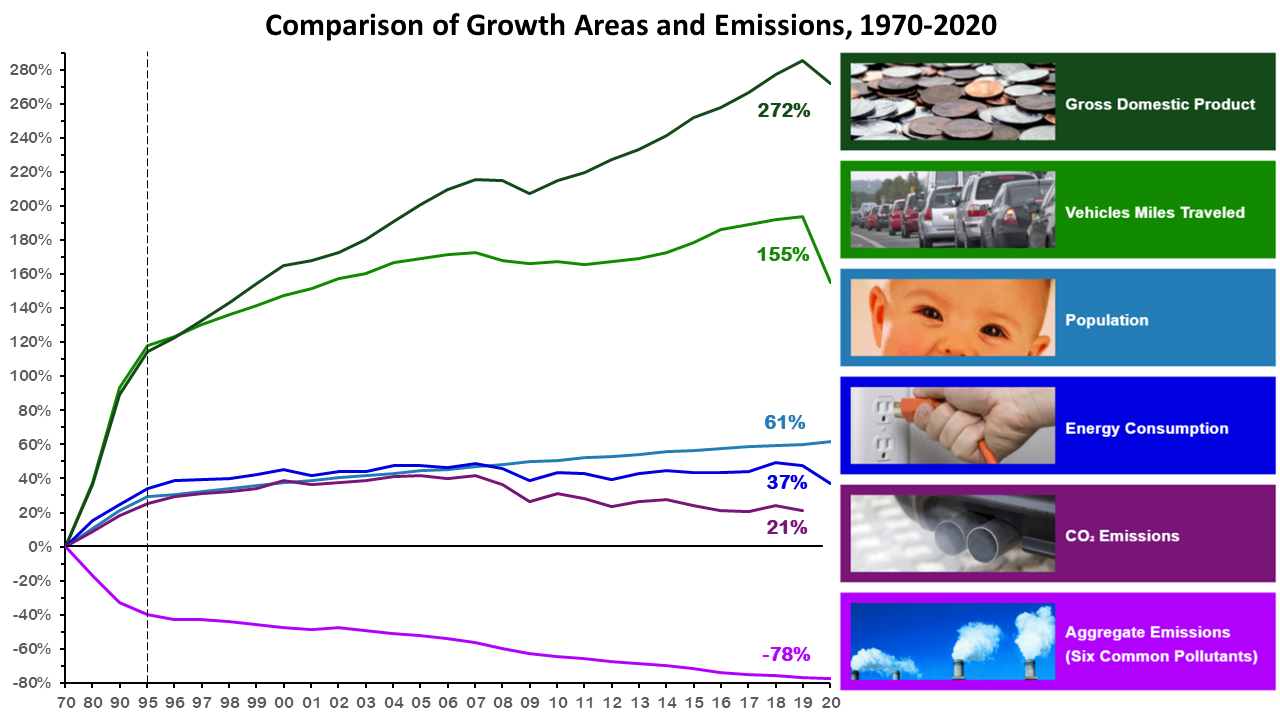
There still are problems to solve. Some pollutants, like plastic, last for thousands of years, so it’s much better to stop releasing them than to try to collect them later. And extinction is permanent, so the only effective way to reduce it is to be more careful about protecting animals, plants and other species.
Reversing climate change
The most serious damage humans are doing to the Earth comes mainly from burning coal, oil and gas, which is dramatically warming its climate. Burning these carbon-based fuels is changing the fundamental chemistry and physics of the air and oceans.
Every lump of coal or gallon of gasoline that’s burned releases carbon dioxide into the atmosphere. There it heats the Earth’s surface, causing floods, fires and droughts. Some of this added carbon dioxide dissolves into the oceans and makes them more acidic, which threatens ocean food webs.
Climate change is a problem that will get worse until humans stop making it worse – and then it will take many centuries for the climate to return to what it was like before the Industrial Revolution, when human actions started altering it on a large scale.
The only way to avoid making things worse is to stop setting carbon on fire. That means societies need to work hard to build an energy system that can help everyone live well without the need to burn carbon.
The good news is that we know how to make energy without releasing carbon dioxide and other pollution. Electricity made from solar, wind and geothermal power is now the cheapest energy in history. Cleaning up the global electricity supply and then electrifying everything can very quickly stop carbon pollution from getting worse.
This will require electric cars and trains, electric heating and cooking, and electric factories. We’ll also need new kinds of transmission and storage systems to get all that clean electricity from where it’s made to where it’s used.
The rest of the carbon mess can be cleaned up through better farm and forest management that stores carbon in land and plants instead of releasing it into the atmosphere. This is also a problem that scientists know how to solve.
The Earth will certainly heal, but it may take a very long time. The best way to start is with everyone doing their part to avoid making the damage any worse.
Hello, curious kids! Do you have a question you’d like an expert to answer? Ask an adult to send your question to
And since curiosity has no age limit – adults, let us know what you’re wondering, too. We won’t be able to answer every question, but we will do our best.
Scott Denning, Professor of Atmospheric Science, Colorado State University
This article is republished from The Conversation under a Creative Commons license. Read the original article.
- Details
- Written by: GOVERNOR’S OFFICE
The text of the proclamation can be found here and a copy is below:
The Armenian Genocide began with the forced deportation and murder of hundreds of Armenian intellectuals and community leaders and ended with the deaths of 1.5 million men, women and children. It was the first genocide of the 20th Century.
As we remember the victims and survivors of the Armenian Genocide, we also honor the strength and resilience of the Armenian people. Forced to build new lives in all corners of the globe, Armenians bravely forged ahead in the face of unimaginable tragedy. Thousands made their homes in California, and we are greater for their contributions.
Today and every day, let us recommit ourselves to making certain that we never forget the Armenian Genocide, and that we always speak out against hatred and atrocities anywhere they occur.
NOW THEREFORE I, GAVIN NEWSOM, Governor of the State of California, do hereby proclaim April 24, 2022, as a "Day of Remembrance of the Armenian Genocide."
IN WITNESS WHEREOF I have hereunto set my hand and caused the Great Seal of the State of California to be affixed this 22nd day of April 2022.
GAVIN NEWSOM
Governor of California
ATTEST:
SHIRLEY N. WEBER, Ph.D.
Secretary of State
- Details
- Written by: DENNIS FORDHAM

When a person acts in a representative capacity as a trustee of another person’s estate or as the court appointed personal representative of a decedent’s probate estate they become a fiduciary.
A fiduciary needs to obtain an employer identification number, or EIN, from the Internal Revenue Service.
The EIN is needed by a fiduciary in order to open financial accounts and to sell assets, especially real property, and to file income tax returns in a representative capacity.
What is an EIN? The IRS website says that, “An employer identification number (EIN) is a nine-digit number assigned by the IRS. It's used to identify the tax accounts of employers and certain others who have no employees. The IRS uses the number to identify taxpayers who are required to file various business tax returns. EINs are used by employers, sole proprietors, corporations, partnerships, nonprofit associations, trusts, estates of decedents, government agencies, certain individuals, and other business entities.”
EINs should not be confused with social security numbers.
When is an EIN needed? A fiduciary needs an EIN when the fiduciary steps in either as a trustee to take control of assets that belong to another person’s trust or as a court appointed personal representative of a decedent’s probate estate.
Why is an EIN needed? Fiduciaries need an EIN in order to report income that the fiduciary receives in their representative capacity and to file “fiduciary tax returns” to report such income and to pay income taxes on behalf of the entity that they represent.
If a fiduciary were to use their own social security number when acting in a representative capacity, and not an EIN, then the IRS would hold the fiduciary liable for the income reported under that social security number even though the income did not belong to the fiduciary personally.
How is an EIN obtained? Prior to applying for an EIN, the fiduciary signs and dates a completed SS-4 Application for Employer Identification Number.
The SS-4 can be obtained from the IRS online. The SS-4 is typically completed by the fiduciary’s attorney or tax accountant as it requires a technical understanding of income tax law.
Once the IRS’s SS-4 form is completed, the EIN is obtained by using an online IRS application, or by faxing or mailing the completed SS-4 EIN application to the IRS.
The IRS no longer assigns EINs over the phone, except to international applicants. The IRS does, however, accept calls at its 800-829-4933 helpline for information regarding EINs.
When the IRS’s online application is used, the IRS provides the EIN immediately upon submission, unless a problem occurs with the application.
It is necessary to proceed slowly through the online process, especially the web page where the EIN application is summarized, prior to submission, and the next page where the EIN is actually assigned, after submission. These two pages should be printed. Neither one is available afterward.
Later, the IRS will also mail the fiduciary a letter with the assigned EIN and with a “name control” to be used by the fiduciary on fiduciary income tax returns.
Lastly, the fiduciary provides a copy of the IRS’s EIN letter (or the printout of the EIN assignment page if the IRS online application was filed) to banks, brokerages, insurance companies, title companies (when selling real property) and tax preparers.
Without an EIN the fiduciary cannot do business and cannot file income tax returns.
The foregoing discussion is neither legal nor income tax advice. Consult a qualified attorney or tax preparer for guidance.
Dennis A. Fordham, attorney, is a State Bar-Certified Specialist in estate planning, probate and trust law. His office is at 870 S. Main St., Lakeport, Calif. He can be reached at
- Details
- Written by: NATIONAL AERONAUTICS AND SPACE ADMINISTRATION

Collecting samples as it explores an ancient and now-dry river channel is but one goal the six-wheeled geologist will pursue during its second Red Planet exploration.
After collecting eight rock-core samples from its first science campaign and completing a record-breaking, 31-Martian-day (or sol) dash across about 3 miles (5 kilometers) of Mars, NASA’s Perseverance rover arrived at the doorstep of Jezero Crater’s ancient river delta April 13.
Dubbed “Three Forks” by the Perseverance team (a reference to the spot where three route options to the delta merge), the location serves as the staging area for the rover’s second science expedition, the “Delta Front Campaign.”
“The delta at Jezero Crater promises to be a veritable geologic feast and one of the best locations on Mars to look for signs of past microscopic life,” said Thomas Zurbuchen, the associate administrator of NASA’s Science Mission Directorate in Washington. “The answers are out there – and Team Perseverance is ready to find them.”
The delta, a massive fan-shaped collection of rocks and sediment at the western edge of Jezero Crater, formed at the convergence of a Martian river and a crater lake billions of years ago.
Its exploration tops the Perseverance science team’s wish list because all the fine-grained sediment deposited at its base long ago is the mission’s best bet for finding the preserved remnants of ancient microbial life.
Using a drill on the end of its robotic arm and a complex sample collection system, Perseverance is gathering rock cores for return to Earth – the first part of the Mars Sample Return campaign.
“We’ve been eyeing the delta from a distance for more than a year while we explored the crater floor,” said Ken Farley, Perseverance project scientist at Caltech in Pasadena. “At the end of our fast traverse, we are finally able to get close to it, obtaining images of ever-greater detail revealing where we can best explore these important rocks.”
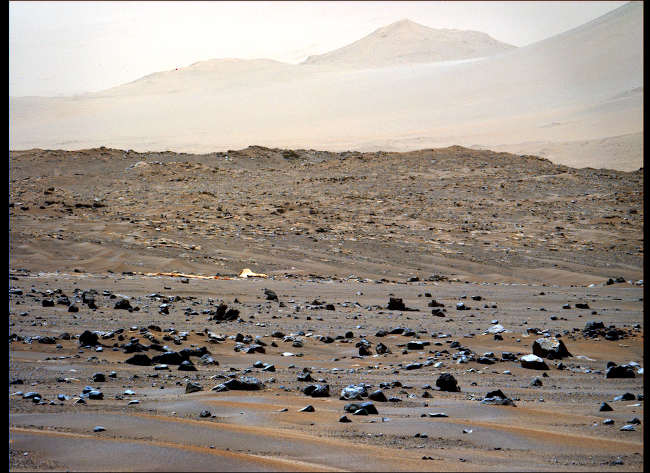
Sticking a fork in Three Forks
The Delta Front Campaign kicked off Monday, April 18, with about a week’s worth of driving to the southwest and then west. One goal of this excursion is to scope out the best route to ascend the delta, which rises about 130 feet (40 meters) above the crater floor.
Two options, called “Cape Nukshak” and “Hawksbill Gap,” look traversable. The science team is leaning toward Hawksbill Gap because of the shorter drive time needed to reach the top of the delta, but that may change as the rover acquires additional information on the two options.
Whichever route Perseverance takes to the plateau atop the delta, the team will perform detailed science investigations, including taking rock core samples, on the way up, then turn around and do the same thing on the way back down. The rover is expected to collect around eight samples over about half an Earth year during the Delta Front Campaign.
After completing the descent, Perseverance will, according to current plans, again ascend the delta (perhaps via the other, untraveled route) to begin the “Delta Top Campaign,” which will last about half an Earth year as well.
“The delta is why Perseverance was sent to Jezero Crater: It has so many interesting features,” said Farley. “We will look for signs of ancient life in the rocks at the base of the delta, rocks that we think were once mud on the bottom of ‘Lake Jezero.’ Higher up the delta, we can look at sand and rock fragments that came from upstream, perhaps from miles away. These are locations the rover will never visit. We can take advantage of an ancient Martian river that brought the planet’s geological secrets to us.”
Perseverance is kicking off its second science campaign more than a month earlier than planned due to the rover’s ability to autonomously negotiate Jezero Crater’s sandpits, craters, boulders, and fields of sharp rocks.
The rover’s six flight-grade-aluminum wheels completed 3,116.25 revolutions during the 16,617-foot (5,065-meter) journey to Three Forks.
Averaging 692 feet (211 meters) per drive (no driving occurred on six sols), the rover’s artificial-intelligence-assisted autonavigation capability, or AutoNav, assessed 10,744 navigation camera images during the road trip and commanded the rover to halt and turn in place to negotiate surface hazards 55 times.
More about Perseverance
A key objective for Perseverance’s mission on Mars is astrobiology, including the search for signs of ancient microbial life.
The rover will characterize the planet’s geology and past climate, pave the way for human exploration of the Red Planet, and be the first mission to collect and cache Martian rock and regolith (broken rock and dust).
Subsequent NASA missions, in cooperation with ESA (European Space Agency), would send spacecraft to Mars to collect these sealed samples from the surface and return them to Earth for in-depth analysis.
The Mars 2020 Perseverance mission is part of NASA’s Moon to Mars exploration approach, which includes Artemis missions to the Moon that will help prepare for human exploration of the Red Planet.
JPL, which is managed for NASA by Caltech in Pasadena, California, built and manages operations of the Perseverance rover.