 How to resolve AdBlock issue?
News
- Details
- Written by: Elizabeth Larson
“An active and fairly wet weather pattern will persist all of next week,” bringing with it chances also for snow in higher elevations, forecasters reported.
The National Weather Service also issued a freeze watch for portions of Lake County from midnight to 9 a.m. Sunday, when temperatures could drop as low as 29 degrees.
The Lake County forecast is calling for continued rain on Saturday, a break in the rain on Sunday, and then chances of rain from Monday through Friday. So far, the estimate is up to about three quarters of an inch for the week.
Gusting winds of more than 20 miles per hour are anticipated on Saturday, with lighter winds of up to 10 miles per hour possible on Sunday and Monday.
On Easter Sunday, temperatures are forecast to be in the low 60s during the day and the high 30s that night.
Through Friday, daytime temperatures are expected to rise into the mid 50s and drop into the low 40s at night.
Email Elizabeth Larson at
- Details
- Written by: NATIONAL AERONAUTICS AND SPACE ADMINISTRATION
Hubble determined the size of the largest icy comet nucleus ever found. And, it’s big! With a diameter of approximately 80 miles across, it’s about 50 times larger than typical comets. Its 500-trillion-ton mass is a hundred thousand times greater than the average comet. Credits: NASA's Goddard Space Flight Center; Lead Producer: Paul Morris
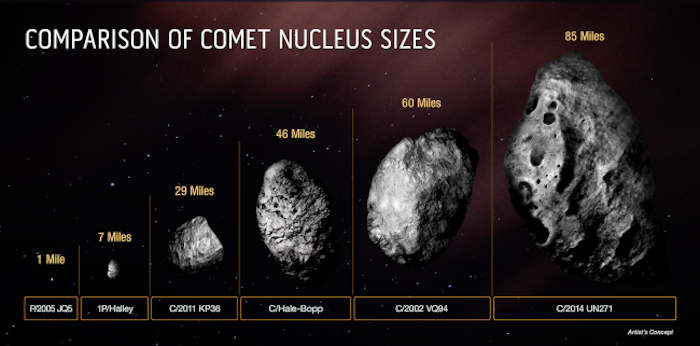
NASA's Hubble Space Telescope has determined the size of the largest icy comet nucleus ever seen by astronomers.
The estimated diameter is approximately 80 miles across, making it larger than the state of Rhode Island.
The nucleus is about 50 times larger than found at the heart of most known comets. Its mass is estimated to be a staggering 500 trillion tons, a hundred thousand times greater than the mass of a typical comet found much closer to the Sun.
The behemoth comet, C/2014 UN271 (Bernardinelli-Bernstein) is barreling this way at 22,000 miles per hour from the edge of the solar system. But not to worry. It will never get closer than 1 billion miles away from the Sun, which is slightly farther than the distance of the planet Saturn. And that won't be until the year 2031.
The previous record holder is comet C/2002 VQ94, with a nucleus estimated to be 60 miles across. It was discovered in 2002 by the Lincoln Near-Earth Asteroid Research (LINEAR) project.
"This comet is literally the tip of the iceberg for many thousands of comets that are too faint to see in the more distant parts of the solar system," said David Jewitt, a professor of planetary science and astronomy at the University of California, Los Angeles, and co-author of the new study in The Astrophysical Journal Letters. "We've always suspected this comet had to be big because it is so bright at such a large distance. Now we confirm it is."
Comet C/2014 UN271 was discovered by astronomers Pedro Bernardinelli and Gary Bernstein in archival images from the Dark Energy Survey at the Cerro Tololo Inter-American Observatory in Chile. It was first serendipitously observed in November 2010, when it was a whopping 3 billion miles from the Sun, which is nearly the average distance to Neptune. Since then, it has been intensively studied by ground and space-based telescopes.
"This is an amazing object, given how active it is when it's still so far from the Sun," said the paper's lead author Man-To Hui of the Macau University of Science and Technology, Taipa, Macau. "We guessed the comet might be pretty big, but we needed the best data to confirm this." So, his team used Hubble to take five photos of the comet on January 8, 2022.
The challenge in measuring this comet was how to discriminate the solid nucleus from the huge dusty coma enveloping it. The comet is currently too far away for its nucleus to be visually resolved by Hubble.
Instead, the Hubble data show a bright spike of light at the nucleus' location. Hui and his team next made a computer model of the surrounding coma and adjusted it to fit the Hubble images. Then, the glow of the coma was subtracted to leave behind the starlike nucleus.
Hui and his team compared the brightness of the nucleus to earlier radio observations from the Atacama Large Millimeter/submillimeter Array, or ALMA, in Chile. This combined data constrains the diameter and the reflectivity of the nucleus.
The new Hubble measurements are close to the earlier size estimates from ALMA, but convincingly suggest a darker nucleus surface than previously thought. "It's big and it's blacker than coal," said Jewitt.
The comet has been falling toward the Sun for well over 1 million years. It is coming from the hypothesized nesting ground of trillions of comets, called the Oort Cloud. The diffuse cloud is thought to have an inner edge at 2,000 to 5,000 times the distance between the Sun and the Earth. Its outer edge might extend at least a quarter of the way out to the distance of the nearest stars to our Sun, the Alpha Centauri system.
The Oort Cloud's comets didn't actually form so far from the Sun; instead, they were tossed out of the solar system billions of years ago by a gravitational "pinball game" among the massive outer planets, when the orbits of Jupiter and Saturn were still evolving. The far-flung comets only travel back toward the Sun and planets if their distant orbits are disturbed by the gravitational tug of a passing star – like shaking apples out of a tree.
Comet Bernardinelli-Bernstein follows a 3-million-year-long elliptical orbit, taking it as far from the Sun as roughly half a light-year. The comet is now less than 2 billion miles from the Sun, falling nearly perpendicular to the plane of our solar system. At that distance temperatures are only about minus 348 degrees Fahrenheit. Yet that's warm enough for carbon monoxide to sublimate off the surface to produce the dusty coma.
Comet Bernardinelli-Bernstein provides an invaluable clue to the size distribution of comets in the Oort Cloud and hence its total mass. Estimates for the Oort Cloud's mass vary widely, reaching as high as 20 times Earth's mass.
First hypothesized in 1950 by Dutch astronomer Jan Oort, the Oort Cloud still remains a theory because the innumerable comets that make it up are too faint and distant to be directly observed. Ironically, this means the solar system's largest structure is all but invisible. It's estimated that NASA's pair of Voyager spacecraft won't reach the inner realm of the Oort Cloud for another 300 years and could take as long as 30,000 years to pass through it.
Circumstantial evidence come from infalling comets that can be traced back to this nesting ground. They approach the Sun from all different directions meaning the cloud must be spherical in shape. These comets are deep-freeze samples of the composition of the early solar system, preserved for billions of years.
The reality of the Oort Cloud is bolstered by theoretical modeling of the formation and evolution of the solar system. The more observational evidence that can be gathered through deep sky surveys coupled with multiwavelength observations, the better astronomers will understand the Oort Cloud's role in the solar system's evolution.
The Hubble Space Telescope is a project of international cooperation between NASA and European Space Agency. NASA's Goddard Space Flight Center in Greenbelt, Maryland, manages the telescope. The Space Telescope Science Institute (STScI) in Baltimore, Maryland, conducts Hubble science operations. STScI is operated for NASA by the Association of Universities for Research in Astronomy, in Washington, D.C.
- Details
- Written by: LAKE COUNTY NEWS REPORTS
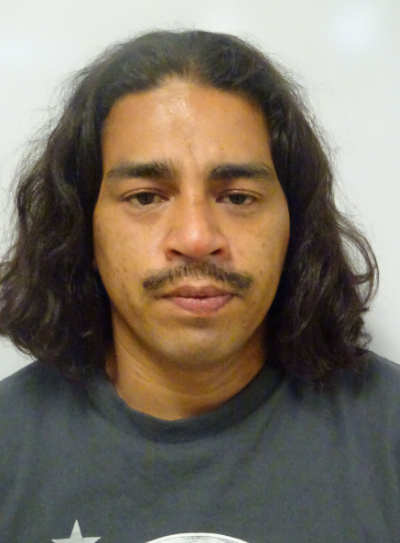
LAKE COUNTY, Calif. — A jury has convicted a Northshore man of several counts of sexual assault.
On April 8, the jury handed down the verdict in the trial of Antonio Thomas Magalhaes, 36, of Nice, after approximately one hour of deliberation, said Chief Deputy District Attorney Richard Hinchcliff.
Magalhaes was convicted of seven separate crimes, including assault with intent to commit sodomy while committing a first degree burglary; sodomy by force; forcible rape; first degree burglary; rape of an intoxicated person; rape of an unconscious person; and domestic violence involving corporal injury.
Magalhaes remains in custody of the Lake County Sheriff’s Office pending sentencing, which is scheduled for June 6.
Magalhaes could face up to a maximum period of 38 years to life in prison, Hinchcliff said.
Hinchcliff said the trial began on March 30 in Judge Andrew Blum’s Department 3 courtroom. Deputy District Attorney Richard Watson prosecuted the case, with Magalhaes represented by Matthew Fregi of Contra Costa County.
Watson said the testimony at trial established that Magalhaes beat and sexually assaulted one victim on multiple occasions from Sept. 1, 2018, through March 19, 2019.
Magalhaes would break into the victim’s home, hold her down, force himself on her and rape her. On one occasion Magalhaes broke into the home while the victim was sleeping, attacked her in her bed and forcefully sodomized her, the District Attorney’s Office reported.
Testimony further established that on Dec. 8 and 9, 2019, Magalhaes raped a second victim while she was too intoxicated to resist or consent and that he raped her while she was unconscious.
The Lake County District Attorney’s Office commended the victims for their courage in coming forward and testifying as to the various abuses committed against them by Magalhaes.
The case was investigated by Ryan Murdaugh of the Mendocino County Sheriff’s Department, Jose Zepeda, Marcos DeLatorre and Cody White of the Lake County Sheriff’s Department, and Denise Hinchcliff and Scott Poma of the Lake County District Attorney’s Office.
The matter was referred to the Lake County Probation Office for a presentence report and recommendation.
- Details
- Written by: Elizabeth Larson
LAKE COUNTY, Calif. — A Novato woman has been sentenced for a double-fatal crash near Middletown last spring.
On March 7, Judge Andrew Blum sentenced Keilah Marie Coyle, 23, to probation and 364 days in jail for the March 2021 crash that killed Clearlake residents Cassandra Elaine Rolicheck, 53, and Miguel Maciel Dominguez, 47.
Coyle’s attorney, Tim Hodson of Sacramento, said he could not offer comment on the case outcome because Coyle would not clear him to do so.
Authorities said Coyle, driving a 2003 Ford F-250 pickup, had been involved in a noninjury hit-and-run crash on Highway 101 in Sonoma County on March 13.
That night, she was driving on Highway 29 north of Middletown when she crossed the highway’s solid double yellow lines and collided head-on with a 2000 GMC van driven by Rolicheck, with Dominguez riding as her passenger.
The Lake County District Attorney’s Office originally charged Coyle with several counts of vehicular manslaughter while intoxicated plus special allegations for causing great bodily injury and the death of more than one person.
Early on in the case, Hodson declared a doubt about Coyle’s competency, which later was resolved.
Coyle remained in custody from the time of the crash until July 12, when she was released from custody by the judge so she could enroll in the Salvation Army drug/alcohol rehabilitation program in San Francisco, said Chief Deputy District Attorney Richard Hinchcliff.
Hinchcliff said Coyle completed and graduated from that program, then started an outpatient drug/alcohol program.
The District Attorney’s Office made an offer to Coyle to plead to vehicular manslaughter, driving under the influence causing bodily injury and causing great bodily injury. Hinchcliff said the offer carried a maximum potential of seven to eight months in prison.
“We made the offer open, so at sentencing the judge could sentence her to anything from felony probation with some jail time, up to seven years eight months in prison, at the judge’s discretion,” Hinchcliff said.
He said the Probation Department did a sentencing investigation and report, and recommended a grant of probation.
Factors that Hinchcliff said the District Attorney’s Office weighed in making the offer was the fact Coyle was only 22 years old at the time of the crash and she had no criminal history. “Both of those factors are ones that significantly weigh in favor of felony probation.”
Another factor in Coyle’s favor was her completion of the drug and alcohol rehabilitation program, Hinchcliff said.
On Jan. 28, Coyle, in accordance with the agreement with the District Attorney’s Office, entered her pleas, Hinchcliff said.
That led to Judge Blum sentencing her on March 7.
New sentencing laws require that when a defendant is youthful, in this case under age 26, and has no criminal record, courts cannot impose upper or middle terms. Rather, judges in these cases can only impose probation or the low term.
In addition to the felony probation and jail time, Hinchcliff said Coyle must not be in possession of or use alcohol, she must participate in an alcohol treatment program and pay restitution.
If Coyle violates her probation, she could be ordered to serve additional time in state prison, up to an additional five and a half years, Hinchcliff said.
Hinchcliff said Coyle did 360 days in custody between time served in the Lake County Jail and the residential treatment program. With the half-time credits she also received, she had an overall credit total of 720 days.
Due to those excess credits, Coyle needed to serve no further time and has been released, Hinchcliff said.
This was not the result of new changes in the law. “It’s been that way for years,” Hinchcliff said of the credits.
He said she is now transferring her probation to Marin County, where she lives.
He said the offer, approved by District Attorney Susan Krones, was “definitely within the norm, and if anything was potentially more serious than what might be considered the norm under the circumstances.”
He said that’s because the District Attorney’s Office made an offer that could have resulted in significant prison time.
Email Elizabeth Larson at