 How to resolve AdBlock issue?
News
- Details
- Written by: LAKE COUNTY LIBRARY
This Saturday, April 16, the Lakeport Library branch will host a cooking class to help patrons apply the principles in “The Blue Zones of Happiness” by Dan Buettner.
Book to Action is a free book club that includes not only book discussions, but also “action” events to help Lake County residents apply the material of the book to their lives.
Libraries across the state are participating with book selections unique to their community.
This year, Book to Action is providing free copies of The Blue Zones of Happiness (first come, first serve), which residents can pick up at any of the four library branches: Lakeport, Middletown, Redbud or Upper Lake. Digital copies are also freely available.
In partnership with Blue Zones Project Lake County, the Lake County Library branches will be hosting the following book discussions and events:
• Book discussion: April 16, Upper Lake at noon (on Zoom and in person).
• Cooking class: Participants may take a cooking class with CalFresh and Blue Zones Project Lake County on April 16 at the Lakeport branch at 10 a.m.
• Book discussion: April 20, Lakeport Branch at noon (on Zoom).
• Book discussion: April 21, Clearlake Branch at 2 p.m. (on Zoom).
• Presentation: The presentation will be on “The Blue Zones of Happiness” by Dan Buettner. Participants can take a test to learn about their body’s health and sign up for a walking group. The presentation will take place on April 23 at the Middletown Branch at 10 a.m.
• Walking group: Participants may join walking groups and hike on April 23 at Robert Louis Stevenson Park at 1 p.m.
• Book discussion: April 27, Middletown Branch at 1 p.m. (in person).
• Book discussion: April 30, Clearlake Branch at 3 p.m. (on Zoom).
• Cooking class: Participants may take a cooking class with CalFresh and Blue Zones Project Lake County on April 30 at Middletown at 10 a.m.
The first two events, a Blue Zones Project Lake County presentation and a hike at Highland Springs, took place on Saturday April 9.
“Both went well,” says event coordinator Amy Patton. “Patrons used the library Chromebooks to take the ‘Real Age’ test. And during the hike that afternoon, the flowers and the weather were perfect! The Middletown library will form another walking group on April 23.”
The library clubs — Book Club, Cookbook Club, Yarn Club and Creative Club — are also participating.
The full calendar of events is available at all library branches and is posted on the library website. Interested residents can sign up in person at the library or on the library website. Informational flyers are available at the library.
This project was made possible in part by the Institute of Museum and Library services.
The Lake County Department of Public Services Parks Division and Lake County Department of Public Health CalFresh Program also will be providing speakers, materials and more for the program.
Visit the Lake County Library website for more information.
- Details
- Written by: EMPLOYMENT DEVELOPMENT DEPARTMENT
EDD and Fraud Special Counsel McGregor W. Scott also recently identified and referred to federal authorities 30 more major fraud cases involving $54 million in benefits — mainly associated with the federal Pandemic Unemployment Assistance program.
These 30 investigations involved fraud schemes crossing state or international boundaries, as well as some schemes within California.
“Fraudsters attacked California and every state in the country with unprecedented criminal activity in 2020,” said Scott. “These criminals defrauded taxpayers and stole benefits from workers in need. California responded aggressively with new anti-fraud measures that blocked billions of dollars in fraud attempts. We are now engaged in a monumental effort to uncover these complex fraud schemes and deliver investigations to law enforcement and prosecutors across California.”
As fraud special counsel, Scott aids the state’s work with law enforcement to combat fraud — including supporting state, federal, and local investigations and prosecutions.
Working with EDD, Scott has leveraged his experience to deliver leads and evidence to aid prosecutions and strengthen ongoing investigations. Hundreds of investigations have opened and scores of suspects have been arrested, criminally charged and convicted.
From January 2021 to January 2022, the California Task Force on Pandemic Unemployment Assistance Fraud has led to at least 370 arrests, 130 convictions, and 1,400 active investigations.
These cases include a great variety of fraud schemes ranging from international crime rings to domestic organized and individual criminal activity.
Efforts continue to recover any remaining funds seized during these investigations, including funds held on frozen debit cards pending the investigation or prosecution.
EDD and Scott have also helped boost data sharing agreements with law enforcement partners to expedite investigations. Similarly, EDD established an information sharing program that helps California agencies to access EDD data more quickly.
Officials said fraud investigations are labor intensive criminal investigations because of the complexity of the schemes and the extensive efforts criminals undertake to conceal their activity.
In response, EDD created law enforcement investigative guides and offers technical assistance to law enforcement partners who are working these cases. EDD set up designated regional contacts for each division of the state and works with any agency that needs assistance with an unemployment insurance fraud case.
Law enforcement has arrested, convicted and imprisoned scores of individuals who defrauded the State — and continues to do so.
Those efforts have led to the following:
• A 37-month prison sentence in April 2021 in the Central District of California for a fraudster who obtained more than $500,000 in fraudulent unemployment benefits.
• Sentencing in April 2021 following an investigation by the U.S. Department of Justice National Unemployment Insurance Fraud Task Force conducted by US DOL, IRS, USPS, Murrieta PD, and EDD into a suspect who stole identities and obtained $500,000 in unemployment benefits.
• Guilty pleas in a federal prosecution of two inmates in Chowchilla in April 2021 following a joint investigation by the FBI, CDCR, the US Attorney, and EDD into $103,000 in fraud.
• A guilty plea in federal court in April 2021 following an investigation by the U.S. Department of Labor, FBI and EDD into attempts to file 100 phony claims using stolen identities and 10 payments worth nearly $200,000.
• Arrests in April 2021 by federal authorities following an investigation by Department of Labor, FBI, U.S. Postal Service and EDD into three people who filed $345,000 in fraudulent benefit applications on behalf of inmates.
• Arrests in Placer County in April 2021 in connection with a criminal organization that filed $4.5 million in fraudulent unemployment claims.
• Indictments by a grand jury in California in June 2021 following an investigation by the U.S. Department of Justice and EDD into three people who stole $1.4 million in unemployment benefits.
• Two defendants were convicted in July 2021 and imprisoned for five years for obtaining more than $74,000 in fraudulent unemployment benefits following an investigation by the FBI, the California Department of Corrections and Rehabilitation Investigative Services Unit and EDD.
• Guilty pleas in August 2021 in Los Angeles following an investigation into 200 fraudulent benefit claims totaling $1.6 million.
• Charges filed in August 2021 in Sacramento County against suspects linked to more than $500,000 in fraudulent claims.
• Criminal sentences against three Florida residents in November 2021 for fraudulently obtaining unemployment benefits in California.
• Criminal sentencing in San Diego in December 2021 of a fraudster sentenced to two years in prison for unemployment benefit fraud.
• Guilty pleas in San Diego County in February 2022 following an investigation by the San Diego District Attorney into a $1 million theft of unemployment insurance.
• A five-year prison sentence in February 2022 following an investigation by the U.S. Attorney, U.S. Department of Labor, Homeland Security, U.S. Postal Service, FBI, Social Security Administration and EDD into $4.3 million in stolen unemployment insurance benefits.
• Criminal charges filed in Sacramento in January 2022 following an investigation by EDD and the Sacramento County District Attorney into multiple suspects stealing $2.75 million in unemployment insurance benefits.
• Federal indictments in Sacramento in January 2022 following an investigation by EDD and federal authorities into a New Jersey resident who filed 78 fraudulent unemployment insurance claims in California.
• A guilty plea in federal court in January 2022 following an investigation by the U.S. Attorney and EDD into $132,000 in stolen unemployment insurance benefits.
• Guilty pleas in San Diego County in February 2022 following an investigation by the San Diego District Attorney into a $1 million theft of unemployment insurance.
• A five-year prison sentence in February 2022 following an investigation by the U.S. Attorney, U.S. Department of Labor, Homeland Security, U.S. Postal Service, FBI, Social Security Administration and EDD into $4.3 million in stolen unemployment insurance benefits.
• Eight defendants indicted in Fresno in February 2022 following an investigation by the U.S. Attorney for the Eastern District, FBI, U.S. Department of Labor, CDCR, and EDD into identity theft and mail fraud and $5 million in unemployment insurance fraud.
• A defendant sentenced to 30 months in prison in February 2022 following an investigation by the U.S. Department of Justice into approximately $170,000 in stolen unemployment benefits.
• Seventeen people charged in Bakersfield in March 2022 following an investigation by EDD, the Kern County District Attorney and others into a $394,000 unemployment insurance fraud scheme.
• Indictment in March 2022 in Las Vegas following an investigation by the Department of Labor-Office of Inspector General (DOL-OIG), U.S. Attorney, Department of Homeland Security-Office of Inspector General (DHS-OIG), Federal Bureau of Investigation, and EDD into $1.1 million in fraudulent claims.
While arrest, prosecution, and imprisonment remains a major avenue for holding fraudsters accountable, EDD said will seek restitution through the judicial system whenever possible.
Court-ordered restitution to EDD as a crime victim occurs after a criminal conviction. This can also include funds seized during a criminal investigation and held as evidence.
Other actions California has taken to strengthen its fraud fighting include:
• Stopping $125 billion in attempted fraud by deploying a new identity verification system, ID.me, in 2020 and partnering with Thomson Reuters to help detect and prevent UI and PUA fraud.
• Setting up the 1099-G call center to help victims of identity theft deal with any tax related questions—work that answered 24,000 calls. Fraud can be reported by selecting Form 1099G in Ask EDD or calling 1-866-401-2849.
• No longer printing Social Security numbers on mailed documents to reduce the risk of identity theft.
• Working with Bank of America to issue chip-enabled debit cards that enhance security and to strengthen fraud-prevention strategies.
• Working with the California Office of Emergency Services Fraud Task Force on over a thousand active investigations, arrests, and prosecutions across California.
• Delivering multiple customer alerts about text message and other phishing schemes.
With identity theft remaining a pervasive threat nationwide and globally, EDD has continued to issue consumer scam alerts throughout the pandemic that warn about cell phone and email phishing schemes designed to steal personal information.
Californians who receive suspicious cell phone or email phishing communications can report those scam attempts to the Federal Trade Commission, or FTC.
Phishing emails can be forwarded to the FTC’s Anti-Phishing Working Group at
- Details
- Written by: LESTINA DONGO AND LINDSAY MONTE
Recent data from the U.S. Census Bureau’s Survey of Income and Program Participation, or SIPP, shows that in 2019, prior to the pandemic, roughly 33.2 million children received school meals, including about 21.3 million who received free school lunches.
However, when the COVID-19 pandemic hit the United States a year later, it disrupted many facets of life, including closing schools for many and jeopardizing access to school meals.
According to the Census Bureau’s experimental Household Pulse Survey (HPS), roughly 20% of at-risk households with children reported being food insecure — defined as sometimes or often not having enough to eat — in the early weeks of the pandemic, when many schools were closed.
But as new policies were enacted in response to COVID-19, such as expanded eligibility for school lunch programs, food insecurity in households with children declined.
New school meal policies during COVID
There were many policy changes designed to compensate for the loss of school meals due to pandemic-related school closures. Among them:
• Many school districts offered meals that could be picked up or delivered via school bus transportation during this period.
• The Pandemic Electronic Benefit Transfer program (P-EBT) provided emergency funds for nutritional benefits that were directly loaded on EBT cards for households with children that would normally receive free or reduced cost lunch if their schools were not partially or fully closed.
• The U.S. Department of Agriculture (USDA) waived the eligibility requirements for free lunch to allow school meal programs to provide safe, free healthy meals to all children and these flexibilities were extended through June of this year.
As these policies were implemented throughout the pandemic, food insecurity in households with children declined.
The decline is likely due in part to improving economic circumstances over the course of the pandemic (as well as the Child Tax Credit and stimulus payments). But our research shows that the change in food security still holds true when we control for economic variables.
Among households with children facing economic insecurity — defined here as those in which an adult indicated concern about their ability to pay the next month’s rent or mortgage — food insecurity fell by about 7 percentage points between the start of the pandemic (21.3% in April/May of 2020) and summer 2021 (14.2% in July/August 2021) when the most recent USDA policy changes were implemented.
Between summer 2021 and the back-to-school period in the fall, food insecurity levels among these at-risk households were not significantly different.
Free meals for all changed who receives meals
When most kids returned to school last fall, school meal receipt looked more like it did pre-pandemic. HPS data collected December 1-13, 2021, show that 18.3 million school-enrolled children were reported to be receiving free meals at school.
However, expanded eligibility and availability changed who received school meals in the fall of 2021, which included some higher income households.
For example, roughly 58% of HPS households that received free school meals owned their homes in December, 2021, compared to 47% of SIPP householders in homes receiving free or reduced-price meals in 2019.
School meals still part of safety net
These same HPS data show that although more households had access to free school meals during the pandemic, receipt was still higher in households that demonstrated financial need.
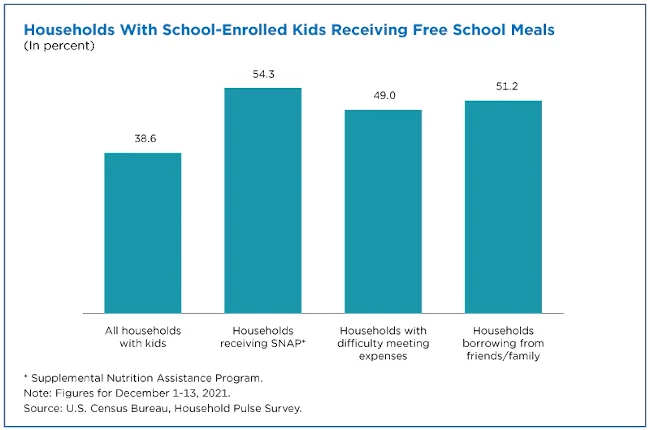
For example, roughly 39% of all households with children in school reported their child was receiving free school meals in December. However, 54% of households with kids that received funds from the Supplemental Nutrition Assistance Program or SNAP, a means-tested food assistance program, reported receiving school meals.
Roughly half of adults in households with kids that reported difficulty meeting expenses reported receiving free school meals. The same was true of households with kids in which adults reported borrowing from friends and family to make ends meet.
Note that the estimates for SNAP households and households that borrowed to make ends meet was not significantly different.
Families benefit from program expansions
HPS data also show the extent to which families continued to rely on pandemic-related expanded national school meals programs. In December 2021:
• Roughly 15 million children ate meals on-site, at school or other locations.
• Over 5 million children picked up meals at school or other locations.
• Roughly 12 million school-enrolled children ages 5-18 received assistance through the expanded SNAP/P-EBT program.
About the data
The HPS is designed to provide near real-time data on how the pandemic is affecting people’s lives.
Information on the methodology and reliability of these estimates can be found in the source and accuracy statements for each data release.
Part of the Census Bureau’s Experimental Data Product series, the HPS was designed to have low respondent burden, provide quick turnaround on product releases and produce estimates that meet urgent public needs.
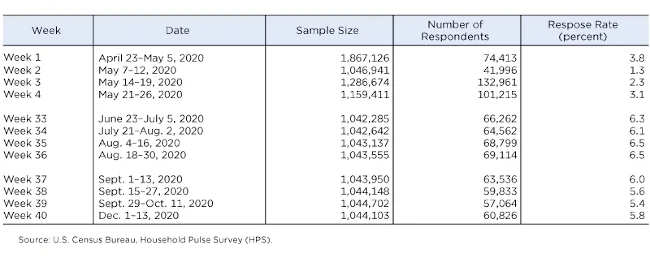
Most HPS data used in this analysis come from HPS Week 40, which was collected between December 1-13, 2021. However, HPS data used to make comparisons over time come from pooled collection periods that are reweighted to account for the pooling.
Data used here to describe the "early weeks of the pandemic" come from HPS Weeks 1-4. Data used to describe the summer of 2021 come from HPS Weeks 33-36, and data covering fall of 2021 come from HPS Weeks 37-40. (Note that collection periods after Week 12 are generally two weeks in length, but the HPS continues to refer to collection periods as "week" for continuity with earlier collections.)
The dates, sample sizes and response rates for all these collections are as follows:
The SIPP is a nationally representative survey of the civilian, noninstitutionalized population. More information about the SIPP, including data on receipt of food assistance programs, is available on the SIPP website. Source and accuracy statements are available on the technical documentation page.
SIPP data about school meal receipt in 2019 were collected for the calendar year and therefore include more than one school year. In contrast, the HPS asks about school meal receipt in the prior seven days.
Lestina Dongo and Lindsay Monte are researchers in the Census Bureau’s Social, Economic, and Housing Statistics Division.
- Details
- Written by: Elizabeth Larson
Supervisor Bruno Sabatier presented the item to his colleagues, asking for them to pass the 45-day temporary moratorium in order to come up with solutions about how to protect the county water supply amid deepening drought conditions.
“This is climate change. Whether you want to agree that this is manmade or not is not the discussion,” he said.
However, with the urgency ordinance requiring a four-fifths vote of the board, it became clear early in the discussion that it would not have enough votes to pass after three board members voiced their opposition.
Sabatier said he believed he had brought traditional agriculture and cannabis growers together with his request. During public comment, both groups would voice opposition.
He presented data showing that Clear Lake is on track to drop to levels not seen since the drought of 1976 and 1977.
Sabatier said his goal was not to prohibit growth but to make sure the county has the vetting tools needed to protect the environment while making sure things are done correctly.
He said no ag projects currently were in the queue. The only cannabis projects that would be able to go through during the moratorium period would be about 14 that have already submitted plans to the state clearinghouse.
Sabatier said he’d spoken to the agricultural commissioners and the Lake County Cannabis Alliance about the matter. He said he’d received mostly positive input from the general public.
With the current drought reported to be the harshest in more than 1,200 years, Sabatier said it felt like the county was waiting for something to happen before taking any action. He said he wanted to make sure Lake County continues to be a farming community.
“It’s a tough topic. It gets very personal for those who are in the industries,” he said.
Despite Sabatier’s belief that the county could have a plan within 90 days to move forward, the majority of the board refused to support it.
Supervisor Tina Scott said she didn’t agree with the moratorium proposal, and that they needed to let Community Development Director Mary Darby complete work on updating county rules.
She said it is going to punish the good actors, but the bad actors will continue to waste water. “It’s just not going to solve the issues.”
Scott said she wanted to see enhanced hydrology standards, but added that the county cannot have knee jerk reactions.
The harshest criticism came from Supervisor Jessica Pyska, who said county staff was weeks away from coming back with proposals for how to rework the planning process to address issues like water.
She said Sabatier’s temporary moratorium would derail that, and that staff only had so much time available to work on these matters.
Citing staff issues and turnover, Pyska said, “To say that nothing’s been happening is wholly untrue.” She added that if Sabatier hadn’t seen any action it was because he wasn’t on the committee working with Community Development.
Pyska said the end goal is to get to a place of sustainability in our county and staff is now researching the watershed.
“This drought didn’t come out of nowhere,” said Psyka, adding that they have to work collaboratively and can’t just pile things on staff all the time.
Supervisor Moke Simon said he completely agreed with Scott and Pyska. “We’re doing the work.”
Simon said people need to think about how they’re living on the earth, bringing up issues with lawn grass, water storage and the local tribes’ lack of say on Clear Lake’s water rights.
“That’s our water,” he said. “Our tribal communities were not at the table when it was taken.”
Board Chair EJ Crandell was the only board member to offer any support for Sabatier,
Noting that in his Northshore district and its town halls there has been a lot of discussion of water in general, Crandell agreed that the county is working on addressing the situation and that the tribes were not considered when water rights were being determined.
He said he thought a 45-day moratorium would allow county staff to catch up on its works.
“I would have no problem considering a moratorium for 45 days despite the fact that it would affect some of you here, many of you here,” he said to the community members in the room.
The comments offered by community members were almost entirely against even a temporary pause.
Farmer and cannabis consultant Richard Derum noted, “Legalization has brought us new challenges.”
He said changes are needed in the industry itself, explaining that mixed light greenhouses are more sustainable than traditional outdoor grows.
Derum said those waiting in the approval queue likely can’t grow a crop this year anyway, so he didn’t see the need for an urgency ordinance.
As a consultant, Serum said he saw a “flip” in the industry last year, with the push going to fresh cannabis that’s more easily obtained through greenhouses.
Sarah Bodnar, a policy adviser for the Lake County Cannabis Alliance, said everyone acknowledges that the drought is a problem and that they are ready to work on solutions. “A moratorium isn’t one of them.”
She said they are farmers. “Without water we cannot farm.”
Ultimately, the board took no action on the proposal.
Sabatier said he appreciated everyone’s feedback and wished the county could come back sooner rather than later with solutions.
Email Elizabeth Larson at