 How to resolve AdBlock issue?
News
- Details
- Written by: NATIONAL OCEANIC AND ATMOSPHERIC ADMINISTRATION
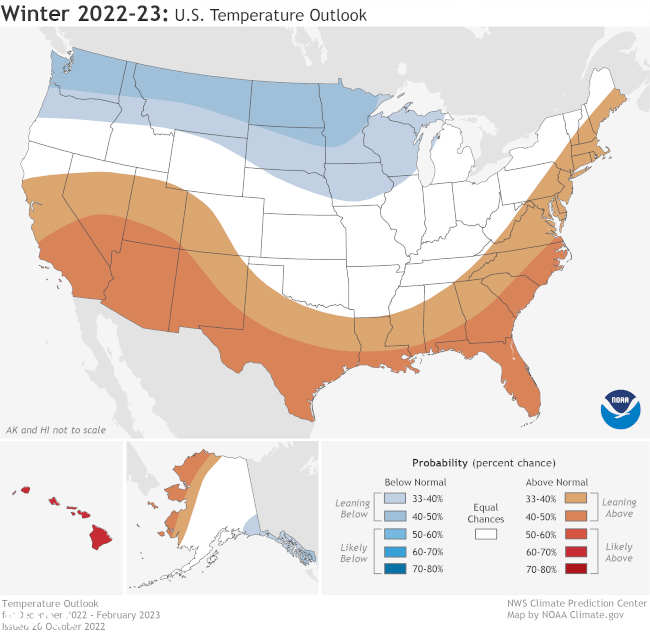
This year La Niña returns for the third consecutive winter, driving warmer-than-average temperatures for the Southwest and along the Gulf Coast and eastern seaboard, according to NOAA’s U.S. Winter Outlook released Thursday by the Climate Prediction Center — a division of the National Weather Service.
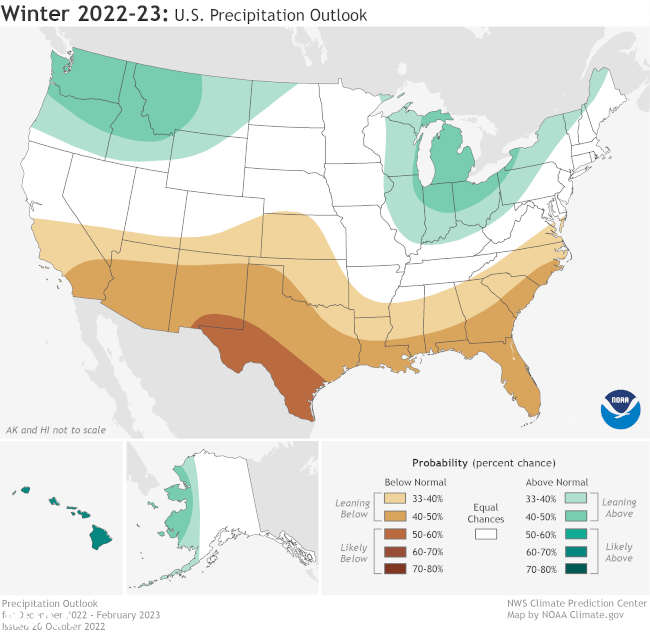
Starting in December 2022 through February 2023, NOAA predicts drier-than-average conditions across the South with wetter-than-average conditions for areas of the Ohio Valley, Great Lakes, northern Rockies and Pacific Northwest.
“The hardworking forecasters at NOAA’s Climate Prediction Center produce timely and accurate seasonal outlooks and short-term forecasts year-round,” said Michael Farrar, Ph.D., director of the National Centers for Environmental Prediction. “NOAA’s new supercomputers are enabling us to develop even better, more detailed forecast capabilities, which we’ll be rolling out in the coming years.”
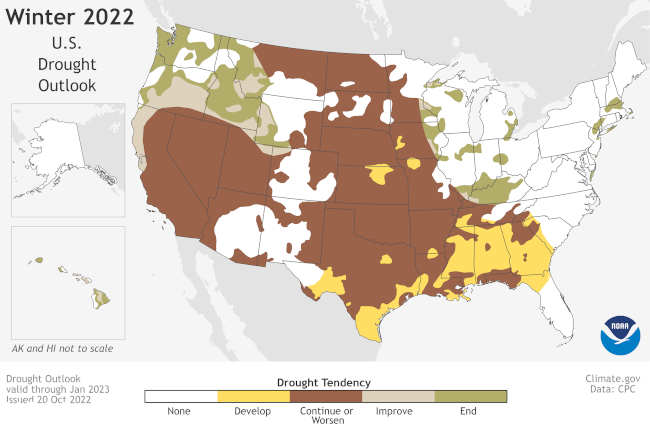
NOAA forecasters, in collaboration with the National Integrated Drought Information System (NIDIS), continue to monitor extreme, ongoing drought conditions that have persisted in the Western U.S. since late 2020, as well as parts of the central U.S. where historic low-water conditions are currently present.
“Drought conditions are now present across approximately 59% of the country, but parts of the Western U.S and southern Great Plains will continue to be the hardest hit this winter,” said Jon Gottschalck, chief, Operational Prediction Branch, NOAA’s Climate Prediction Center. “With the La Niña climate pattern still in place, drought conditions may also expand to the Gulf Coast.”
Temperature
• The greatest chance for warmer-than-average conditions are in western Alaska, and the Central Great Basin and Southwest extending through the Southern Plains.
• Warmer-than-average temperatures are also favored in the Southeastern U.S. and along the Atlantic coast.
• Below-normal temperatures are favored from the Pacific Northwest eastward to the western Great Lakes and the Alaska Panhandle.
Precipitation
• Wetter-than-average conditions are most likely in western Alaska, the Pacific Northwest, northern Rockies, Great Lakes and Ohio Valley.
• The greatest chances for drier-than-average conditions are forecast in portions of California, the Southwest, the southern Rockies, southern Plains, Gulf Coast and much of the Southeast.
• The remainder of the U.S. falls into the category of equal chances for below-, near-, or above-average seasonal total precipitation.
Drought
• Widespread extreme drought continues to persist across much of the West, the Great Basin, and the central-to-southern Great Plains.
• Drought is expected to impact the middle and lower Mississippi Valley this winter.
• Drought development is expected to occur across the South-central and Southeastern U.S., while drought conditions are expected to improve across the Northwestern U.S. over the coming months.
- Details
- Written by: Elizabeth Larson
The Clearlake City Council gave staff direction to develop a proposal for the program at its Oct. 6 meeting.
“One of the more difficult tasks we face as an organization is retention, and retention of high performing and committed employees,” said City Manager Alan Flora.
While the city has a great group of employees now, Flora said homeownership is the one of the keys both to bringing people to the city and keeping them as staff.
Access to housing locally is a challenge, and Flora said the city is trying to come up with ways to keep employees here. So he wanted to bring the matter to the council.
“There’s not very many examples of this type of program out there,” he said, although they did track down four such programs in California.
Some of the program’s requirements could include a specific incentive amount, a requirement that the home purchased be within the city and owner-occupied. Other considerations are for there to be a requirement for applicants to be employed with the city a certain amount of time as well as an effort made to be sure that the incentive itself is tax-free.
Councilwoman Joyce Overton said she liked the idea and recalled the city having done such a program for police officers. Councilman Russ Perdock said that program was done through a federal grant.
Councilman David Claffey asked about other city retention programs. Flora said the city doesn’t have any other programs per se. They try to give people meaningful work and training opportunities to advance.
Flora said the city has had a few employees apply for the homestead program — which the city established about two years ago to help develop quality housing for professionals — as well as others outside of the city organization.
“It is even more of a challenge to build a new house,” Flora said, noting that there is a real deficit of quality housing in the city.
The average home price in Clearlake is $230,000 to $240,000. Flora said he spoke to a contractor who said new construction would cost around $420,000 for a 1,200 square foot home. He added that he hates hearing about people taking second jobs to afford a home.
During the discussion Flora said the funding would not come from the general fund but from housing set aside money, the same funding source for the homestead program.
Flora said most of the city’s hires have been from out of the area, and sometimes it has been a real scramble to find them a place to live. “This isn’t going to solve the inventory problem.”
He said he was thinking initially that the program could offer $20,000 or $25,000. Flora said he liked terms in Walnut Creek’s plan, which allows a maximum amount of $65,000 or up to $200,000 under a special exception for hard-to-fill positions. The borrower has to be able to pay closing costs of mortgage and 5% down payment.
That program is structured like a loan in which the employee doesn’t make payments or accrue interest and when the house is sold, the increase in value of the home is split with the city.
Councilman Russ Cremer wanted a requirement that the house not be sold for a certain number of years. Flora said that makes sense, and pointed out that most of the programs he’s looked at require a five-year term before the home can be sold.
Claffey wanted to take a step back and consider whether such a program would be important to employees, adding that housing isn’t unaffordable in Clearlake.
Mayor Dirk Slooten said he thought it is a great idea, that it would definitely help with retention and community building.
Perdock suggested the funds also could be used to buy down interest rates for homebuyers.
The council gave Flora direction to come back with a program proposal at a future meeting.
Also during that meeting, Mark Harden was sworn in as the newest police sergeant, the council presented a proclamation declaring October 2022 as Domestic Violence Awareness
Month and Curt Giambruno to the Lake County Vector Control District Board for a term of four years.
Email Elizabeth Larson at
- Details
- Written by: LAKE COUNTY NEWS REPORTS
LAKE COUNTY, Calif. — The annual Great ShakeOut is giving people the opportunity to practice earthquake safety skills communitywide.
Thursday, Oct. 20 is International ShakeOut Day! In California.
It’s part of the Great ShakeOut, a worldwide earthquake safety movement now in its 15th year that encourages people to practice how to protect themselves during shaking to reduce injuries and even loss of life.
The ShakeOut continues to support earthquake safety and overall preparedness within schools, businesses, organizations, communities and households.
As participation can be any day of the year, people and organizations can still register drills to be held in coming months at the ShakeOut website.
After two years of COVID, participation is rebounding. Organizers said 44 million people worldwide are participating in earthquake drills in 2022, including more than 18 million Americans holding drills on International ShakeOut Day on Thursday, an increase of more than 2.3 million compared to 2021.
In California, 9.6 million people are taking part, including 65,576 on the North Coast.
In Lake County, approximately 9,734 people are taking part in the ShakeOut, including more than 8,200 in schools, nearly 1,200 in government and almost 200 in health care.
"California is no stranger to natural disasters, like earthquakes," said Cal OES Director Mark Ghilarducci. "That's why it's important Californians have the life-saving information they need to be prepared before the next seismic event."
ShakeOut participants practice "Drop, Cover, and Hold On" and other recommended earthquake safety actions for a variety of situations — if you're near a sturdy desk or table, in a stadium or theater, along the coast, driving a car, in bed, or if you have a mobility disability.
Many ShakeOut participants also secure items that could fall or fly, assemble disaster kits and other aspects of the Seven Steps to Earthquake Safety.
“In 2008, the Earthquake Country Alliance organized the first Great ShakeOut Earthquake Drill as a one-time event in Southern California,” said Mark Benthien, Global ShakeOut coordinator and outreach director for the Southern California Earthquake Center at the University of Southern California. “We had no idea that it would grow statewide, then across the country, and around the world.”
Benthien added, “ShakeOut is a way to increase community resilience at all levels," said Benthien. "Earthquakes can be sudden and violent, but if we have taken steps to prepare ourselves, those around us, and the structures we live, work, and study in, we can greatly reduce their effects.”
Know how to protect yourself during shaking, whether it may occur where you live, work, or travel.
If you use a mobility device, learn how to "Lock, Cover, and Hold On" at EarthquakeCountry.org/accessibility.
Any shaking felt along the coast could mean a tsunami is imminent, so get to know your zone, and how to plan an evacuation route at TsunamiZone.org/california.
Guidance for each situation provided at https://www.earthquakecountry.org/step5/. Many also practice other aspects of their emergency plans.
Join millions worldwide practicing earthquake safety this year! Learn how and register to participate at www.ShakeOut.org.
- Details
- Written by: Mendocino National Forest
LAKE COUNTY, Calif. — Mendocino National Forest officials have taken action to move forward on a project to restore fire-damaged forestland.
Joseph Rechsteiner, acting forest supervisor for the Mendocino National Forest, has signed a decision on the North Shore restoration project.
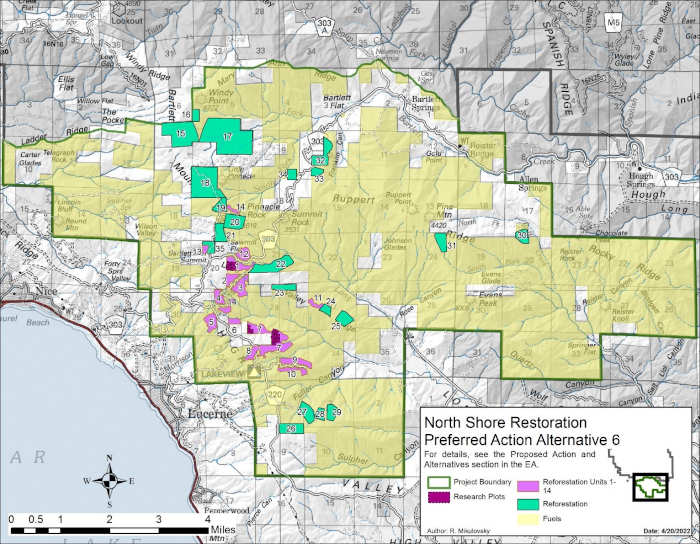
The purpose of the project is to improve community wildfire safety by reducing fuels within the wildland urban interface while also restoring and reforesting burned areas from the 2018 Ranch Fire.
The project area is located in Lake County, about 11 miles southeast of Upper Lake, near communities on the north and northeast shores of Clear Lake.
"This decision allows for reforestation on just over 2,600 acres located on the Upper Lake Ranger District in areas that experienced high levels of tree mortality during the 2018 Ranch Fire, as well as fuels reduction on approximately 40,000 acres. This is a significant milestone for the Mendocino as the largest project decision signed to date,” said Rechsteiner.
Some of those fuels treatments could include prescribed burning, pile burning, hand thinning and mechanical treatment on areas with slopes less than 35%.
The forest’s interdisciplinary team consulted with tribes and other state and federal agencies throughout the environmental analysis.
The team also incorporated feedback from the public, which was collected during comment periods, a public meeting and during field trips to the project area.
Project implementation is expected to occur over several years.
Now that the decision is signed, forest managers will begin prioritizing areas to be treated within the project footprint.
Partnership agreements with the Clear Lake Environmental Research Center and the Tribal Eco-Restoration Alliance are in place.
A third partnership with the North Shore Fire Protection District’s fuels crew is also underway. These partnerships will be instrumental in getting the work done on the ground.
The Forest Service’s Pacific Southwest and Pacific Northwest Research Stations and the University of California-Davis will be conducting research on the North Shore restoration project.
The varying degrees of fire severity across large areas provide a unique research opportunity, and the regimented monitoring required of research will provide a robust review of conditions before treatment as well as short-term and long-term impacts of treatments.
The final decision letter and environmental analysis are available online at http://www.fs.usda.gov/project/?project=55716.