 How to resolve AdBlock issue?
News
- Details
- Written by: California Highway Patrol
The Teen Distracted Driving II grant announcement coincides with National Teen Driver Safety Week Oct. 16 to 22.
The No. 1 killer of teens in America is car crashes. Using cell phones, eating, drinking, changing the music, or simply talking with friends are all activities teens engage in every day, but these activities become life-threatening hazards while driving.
Distracted or inattentive driving presents a significant danger to all motorists.
The grant-funded Teen Distracted Driving campaign consists of an education component that will allow for CHP officers and traffic safety partners to make appearances at schools and community events throughout the state.
Distracted driving enforcement operations will be conducted during National Teen Driver Safety Week in October and National Distracted Driving Awareness Month in April.
According to the California Department of Motor Vehicles, there are nearly 792,970 licensed teenage drivers in California, which increased by 6% since last year.
Data from the CHP’s Statewide Integrated Traffic Records System indicated that in 2020 there were 6,644 fatal and injury crashes involving teen drivers between 15 and 19 years of age.
This age group has the largest proportion of drivers who were distracted at the time of the fatal crashes.
“The combination of inattention and inexperience behind the wheel can lead to tragedy,” said CHP Commissioner Amanda Ray. “This grant will assist our officers in keeping California’s roads safe, while addressing California’s distracted driving crisis among the state’s teens.”
Funding for this program was provided by a grant from the California Office of Traffic Safety, through the National Highway Traffic Safety Administration.
- Details
- Written by: Elizabeth Larson
The council will meet at 6 p.m. Thursday, Oct. 20, in the council chambers at Clearlake City Hall, 14050 Olympic Drive.
The meeting will be broadcast live on the city's YouTube channel or the Lake County PEGTV YouTube Channel. Community members also can participate via Zoom or can attend in person.
The agenda can be found here.
Comments and questions can be submitted in writing for City Council consideration by sending them to City Clerk Melissa Swanson at
To give the council adequate time to review your questions and comments, please submit your written comments before 4 p.m. Thursday, Oct. 20.
Each public comment emailed to the city clerk will be read aloud by the mayor or a member of staff for up to three minutes or will be displayed on a screen. Public comment emails and town hall public comment submissions that are received after the beginning of the meeting will not be included in the record.
On Thursday, the council will consider a joint use agreement with the Konocti Unified School District for the use of the Clearlake Youth Center at 4750 Golf Ave. for youth- and recreation-oriented activities.
Administrative Services Director/City Clerk Melissa Swanson’s report explains that in June the council approved the formation of the Recreation and Events Division of the Administrative Services Department “with the intent to increase public engagement and activities through the creation of recreation programs and community events.”
Since then, she said city staff have met with community groups and potential collaborators to develop the best and most effective means to serve the community.
Swanson said staff has formed a valuable partnership with Konocti Unified School District to jointly bring youth and recreation programs to the youth center.
The school district “has agreed to assist with funding and completing much-needed repairs and remodeling in return for cooperative use of the Youth Center for planned after-school activities, youth camps, and City and District employee daycare. Additionally, the City would retain the flexibility to allow use by many other youth activity groups such as the South Shore Little League, scout troops, and Children’s Museum of Art and Science.”
Swanson said if the council approves the agreement, it will be presented to the Konocti Unified School Board for approval.
In another business item, the council will consider amendments to the city's environmental guidelines to include internal guidance for management of tribal cultural resources and consultation.
City Manager Alan Flora’s report to the council explains that in 2016 the city adopted a set of environmental guidelines in order to implement the requirements of AB 52, adopted the previous year by the state Legislature, which requires public agencies to consult with Native American tribes and consider tribal cultural resources.
Flora explained that, historically, there have been three tribes with ancestral lands within the city’s boundaries: the Elem Indian Colony of Pomo Indians of the Sulphur Bank Rancheria, the Koi Nation of Northern California and the Middletown Rancheria of Pomo Indians of California.
“While in large part consultation and coordination between the City as lead agency and the tribes has worked quite well, more recently new staff within the tribal environmental community have resulted in a inconsistent, confrontational, and difficult approach to complete projects. Staff believe that by adopting a more comprehensive policy framework related to tribal cultural resources would result in more predictability, less room for disagreement, and a more streamlined and economic project completion,” Flora explained.
He said the draft policy is adapted from several similar policies adopted within the past few years by various California municipalities.
“While this policy framework is well vetted with tribes in California, it has not been discussed with any Lake County tribes. The Council may wish to pursue this discussion, however staff believe at a minimum an interim policy is needed to guide staff in tribal relations,” Flora wrote.
Also on Thursday, the council will meet one of the adoptable dogs from the city’s shelter, receive a presentation by the Health and Social Policy Institute on second and third-hand smoke and
aerosol exposure and their health effects on community members, and hear from the Scotts Valley Energy Corp. on bioenergy and wildfire mitigation.
On the meeting's consent agenda — items that are considered routine in nature and usually adopted on a single vote — are warrants; consideration of acceptance of the property located at 16331 6th Ave.; authorize the city manager to sign the certificate of acceptance; authorization of the subrecipient agreement with Lake County Rural Arts Initiative to receive $474,700 of the Clean California grant; the minutes of the August and September meetings; award of the bid for roofing repairs at 6805 Airport Road; and authorization of the Main Street Project Agreement with Lake County Rural Arts Initiative for an art project development.
The council also will hold a closed session to discuss a lawsuit against the county of Lake and liability claims against the city.
Email Elizabeth Larson at
- Details
- Written by: Peter Mateyka and Wan He
Most move within their counties, either to downsize or because they need housing (like one-story or assisted living facilities) to accommodate changes in their health and disability status.
A new U.S. Census Bureau report uses data from the Census Bureau’s 2015-2019 American Community Survey (ACS) to show the number and characteristics of older U.S. adults who moved and how far they moved. The ACS collects data on where people currently live and where they lived in the prior year and on their disability status.
In addition to the moving patterns of older adults, the report also looks at how disabilities affect their likelihood of changing locations. This month is the 77th anniversary of National Disability Employment Awareness Month.
Impact of disability on migration
Individuals may experience disability if they have difficulty doing certain daily tasks due to a physical, mental or emotional condition. The ACS considers someone to have a disability if they reported vision, hearing, cognitive, ambulatory, self-care or independent living difficulty.
Annually, during the 2015-2019 period, about 18.2 million older people, or about 36.0% of people ages 65 and older, reported at least one disability.
A disability may create a mismatch between a person’s housing needs and their current housing situation, necessitating a move to a new residence.
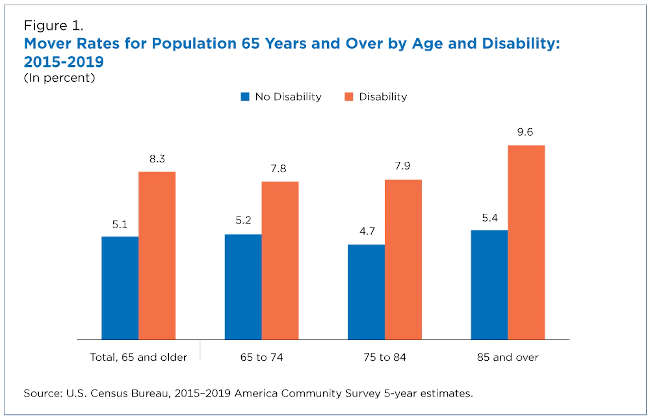
Older people with at least one disability were more likely to move (8.3%) than older people without a disability (5.1%).
However, older adults with disabilities made more short-distance moves and fewer long-distance moves than those without a disability. Of those who moved, 61.8% of those with a disability stayed in the same county compared to 54.6% of older movers without a disability.
About 240,000 older adults with a disability made interstate moves.
Out of the four U.S. regions, the South had the largest net migration gain (17,500) among older movers with a disability in a typical year during the 2015-2019 period. The net number of movers from the West was not statistically significant from zero, while the Northeast (11,500) and Midwest (7,400) both had net losses.
Florida had a net gain of about 9,730 people with a disability. Both Texas (about 4,780) and Arizona (about 4,390) also had net gains of at least 3,000 people with a disability.
Do most older adults migrate short distances?
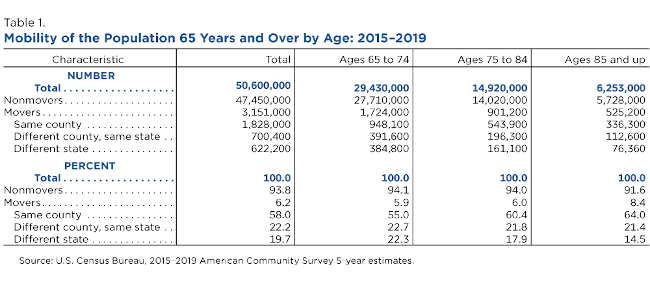
Only about 6.2% of adults ages 65 and over (over 3 million) moved during the prior year in a typical year during 2015-2019. People ages 85 and over were slightly more likely to move than those ages 65 to 74 and 75 to 84.
Most older movers stayed in the same county – about 58% – while only 19.7% or 620,000 moved to another state annually during the 2015 to 2019 period.
What regions draw older adults?
The South had the largest net migration gain (more moving in than out) of older people of any region: about 72,900 during a typical year in 2015-2019.
This far outpaced the West, which had a net gain of about 8,800 older people from migration.
The Northeast and Midwest both had net losses in the number of older adults from migration: a loss of about 46,800 and 34,900 respectively.
These patterns echo longstanding trends of older adults moving out of the Northeast and Midwest to the South and West. Some make these long-distance retirement moves to warmer climates and amenities-rich areas. However, the states they choose to move to within these regions vary substantially.
What states gained most older movers?
Florida gained more older adults from net migration than any other state: 53,150 annually during the 2015-2019 period. This was more than twice the 21,440 older people that Arizona added.
New York had larger net losses (23,420 people 65 and older) annually during the period from domestic migration than any other state. And California had the second-largest net loss (19,200) of any state.
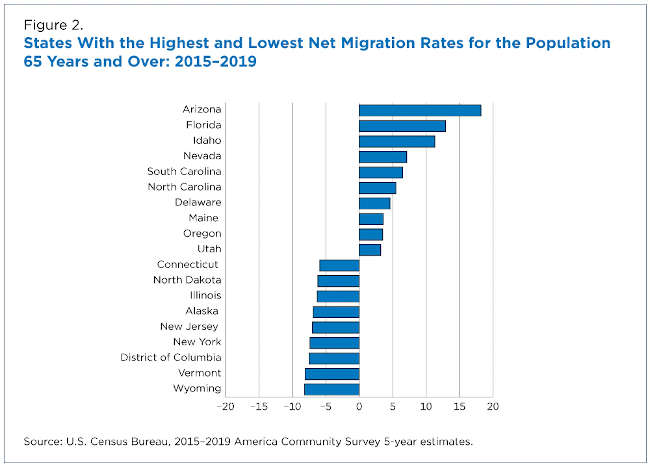
The net migration rate gives a better sense of the size of the influx relative to a state’s population. The reason: it calculates the net number, in this case of older adults, added to a state from migration per 1,000 people living in the state.
By that measure, Arizona had the highest net migration rate at 18.2. Florida and Idaho were also among the highest of any states in the nation with rates of 12.9 and 11.3, respectively.
Where did older movers come from?
State-to-state migration flows illustrate the geographic origin and destination of people moving across state boundaries.
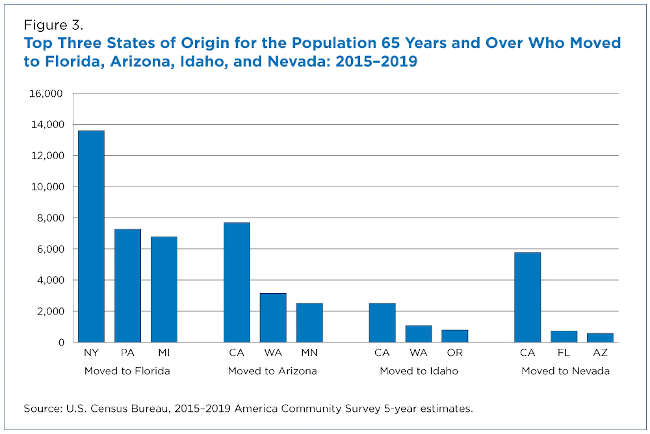
Many older adults who moved to Florida during 2015 to 2019 came from New York, Pennsylvania, and Michigan.
For Arizona, Idaho, and Nevada, the highest inflows came from nearby California, Washington, and Oregon.
This research was supported in part by the National Institute on Aging.
Peter Mateyka is a statistician in the Housing Statistics Branch of Census Bureau’s Social, Economic, and Housing Statistics Division. Wan He is director of the Aging Research Program in the Census Bureau’s Population Division.
- Details
- Written by: LAKE COUNTY BEHAVIORAL HEALTH SERVICES
According to a recent study conducted at Columbia University, 1 in 10 adult Americans reported living with depression, and nearly 1 in 5 adolescents and young adults also reported experiencing some sort of depression.
Unfortunately, many of those experiencing depression and other behavioral health concerns are not seeking timely treatment, according to Lake County Behavioral Health.
Taking action to close the “treatment gap” is critical; there is a great need to ensure individuals are being screened for anxiety and depression, and made aware of treatment resources.
October is National Depression and Mental Health Screening Month, and Lake County Behavioral Health Services invites the community to join in raising awareness at this crucial juncture.
People experience depression in different ways, and it can affect anyone, any time.
Depression, which may be coupled with dementia in older adults, can have an adverse effect on one’s quality of life; it can also contribute to lost productivity at home and at work, and increased risk of death.
Help is available.
Lake County Behavioral Health Services offers a range of supports for county residents facing behavioral and mental health concerns, including depression and substance use disorder services.
If you need immediate support, and it is after business hours, Lake County Behavioral Health Services 24-hour Crisis Hotline is available. Dial 800-900-2075; our Crisis Team will be ready to assist.
Other useful resources to connect with services include the newly-launched 988 Suicide and Crisis Lifeline (dial 988, https://988lifeline.org/), Substance Abuse and Mental Health Services National Helpline [800-662-HELP (4357)] and Adventist Health Clear Lake’s Live Well Program.
For more information and assistance, please contact Lake County Behavioral Health Services at 707-274-9101 or 707-994-7090.