 How to resolve AdBlock issue?
News
- Details
- Written by: Elizabeth Larson

LAKE COUNTY, Calif. — The city of Clearlake’s animal shelter is filled with dogs ready for adoption, and officials are asking community members for help in fostering and adopting the pets.
At Thursday’s Clearlake City Council meeting, shelter staff presented some of the adoptable dogs as is common at the meetings.
During the presentation, Charmaine Weldon, an animal control technician and adoption and rescue coordinator for Clearlake Animal Control, said there are 30 adoptable dogs available and a total of 70 dogs now being held at the shelter.
When council members asked about the high number of dogs at the shelter, Weldon said it’s part of a nationwide crisis. Rescues also are challenged with adopting out the high number of animals they’re caring for now.
“We have a lot more dogs than we would like to have,” said Clearlake Police Chief Andrew White, whose department oversees animal control.
White said the situation is such that some shelters in other areas have stopped taking in animals.
North Bay Animal Services, the city’s animal control contractor, is trying to make it work, White said.
However, he said people need to step up and adopt where they can, as the city can’t sustain having the shelter as full as it is. White said they didn’t build it for 70 dogs.
White himself has been fostering a young male Rottweiler named Parker, who White announced during the meeting is being adopted by City Clerk/Administrative Services Director Melissa Swanson.
Adopters, foster homes and those willing to help exercise the dogs are welcome.
Visit Clearlake Animal Control on Facebook or on the city’s website to find pictures and information about the dogs.
Those looking for lost animals should check here.
For more information, call the Clearlake Animal Control shelter at 707-273-9440, or email
Email Elizabeth Larson at
- Details
- Written by: LAKE COUNTY NEWS REPORTS
March of March of Dimes’ new report, “Nowhere to Go: Maternity Care Deserts Across the U.S.,” revealed access to maternity care is diminishing in places where it’s needed most, impacting nearly seven million American women of childbearing age and roughly 500,000 babies.
The third update of the report, produced in partnership with Reckitt, shows a 2% increase in counties classified as maternity care deserts since the 2020 report, primarily driven by hospital and maternity care unit closures and loss of obstetrics providers.
The data reinforces that the U.S. is still among the most dangerous developed nations for childbirth, especially in rural areas and communities of color.
Maternity care deserts are counties without a hospital or birth center offering obstetrics care and without any obstetrics providers.
The report showed that Lake County is among five California counties listed as having “moderate” access to maternity care.
In Lake County, both hospitals, Adventist Health Clear Clearlake and Sutter Lakeside Hospital, have birthing centers.
However, in July, a lack of available obstetricians led to Sutter Lakeside closing its birthing center for four days, as Lake County News has reported.
In addition to Lake, the counties with moderate access are Calaveras, San Benito, Tehama and Yuba.
Another five counties are ranked at maternity care deserts. They include neighboring Colusa and Glenn counties, Alpine, Modoc and Sierra.
Two other counties, Imperial and Madera, are listed as having low access.
The remaining 46 counties in California are rated as having full access to maternity care.
“With an average of two women dying every day from complications of pregnancy and childbirth and two babies dying every hour, our country is facing a unique and critical moment as the infant and maternal health crisis continues intensifying,” said Stacey D. Stewart, president and CEO. “With hospital closures, inflation and COVID-19 limiting access to care, the compounding issues of our time are bearing down on families, forcing them to extend themselves in new ways to find the care they need and ways to afford it. Access to maternity care should not be optional, which is why we’re launching the Mamagenda for #BlanketChange to build support for policies to ensure all families everywhere have access to high quality maternity care.”
Specifically, the 2022 Maternity Care Deserts Report shows:
• 36% of counties across the U.S. are designated as maternity care deserts, counties with zero obstetric hospitals or birth centers and zero obstetric providers.;
• 2.2 million women of childbearing age live in maternity care deserts and more than 146,000 babies are born there;
• 5% of counties have a worse designation in this report than in the 2020 report;
• Nearly 7 million women are living in communities with no or limited access to maternity care. 1 in 8 babies are born in these areas;
• The loss of obstetric providers and obstetric services in hospitals were responsible for decreases in maternity care access in over 110 counties between this report and the 2020 report;
• 1 in 4 Native American babies were born in areas with no or limited access to maternity care services; and
• 1 in 6 Black babies were born in areas with no or limited access to maternity care services.
“Our 2022 report confirms lack of access to care is one of the biggest barriers to safe, healthy pregnancies and is especially impacting rural areas and communities of color where families face economic strains in finding care,” said Dr. Zsakeba Henderson, senior vice president and interim chief medical and health officer. “While we’ve seen a slight increase in obstetric providers nationwide, we continue seeing a troubling decrease in providers serving rural areas. In fact, only seven percent of obstetric providers serve rural areas and, with more than 500,000 babies born to women living in these areas, families in rural areas are at higher risk for poor outcomes.”
As part of the effort to address the growing infant and maternal health crisis, March of Dimes works to evolve the Maternity Care Desert Report year after year to reflect recent advancements.
In partnership with Elevance Health Foundation, March of Dimes will release supplemental reports on the availability of maternity care in all 50 states, as well as Washington D.C. and Puerto Rico in Spring 2023.
- Details
- Written by: Brian Lada
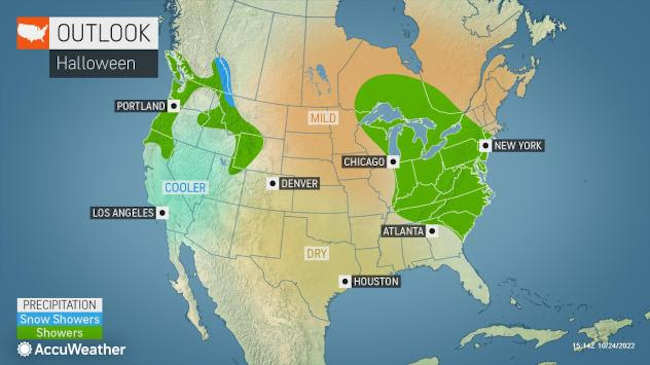
ACCUWEATHER GLOBAL WEATHER CENTER — The Halloween season is nearing its peak with carved pumpkins illuminating sidewalk stoops, skeleton decorations pieced together in leaf-covered lawns and teeth-chattering weather starting to chill parts of the United States.
Young masqueraders going door-to-door to collect candy in the coming nights to celebrate Halloween will want to check the AccuWeather forecast since waterproof costumes will be a necessity in some corners of the country, while an extra layer or two may be needed under costumes to stay warm while trick-or-treating in other areas.
The forecast in Northern California includes the potential for rain. Lake County is expected to have chances of showers beginning on Friday night and continuing through Halloween on Monday, with daytime highs in the low 60s and nighttime temperatures in the low 40s.
Spells of rain are predicted in some of the country's largest cities, but a repeat of the monster snowstorm of 2011 or the Halloween ice storm of 1991 is not expected.
A dry start to the Halloween weekend is foreseen for millions of residents across the East Coast, but like a vampire transforming into a bat, the weather will eventually evolve Sunday and Monday.
Rain showers are in the forecast from Bat Cave, North Carolina, to Spider, Kentucky, and northward into Sleepy Hollow, New York.
It may even be a damp day in Hell, Michigan, with showers spreading across the Ohio Valley and into the Great Lakes Monday.
Umbrellas may be enough to stay dry in areas where lighter, spottier showers occur, but anyone that is planning to wear a costume that requires the use of batteries, such as an inflatable outfit that requires a portable fan, should take extra precautions.
Much better trick-or-treating weather is predicted for folks across the nation's heartland with widespread dry and mild conditions in the cards through the weekend and into Monday.
A coat or sweater may still be needed for parents accompanying young candy collectors with temperatures from Pumpkin Center, Oklahoma, through Frankenstein, Missouri, predicted to drop into the 50s and 40s F after sunset.
While this may be chilly for some, it is an improvement over the weather across the northern Plains Monday, Oct. 24, when snow fell in regions of North Dakota, South Dakota, eastern Montana, Wyoming and the Front Range of Colorado.
Children across the West Coast dressing up as witches and wizards may want to consult the AccuWeather app rather than the crystal ball when looking into the future, as stormy weather is in the forecast for the final days of October.
It has not rained on Halloween in Portland or Salem, Oregon, or in Seattle since 2018, but the streak of rain-free Halloweens is likely to come to an end this year.
A parade of storms will drench the Pacific Northwest in the coming days, soaking many outdoor Halloween festivities throughout the weekend and into Monday.
Rain and high-elevation snow could also spread across the northern Rockies throughout the weekend and into Halloween, including Devils Tower and Casper, Wyoming.
Drier but chilly conditions are in the offing for the remainder of the western U.S., with temperatures near to slightly below typical late-October levels. This includes Death Valley, California, through Tombstone, Arizona, and everywhere in-between.
Brian Lada is an AccuWeather meteorologist and staff writer.
- Details
- Written by: LAKE COUNTY NEWS REPORTS

LAKE COUNTY, Calif. — Pacific Gas and Electric Co. said it is conducting aerial patrols in Marin, Napa, Sonoma, Mendocino, Lake and Humboldt counties this week as part of efforts to reduce wildfire risk in its service area.
Scheduled helicopter patrols are part of the company’s Vegetation Management Program to detect dead or dying trees.
The patrols, which began on Monday, will occur along several electric transmission lines located in the following areas:
• Lake County: Clearlake, Lower Lake, Kelseyville, Middletown, Lucerne, Clearlake Oaks, Upper Lake, Lakeport, Cobb (The Geysers).
• Humboldt County: Humboldt Bay, Orrick.
• Marin County: Sausalito, San Rafael, Bolinas, Novato, Olema.
• Mendocino County: Hopland, Mendocino, Gualala, Fort Bragg, Philo, Ukiah, Elk, Point Arena.
• Napa County: Napa, Calistoga, St. Helena.
• Sonoma County: Healdsburg, Geyserville, Fort Ross, Santa Rosa, Cotati, Cloverdale, Monte Rio, Windsor, Jenner, Annapolis.
“Helicopter patrols allow our crews to identify hazard trees that could pose a safety risk, just one of the many ways PG&E is working to manage trees and other vegetation located near powerlines,” said Ron Richardson, regional vice president for PG&E’s North Coast Region.
Depending on the weather conditions, foresters will fly a Bell 407 from the Ukiah Municipal Airport to the transmission lines and back for refueling. Flights may be as low as 300 feet and could be between the hours of 8:30 a.m. and 4 p.m.
Flights are expected to conclude by end of day Friday, Oct. 28; however, weather delays may push flights to additional days.
Helicopters may reach higher elevations in areas where livestock are present. If determined necessary by a spotter from the helicopters, PG&E will send ground crews to conduct further inspections.
PG&E is using helicopters to inspect the trees along transmission lines within high fire-threat districts, as outlined by the California Public Utilities Commission, across Northern and Central California through the end of the year.