 How to resolve AdBlock issue?
News
- Details
- Written by: Elizabeth Larson
The courthouse project is scheduled to begin the “design-build phase” in November, said Blaine Corren, Judicial Council of California spokesperson.
Corren said that phase, which includes construction, is expected to be completed in May 2026. Completion previously had been anticipated in February 2026.
The 45,300 square foot courthouse will be built at 675 Lakeport Blvd., next to the visitor center.
The building will have a main entry floor where four courtrooms and offices will be located, as well as a lobby and waiting area, and a lower floor, or a basement, where the clerk's office, administration, self-help office, jury assembly area and building support will be located.
There also will be secure parking for judges and staff, 100 public parking spaces and solar power generation capability.
It will replace the Lakeport Division Courthouse, the 15,332 square foot space on the fourth floor of the current courthouse at 255 N. Forbes St., along with a leased records facility.
The architect is Moore Ruble Yudell Architects & Planners, with AECOM selected as the construction management agency. The design-build entity selection process is underway, the Judicial Council reported.
The Judicial Council’s Facilities Service office explained that the design-build phase starts when the design build entity — the architect, engineers and contractor team — is selected and provided with a notice to proceed. They first design then obtain permits before building the project.
This design-build phase ends with the completion of construction, the agency reported.
The project’s price tag is approximately $73,134,000, surpassing original construction cost estimates.
“It’s gonna happen,” Lake County Superior Court Judge Michael Lunas told Lake County News.
“It’s reality at this point. We’re past all the ifs and maybes,” he said.
The project has faced many ifs and maybes over the last 14 years.
In July 2008, the state Administrative Office of the Courts submitted 18 trial court funding projects to the state's Department of Finance, with Lakeport’s courthouse included as an immediate need facility because of its crowded conditions and safety issues.
The Judicial Council purchased the building site for a new courthouse in 2011 and it had appeared ready to go forward, with the state at that point anticipating construction would begin in spring 2013 and be completed in late 2014.
Throughout that time, Judge Richard Martin had championed the effort to get the courthouse built, working through endless meetings and a process to select the site.
“We were ready to go,” Martin told Lake County News in an interview this month.
However, the state’s budget crisis that was triggered by the Great Recession, and several years of funding and budget shortfalls, led to the project being placed on hold.
In an August 2019 feature titled “California Courthouse Construction, Explained,” published on the Judicial Council’s website, Corren explained, “The state’s fiscal crisis caused many construction projects to be cancelled or delayed. Beginning in 2008, more than $1.4 billion in court user fines and fees originally designated by the Legislature for court construction were borrowed, transferred to the state’s General Fund, or redirected to help fund court operations.”
“We were standing there with nothing to do for years,” Martin said.
However, the project did finally get back on track several years later.
In late 2019, the Judicial Council approved an updated courthouse priority project list that put Lakeport’s courthouse at No. 1 out of 80 projects statewide.
Ahead of that decision, Lunas — then presiding judge — and Lake County Superior Court Executive Officer Krista LeVier sent a letter to the Judicial Council supporting the methodology used for that list and saying that it should be the basis of funding decisions.
In the No. 2 spot on that priority list is a new Ukiah courthouse in Mendocino County, with a new $15 million one-room courthouse in Clearlake at the No. 6 spot. All of those projects were included in the “immediate need” category.
The original price tag for Lakeport’s courthouse was $70.8 million. When the updated courthouse priority list was issued in 2019, the estimated cost for Lakeport’s slimmed down project was $51.2 million. Since then, construction costs have risen rapidly, with the estimated cost increasing by more than $22 million for a total cost of more than $73.1 million.
Martin, who retired in 2017, said he put everything he had into the effort and was bothered by how it was put on hold.
However, he said it’s good news that it’s getting started now.
For more information about the process and to see the current project diagrams, visit the Lakeport Courthouse page on the Judicial Council’s website.
Email Elizabeth Larson at
- Details
- Written by: Elizabeth Larson
The National Weather Service said a weak frontal system was to pass northwest of the North Coast overnight, with no rainfall expected, although there is the potential for early morning patchy fog on the coast and in areas of Lake County, including Cobb, on Friday morning.
A stronger front is expected to move into the area on Tuesday, bringing with it the potential for snow showers above the 3,000 foot elevation mark.
“This will be the coldest air of the season so far. Cool and unsettled weather with showers, mountain snow and gusty winds are expected,” the National Weather Service’s long term forecast said.
The specific Lake County forecast says that rain could actually arrive late Monday night, with chances of rain to continue through Thursday.
Temperatures through the weekend are forecast to rise up to the low 70s during the day and high 40s at night, dropping into the low 50s during the day and at night into the high 30s with the arrival of the cold front.
Light winds also are in the forecast for Friday, Saturday and Sunday evenings, the forecast said.
Email Elizabeth Larson at
- Details
- Written by: LAKE COUNTY NEWS REPORTS
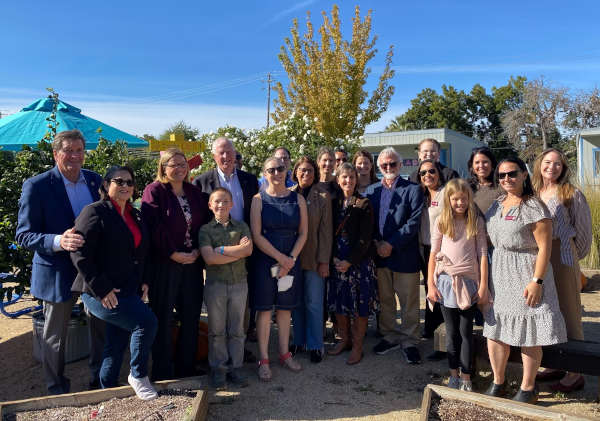
NORTHERN CALIFORNIA — This week, the U.S. Department of Agriculture’s Agricultural Marketing Service Under Secretary Jenny Moffitt and Reps. Mike Thompson and John Garamendi and Assemblymember Cecilia Aguiar-Curry announced a cooperative agreement with California for more than $23 million to increase our state’s purchase of nutritious, local foods for school meal programs.
Through the Local Food for Schools Cooperative Agreement Program, California Department of Education will purchase and distribute local and regional foods and beverages for schools to serve children through the National School Lunch and School Breakfast Programs.
These products will be healthy and unique to their geographic area, with the goal of improving child nutrition and building new relationships between schools and local farmers.
“School lunches are vital to the health and success of students in California. Nutrition plays a key role in school lunches and our local producers are the backbone of providing the food necessary to maintain this system,” said Thompson. “When we provide farm to table meals for our students, they are better prepared for the school day and benefit from fresh and healthy meals. This program will promote a more resilient food system with a foundation of our local producers, and I am proud to work with USDA, our local schools, and local growers to strengthen this program.”
“I am excited to see the USDA making a $24 million investment in California’s farmers and in the well-being of our children. I’ve fought for years to ensure nutritious, American-grown food is the foundation of our school lunch programs nationwide. This program is a big step in that direction, helping California schools support the local producers who’ve helped make our state the fruit and vegetable capital of the world,” said Garamendi.
“I am incredibly appreciative of Congressmen Thompson and Garamendi, and USDA Secretaries Lester Moffit and Dean, for hosting this announcement of California’s partnership on Farm to School programs under the National School Lunch and School Breakfast Program,” said Cecilia Aguiar-Curry (D-Winters). “This $23 million in federal support to supplement California’s investments and First Partner Jennifer Siebel-Newsom’s leadership as a champion of healthy meals in schools is a major breakthrough for our kids. We have the momentum to expand a concept we started in my home town of Winters years ago to every child in California. Fresh, local foods are the building blocks of a healthy child. And, a healthy child is one who we’ve prepared to learn, grow and succeed in life.”
“This cooperative agreement supporting California schools is another example of how USDA is working to build a more resilient food system rooted in local and regional production,” said USDA Under Secretary for Marketing and Regulatory Programs Jenny Lester Moffitt. “The Local Food for Schools Cooperative Agreement Program provides an opportunity for states to strengthen ties between local farmers, ranchers, food businesses and schools, and gives students access to nutritious foods unique to the area they live in, building stronger connections across local communities.”
“Strengthening relationships between local producers and schools is a long-term strategy to ensure our children always have access to nutritious foods in school, a win-win for child health and American agriculture,” said Deputy Under Secretary for Food, Nutrition, and Consumer Services Stacy Dean. “Through this program and many other efforts to support the school meal programs, USDA is committed to giving schools the tools they need to set children up to learn, grow, and thrive.”
With the Local Food for Schools funds, THE California Department of Education will strengthen local and regional purchasing relationships between School Food Authorities participating in the National School Lunch Program or School Breakfast Program with local farmers and producers. Schools and students will benefit from the economic support from the program to continue to provide fresh and minimally processed local foods in school meals.
“California is thrilled to receive over $23 million in local assistance funding from USDA for our schools operating the National School Lunch Program and School Breakfast Program. As the first state in the nation to adopt a permanent Universal Meals Program for our students, this funding aligns with the historic investments California is making to transform schools and ensure every public school student has access to not only a nutritious breakfast and lunch each school day, but also meals that are minimally processed, delicious, culturally relevant, California-grown and sourced from historically underserved producers” said State Superintendent of Public Instruction Tony Thurmond.
The Local Food for Schools cooperative agreements will allow organizations the flexibility to design food purchasing programs and establish partnerships with farmers and ranchers that best suit their local needs, accommodate environmental and climate conditions, account for seasonal harvests, improve supply chain resiliency and meet the needs of schools within their service area. Additionally, the program will provide more opportunities for historically underserved producers and processors to sell their products. Local Food for Schools Cooperative Agreement Program is authorized by the Commodity Credit Corporation Charter Act.
The Agricultural Marketing Service said it looks forward to continuing to sign agreements under this innovative program.
- Details
- Written by: LAKE COUNTY NEWS REPORTS
These advanced notifications provided up to 19 seconds, in many locations, for Californians to take protective action to “drop, cover, and hold on” and stay safe during the earthquake.
An estimated 2.1 million Android users received the notification directly on their phone without needing an additional app because the state’s partnership with Google incorporates the technology on all Android smartphones, in addition to more than 95,000 MyShake App users who also received the warning.
The United States Geological Survey received approximately 23,820 shake reports for the quake, primarily in the Bay Area, but also had reports come in from Southern California, Nevada, Idaho, Oregon and Washington.
“California continues to harness the power of science and technology to help keep our communities safe. When it comes to earthquakes, seconds can save lives. That’s why California continues to invest in new and emerging technologies to protect the most vulnerable among us,” said Gov. Gavin Newsom.
There were no reports of significant damage or injuries related to the earthquake, whose epicenter was in the community of Seven Trees and was felt across large portions of Northern California.
The Governor’s Office of Emergency Services, or Cal OES, which manages the earthquake warning system on behalf of the state, continues to coordinate closely with local officials in the impacted region to evaluate any issues or unmet needs.
Due to the success of Tuesday's performance, the Earthquake Early Warning System saw more than 108,000 new downloads of the MyShake App in a single day, a record.
In addition to the emergency alerts sent to individuals through MyShake and Android, the underlying technology is also being used to automate protective actions such as slowing trains, opening firehouse doors, recalling elevators, shutting off water and gas valves as well as closing bridges gates and notifying personnel in school and medical settings.
“While California has faced fires, drought and even a global pandemic, the single biggest threat we face to life and property in our state is a sizable earthquake in one of our major population centers,” said Cal OES Director Mark Ghilarducci. “Tuesday was another important step in testing our technology but work still remains to prepare for the next big one.”
Warnings delivered through the system are based on a computerized program called ShakeAlert, operated by the United States Geological Survey in partnership with Cal OES that analyzes data from seismic networks in California, calculates preliminary magnitudes, and then estimates which areas will feel shaking.
In 2019, on the 30th anniversary of the deadly Loma Prieta earthquake, Gov. Newsom announced the launch of the nation’s first statewide Earthquake Early Warning System.
The California Earthquake Early Warning System marries a smartphone application with traditional alert and warning delivery methods such as Wireless Emergency Alerts.
The system uses ground motion sensors from across the state to detect earthquakes before humans can feel them.
In 2020 Newsom announced a partnership with Google to incorporate California’s earthquake early warning technology into all Android smartphones.
To date, more than two million users have downloaded California’s MyShake App.
To learn more about earthquake preparedness and download the earthquake early warning application, visit www.earthquake.ca.gov.
How to receive alerts
• To receive earthquake warnings, there are three ways for individuals and families to get alerts through the Earthquake Warning California system.
• MyShake App: Free smartphone app that provides iPhone users with audio and visual warnings, available in both English and Spanish.
• Android Earthquake Alerts: Android phones with updated operating systems are automatically subscribed to Android Earthquake Alerts, which uses the same technology as the MyShake App; and
• Wireless Emergency Alerts: No-cost text messages for emergency situations sent through the nation-wide system providing lifesaving information for the State of California
HomeBase Feature,
The MyShake app launched its newest enhancement called HomeBase in 2022. This feature allows users to set a default location where they can receive earthquake early warning alerts, even if location services are temporarily down or turned off.
This will increase MyShake’s ability to send timely alerts so that Californians affected by an earthquake can receive warnings at a location of their choosing and be prepared for shaking.
To activate the HomeBase function, users should update their MyShake app and navigate to the Settings page, where they will find an “Add HomeBase Location” button.
The HomeBase feature differs from a function already in the app where users can receive earthquake notifications for other locations, even in other countries. For example, if users want to receive notifications for earthquakes that occur where family or friends live, they can add those locations under Settings > Notifications.