 How to resolve AdBlock issue?
News
- Details
- Written by: LAKE COUNTY NEWS REPORTS
Hometown Christmas in Lower Lake will take place from 4 to 8 p.m. Friday, Dec. 9 on Main Street.
Shop local vendors throughout the evening and enjoy several special festivities.
At 5:15 p.m. there will be the Christmas tree lighting at the museum.
Santa Claus will arrive at the museum by fire truck at 5:30 p.m. and community members will be invited to come inside for Christmas carols, hot cider and cookies.
At 7 p.m. there will be a light parade on Main Street from Lake to Mill streets.
For parade or vendor applications, call Coleen at 707-533-7363 or Teresa at 707-888-1486.
- Details
- Written by: Lynda Laughlin, Anthony Martinez and Asiah Gayfield
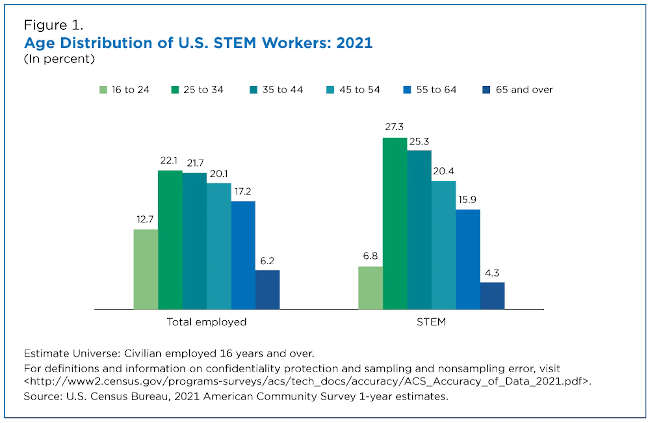
Jobs in the fields of science, technology, engineering and math, or STEM, often require a bachelor’s degree or higher, leaving few STEM opportunities for workers younger than 25 who shape the nation’s future workforce.
As a result, in 2021 workers between the ages of 16 and 24 made up 12.7% of total employment across all occupations but only 6.8% of all STEM workers (just under 800,000) in the United States.
While less common, STEM opportunities for young workers without a college degree exist – mostly technician occupations – and are needed to meet future demand.
According to the Bureau of Labor Statistics, employment in STEM occupations is projected to grow at twice the rate (10.8%) of overall employment (5.3%) through 2031.
National STEM/STEAM Day is celebrated every year on November 8 to encourage kids to explore their interests in science, technology, engineering, arts, and math careers. And nationwide efforts are underway to attract and train young workers through registered apprenticeship programs.
STEM occupations range from computer specialists to social scientists and STEM-related occupations include health care practitioners and architects.
As STEM employment increases, what are some potential STEM pathways for workers under 25?
We explore data from the recently released 2021 American Community Survey to highlight STEM occupations by age.
Younger workers and STEM
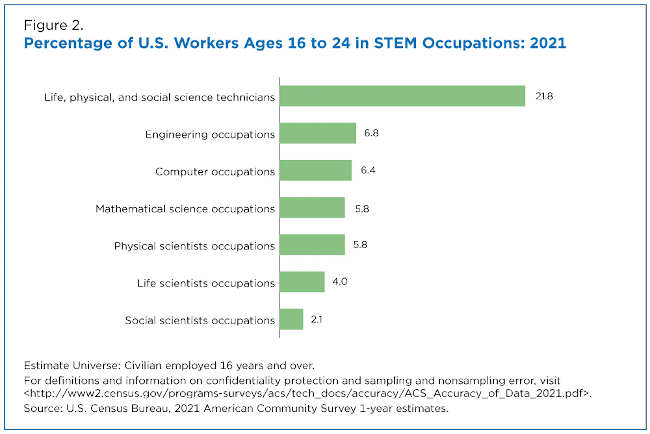
Younger workers (defined here as those between the ages of 16 to 24) are employed in a wide range of STEM occupations, with the largest concentration in technician-related ones.
Workers between the ages of 16 to 24 accounted for 21.8% of all life, physical and social science technicians in the United States in 2021. Smaller percentages of younger workers held STEM jobs as life scientists (4.0%) or social scientists (2.1%).
Life science technicians often work in laboratories assisting scientists and researchers with tasks such as collecting lab samples, performing routine tests and maintaining laboratory equipment. Life science technician jobs generally only require a high school or associate degree and receive on-the job training to maintain or advance to a new position.
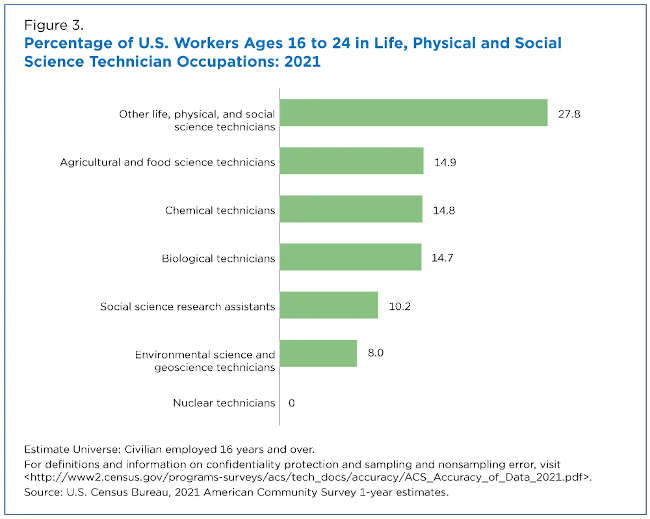
Among the life, physical and social science technician occupations, “other” was the detailed category with the largest proportion (27.8%) of young STEM workers. This group of workers includes polygraph examiners, soil testers, meteorological aides and others.
Within the various technician-related occupations, a similar share (around 15%) of workers between the ages of 16 and 24 were employed as agricultural and food science technicians, biological technicians or chemical technicians. Another 10% were social science research assistants and 8% were environmental science and geoscience technicians.
Aging STEM workforce still younger than total labor force
The STEM workforce tends to have a younger age profile than the overall workforce.
In 2021, workers between the ages of 25 to 44 made up more than half (52.6%) of STEM workers – the largest share of STEM workers. Around 40% of older workers, those ages 45 and more, worked in STEM.
Despite the smaller share of older workers, the STEM workforce is aging. Older workers are staying in the labor market longer, potentially limiting opportunities for younger STEM workers.
These findings come amid longstanding efforts to not only increase the racial and gender make-up of STEM occupations but to encourage students from a young age to pursue STEM and STEM-related degrees.
The pathway to STEM varies by field, with less than a third of STEM-educated workers actually working in a STEM job. Still, STEM workers face favorable labor market opportunities compared to non-STEM workers, potentially benefiting the next generation of workers.
Overview of STEM occupations
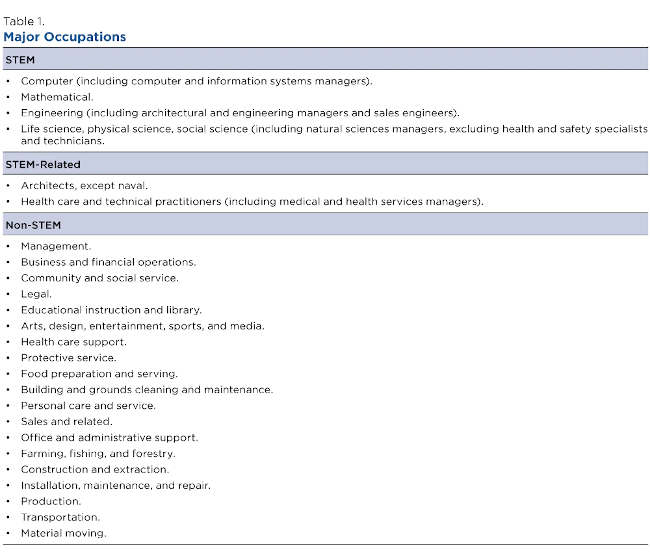
STEM occupations include computer specialists, mathematicians, engineers, life scientists, physical scientists, social scientists and science technicians.
STEM-related occupations consist primarily of architects, healthcare practitioners, and healthcare technicians.
Non-STEM occupations are all other jobs not classified as STEM or STEM-related. The Census STEM code list includes 70 specific STEM occupations, 49 STEM-related occupations and 446 non-STEM occupations (excluding military-specific occupations).
Lynda Laughlin is chief of the Industry and Occupation Statistics Branch in the Census Bureau’s Social, Economic, and Housing Statistics Division. Anthony Martinez and Asiah Gayfield are survey statisticians in the Census Bureau’s Social, Economic, and Housing Statistics Division.
- Details
- Written by: Lake County Behavioral Health Services
Transgender Day of Remembrance was first observed in 1999 and is now recognized in more than 20 countries. This day honors Rita Hester, a transgender woman who was murdered in Allston, Massachusetts in 1998.
On Nov. 20, we remember transgender individuals who have lost their lives.
The Human Rights Campaign documented 57 “violent fatal incidents against transgender and gender non-conforming people” in 2021 — the highest number since their monitoring began in 2015, and more than 2.7 times the 2015 and 2016 totals.
HRC reports at least 32 such instances have been documented in 2022, thus far.
The week prior to Transgender Day of Remembrance, Transgender Awareness Week seeks to “help raise the visibility of transgender people and address issues members of the community face.”
“At Behavioral Health Services, we ensure our doors are open to all, regardless of gender identity,” states Todd Metcalf, director of Lake County Behavioral Health Services. “We embrace and celebrate differences, offering a haven of safety and security. The majority of people we serve have experienced some sort of trauma. Transgender and gender non-conforming people are too often targeted with violence, and we must create safe places to heal.”
Mental health challenges are common. In fact, about one in five Americans are currently living with a mental illness such as anxiety or depression.
Unfortunately, in the transgender community, that number is much higher. A cross-sectional analysis of electronic health record data published in 2019 found diagnoses of mood disorders (e.g. depression, bipolar disorder) among transgender patients five times more prevalent than in the general population.
More than 80% of transgender individuals have considered suicide and over 40 percent have attempted suicide, with suicidality highest among transgender youth.
Homelessness is also a critical issue for transgender people. In November 2021, the White House’s Interagency Working Group on Safety, Opportunity, and Inclusion for Transgender and Gender Diverse Individuals reported, “One in three transgender adults [had] experienced homelessness.”
Mental health issues can be exacerbated by a transgender or gender non-conforming individual’s response to stigma, discrimination, lack of acceptance and abuse faced on a regular basis.
For many, having to deal with discrimination results in heightened stress responses, which can lead to depression and/or anxiety. Beyond threats to psychological wellbeing, transgender people are at far greater risk of experiencing violence and death.
Lake County Behavioral Health Services provides recovery-oriented mental health, substance use disorder and homeless services to those in need.
For more information, please contact Lake County Behavioral Health Services at 707-274-9101 or 707-994-7090.
If you are a transgender person of any age, support is also available via the Trans Lifeline, at 877-565-8860. Visit https://translifeline.org/ for more information.
- Details
- Written by: LAKE COUNTY NEWS REPORTS
The effort to build a new monument commemorating Native Americans in California’s capital took another step forward on Monday.
Assemblymember James C. Ramos (D-Highland), Sacramento-area tribal leaders and other dignitaries on Monday broke ground in Sacramento’s Capitol Park for a monument honoring Native Americans on whose ancestral the Capitol now sits.
The groundbreaking comes as the state and nation celebrate Native American Heritage Month.
California has a greater number of Native Americans than any other state, and tribal leaders noted that the new tribute is a welcome, if long overdue, acknowledgment.
Ramos — the first California Native American elected to the Legislature since statehood 172 years ago — introduced AB 338 in 2021, which authorized erection of the monument.
He authored the measure after the removal of the Junipero Serra sculpture.
The new statue will stand where the Serra sculpture was located.
Capitol Park’s newest memorial will highlight respected Miwok leader and cultural dancer, the late William Franklin.
Franklin, played a critical role in preserving Miwok dances and traditions and helped build three Northern California roundhouses, dedicated spaces for Native Americans ceremonies, songs, dances and gatherings.
Sacramento sculptor Ronnie Frostad will undertake the design of the project.
“Once this new monument is completed, it will serve to remind students and all visitors to this historic Capitol Park that Native Americans lived on this land — and cared for it — long before California statehood and its preceding eras,” Ramos said.
“It is truly a momentous occasion to finally have a depiction of California’s first inhabitants on Capitol grounds,” said Wilton Rancheria Tribal Chairman Jesus Tarango, who also is a bill sponsor. “Our people have lacked representation for far too long on our own lands, but this moment is a step in the right direction for all California Indigenous people.”
"In our culture it is customary to show appreciation and gratitude when invited to another nation's ancestral homelands. This is a monumental moment for all of California’s First People – to have the ability to not only share a rendering but to share our culture, resiliency and legacy of survival shown by our ancestors,” said Andrea Reich, chairwoman of the Tuolumne Band of Me-Wuk Indians.
Lloyd Mathiesen, chairman of the Chicken Ranch Rancheria Tribal Council, added, “After 200 plus years the native people of this land will be represented at our state capital.”
AB 338 sponsors included six Northern California tribes: Wilton Rancheria, Buena Vista Rancheria of Me-Wuk Indians, Chicken Ranch Rancheria of Me-Wuk Indians, Ione Band of Miwok Indians, Shingle Springs Band of Miwok Indians and the Tuolumne Band of Me-Wuk Indians.
Other bill supporters included Nashville-Enterprise Miwok-Maidu-Nishinam Tribal Council, Paskenta Band of Nomlaki Indians, Santa Ynez Band of Chumash Indians, San Manuel Band of Mission Indians, Yocha Dehe Wintun Nation, The Yurok Tribe, Mechoopda Indian Tribe of Chico Rancheria, Northern Chumash Tribe San Luis Obispo County and Region, the Coyote Valley Band of Pomo Indians, Central California Tribal Chairs Associations, California Tribal Business Alliance, Tribal Alliance of Sovereign Indian Nations and the California Nations Indian Gaming Association.