How to resolve AdBlock issue?
News
- Details
- Written by: GOVERNOR’S OFFICE
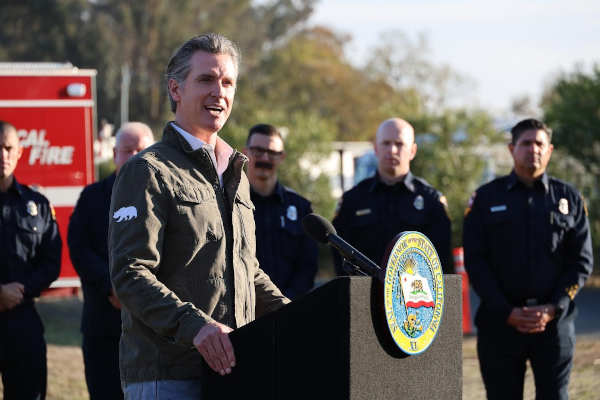
NORTHERN CALIFORNIA — At a fire station in Napa on Thursday, Gov. Gavin Newsom and state fire officials announced the end of peak fire season in most areas of California, while highlighting Cal Fire’s early work in preparation for next year’s wildfire season.
The state stays ready to respond to wildfires across the state.
On Wednesday, Los Angeles and Ventura counties were under red flag warnings, underscoring how California wildfire season is year-round.
Due to a number of factors — including weather, the work of local, state and federal firefighters, and state investments — this year’s wildfire season was significantly less severe than previous years, which officials said allowed Cal Fire to get a head start on prevention projects ahead of next year.
Cal Fire has completed more than 20,000 acres of prevention and mitigation projects like prescribed burns in the last two months alone, compared to lesser amounts in recent years when firefighters were instead battling wildfires.
“There’s no better representation of how volatile fire seasons can be than my first term as governor — two of the most destructive wildfire seasons in recorded history, and two of the least destructive in a decade,” said Gov. Newsom. “That’s why we’ve made record investments in wildfire response and treating more acres than ever before so we can protect lives and save homes. While we’ve reached the end of peak fire season in a better position than recent years, wildfire season in California is year-round and we remain vigilant, focused on protecting lives and livelihoods.”
On his first full day in office in January 2019, Gov. Newsom focused on wildfire resilience and preparedness, signing two executive orders aimed at protecting Californians from the growing threat of wildfires and other natural disasters.
In just the past two years, the state has allocated a record $2.8 billion in wildfire resilience as part of the California Climate Commitment. These investments in restoring forest health are guided by the Governor’s 99-point Wildfire and Forest Resilience Action Plan. The exponential increase in funding launched more than 552 wildfire resilience projects in less than a year.
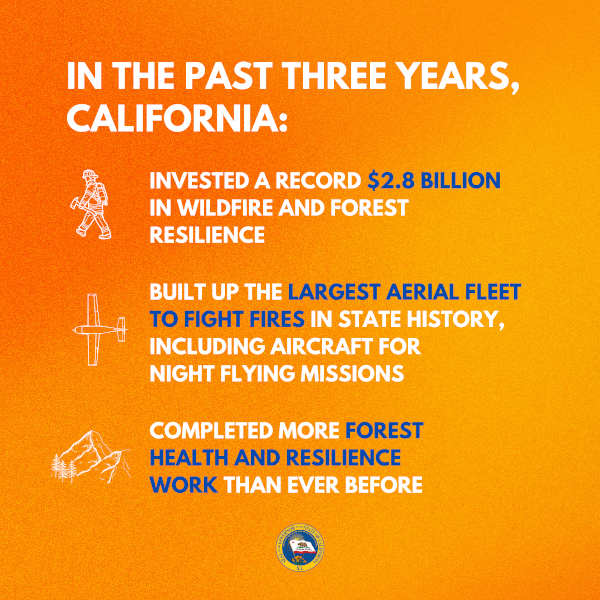
Cal Fire also met its 2025 goal of treating 100,000 acres a year a full three years ahead of schedule. Since fiscal year 2019-20, treatment work has significantly increased and Cal Fire has averaged 100,000 acres treated each year.
An additional $674.1 million in 2022-23 will add 1,350 new positions and expand fire crews, air attack operations, and provide for additional relief for Cal Fire staff to meet the demands of wildland firefighting in a changing climate. California also introduced “FIRIS” statewide, to provide real-time information and situational awareness to the state and California’s mutual aid system responders and managers.
Never in California’s history has the state had the number of initial attack aircraft available to respond to fires that it does today, the state reported.
In addition to Cal Fire’s existing fleet of 62 aircraft, 18 exclusive use helicopters and six exclusive use fixed wing aircraft were hired and strategically located throughout the state to provide an even greater response capability.
Additionally this was the first year Cal Fire’s new Fire Hawk helicopters were capable of nighttime aerial firefighting operations, which has proved to be another valuable capability. This year’s state budget provided four additional Fire Hawk helicopters, adding to the 12 Fire Hawks purchased by the state since Gov. Newsom was elected in 2018.
“We’re proud to announce the end of the 2022 peak fire season and sincerely thank the brave women and men who have worked tirelessly this year to protect and safeguard California communities and natural resources,” said Cal Fire Director Joe Tyler. “While Mother Nature gave us favorable conditions, it’s the investments made by Gov. Newsom and the Legislature, and the hard work of our crews and communities coming together that will continue to turn the page on the severity and destruction of past wildfire seasons. But our work is far from over and we continue to ask all Californians to double-down on fire safety and prevention efforts.”
According to Cal Fire, the state has seen a significant reduction in acres burned and structures damaged or destroyed this year compared to years past.
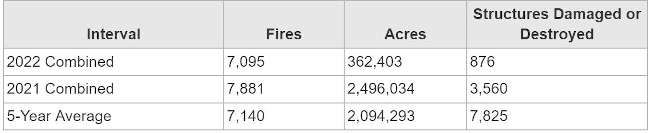
While firefighters still battled blazes this time last year, the state has been able to pivot early and focus on prevention and mitigation, completing more than 20,000 acres of prescribed fire and mechanical fuels reduction in strategic areas in the past two months. Completed in partnership with local, state and federal partners, and a range of tribal communities, significantly more work is underway than in recent previous years.
“California is rising to meet the growing challenges posed by climate change by building robust partnerships across the local, state and federal levels,” said Mark Ghilarducci, director of the California Governor’s Office of Emergency Services. “We are also leveraging new technology, adding more personnel and equipment and upping our game to detect fires rapidly and put them out where they start.
Successful and aggressive initial attack efforts were aided by additional staff, aerial resources, and equipment kept many fires small that could have been catastrophic. Examples include the Rices Fire, Electra Fire and Dutch Fire.
In larger wildfires where properties were lost, firefighters were able to prevent massive catastrophes, including saving an estimated 9,236 threatened structures on the Mosquito Fire (where 78 structures were destroyed), and saved 427 threatened structures from damage or destruction on the Oak Fire (where 194 structures were destroyed).
While mother nature played a substantial role, the full fire prevention and protection toolbox of prevention, education, suppression and protection, and recovery all worked together to keep Californians safe while protecting state communities and forests.
This year is likely an outlier in terms of favorable conditions. According to a state report published earlier this month, half of the state’s largest wildfires in the past 70 years occurred in just two years: 2020 and 2021.
- Details
- Written by: OFFICE OF CONGRESSMAN MIKE THOMPSON
“California remains on the frontlines of the climate crisis, and as wildfires and drought continue to threaten our communities, we must ensure that we have the resources we need to efficiently prepare and respond to disasters,” said Rep. Thompson. “The FIRE Act will help us provide a robust response to wildfires, pre-deploy resources before potential disasters, and improve equitable disaster assistance. Proud to work with leaders such as Reps. Lofgren, Huffman, and Panetta and Senator Padilla to ensure FEMA’s disaster preparedness can fully address wildfires and the communities they impact.”
“Wildfires present a unique and increasing danger in California and across the country. Congress must ensure all federal agencies and statutes are set up in ways that best support our communities as they prepare for and respond to deadly fires,” said Rep. Lofgren. “Wildfire assistance should not be treated as less important than hurricanes, tornadoes or floods, and our bill importantly improves and brings parity to FEMA’s efforts by focusing on disaster-specific needs. Passage of this bill is part of a whole-of-government approach to better prevent and respond to destructive wildfires.”
“The FIRE Act advancing in the House today will ensure that our state and country are better equipped to prepare for and respond to the imminent threat of wildfires each year,” said Sen. Padilla. “Protecting our communities from destructive wildfires is a bipartisan issue that requires the complete coordination of all levels of the government. I thank my colleagues in Congress for understanding the importance of providing the necessary resources for our communities to face the threat of wildfires every year, and I look forward to sending the FIRE Act to the President’s desk as soon as possible.”
“Climate change is accelerating, and our policies need to keep pace so communities can withstand the worst of its impacts – like the devastating wildfires my district has been battling year after year,” said Rep. Huffman. “Today’s vote on our FIRE Act is an important step towards reaching that goal. This bill will help FEMA evolve their practices to respond faster and prioritize the needs of impacted communities and survivors, while improving partnerships with tribal governments. The climate crisis isn’t waiting, and I hope to see the Senate take this up again and get it to the President’s desk as soon as possible for the health and safety of our communities.”
“As the American West continues to endure record drought, we will continue to be threatened by catastrophic wildfires,” said Rep. Panetta. “The FIRE Act would help meet that threat by reviewing expansion of eligibility for relocation assistance to fire-prone areas and allowing FEMA to proactively deploy its resources during red flag warnings. Such critical measures will allow FEMA to provide timely, efficient, and necessary disaster preparedness that is so deserved and needed by our vulnerable communities.”
“Since the aftermath of the Tubbs fire, Santa Rosa has been working closely with FEMA and other federal partners to rebuild a more resilient community,” said Santa Rosa Mayor Chris Rogers. “Along the way we had to overcome federal regulatory and policy issues that have added significant time and expense to our rebuilding process. Congressman Thompson’s work and leadership on the FIRE Act will ensure that federal policy must continue to adapt to meet today’s disaster mitigation and recovery needs. The FIRE Act will provide FEMA with additional flexibility to help fire impacted communities rebuild faster and in a more efficient manner.”
The FIRE Act will update the Stafford Act that governs the Federal Emergency Management Agency, or FEMA, to improve its wildfire preparedness and response programs such as by looking at pre-deployment of assets during times of highest wildfire risk and red flag warnings and by increasing equity and consistency across multiple FEMA assistance programs. In September, the Senate passed a version of the bill, sponsored by Senator Padilla.
In 2015, the City of Santa Rosa restored Santa Rosa Fire Station No. 5. In 2017, it was completely burned to the ground.
Normally in disasters, cities can utilize FEMA's relocation assistance. However, when the city went to FEMA for help rebuilding the fire station, which was essential to the safety of the community, they were told that the fire station didn't qualify for relocation assistance, because the Stafford Act specifically states that there must be demonstrated repeated damage to a structure before FEMA will release funding for rebuilding or repair. In the case of fires, it is impossible to show repeated damage.
Due to FEMA being bound by the Stafford Act, they couldn't provide assistance to rebuild the fire station and the city had to work with Congressman Thompson to get funding elsewhere.
Click here to view or download full text of the House-passed FIRE Act.
- Details
- Written by: Bill Deger
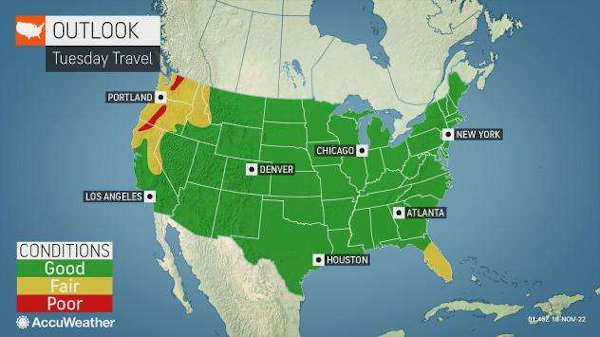
AccuWeather forecasters say a wide-ranging storm could develop and move across the country, just in time to disrupt travelers on Thanksgiving and in the days immediately after the holiday.
AccuWeather meteorologists are monitoring the potential for a significant storm to cause a slew of hazards across the eastern United States, including heavy rain, snow and gusty winds, next week with the potential for holiday travel disruptions in the days leading up to Thanksgiving — and impacts may continue beyond the holiday as well.
The adverse weather will initially develop as two smaller storms form and travel thousands of miles, impacting millions of people around the holiday from the nation's midsection to the East Coast. Travelers in parts of the Midwest and Northeast may need to factor in the potential for wintry weather in their travel plans later in the week.
For those getting a head start on their holiday travel this weekend into Monday, people in a large swath of the nation will enjoy quiet weather conditions, and the vast majority of people will encounter few weather-related travel issues.
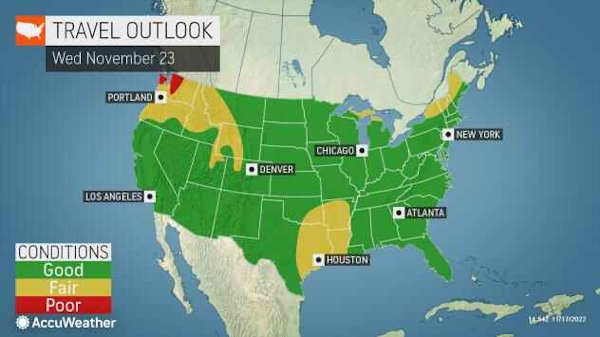
One of the ingredients for this potentially significant storm, an area of low pressure, will start to impact travelers beginning on Tuesday. Heavy rain and mountain snow will move into the Northwest and western Canada. This part of the storm will pack most of the energy needed for the bigger storm to form later in the week.
On Wednesday, the second ingredient, moisture emerging from the Gulf of Mexico, will help spark showers and thunderstorms across eastern Texas and the lower Mississippi Valley, slowing pre-Thanksgiving travel there, including in Houston and Dallas.
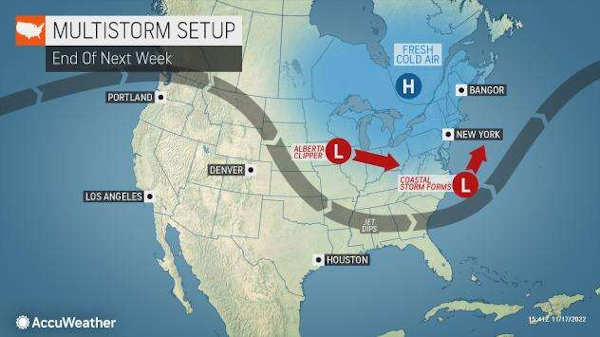
Those two separate systems will begin to combine into a larger storm over the Midwest, Mississippi and Ohio valleys and parts of the South on Thanksgiving.
Thunderstorms packing torrential downpours will make for a soggy Turkey Day in cities such as Lake Charles and New Orleans, Louisiana, and Jackson, Mississippi. Meanwhile, snow showers will make for a wintry scene and slick roads in parts of the northern Plains and Upper Midwest, including in Minneapolis and Duluth, Minnesota.
While the strength and positioning of any developing storm are still uncertain a week out, there is the potential for further strengthening to occur as the storm reaches the Atlantic coast around Friday. Combined with fresh cold air rushing in from Canada, a swath of snow can interrupt post-Thanksgiving travel in parts of the Great Lakes and interior Northeast from Friday into next weekend.
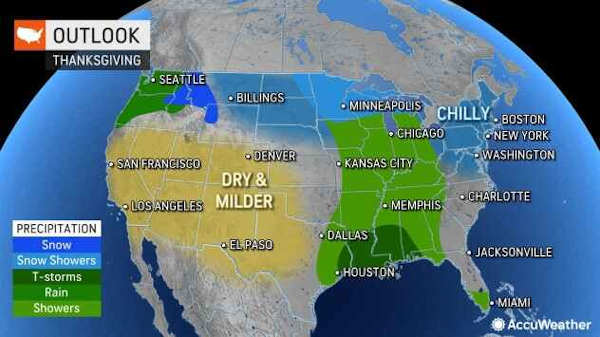
Impacts can also occur along the coast, from the Carolinas to New England, including strong winds, high waves and tidal flooding, as the storm strengthens offshore.
If the two storms end up being weaker or the colder air ends up pushing farther south, the ingredients may not come together in the right position or in time to produce significant travel-impacting precipitation in the East.
Regardless, travelers should plan in advance for the potential of flight delays or cancellations at major airports, including Chicago-O'Hare, Atlanta-Hartsfield and the airports in the New York City tri-state area, as well as slow travel on major highways such as interstates 40, 70, 80, 90 and 95.
The potential for more snow in the Great Lakes will come in the wake of a major lake-effect snow event late this week and weekend, where several feet of snow is expected to accumulate, including in Buffalo.
Bill Deger is an AccuWeather senior meteorologist.
- Details
- Written by: LAKE COUNTY NEWS REPORTS
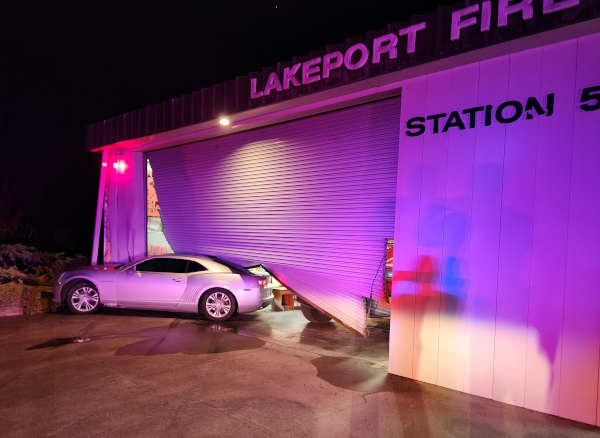
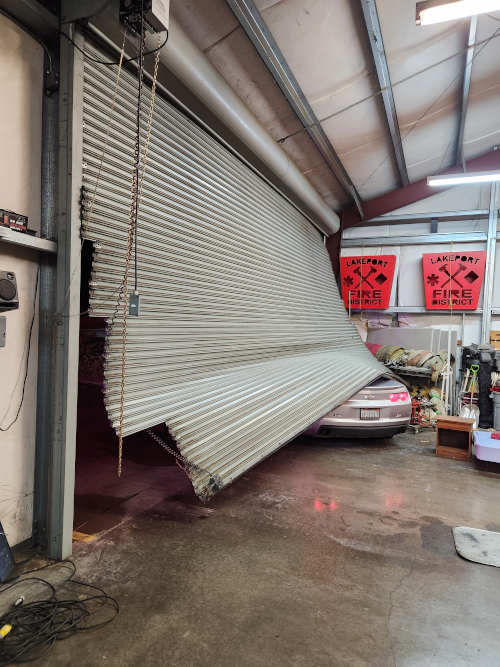
LAKE COUNTY, Calif. — The Lakeport Fire Protection District said its north Lakeport station sustained major damage on Saturday night after a vehicle crashed into it.
The damage was done to Lakeport Fire Station 52 at 3600 Hill Road East.
Station 52, which is currently unstaffed due to budget constraints, sustained significant damage to its steel framework, as well as the bay doors, the district reported.
On Wednesday, the district said it did not yet have a formal estimate of the cost to repair the station, but conservative estimates place the damage as likely over $100,000.
The district said that at 9:15 p.m. Saturday a vehicle traveling at high speed crashed into Station 52.
Due to the high rate of speed of the vehicle, the district said the driver was unable to properly negotiate the Hill Road exit off Highway 29.
As a result, the vehicle crossed Park Way, went over a curb and through a grassy area, traveled through a Caltrans highway fence and across Hill Road before hitting the station and finally coming to a stop.
The district said the California Highway Patrol was on scene immediately and the Lakeport Fire Protection District firefighters and paramedics arrived within minutes to render medical aid to the driver.
The driver was uninjured, the district reported.
The district’s main operations are based out of its headquarters, Station 50, located at 445 N. Main St. in downtown Lakeport.