 How to resolve AdBlock issue?
News
- Details
- Written by: Elizabeth Larson
The council will meet in closed session at 5 p.m. before the public portion of the meeting begins at 6 p.m. Thursday, March 16, in the council chambers at Clearlake City Hall, 14050 Olympic Drive.
The meeting will be broadcast live on the city's YouTube channel or the Lake County PEGTV YouTube Channel. Community members also can participate via Zoom or can attend in person.
The agenda can be found here.
Comments and questions can be submitted in writing for City Council consideration by sending them to City Clerk Melissa Swanson at
To give the council adequate time to review your questions and comments, please submit your written comments before 4 p.m. Thursday, March 16.
Each public comment emailed to the city clerk will be read aloud by the mayor or a member of staff for up to three minutes or will be displayed on a screen. Public comment emails and town hall public comment submissions that are received after the beginning of the meeting will not be included in the record.
The council’s closed session before the regular meeting will cover labor negotiations with the Clearlake Middle Management Association, a performance evaluation of City Manager Alan Flora, and two cases of litigation, Koi Nation of Northern California v. City of Clearlake, et Al. and City of Clearlake v. Testate & Intestate Successors of Bailey Lumbers Co., et al.
The council on Thursday will meet March’s adoptable dogs, and hear presentations on the city’s annual financial report for 2020-21 and the Public, Education and Government, or PEG, Channel Board’s annual report.
Under business, the council will discuss norms and procedures and Brown Act review.
The council also will discuss a Community Project Funding request through Congressman Mike Thompson.
On the meeting's consent agenda — items that are considered routine in nature and usually adopted on a single vote — are warrants; approval of a $250,000 professional services contract with Downey Brand for legal services; receipt and filing of the Clearlake Waste Solutions 2022 Annual Solid Waste and Recycling Report; and acceptance of the annual financial report for Fiscal Year 2020-21; Resolution No. 2023-15.
Email Elizabeth Larson at
- Details
- Written by: Keith Musselman, University of Colorado Boulder
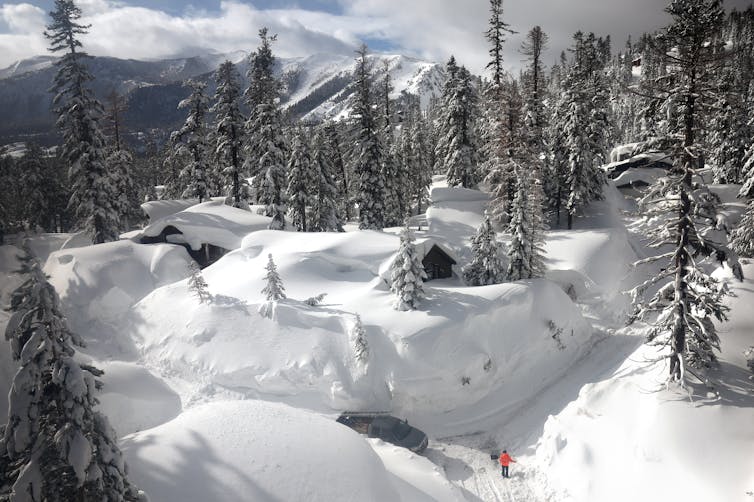
Another round of powerful atmospheric rivers is hitting California, following storms in January and February 2023 that dumped record amounts of snow. This time, the storms are warmer, and they are triggering flood warnings as they bring rain higher into the mountains – on top of the snowpack.
Professor Keith Musselman, who studies water and climate change at the University of Colorado’s Institute of Arctic and Alpine Research, explained the complex risks rain on snow creates and how they might change in a warming climate.
What happens when rain falls on snowpack?
For much of the United States, storms with heavy rainfall can coincide with seasonal snow cover. When that happens, the resulting runoff of water can be much greater than what is produced from rain or snowmelt alone. The combination has resulted in some of the nation’s most destructive and costly floods, including the 1996 Midwest floods and the 2017 flood that damaged California’s Oroville Dam.
Contrary to common belief, rainfall itself has limited energy to melt snow. Rather, it is the warm temperatures, strong winds and high humidity, which can transport substantial energy in the form of latent and sensible heat, that predominantly drive snowmelt during rain-on-snow events.
Snowpack has air spaces that water can move through. As the rain falls, the water can travel relatively rapidly through the snowpack’s layers to reach the underlying soil. How streams respond to that runoff depends on how much water is already flowing and how saturated the soil is.
When the soil isn’t yet saturated, it can dampen or delay a flood response by soaking up rain and melting snow. But when the ground is saturated, snowmelt combined with rain can lead to fast and devastating flooding.
One of the challenges for dealing with these rain-on-snow events is that the flood risk is hard to forecast.
To predict whether a flood will occur requires knowledge of weather and hydrological conditions. It requires knowing the soil moisture and snowpack conditions before the storm, the elevation at which rain transitions to snow, the rainfall rate, the wind speed, air temperature and humidity, and estimates of how those factors contribute to snowmelt. Additionally, each factor varies in time during a storm and varies in complex ways, especially across a mountainous landscape.
This is why rain-on-snow floods are characterized as compound extreme events. Despite the extensive damage they can cause, it may be surprising how little is known about how they vary in time, spatial extent and intensity.
California is getting another atmospheric river, with more rain on snow expected. How does the rain-on-snow effect differ by elevation in the mountains there?
In the California mountains right now, it’s the middle elevations that people need to pay attention to.
The lower elevations have primarily seen rainfall rather than snow, so there is less snowpack to melt. And in the highest elevations, colder temperatures promote the continued accumulation of deep snowpack and rainfall is less likely.
In the middle transition zone – where either substantial rainfall or snowfall can occur – rain-on-snow events are most common, causing both melting and risk of roof collapses.
If all storms were created equal, there would be well-defined rain zones and snow zones, and the rain-on-snow flood risk would be low. But that isn’t what happens. Instead, not only does the snow zone elevation vary during an event, but it also varies substantially from one storm to the next.
The most destructive rain-on-snow events occur when rivers are already running high and soils are saturated, which can occur in response to a series of warm atmospheric rivers interacting with a deep snowpack – like California’s mountains have right now. The order in which these storms occur – or the storm sequencing – is especially important for assessing flood risk because these events are, in part, caused by rapid shifts between cold periods of snow accumulation followed by warm rainfall events.
What does research show about the future risk of rain-on-snow events in a warming climate?
Even less is known about how rain-on-snow flood risk may respond as the planet warms.
In a warmer climate, there will be less risk of rain falling on snow in the lower elevations as the snowpack declines, particularly in warmer regions such as the Pacific Northwest.
But at higher elevations, more frequent rain-on-snow events are expected. While warmer temperatures are expected to increase rainfall intensity, research shows that’s not the most important driver of this risk. Much of the expected increase in rain-on-snow flood risk is a result of the rain-snow transition zone expanding higher in elevation to include alpine areas that historically received predominantly snowfall.
Flood control and reservoir management systems in these mountainous regions will have to consider these future changes in rain-on-snow events – in addition to changes in rainfall intensity and storm sequencing – to fully understand and prepare for the local flood risk as the planet warms.
So, will projected increases in precipitation extremes and winter rainfall increase rain-on-snow occurrence and the associated flood risk? Or will less snow cover and larger soil moisture deficits reduce rain-on-snow flood risk in a warmer climate?
In a future climate, the response of rain-on-snow flood risk is expected to change in complex and often contradictory ways. The projected changes are likely to vary by region, season, climate model, emissions scenario and future time horizon. It’s a costly risk that requires more research.
Keith Musselman, Assistant Professor in Geography, Mountain Hydrology, and Climate Change, University of Colorado Boulder
This article is republished from The Conversation under a Creative Commons license. Read the original article.
- Details
- Written by: LAKE COUNTY NEWS REPORTS
The district, or LCTID, does business as Visit Lake County CA and is now authorized to continue operating until Dec. 31, 2033.
Consent hearings were held in January with both the Lakeport City Council and the Clearlake City Council. Both councils unanimously approved resolutions supporting the extension.
The new management district plan increases the room night assessment from 1.5% to 2.5% beginning in January 2024.
“We are excited about the future of tourism marketing in Lake County.” said Lynne Butcher, owner of The Tallman Hotel and Blue Wing Saloon and current treasures of the LCTID. “We clearly saw that the current 1.5% assessment did not fully fund the district. We are confident the new plan will continue to give us the resources needed to increase visitors to Lake County.”
Since its founding in 2018, Visit Lake County CA has increased visitor-interested website traffic from 6,000 unique users viewing accommodation pages to over 86,000 in the current year.
Social media platforms under the guidance of Visit Lake County CA have exploded from just under 16,000 Facebook followers in 2018 to over 34,000 in the current year.
Additionally, Visit Lake County CA hosted travel reporters from The San Francisco Chronicle, Lonely Planet, 7X7 Bay Area, and several social media influencers.
“Tourism in Lake County is a vital industry,” said Brian Fisher, Executive Director of Visit Lake County CA, “for every $1 a visitor spends in accommodations they spend an additional $3 in other county businesses.”
Lodging revenue has increased every year since the establishment of Visit Lake County CA.
“We are excited about new accommodations coming online in 2023,” said Fisher, “Huttopia, a glamping resort at Six Sigma Ranch will have over 60 tents ready by this summer. It is a great product targeting a growing demographic for Lake County.”
Lake County also has a little more than 300 short-term rental properties available for visitors.
Anyone renting a home, cabin, room or tent is required to obtain an accommodation permit from the county or city they are renting in and pay the required taxes and assessments.
“We are seeing greater compliance of short-term rental operators in meeting their tax and assessment requirements" said County Treasurer-Tax Collector Patrick Sullivan. “These funds are vital to the future of tourism in Lake County.”
Lake County Tourism Improvement District meets quarterly and operates the trade website, www.discoveryourlake.com.
You can find the new management district plan at this website.
- Details
- Written by: LAKE COUNTY NEWS REPORTS

CLEARLAKE, Calif. — The Clearlake Police Department is asking for the community’s assistance in locating a missing boy.
Police are working to locate 11-year-old John Clements, who was last seen on Sunday in Clearlake.
He is described as a white male juvenile, 5 feet and 110 pounds, with dirty blonde short hair and blue eyes.
John was last seen wearing a black champion sweatshirt, black sweatpants and brown shoes.
If you have information regarding his whereabouts please contact the Clearlake Police Department at 707-994-8251, Extension 1.