 How to resolve AdBlock issue?
News
- Details
- Written by: Vicki Crawford, Morehouse College
Historian Vicki Crawford was one of the first scholars to focus on women’s roles in the civil rights movement. Her 1993 book, “Trailblazers and Torchbearers,” dives into the stories of female leaders whose legacies have often been overshadowed.
Today she is the director of the Morehouse College Martin Luther King Jr. Collection, where she oversees the archive of his sermons, speeches, writings and other materials. Here, she explains the contributions of women who influenced King and helped to fuel some of the most significant campaigns of the civil rights era, but whose contributions are not nearly as well known.
An activist in her own right
Coretta Scott King is often remembered as a devoted wife and mother, yet she was also a committed activist in her own right. She was deeply involved with social justice causes before she met and married Martin Luther King Jr., and long after his death.
Scott King served with civil rights groups throughout her time as a student at Antioch College and the New England Conservatory of Music. Shortly after she and King married in 1953, the couple returned to the South, where they lent their support to local and regional organizations such as the NAACP and the Montgomery Improvement Association.
They also supported the Women’s Political Council, an organization founded by female African American professors at Alabama State University that facilitated voter education and registration, and also protested discrimination on city buses. These local leadership efforts paved the way for widespread support of Rosa Parks’ resistance to segregation on public busing.
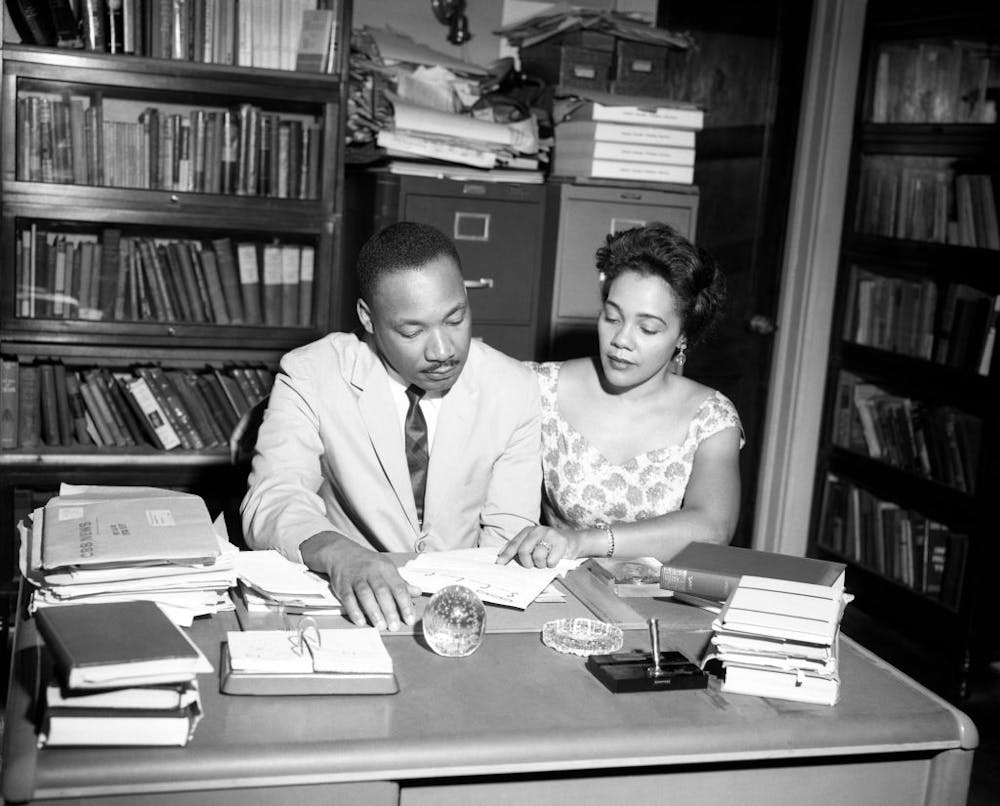
Following her husband’s assassination in 1968, Scott King devoted her life to institutionalizing his philosophy and practice of nonviolence. She established the King Center for Nonviolent Social Change, led a march of sanitation workers in Memphis and joined efforts to organize the Poor People’s Campaign. A longtime advocate of workers rights, she also supported a 1969 hospital workers’ strike in South Carolina, delivering stirring speeches against the treatment of African American staff.
Scott King’s commitment to nonviolence went beyond civil rights at home. During the 1960s, she became involved in peace and anti-war efforts such as the Women’s Strike for Peace and opposed the escalating war in Vietnam. By the 1980s, she had joined protests against South African apartheid, and before her death in 2006, she spoke out in favor of LGBT rights – capping a lifetime of activism against injustice and inequalities.
Women and the March
While Scott King’s support and ideas were particularly influential, many other women played essential roles in the success of the civil rights movement.
Take the most iconic moment of the civil rights struggle, in many Americans’ minds: the Aug. 28, 1963, March on Washington for Jobs and Freedom, at which King delivered his landmark “I Have a Dream” speech on the steps of the Lincoln Memorial.
As the 60th anniversary of the march approaches, it is critical to recognize the activism of women from all walks of life who helped to strategize and organize one of the country’s most massive political demonstrations of the 20th century. Yet historical accounts overwhelmingly highlight the march’s male leadership. With the exception of Daisy Bates, an activist who read a short tribute, no women were invited to deliver formal speeches.
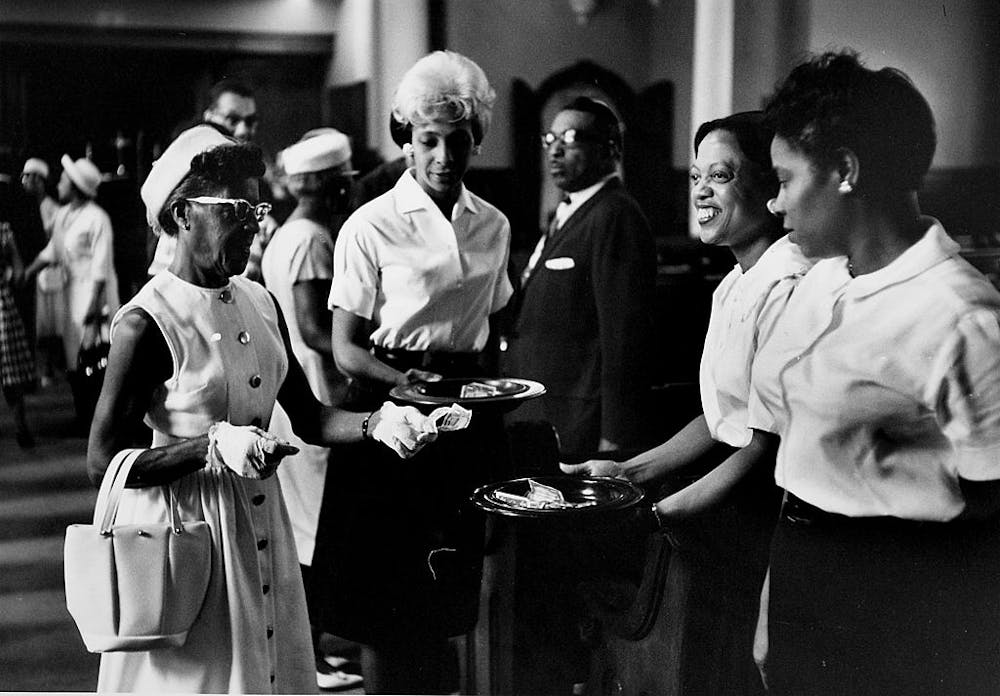
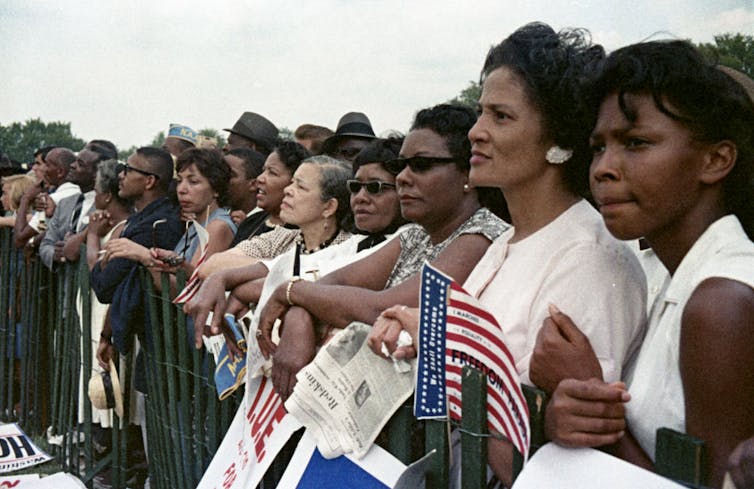
Women were among the key organizers of the march, however, and helped recruit thousands of participants. Dorothy Height, president of the National Council of Negro Women, was often the lone woman at the table of leaders representing national organizations. Anna Arnold Hedgeman, who also served on the planning committee, was another strong advocate for labor issues, anti-poverty efforts and women’s rights.

Photographs of the march show women attended in large numbers, yet few historical accounts adequately credit women for their leadership and support. Civil rights activist, lawyer and Episcopalian priest Pauli Murray, among others, called for a gathering of women to address this and other instances of discrimination a few days later.
Hidden in plain view
African American women led and served in all the major campaigns, working as field secretaries, attorneys, plaintiffs, organizers and educators, to name just a few roles. So why did early historical accounts of the movement neglect their stories?
There were women propelling national civil rights organizations and among King’s closest advisers. Septima Clark, for example, was a seasoned educator whose strong organizing skills played a consequential role in voter registration, literacy training and citizenship education. Dorothy Cotton was a member of the inner circle of the Southern Christian Leadership Conference, of which King was president, and was involved in literacy training and teaching nonviolent resistance.
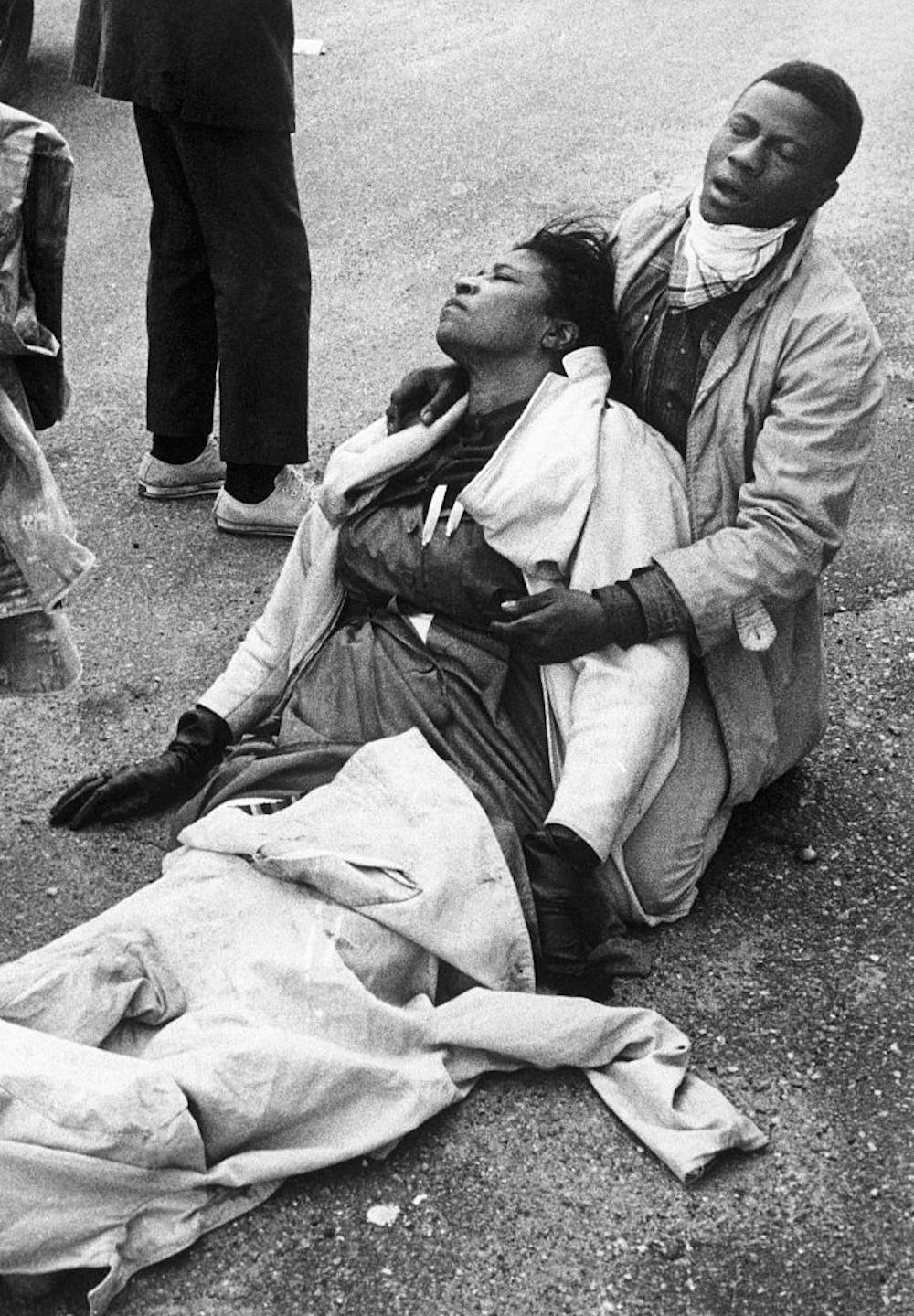
Yet women’s organizing during the 1950s and 1960s is most evident at local and regional levels, particularly in some of the most perilous communities across the deep South. Since the 1930s, Amelia Boynton Robinson of Dallas County, Alabama, and her family had been fighting for voting rights, laying the groundwork for the struggle to end voter suppression that continues to the present. She was also key in planning the 50-mile Selma-to-Montgomery march in 1965. Images of the violence that marchers endured – particularly on the day that came to be known as Bloody Sunday – shocked the nation and eventually contributed to the passage of the landmark Voting Rights Act of 1965.

Or take Mississippi, where there would not have been a sustained movement without women’s activism. Some names have become well known, like Fannie Lou Hamer, but others deserve to be.
Two rural activists, Victoria Gray and Annie Devine, joined Hamer as representatives to the Mississippi Freedom Democratic Party, a parallel political party that challenged the state’s all-white representatives at the 1964 Democratic Convention. A year later, the three women represented the party in a challenge to block the state’s congressmen from taking their seats, given ongoing disenfranchisement of Black voters. Though the congressional challenge failed, the activism was a symbolic victory, serving note to the nation that Black Mississippians were no longer willing to accept centuries-old oppression.
Many African American women were out-front organizers for civil rights. But it is no less important to remember those who assumed less visible, but indispensable, roles behind the scenes, sustaining the movement over time.
Vicki Crawford, Professor of Africana Studies, Morehouse College
This article is republished from The Conversation under a Creative Commons license. Read the original article.
- Details
- Written by: Elizabeth Larson
Dogs available for adoption this week include mixes of Australian cattle dog, blue heeler, border collie, boxer, German shepherd, German shorthaired pointer, Great Pyrenees, hound, Labrador retriever, mastiff, pit bull, Rottweiler, shepherd, treeing walker coonhound and terrier.
Dogs that are adopted from Lake County Animal Care and Control are either neutered or spayed, microchipped and, if old enough, given a rabies shot and county license before being released to their new owner. License fees do not apply to residents of the cities of Lakeport or Clearlake.
The following dogs at the Lake County Animal Care and Control shelter have been cleared for adoption.
Call Lake County Animal Care and Control at 707-263-0278 or visit the shelter online for information on visiting or adopting.

Male German shorthaired pointer
This 6-month-old male German shorthaired pointer has a short brown and white coat.
He is in foster, ID No. LCAC-A-4769.

Male German shepherd puppy
This 3-month-old male German shepherd puppy has a black and tan coat.
He is in kennel No. 2a, ID No. LCAC-A-4845.

Male German shepherd puppy
This 3-month-old male German shepherd puppy has a black and tan coat.
He is in kennel No. 2b, ID No. LCAC-A-4846.

Female pit bull terrier puppy
This 3-month-old female American pit bull terrier puppy has a short brindle coat.
She is in kennel No. 4a, ID No. LCAC-A-4787.

Female pit bull terrier puppy
This 3-month-old female American pit bull terrier puppy has a short black and white coat.
She is in kennel No. 4b, ID No. LCAC-A-4788.
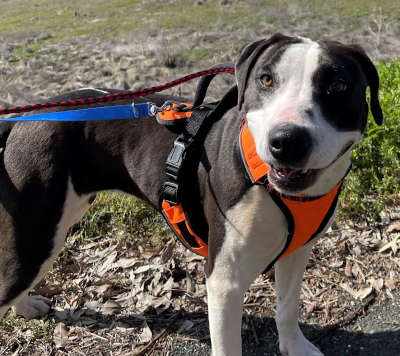
Female pit bull terrier
This 1-year-old female pit bull terrier has a short black and white coat.
She is in kennel No. 5, ID No. LCAC-A-4873.

Male Labrador retriever mix
This 1-year-old male Labrador retriever mix has a short black coat with white markings.
He is in kennel No. 6, ID No. 4841.

‘Able’
“Able” is a 6-year-old male coonhound mix with a short black and tan coat.
He is in kennel No. 7, ID No. LCAC-A-4773.

Female German shepherd
This one and a half year old female German shepherd has a black and tan coat.
She is in kennel No. 8, ID No. LCAC-A-4898.

Female border collie
This 1-year-old female border collie has a black and white coat, and one brown eye and one blue eye.
She is in kennel No. 11, ID No. LCAC-A-4903.

‘Luigi’
“Luigi” is a 2-year-old male pit bull terrier with a short red and white coat.
He is in kennel No. 12, ID No. LCAC-A-4742.
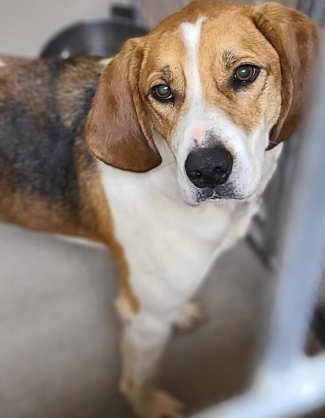
‘Oreo’
“Oreo” is a 2-year-old male treeing walker coonhound with a short tricolor coat.
He is in kennel No. 13, ID No. LCAC-A-4738.

Female Rottweiler
This 5-month-old female Rottweiler has a black and tan coat
She is in kennel No. 14, ID No. LCAC-A-4912.

Female German shepherd-hound mix
This 2-year-old female German shepherd-hound mix has a black and tan coat.
She is in kennel No. 15, ID No. LCAC-A-4816.

Male German shepherd mix
This 2-year-old male German shepherd mix has a red and white coat.
He is in kennel No. 16, ID No. LCAC-A-4835.
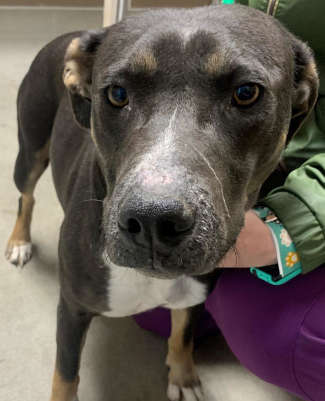
Female pit bull-Labrador retriever mix
This female pit bull-Labrador retriever mix has a short tricolor coat.
She is in kennel No. 17, ID No. LCAC-A-4692.

Male pit bull terrier
This one and a half year old male pit bull terrier has a black coat with white markings.
He is in kennel No. 19, ID No. LCAC-A-4843.

Female Australian cattle dog-blue heeler
This 2-year-old female Australian cattle dog-blue heeler has a short blue and black coat.
She is in kennel No. 20, ID No. LCAC-A-4836.

Male Anatolian shepherd
This 1-year-old male Anatolian shepherd has a black and tan coat.
He is in kennel No. 22, ID No. LCAC-A-4844.
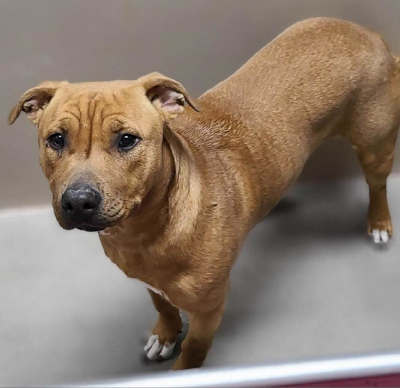
‘Bruno’
“Bruno” is a 9-month-old male mastiff-pit bull mix with a short tan coat.
He is in kennel No. 23, ID No. LCAC-A-4789.

Male Australian cattle dog-blue heeler
This one and a half year old male Australian cattle dog-blue heeler has a short red and white coat.
He is in kennel No. 25, ID No. LCAC-A-4837.

Male boxer-pit bull mix
This 8-year-old male boxer-pit bull mix has a short brown brindle coat.
He is in kennel No. 26, ID No. LCAC-A-4678.
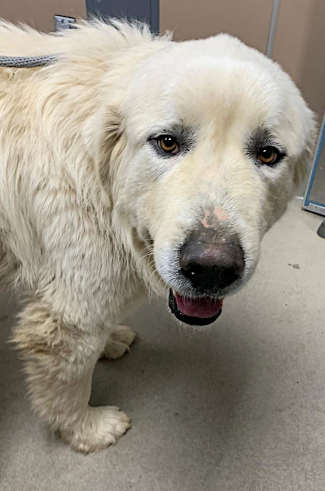
Male Great Pyrenees
This 2-year-old male Great Pyrenees has a long white coat.
He is in kennel No. 28, ID No. LCAC-A-4821.

Female terrier
This 1-year-old female terrier has a black and tan coat.
She is in kennel No. 30, ID No. LCAC-A-4920.

Male border collie puppy
This 3-month-old male border collie puppy has a short black coat with white markings.
He is in kennel No. 32, ID No. LCAC-A-4783.

Female German shorthaired pointer pup
This 6-month-old female German shorthaired pointer pup has a black and white coat.
She is in kennel No. 34a, ID No. LCAC-A-4771.

Female German shorthaired pointer pup
This 6-month-old female German shorthaired pointer pup has a black and white coat.
She is in kennel No. 34b, ID No. LCAC-A-4772.
Email Elizabeth Larson at
- Details
- Written by: GOVERNOR’S OFFICE
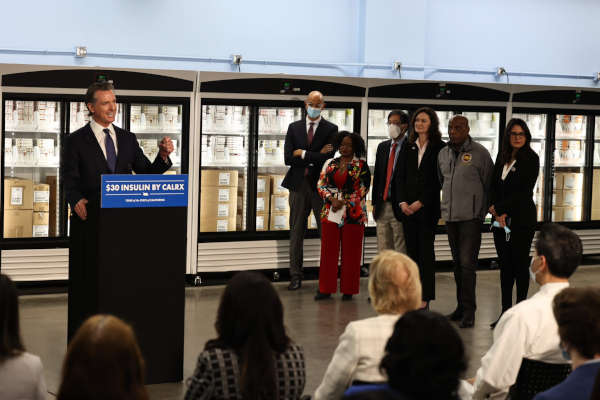
DOWNEY, Calif. – Gov. Gavin Newsom, as part of his tour of the state of California, announced that CalRx has secured a contract with a manufacturer, or CIVICA, to make $30 insulin available to all who need it.
The governor also announced Saturday that California will seek to manufacture its own Naloxone.
Saturday’s announcement makes good on Gov. Newsom’s promise on his first day in office, to bring down the price of prescription drugs for Californians and increase accountability and transparency in health care.
Californians can learn more about CalRX on the newly launched website.
“People should not be forced to go into debt to get life saving prescriptions,” said Newsom. “Through CalRx, Californians will have access to some of the most inexpensive insulin available, helping them save thousands each year. But we’re not stopping there – California will seek to make our own Naloxone as part of our plan to fight the fentanyl crisis.”
The announcement will bring down the price of insulin by about 90%, saving cash-paying patients between $2,000 and $4,000 annually.
With CalRx, and unlike private companies, we’re getting at the underlying cost — the price is the price, and CalRx will prevent the egregious cost-shifting that happens in traditional pharmaceutical price games.
It’ll cost us $30 to manufacture and distribute, and that’s how much the consumer can buy it for. You don’t need a voucher or coupon to access this price, and it’s available to everybody regardless of insurance plan.
This is a crucial step in not just cutting the cost for the consumer, but cutting costs across the board in order to bring cheaper prescription drugs to all Californians.
“To address the affordability crisis in California, we have to address the high cost of prescription drugs,” said Dr. Mark Ghaly, secretary of the California Health and Human Services Agency. “The CalRx Biosimilar Insulin Initiative will benefit Californians who are today paying too much for a medication that we know is life saving and life altering.”
KEY DETAILS
A 10mL vial will be made available for no more than $30 (normally $300)
A box of 5 pre-filled 3mL pens will be made available for no more than $55 (normally more than $500)
No new prescription will be needed. Californians will be able to ask for the CalRx generic at their local pharmacy or via mail order pharmacies. Pharmacies must agree to order/stock the product.
CalRx plans to make biosimilar insulins available for: Glargine, Aspart, and Lispro (expected to be interchangeable with Lantus, Humalog, and Novolog respectively)
WHAT COMES NEXT
As part of the State’s Master Plan to Tackle the Fentanyl Crisis, California is exploring potential next products to bring to market, like Naloxone, to aid in the State’s effort to combat fentanyl overdoses.
CIVICA is working with the California Health and Human Services Agency to identify a California-based manufacturing facility.
- Details
- Written by: Joey Rodriguez, Michigan State University and Andrew Vanderburg, Massachusetts Institute of Technology (MIT)


NASA recently announced the discovery of a new, Earth-sized planet in the habitable zone of a nearby star called TOI-700. We are two of the astronomers who led the discovery of this planet, called TOI-700 e. TOI-700 e is just over 100 light years from Earth – too far away for humans to visit – but we do know that it is similar in size to the Earth, likely rocky in composition and could potentially support life.
You’ve probably heard about some of the many other exoplanet discoveries in recent years. In fact, TOI-700 e is one of two potentially habitable planets just in the TOI-700 star system.
Habitable planets are those that are just the right distance from their star to have a surface temperature that could sustain liquid water. While it is always exciting to find a new, potentially habitable planet far from Earth, the focus of exoplanet research is shifting away from simply discovering more planets. Instead, researchers are focusing their efforts on finding and studying systems most likely to answer key questions about how planets form, how they evolve, and whether life might exist in the universe. TOI-700 e stands out from many of these other planet discoveries because it is well suited for future studies that could help answer big question about the conditions for life outside the solar system.
From 1 to 5,000
Astronomers discovered the first exoplanet around a Sun-like star in 1995. The field of exoplanet discovery and research has been rapidly evolving ever since.
At first, astronomers were finding only a few exoplanets each year, but the combination of new cutting-edge facilities focused on exoplanet science with improved detection sensitivity have led to astronomers’ discovering hundreds of exoplanets each year. As detection methods and tools have improved, the amount of information scientists can learn about these planets has increased. In 30 years, scientists have gone from barely being able to detect exoplanets to characterizing key chemical clues in their atmospheres, like water, using facilities like the James Webb Space Telescope.
Today, there are more than 5,000 known exoplanets, ranging from gas giants to small rocky worlds. And perhaps most excitingly, astronomers have now found about a dozen exoplanets that are likely rocky and orbiting within the habitable zones of their respective stars.
Astronomers have even discovered a few systems – like TOI-700 – that have more than one planet orbiting in the habitable zone of their star. We call these keystone systems.


A pair of habitable siblings
TOI-700 first made headlines when our team announced the discovery of three small planets orbiting the star in early 2020. Using a combination of observations from NASA’s Transiting Exoplanet Surveying Satellite mission and the Spitzer Space Telescope we discovered these planets by measuring small dips in the amount of light coming from TOI-700. These dips in light are caused by planets passing in front of the small, cool, red dwarf star at the center of the system.
By taking precise measurements of the changes in light, we were able to determine that at least three small planets are in the TOI-700 system, with hints of a possible fourth. We could also determine that the third planet from the star, TOI-700 d, orbits within its star’s habitable zone, where the temperature of the planet’s surface could allow for liquid water.
The Transiting Exoplanet Surveying Satellite observed TOI-700 for another year, from July 2020 through May 2021, and using these observations our team found the fourth planet, TOI-700 e. TOI-700 e is 95% the size of the Earth and, much to our surprise, orbits on the inner edge of the star’s habitable zone, between planets c and d. Our discovery of this planet makes TOI-700 one of only a few known systems with two Earth-sized planets orbiting in the habitable zone of their star. The fact that it is relatively close to Earth also makes it one of the most accessible systems in terms of future characterization.


The bigger questions and tools to answer them
With the successful launch of the James Webb Space Telescope, astronomers are now able to start characterizing the atmospheric chemistry of exoplanets and search for clues about whether life exists on them. In the near future, a number of massive, ground-based telescopes will also help reveal further details about the composition of planets far from the solar system.
But even with powerful new telescopes, collecting enough light to learn these details requires pointing the telescope at a system for a long period of time. With thousands of valuable scientific questions to answer, astronomers need to know where to look. And that is the goal of our team, to find the most interesting and promising exoplanets to study with the Webb telescope and future facilities.
Earth is currently the only data point in the search for life. It is possible alien life could be vastly different from life as we know it, but for now, places similar to the home of humanity with liquid water on the surface offer a good starting point. We believe that keystone systems with multiple planets that are likely candidates for hosting life – like TOI-700 – offer the best use of observation time. By further studying TOI-700, our team will be able to learn more about what makes a planet habitable, how rocky planets similar to Earth form and evolve, and the mechanisms that shaped the solar system. The more astronomers know about how star systems like TOI-700 and our own solar system work, the better the chances of detecting life out in the cosmos.
Joey Rodriguez, Assistant Professor of Physics and Astronomy, Michigan State University and Andrew Vanderburg, Assistant Professor of Physics, Massachusetts Institute of Technology (MIT)
This article is republished from The Conversation under a Creative Commons license. Read the original article.