 How to resolve AdBlock issue?
News
- Details
- Written by: Edouard Wemy, Clark University
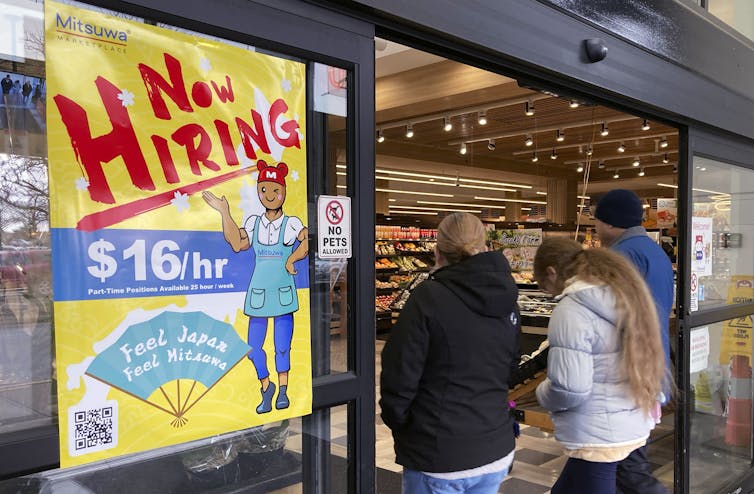
The hot U.S. labor market is showing few signs of cooling down, with the latest jobs report showing continued strong gains, particularly in service industries such as retail and hospitality. The robust employment landscape may put pressure on the Federal Reserve to raise rates more than expected later this month in a bid to further tame inflation.
The U.S. economy added 311,000 jobs in February, the Bureau of Labor Statistics reported on March 10, 2023, higher than economists were forecasting. The unemployment rate ticked up slightly to 3.6%, still near the lowest level in over 50 years.
To better understand what all this means and why the job market remains strong despite the most aggressive pace of interest rate hikes since the 1980s, we turned to Edouard Wemy, an economist at Clark University.
What stood out for you most in the jobs report?
It’s kind of strange how the labor market remains quite strong, with notable gains in labor-intensive service sectors like hospitality and leisure, health care and retail. That’s also where wage growth in February was strongest.
For workers, the report is good news, since it suggests if you’re looking for work you’ve got a strong chance of finding a job. The Job Openings and Labor Turnover Survey shows that there are almost two vacancies for every unemployed worker, which is pretty high compared with an average of under 0.6 vacancies per jobless person before the pandemic.
But it’s very puzzling. Why is the job growth so strong at a time when the Fed has been aggressively raising borrowing costs to tame the highest inflation since the 1980s? Typically, a sudden increase in interest rates – and the Fed has raised rates 4.5 percentage points over the past year – would chill the labor market and send unemployment much higher.
I believe, as is often the case in economics, it’s a question of supply and demand. The Fed has been focused on the latter. Raising the borrowing costs consumers and businesses have to pay should reduce consumer demand for goods and services, which in turn lowers demand for workers.
But the Fed can’t do much about the supply side of the equation – which refers to the number of available workers in the labor market. That’s measured by the participation rate, which plunged at the beginning of the pandemic and still hasn’t fully recovered to pre-COVID-19 levels. This is especially true for men, who are participating in the labor market at a rate of 68%, or 1.1 percentage point below February 2020 levels – the equivalent of about 1.5 million men gone from the workforce.
In other words, if the reason the job market is so tight right now is the relatively low participation rate, then that explains why the Fed’s interest rate hikes are not having much of an effect.
Why is the participation rate still low?
Economists, me included, are trying to work that out and have some theories.
The pandemic caused significant disruptions to the labor market – first, lockdowns caused unemployment to soar, then trillions of dollars in government aid meant to support the economy made it easier to get by without a job – and this has resulted in structural changes that persist today.
Recent research suggests part of the explanation for the lower participation rate is that more younger workers may be joining the gig economy, which isn’t fully reflected in the government’s job and participation numbers.
What does this mean for Fed’s rate-hike campaign?
A few weeks ago markets were expecting the Fed to lift interest rates by another quarter-point when it meets on March 21-22. That changed after Fed Chair Jerome Powell told Congress on March 7 that the rate-hiking campaign still “has a long way to go.”
After the latest jobs report showed the strength of the labor market, I agree that a half-point increase is likely. But I’m hoping the Fed isn’t going to push up rates much more.
If the reason for the hot jobs market is primarily a supply or structural issue, then higher rates aren’t going to have the effect the Fed seeks – and would only increase the odds of recession. So I’m hoping the Fed’s economists recognize this and adjust their strategy.
What are the odds of a recession?
I still don’t think a recession is likely, mainly because recent economic data, such as solid consumer spending along with the latest jobs report, have been so strong. But also I do believe the Fed will change its tune, accept inflation may be a bit higher than it hopes and slow the pace of rate hikes.
But if the Fed stays focused on driving inflation to near its target of 2% – from an annual pace of 6.4% currently – that would greatly increase the odds of a recession this year or the next.
Edouard Wemy, Assistant Professor of Economics, Clark University
This article is republished from The Conversation under a Creative Commons license. Read the original article.
- Details
- Written by: Elizabeth Larson
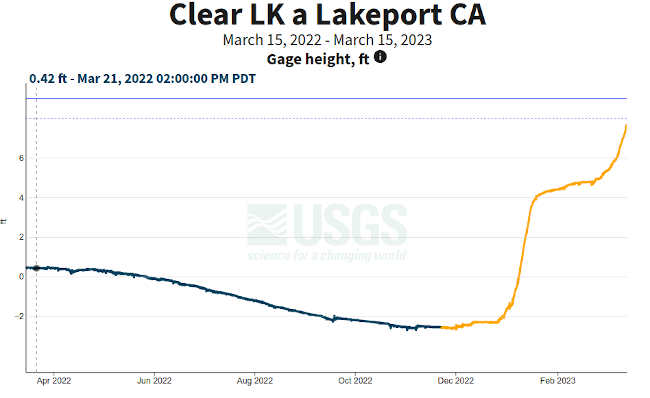
LAKE COUNTY, Calif. — For the first time in several years, Clear Lake is officially full.
The lake hit the full mark, 7.56 feet Rumsey — the special measure for Clear Lake — on Tuesday. It hasn’t been full since May of 2019, which was a flood year.
With more rain in the forecast this week, it’s anticipated Clear Lake could hit the monitor stage, which is 8 feet Rumsey, later this week. Flood stage is at 9 feet Rumsey, which it last reached in March of 2019.
On March 15 of last year, Clear Lake was at 0.43 feet Rumsey. Going into the water year in late 2022, predictions had been for another low water year.
However, the series of atmospheric rivers that began at Christmas and stretched into mid-January, as well as the late-February and early March snowstorms, have helped replenish Clear Lake after some of the driest years since the late 1970s drought.
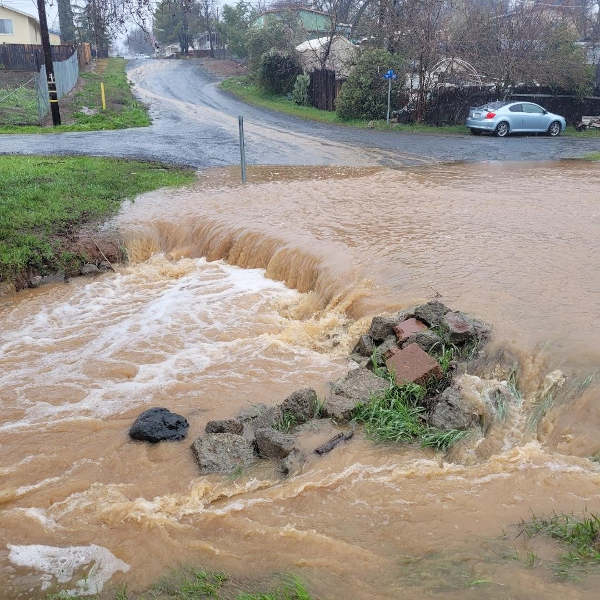
With the high water levels have come some localized flooding.
On Tuesday, the Clearlake Police Department said the road was closed at 37th and Irving avenues due to flooding.
Concerns for high water and flooding also led the Lake County Health Services Department on Tuesday to issue a health advisory.
The department said it is monitoring flood conditions around Clear Lake and other low-lying areas during this period of “significant precipitation.”
“With saturated soil and more rain and snowfall on the way, the department remains concerned about localized flooding and is advising residents to be aware of their proximity to the lake and of the possibility of flood conditions in their immediate area,” Health Services said in a Tuesday statement.
To prevent sewage contamination, which can lead to disease transmission, Health Services said residents at risk of potential flooding should reduce the flow into their drains with strict water conservation measures in addition to checking to ensure that their systems are not backing up, allowing sewage to surface.
Health Services said residents should also prepare to take the following precautions:
• Wastewater systems may not work until floodwaters recede and the water table drops below the septic tank and drain field trenches. A septic system will not function in a flooded yard and should not be used. If a wastewater system depends on a pump, it will not operate properly if the system controls experienced water damage or during a power outage.
• Do not continue to use water if sewage backs up into the household or if water or sewage is visibly surfacing near the septic system. Exposure to raw sewage is a significant health threat and can cause disease.
• Remove and discard household items that become contaminated with sewage and cannot be disinfected, such as rugs, wall coverings and drywall.
• Wear rubber boots and waterproof gloves when cleaning up sewage.
• When power to the system is restored and flood waters recede, the pump system's high-water alarm may sound. If the alarm does not stop sounding, or if the system does not appear to be working properly in some other way, contact the system operator, installer or Environmental Health at 707-263-1164. Repairs may be necessary prior to returning to normal water use, possibly by an electrician if the sewage system's electrical control panel was submerged or if the service connection sustained physical damage.
• Most septic tanks are not damaged by a flood because they are below ground and completely covered. However, septic tanks or pump chambers can become filled with debris. If safe, please attempt to reduce the amount of debris such as yard waste and sediment that may enter the septic tank and plumbing systems.
• If a person suspects that their septic tank is damaged, they should call a professional to inspect, service and clean it, in addition to Environmental Health at 707-263-1164.
Lake County residents with questions or concerns about their on-site wastewater systems or whose homes or businesses are inundated are urged to contact the Lake County Community Development office, 707-263-2221, and Lake County Environmental Health, 707-263-1164, before reoccupying the structures.
Email Elizabeth Larson at
- Details
- Written by: Elizabeth Larson
In a 5-0 vote Tuesday afternoon, the board acted to rescind Resolution No. 2020-22, which enacted the emergency in March of 2020.
As of Tuesday, there have been 13,661 cases in Lake County and 157 deaths. Statewide, there have been 11.1 million cases and 100,640 total deaths since the start of the pandemic.
Resolution No. 2020-22 originally was passed 4-1 — with then-District 5 Supervisor Rob Brown voting no — on March 10, 2020.
The board’s action ratified a public health emergency that then-Public Health Officer Dr. Gary Pace declared on the same day.
Three days later, on Friday, March 13, 2020, then-Sheriff Brian Martin proclaimed the existence of a local emergency due to existing conditions that could introduce COVID-19 into Lake County.
That action was followed within hours by the cities of Clearlake and Lakeport issuing emergency declarations citing the existence of “conditions of extreme peril to the safety of persons and property” due to the potential for COVID-19’s introduction into their respective communities.
At the time of those initial declarations, COVID-19 hadn’t yet been detected in Lake County.
On March 22, 2020, Pace ordered that Clear Lake be closed due to concerns about an influx of visitors despite Gov. Gavin Newsom’s stay-at-home order.
“The risk of a devastating surge in Lake County was significant, and Clear Lake was serving as a magnet, drawing activity that threatened public health,” Pace said in the weeks that followed the action. “I felt I had to shut it down, to protect the well-being of all Lake County residents.”
On April 23, officials once again allowed fishing from Clear Lake’s shorelines, and fishing from kayaks and other hand-propelled vessels shortly followed, with public ramps reopening in early May.
It wasn’t until April 5, 2020, that Pace confirmed Lake County’s first confirmed COVID-19 case, in an individual who contracted it due to an exposure at an out-of-county workplace.
Lake County’s first COVID-19 death was confirmed at the start of July 2020. That individual had become sick at home and was transported by ambulance to a hospital emergency room where they died.
In August 2020, most of Lake County’s schools reopened classes in distance learning mode, with Lucerne Elementary and Upper Lake Unified leading the way by being on campus — although with hybrid options — earlier than other districts.
The county’s convalescent and skilled nursing facilities were hard hit in the summer and early fall of 2020 as numerous cases and deaths were reported.
The Lake County Jail also reported outbreaks, and numerous measures were taken to lessen the impact of the virus, including changing visitation procedures and taking in fewer inmates for an extended period of time.
The pandemic also resulted in impacts to the operations of the Lake County Superior Court. The court asked for, and received, from the state Judicial Council trial time extensions and for some time jury selection and trials took place at the Lake County Fairgrounds, where people could be safely spaced apart.
In July 2021, the Board of Supervisors unanimously passed a resolution urging all community members to wear masks in indoor public settings at the same time as Lake County’s COVID-19 case rate doubled and showed no sign of slowing.
In August 2021, the California Department of Public Health issued a new public health order requiring all school staff to either show proof of full vaccination or be tested at least once per week.
In October 2021, Gov. Gavin Newsom announced his plans to add the COVID-19 vaccine to the list of vaccinations required to attend school in-person when the vaccine receives full approval from the Food and Drug Administration for middle and high school grades, making California the first state in the nation to take such action.
Throughout late 2021 and into 2022, those COVID-19 vaccination mandates at schools led to numerous heated school board meetings. Several county school boards approved a similar resolution asking the state not to enforce vaccine mandates for students and staff.
In October 2022, with no major surge, restrictions began to ease and Newsom announced his plans to end the COVID-19 emergency at the end of February.
With the state’s emergency ending on Feb. 28, local jurisdictions also began to end their emergencies.
On March 7, the Lakeport City Council terminated its COVID-19 emergency declaration.
Earlier that same day, the Board of Supervisors had pulled the ongoing resolution from the consent agenda to ask staff if it was still needed.
In response, County Administrative Officer Susan Parker and her staff followed up with the Public Health Department.
In the letter to the board dated March 9, Sporer requested that the COVID-19 emergency be rescinded and he didn’t believe continued enforcement of an emergency declaration remains necessary given the current state of the pandemic.
Per the direction of the California Department of Public Health, Sporer said the Health Service Department will ensure that any changes in the community-based spread of COVID-19 that could impact the County of Lake is communicated.
“While the pandemic has presented significant challenges to our community, I believe that it is time to reconsider the need for an emergency declaration. We have made significant progress in mitigating the spread of the virus through vaccinations, mask-wearing, and social distancing measures. Currently, the county is at a low to medium tier, and we have remained on this trend for several weeks,” Sporer wrote.
He added, “It is important to note, however, that even with this progress, it is still encouraged to practice necessary safety measures to prevent illness and the potential spread of Covid-19. This is especially important if a resident of the county is experiencing symptoms of Covid-19 or has tested positive for Covid-19. Also, this is important for those who could have compromised
immune systems or potential comorbidities.”
Supervisor Michael Green noted, “A lot has happened in the last three years,” and that it has impacted remote work, how we design work spaces and congregate in crowded rooms.
He asked staff if the county’s workplace policy developed in response to COVID-19 is going to survive if they rescinded the resolution.
Parker said it would, and Human Resources Director Pam Samac said it will become a part of the county’s injury and illness prevention program.
There were no comments from the public before Supervisor Moke Simon moved to rescind the ordinance.
Supervisor Bruno Sabatier seconded Simon’s motion, and the board voted 5-0.
Email Elizabeth Larson at
- Details
- Written by: Elizabeth Larson
The council will meet at 6 p.m. Wednesday, March 15, in the council chambers at Lakeport City Hall, 225 Park St.
The agenda can be found here.
The council chambers will be open to the public for the meeting. Masks are highly encouraged where 6-foot distancing cannot be maintained.
If you cannot attend in person, and would like to speak on an agenda item, you can access the Zoom meeting remotely at this link or join by phone by calling toll-free 669-900-9128 or 346-248-7799.
The webinar ID is 973 6820 1787, access code is 477973; the audio pin will be shown after joining the webinar. Those phoning in without using the web link will be in “listen mode” only and will not be able to participate or comment.
Comments can be submitted by email to
On the agenda for the special meeting are two Community Project Funding requests to Congressman Mike Thompson for the federal fiscal year 2024 budget.
Thompson’s office informed the city that each member of Congress is limited to submitting 15 Community Project Funding requests that are responsive to needs across the entirety of their districts.
“There is no guarantee all requests submitted will be funded. Projects demonstrating a high level of public benefit, regional focus and strong local support is frequently pivotal in the Committee on Appropriations’ competitive evaluation process. Further, Congressman Thompson advises this process is likely to be even more challenging than in recent previous years,” City Manager Kevin Ingram explained in his written report to the council.
Ingram said the city of Lakeport’s staff — working closely with the county of Lake and city of Clearlake — is recommending the Lakeport City Council adopt resolutions of support for two projects.
The first request is for $1,950,000 for predevelopment costs for the development of a regional navigation center to assist homeless individuals in Lakeport.
“Low barrier navigation centers are facilities that provide a safe and welcoming environment for individuals experiencing homelessness. They typically offer basic services such as shelter, food, and hygiene facilities, as well as access to support services such as counseling, healthcare, and job training,” Ingram explained.
Ingram said the public benefits of such facilities will include, but not be limited to, reduced homelessness, supporting mental health and addiction recovery, improved public health, cost savings, improved public safety and increased community engagement.
The second resolution the council will consider is for $31,800,000 for predevelopment and
construction costs for the development of a regional recreation center in the city of Clearlake and aquatic/community center swim center in Lakeport.
The Board of Supervisors approved resolutions supporting the navigation center, and the recreation and aquatic centers at its Tuesday meeting.
During that meeting, both Ingram and City Manager Alan Flora spoke in support of a group effort to seek the funding.
Regarding the navigation center, Ingram told the board that nearly two-thirds of all call volumes through the Lakeport Police Department are related to either homelessness or people experiencing a mental health crisis.
He said they are still working on a site for that facility.
The Clearlake City Council also is set to consider its funding requests at its regular Thursday evening meeting.
Email Elizabeth Larson at