 How to resolve AdBlock issue?
News
- Details
- Written by: DENNIS FORDHAM

An executor bond is a type of probate bond that guarantees that if an executor or an administrator of a decedent’s estate fails to fulfill his or her duties as the personal representative — and harms the estate — that the estate can recover its damages against the value of the bond.
A bond, therefore, is similar to, but is not the same as, insurance.
It is not the same as insurance: If a bond company pays out to the estate, the bond company can try to recover what it pays the estate by going after the personal assets of the executor or administrator. Thus, the point of a bond is to protect the decedent’s beneficiaries but not to protect the administrator or executor who damaged the estate.
In California, generally, a personal representative of a decedent’s probate estate is required to file a probate bond with the court before the court issues the letters of administration or letters testamentary, as relevant, authorizing the personal representative to administer the decedent’s estate.
The probate bond requirement may be, and very often is, waived in the decedent’s will (if a will exists). Otherwise, the bond requirement may also be waived if all the decedent’s heirs are adults and they all sign waivers of bond.
Of course, a decedent’s will, if relevant, may actually require a bond and prohibit a waiver. Moreover, when the personal representative is a resident of another state, the probate court may still require a small bond because the court lacks personal jurisdiction over an out of state representative.
Accordingly, a person petitioning to be appointed as the personal representative of a decedent’s estate must be “bondable” unless the requirement is waived. This reality needs to be considered when a person does a will or when a person petitions to be appointed as personal representative.
Bonds are sold by private bond companies, which set their own prices and standards regarding the issuance of a bond. To be bondable, a person must usually have a sufficient combination of “net worth,” “income,” “credit worthiness” and a “clean criminal record.”
A person with insufficient assets and/or a bad criminal record may not be bondable. No bond company wants to take the risk of a wrongful act occurring and the personal representative having insufficient personal assets against which to recover the bond amount.
The required bond amount is determined by the total value of the estate’s assets and its yearly income. The bond’s annual cost (price) is determined both by the bond amount and the bond applicant’s individual creditworthiness (risk). It is an annual cost and can be paid by (or reimbursed by) the estate itself.
For example, if a probate bond charges 1% annually of the bond price and the amount of the estate and annual income is $500,000 combined, then the bond price for one year is $500.
The initial bond amount is based, in part, on what the bond applicant self-reports as the value of the estate’s assets and its yearly income. After the probate commences, the value of the estate is determined by the probate referee and reported on the estate’s inventory. The bond amount is then adjusted to the reported amount (value) of the estate.
Once a probate goes past 12 months the bond is renewed. The bond can only be discharged (terminated) when the probate court has issued an order to close the probate estate, i.e., which order is granted after all assets are distributed and the business of the probate estate is completed.
The foregoing discussion is a simplified overview and not legal advice. Consult an attorney.
Dennis A. Fordham, attorney, is a State Bar-Certified specialist in estate planning, probate and trust law. His office is at 870 S. Main St., Lakeport, Calif. He can be reached at
- Details
- Written by: LAKE COUNTY NEWS REPORTS
Supplies for the clean-up will be provided — trash bags, trash grabbers, gloves and safety vests for the public to use.
The Rotary is working in partnership with the county of Lake.
All the collected trash will be hauled to the dump. Community volunteers are welcome to join in this effort.
The Rotary Club of Kelseyville Sunrise is participating in the cleanup event organized by Lake County Water Resources.
Club members and community volunteers will work on cleaning up our waterways by picking up trash/tires/anything that doesn’t belong. There will be a site host at two locations, Kelseyville mini park, and Highland Springs, from 9 a.m. to noon.
The Rotary Club of Middletown will be participating in the Clean California Community Day Spring into Action Caltrans sponsored event at two separate locations in South Lake County.
At 9 a.m., the group will meet at the Trailside Park off Dry Creek Cut-off on the outskirts of town. Trailside Park is the home of the EcoArts Sculpture Walk and, in the past, was the site for the High School Cross Country Team training and competition meets.
Rotary Club members will clean up the parking lot area and roadside locations along Dry Creek Cut-off.
At 10 a.m., the group will relocate to Hidden Valley Lake and meet at the Mountain High Coffee Shop in the Hardester’s Market Shopping Plaza.
The group will remove trash and litter along Hartmann Road and along the side road of the shopping plaza that leads to Coyote High School.
After the Middletown event, the group will head to Rock ‘n Rolled Ice-Cream for lunch and/or dessert in support of local small businesses. Rock ‘n Rolled Ice-Cream owner Baylee Grove was the first place winner in the Startup Business Category of the 2022 1Team1Dream Third Annual ‘Hands Up’ Lake County Small Business Competition.
For more information regarding Clean California Lake County projects contact Terry Dereniuk, Rotary of Kelseyville Club president, at
- Details
- Written by: Dan McEvoy, Desert Research Institute
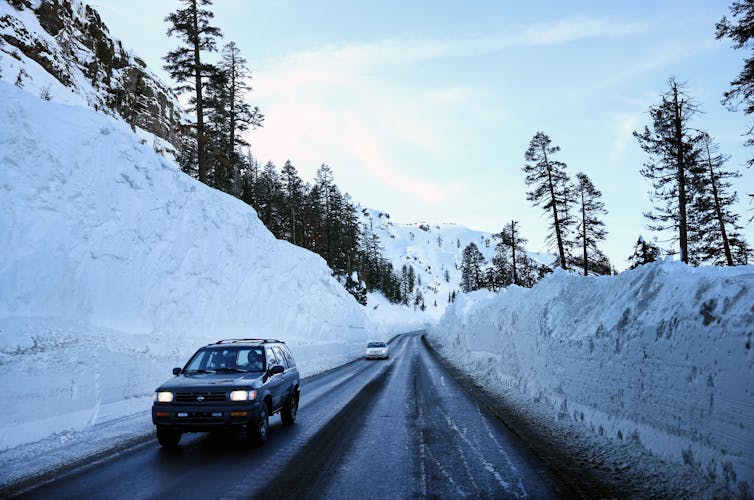
After three years of extreme drought, the Western U.S. is finally getting a break. Mountain ranges are covered in deep snow, and water reservoirs in many areas are filling up following a series of atmospheric rivers that brought record rain and snowfall to large parts of the region.
Many people are looking at the snow and water levels and asking: Is the drought finally over?
There is a lot of nuance to the answer. Where you are in the West and how you define “drought” make a difference. As a drought and water researcher at the Desert Research Institute’s Western Regional Climate Center, here’s what I’m seeing.
How fast each region recovers will vary
The winter of 2023 has made a big dent in improving the drought and potentially eliminating the water shortage problems of the last few summers.
I say “potentially” because in many areas, a lot of the impacts of drought tend to show up in summer, once the winter rain and snow stop and the West starts relying on reservoirs and streams for water. Spring heat waves like the ones we saw in 2021 or rain in the mountains could melt the snowpack faster than normal.
California and the Great Basin
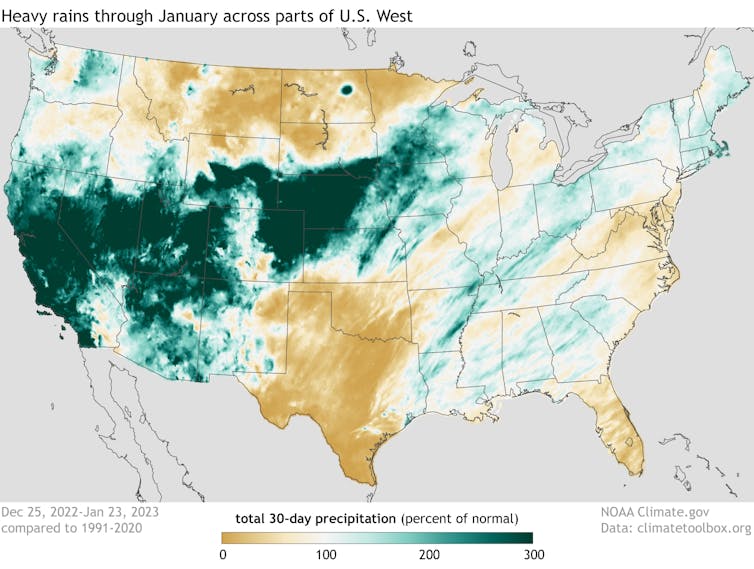
In California, the state’s three-year precipitation deficit was just about erased by the atmospheric rivers that caused so much flooding in December and January. By early March, the snowpack across the Sierra Nevada was well above the historical averages – and more than 200% of average in some areas. The Metropolitan Water District of Southern California announced it was ending emergency water restrictions for nearly 7 million people on March 15.
It seems as though most of the surface water drought – drought involving streams and reservoirs – could be eliminated by summer in California and the Great Basin, across Nevada and western Utah.
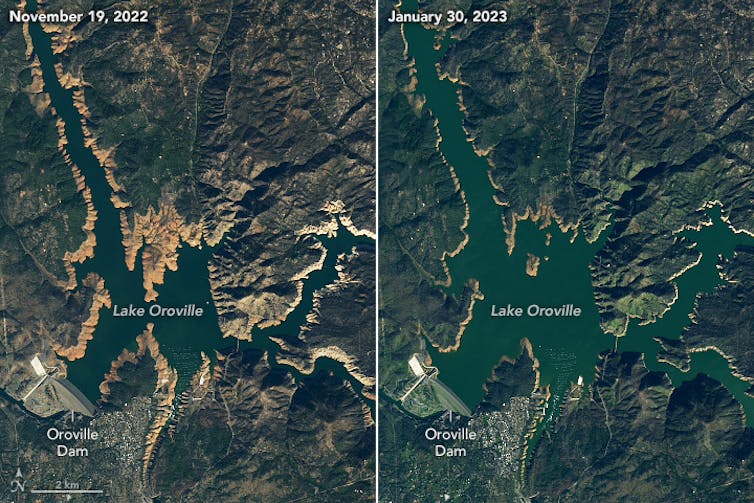
But that’s only surface water. Drought also affects groundwater, and those effects will take longer to alleviate.
Studies in California have shown that, even after wet years like 2017 and 2019, the groundwater systems did not fully recover from the previous drought, in part because of years of overpumping groundwater for agriculture, and the aquifers were not fully recharging.
In that sense, the drought is not over. But at the broader scale for the region, a lot of the drought impacts that people experience will be lessened or almost gone by this summer.
The Colorado River Basin
Similar to the Sierra Nevada, the Upper Colorado River Basin – Wyoming, Colorado, Utah and northwestern New Mexico – has a healthy snowpack this year, and it’s looking like a very good water year there.
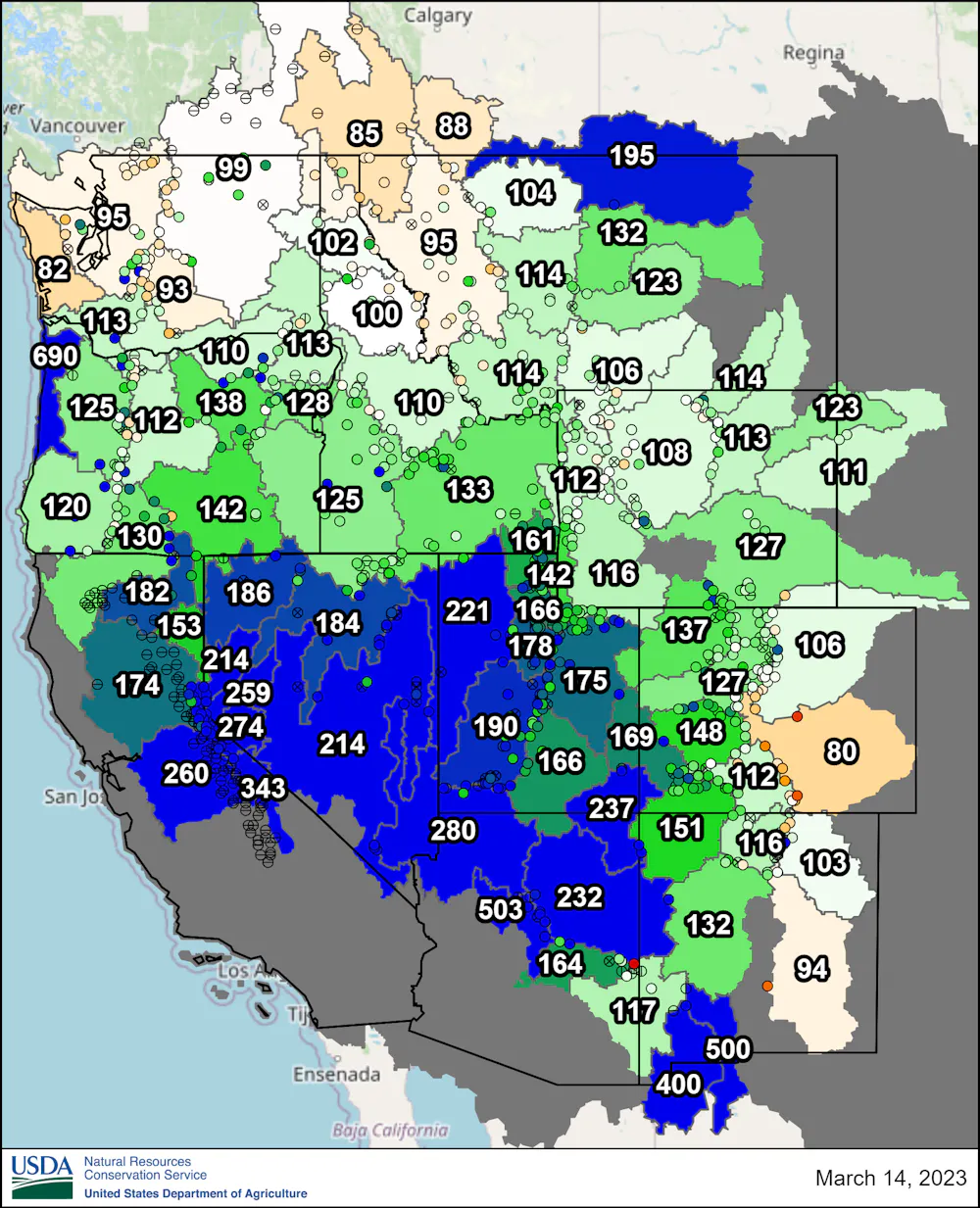
But one single good water year is not going to fill Lake Mead and Lake Powell. Most of the region relies on those two reservoirs, which have declined to worrying levels over the past two decades. NOAA’s seasonal drought outlook released on March 16 noted that both remained low.
Two good water years won’t do it either. Over the next decade, most years will have to be above average to begin to fill those giant reservoirs. Rising temperatures and drying will make that even harder.
So, that system is still going to be dealing with a lot of the same long-term drought impacts that it has been seeing. The reservoirs will likely rise some, but nowhere close to capacity.
The Pacific Northwest
The Pacific Northwest isn’t having as much rain and snow, and it’s a little drier there. But it’s close to average, so there’s not a huge concern there, at least not right now.
Forests, range land and the fire risk
Drought can also have longer-term impacts on ecosystems, particularly forest health.
The Sierra Nevada range has seen large-scale tree die-offs with the drought in recent years, including in northern areas around Lake Tahoe and Reno that weren’t as affected by the previous drought. Whether the recent die-offs there are due to the severity of the current drought or lingering effects from the past droughts is an open question.
Even with a wet winter, it’s not clear how soon the forests will recover.
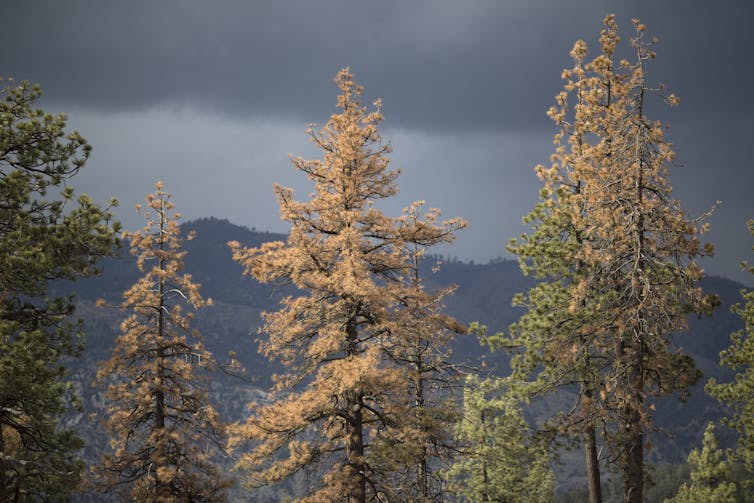
Rangelands, since they are mostly grasses, can recover in a few months. The soil moisture is really high in a lot of these areas, so range conditions should be good across the West – at least going into summer.
If the West has another really hot, dry summer, however, the drought could ramp up again, particularly in the Northwest and California. And then communities will have to think about fire risk.
Right now, there’s a below-normal likelihood of big fires in the Southwest for early spring due to lots of soil moisture and snowpack.
In the higher-elevation mountains and forests, the above-average snowpack is likely to last longer than it has in recent years, so those regions will likely have a later start to the fire season. But lower elevations, like the Great Basin’s shrub- and grassland-dominated ecosystem, could see fire danger starting earlier in the year if the land dries out.
Long-term outlooks aren’t necessarily reliable
By a lot of atmospheric measures, California appears to be coming out of drought, and the drought feels like it’s ending elsewhere. But it’s hard to say when exactly the drought is over. Studies suggest the West’s hydroclimate is becoming more variable in its swings from drought to deluge.

Drought is also hard to forecast, particularly long term. Researchers can get a pretty good sense of conditions one month out, but the chaotic nature of the atmosphere and weather make longer-range outlooks less reliable.
We saw that this year. The initial forecast was for a dry winter 2023 in much of the West. But in California, Arizona and New Mexico, the opposite happened.
Seasonal forecasts tend to rely heavily on whether it’s an El Niño or La Niña year, involving sea surface temperatures in the tropical Pacific that can affect the jet stream and atmospheric conditions around the world. During La Niña – the pattern we saw from 2020 until March 2023 – the Southwest tends to be drier and the Pacific Northwest wetter.
But that pattern doesn’t always set up in exactly the same way and in the same place, as we saw this year.
There is a lot more going on in the atmosphere and the oceans on a short-term scale that can dominate the La Niña pattern. This year’s series of atmospheric rivers has been one example.
Dan McEvoy, Associate Research Professor in Climatology, Desert Research Institute
This article is republished from The Conversation under a Creative Commons license. Read the original article.
- Details
- Written by: Elizabeth Larson
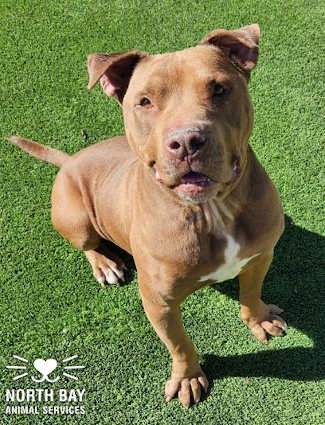
CLEARLAKE, Calif. — Despite having a large number of dogs waiting for new homes, Clearlake Animal Control continues to maintain a high live release rate.
At Thursday’s Clearlake City Council meeting, Alyssa Terry, a shelter animal care technician, and Lt. Ryan Peterson of the Clearlake Police Department offered the monthly shelter update.
They brought with them Mila, a female shepherd mix who Terry said loves everybody and is in need of a home.
Mila, who is in foster care, is very polite, likes to sit in laps and get tummy rubs, knows commands, is house- and crate-trained, and would probably be OK with cats with a proper introduction, Terry said.
Terry also said Mila is spayed and vaccinated.
She said another 10 dogs have been transferred to North Bay Animal Services’ Petaluma shelter last week. North Bay Animal Services provides animal control services for the city.
“Our volunteers rock,” said Terry, explaining that they come in daily to exercise the dogs and to help with dishes and laundry.

Lt. Peterson said that, as of Thursday, 108 dogs had come into the shelter since the start of the year.
Of those, 56 dogs have left — 27 were rescued, 23 were returned to owners, five adopted, one died or was lost, he said.
Peterson said none have been euthanized, giving the city a 99.9% live release rate.
There continue to be 33 adoptable dogs on the website, with another 19 in the shelter that are expected to be listed soon.
The shelter is located at 6820 Old Highway 53. It’s open from 9 a.m. to 6 p.m. Tuesday through Saturday.
For more information, call the shelter at 707-762-6227, email
This week’s adoptable dogs are featured below.
Email Elizabeth Larson at