 How to resolve AdBlock issue?
News
- Details
- Written by: UNITED STATES FOREST SERVICE
The greatest impacts are expected over Central and Northern California, particularly flooding across the Sierras.
Several feet of water are trapped in Central and Northern California snowpack. Heavy rains will cause significant melting of heavy snowpack below 6,000 feet and could lead to significant flooding, road and infrastructure damage in those areas.
Heavy rains are expected to continue through early next week, which could worsen and prolong flooding impacts.
Some national forests, like Sequoia National Forest, have already closed many forest-managed roads. Closures are being put in place for public and employee safety. Heavy rain can put forest visitors and residents at risk. Debris flows and flash floods often develop with little warning.
Safety tips for heavy rain and flooding
Please act with extra caution if in affected areas during this high-alert weather event.
• Do not camp or park vehicles along streams or rivers.
• Move to higher ground if heavy rain or rising water occurs.
• NEVER drive through flooded roadways.
Weather and planning resources
California National Forests | Contact Directory
Caltrans QuickMap — Current information on road closures
Weather Watches, Warnings and Advisories | National Weather Service
Turn Around, Don’t Drown | Ready.gov
California Office of Emergency Services | Cal OES
- Details
- Written by: Elizabeth Larson

CLEARLAKE, Calif. — There are many dogs continuing to wait for homes at Clearlake Animal Control.
There currently are 33 adoptable dogs at the shelter available to be adopted into new homes.
They include “Chogi,” a pit bull terrier mix, and “Evie,” a female German shepherd mix.

The shelter is located at 6820 Old Highway 53. It’s open from 9 a.m. to 6 p.m. Tuesday through Saturday.
For more information, call the shelter at 707-762-6227, email
This week’s adoptable dogs are featured below.
Email Elizabeth Larson at
- Details
- Written by: Ray Block Jr, Penn State; Andrene Wright, Penn State, and Mia Angelica Powell, Penn State
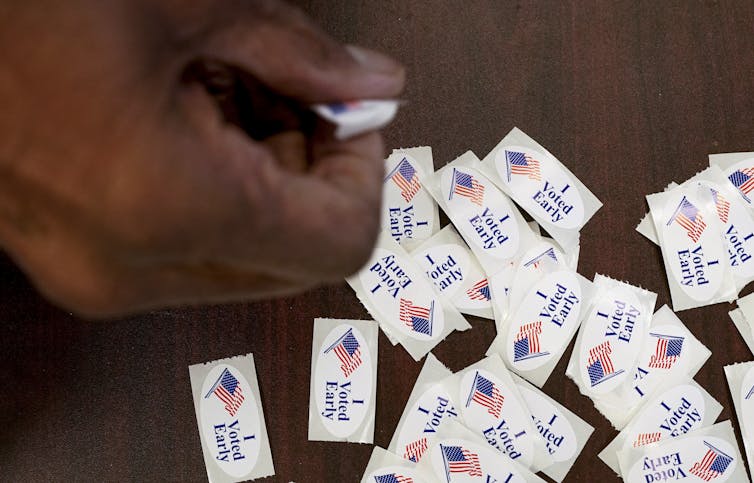
President Joe Biden will convene world leaders beginning on March 29, 2023, to discuss the state of democracies around the world.
The Summit for Democracy, a virtual event being co-hosted by the White House, is being touted as an opportunity to “reflect, listen and learn” with the aim of encouraging “democratic renewal.”
As political scientists, we have been doing something very similar. In the fall of 2022 we listened to thousands of U.S. residents about their views on the state of American democracy. What we found was that, despite widespread fears over the future of democracy, many people are also hopeful, and that hope translated into “voting for democracy” by shunning election result deniers at the polls.
Our study – and indeed Biden’s stated push for democracy – comes at a unique point in American political history.
As a group, we have decades of experience studying politics and believe that not since the American Civil War has there been so much concern that American democracy, while always a work in progress, is under threat. Survey trends point to eroding trust in democratic institutions. And in addition to serving as a direct reminder of our political system’s fragility, the Jan. 6, 2021, attack on the Capitol provoked concern of the potential of democratic backsliding in the U.S.
Fears of a failing democracy
The 2022 midterms were the first nationwide ballot to take place after the Jan. 6 attack. The vote provided a good opportunity to check in with potential U.S. voters over how they viewed the risks to democracy.
As such, in the fall of 2022, the African American Research Collaborative – of which one of us is a member – worked with a team of partners to create the Midterm Election Voter Poll. In an online and phone survey, we asked more than 12,000 U.S. voters from a variety of backgrounds a series of questions about voting intention and trust in national politics. Respondents were also quizzed over their concern about the state of American democracy.
On a five-point scale ranging from “very” to “not at all,” the survey asked how worried respondents were that: “The political system in the United States is failing and there is a decent chance that we will no longer have a functioning democracy within the next 10 years.”
Roughly 6 in 10 Americans expressed fear that democracy is in peril, with 35% saying they were “very worried.”
Broken down by race and ethnicity, white Americans were the most concerned, with 64% expressing some worry that democracy is in peril. Black and Latino Americans were slightly less concerned. Asian Americans appeared the least worried, with 55% expressing concern.
Of the 63% of respondents who registered concern, more than half said they were “very worried” that democracy is in trouble and that it may soon come to an end.
Such fragility-of-democracy concerns can have a self-perpetuating effect; voters’ increasing lack of faith in their system can hasten the collapse in government they fear.
For example, negative attitudes about democracy can also destabilize voting habits – prompting some to skip elections altogether while motivating others to swing back and forth between candidates and political parties from one election to another. This pattern of voting can, in turn, lead to gridlock in government or worse: the election of cynical politicians who are less able – or even willing – to govern. It is a process that former Democratic Rep. Barney Frank of Massachusetts described in 2015 as the “self-fulfilling prophesy of ‘government doesn’t work.’”
Turning hope into action
But the story that emerged from our survey isn’t all doom and gloom.
In addition to confirming how endangered Americans believe their democracy is, citizens appear hopeful that their political system can recover. When given the prompt: “Overall, as you vote in November 2022, are you mostly feeling …,” more than 40% of the respondents – regardless of race or ethnicity – said they felt “hopeful.”
Indeed, “hope” was by far the most common feeling out of the four emotions that respondents were able to choose from. “Worry” was the second most typical emotion, with 31% of the total sample selecting it, followed by “pride” and “anger.”
Rather than resigning themselves to a lost democracy, the results indicate that voters from a broad array of demographic and political backgrounds feel hopeful that American democracy can overcome the challenges facing the nation.
Black Americans were among the most hopeful (49%), second only to Asian Americans (55%), while white Americans were the most worried (33%). These racial and ethnic differences are consistent with recent research on how emotions can shape politics.
The results also make sense in the context of the trajectory of race relations in the U.S. Black people have borne the brunt of what happens when authoritarian forces in this country have prevailed. They have suffered firsthand from anti-democratic actions being used against them, depriving them of the right to vote, for example. Throughout U.S. history, stories of racial progress often reveal a struggle to reconcile feelings of hope and worry – particularly when thinking about what America is versus what the nation ought to be.
Such hope in democracy has turned into action. Efforts to counter GOP-led attempts to suppress votes are encouraging signs of citizens combating anti-democratic measures, while punishing parties deemed to be pushing them.
Take the example of Georgia, which has “flipped from Republican to Democrat” in large part because of voting rights activist and Democratic politician Stacey Abrams’ tireless mobilization efforts. In the midterm election, GOP Senate candidate Herschel Walker underperformed among Black voters, winning less of the Black vote than GOP candidates in other states.
The breaking of the Republican stronghold in Georgia fits with a broader theme of Black voters casting ballots to “save democracy,” as scholars writing for the Brookings Institution think tank put it. In rejecting anti-democratic measures – and representatives of the party held responsible – in Georgia, “Black people were the solution for an authentic democracy.”
Black women deserve the most credit here, consistently voting for pro-democracy candidates. Not surprisingly, when broken down by race and gender, our survey shows that Black women are most hopeful (56%), some way ahead of white men (43%), with Black men and white women both at 42%.
A democracy, to keep for good.
Democracy has long been a cherished ideal in the U.S. – but one that from the country’s founding was perceived to be fragile.
When asked what sort of political system the Founding Fathers had agreed upon during the Constitutional Convention of 1787, Benjamin Franklin famously replied: “A republic, if you can keep it.”
While acknowledging that the success of our government isn’t promised, Franklin’s words serve as a reminder that citizens must work relentlessly to maintain and protect what the Constitution provides. What we’ve discovered, both from our survey and from how people voted, is that Americans are sending a clear message that they support democracy, and will fight anti-democratic measures – something that politicians of all parties might benefit from listening to if we want to keep our republic.
Ray Block Jr, Brown-McCourtney Career Development Professor in the McCourtney Institute and associate professor of political science and African American studies, Penn State; Andrene Wright, Presidential Postdoctoral Fellow, Penn State, and Mia Angelica Powell, PhD Student in Department of Political Science, Penn State
This article is republished from The Conversation under a Creative Commons license. Read the original article.
- Details
- Written by: PRESTON DYCHES
What's up for March? Venus climbs high while Jupiter dives sunward, and the little planet that shares its namesake with your breakfast cereal.
Venus and Jupiter began the month very close together in the evening sky, following their close conjunction on March 1.
They quickly went their separate ways, though.
Venus climbs higher in the sky each night for the next couple of months, while Jupiter dives after the Sun.
The giant planet appears lower in the sky each night through the month, making its exit as an evening object. It'll reappear in May, in the predawn sky, with Saturn.
On the 23rd and 24th, in the couple of hours after sunset, you'll find the Moon as a beautifully slim crescent hanging just below, and the next night above, blazing bright Venus. Then, on the 25th, the Moon continues upward in the sky, landing right next to the brilliant Pleiades star cluster that night.
With March bringing the arrival of spring in the Northern Hemisphere and fall in the Southern Hemisphere, it's a time for both planting or harvesting crops, depending on where you live. So it's perhaps a fitting time to try and spot the planet named for a mythical goddess of agriculture, grains, and fertile lands. (In addition to being the origin of the word "cereal.")
That's dwarf planet Ceres. This month it's at opposition, meaning it's directly on the opposite side of Earth from the Sun. This is when a planet is around its shortest distance from Earth, making this the best time to have a go at observing it when it's at its brightest.
Ceres is the largest object in the main asteroid belt between Mars and Jupiter. Still it's only about 600 miles wide — far smaller than our own Moon. Its dusty surface is peppered with impact craters, with bright salt deposits here and there, that hint at the possibility of slushy, briny ice beneath. In fact, NASA's Dawn spacecraft found that Ceres could be up to one-quarter water ice on the inside.
Now, Ceres is too faint to see with the unaided eye, so to locate it in the March sky, you'll need binoculars or a small telescope. Find the lion constellation Leo in the southeast after around 9 p.m.
The bright, bluish-white star Regulus (the lion's heart) should catch your eye first. Then look eastward about 25 degrees to find Denebola, which represents the lion's tail. From there Ceres should be 8 or 9 degrees farther east from Denebola. It appears as a faint, starlike point of light — which is why, when Ceres and objects like it were first discovered in the early 19th century, they were called "asteroids," which means "starlike."
Since 2006, Ceres has been classified as a dwarf planet — along with other diminutive worlds in our solar system including Pluto, Eris, Haumea, and Makemake. Wherever you land on the topic of "planet vs. dwarf planet" -status for worlds like Ceres and Pluto, what's really important to remember is that the way we think about different families of objects in our solar system has evolved over time, and likely will continue to evolve as we explore and learn more about them.
So here's hoping you try your hand at spotting Ceres as you explore the skies above your home planet this month.
Stay up to date with all of NASA's missions to explore the solar system and beyond at www.nasa.gov.
Preston Dyches works for NASA's Jet Propulsion Laboratory.