 How to resolve AdBlock issue?
News
- Details
- Written by: Elizabeth Larson
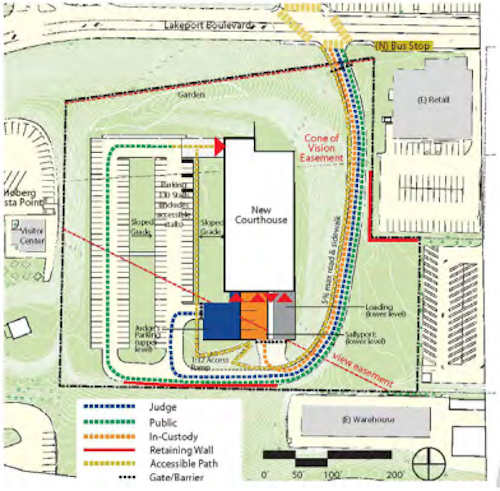
LAKE COUNTY, Calif. — With the construction of Lakeport’s new courthouse set to start early next year, the Lakeport City Council held a discussion on Tuesday about possible traffic improvements to facilitate the higher traffic volumes expected in the project area.
The 45,300 square foot courthouse will be built on a five-acre site at 675 Lakeport Blvd. The cost is $73.1 million.
The Judicial Council of California reported that the project is now in the design-build phase, with construction expected to begin in February 2024 and to be completed in October 2025.
City Manager Kevin Ingram updated the council on the courthouse project and asked for direction on which traffic improvement options to take in Lakeport Boulevard.
Those improvements will be focused mainly on the area around the intersection with Larrecou Lane, which also is an access street to the Lakeport Senior Center and the city’s corporation yard.
Ingram said the main access to the courthouse site is a private driveway from the top of the hill along the eastern boundary of the property to Lakeport Boulevard near the intersection with Larrecou Lane.
“That was not originally the city’s preference” for the site access, but Ingram said that’s the direction the state’s studies are taking them.
Initially, the city wanted the Judicial Council to consider changing the access to the west side of the property, which would go around the county-owned agriculture building. However, he said the state has not been open to that option.
Now, the state is picking up the pace on the courthouse project, and the state’s traffic studies are showing minimal impact on traffic. Over the years, Ingram said the city has expressed its dissatisfaction with those findings.
With the state telling the city that it only has a small amount of money for roadway improvements, Ingram said the city has looked at the Lakeport Boulevard corridor and developed four options.
The first option, which Ingram said city staff didn’t support, is a traffic signal at Lakeport Boulevard at Larrecou Lane.
Ingram said there are no stoplights in Lakeport now, explaining they require maintenance estimated at $150,000 to keep them calibrated.
In addition to that ongoing cost that the city would have to absorb, Ingram said a traffic signal would be obtrusive to the corridor and its businesses — which include two grocery stores — especially on the east side.
The second option, and a less obtrusive one, is a small roundabout at the Lakeport Boulevard and Larrecou Lane intersection, Ingram said.
Ingram said the main problem with the roundabout option is expense due to acquiring the right of way. As a result, it’s likely to exceed the $500,000 for intersection improvements the Judicial Council has tentatively offered.
The third option is a two-way stop, with controlled access. Ingram said a new stop sign would be placed at the bottom of the courthouse driveway, across from the existing stop sign on Larrecou.
Ingram said that option likely would require some geometric redesign of Lakeport Boulevard. It would need a deceleration lane and a dedicated turn lane to turn into the site. A challenge would be pedestrian access, with city staff having discussed a lighted crosswalk.
The fourth option is a four-way stop. “That would certainly meet the needs when the court is in session,” said Ingram, but it would stop traffic along that entire traffic corridor around the clock, seven days a week.
Ingram said the third and fourth options could fit into the state’s $500,000 proposed budget, while the city would have to fund the traffic signal and roundabout options.
Councilman Kenny Parlet raised an issue with why the city should pick up the entire tab for the road improvements, since it’s a county courthouse. Ingram said it was a valid point, and that the county hasn’t yet been asked to contribute.
Councilman Michael Froio said they don’t want to see the courthouse leave the city. He said the city needed to try to plan for the future and determine the best ingress and egress, as the state is determined to build the courthouse in that location.
Councilmember Kim Costa pointed out the potential traffic challenges with vehicles coming off the overpass a block away.
Mayor Stacey Mattina said the additional traffic would mean that left hand turns to get out of store parking lots would be very difficult, forcing vehicles to turn right toward Main Street.
Froio pointed to the “Lakeport Hub” project, consisting of a new hotel, stores, restaurants and a gas station, that’s proposed to be built at 1842 Todd Road.
With all of that new development going on in the area and impacting traffic, “This thing is looking like a mess,” Froio said.
Ingram said there are positive aspects for traffic flow by having a roundabout at the intersection with Lakeport Boulevard and Bevins Street
He said he believes the court is underestimating the amount of money that will be required to dig into the hill to do the deceleration lane for the courthouse driveway.
While he said the Bevins Street and Lakeport Boulevard intersection is a critical piece for developing the traffic corridor, the state has made it clear that it’s off the table in connection to the courthouse project.
Costa moved to direct city staff to work with a traffic engineering consultant to develop preliminary design and detailed cost estimates for the two options the council favored following discussion — a roundabout and a two-way stop.
Parlet seconded and the council voted 5-0.
Ingram said city staff would get to work on that process and return to the council with options to review in a few months.
On Tuesday the council also welcomed new Community Development Department Administrative Specialist Mel Olea.
An MIT graduate who grew up in Lake County and has worked in the Bay Area, Olea told the council, “I’m really happy to be back to where I have roots.”
He said his family and friends are here, “And now my work family's here.”
Mattina quipped that Parlet nearly fell out of his seat when he heard Olea had attended MIT.
In other business on Tuesday, the council approved setting a public hearing next month for the purpose of certifying a mitigated negative declaration with a mitigation monitoring and reporting program, adopting a general plan amendment and zone change to revise the zoning associated with the Martin Street Phase III Residential Project.
That 40-unit project will be built by AMG & Associates LLC at 519 S. Smith St., next to the Phase I and II of the Martin Street Apartments, also built by AMG.
Council members also approved authorizing Ingram to execute the professional services agreement with Community Development Services for federal grant business financial assistance program services, and conditionally awarded a construction contract to James Day Construction Inc. dba Coastal Mountain Electric for the Silveira Community Center Electrical and HVAC Project.
Email Elizabeth Larson at
- Details
- Written by: LAKE COUNTY NEWS REPORTS
Those counties are Butte, El Dorado, Fresno, Humboldt, Imperial, Inyo, Lake, Mendocino, Merced, Monterey, Napa, Placer, Plumas, Sacramento, San Francisco, San Mateo, Santa Clara, Santa Cruz, Stanislaus, Tuolumne and Yuba.
The governor last week proclaimed a state of emergency in 13 counties due to storms, and activated the California Guard and State Operations Center to bring state support to county-led emergency response efforts and coordinate mutual aid from neighboring jurisdictions.
“The state is working around the clock with local partners to deploy life-saving equipment and first responders to communities across California,” said Gov. Newsom. “With more dangerous storms on the horizon, we’ll continue to mobilize every available resource to protect Californians.”
The state has significant staffing and equipment resources from the Governor’s Office of Emergency Services, or Cal OES, along with Caltrans, the California Highway Patrol, Cal Fire and the California National Guard on the ground in impacted areas.
Cal Fire and partner agencies have 43 crews active statewide, 12 of which are committed to the San Bernardino storm incident, as well as two helicopters, two dozers and an Incident Management Team, among other resources.
The California Guard is pre-positioning high water vehicles in preparation for flood response operations.
Caltrans has mobilized more than 4,000 crew members to hundreds of incidents statewide, working 24/7 in shifts.
In San Bernardino County, more than 57 Caltrans employees operating 40 high-powered pieces of equipment, including snowplows, graders, loaders and dump trucks, have removed more than 12.6 million cubic yards of snow off state highways as of March 8, which equates to more than 3,800 Olympic-size swimming pools.
CHP is increasing resources in targeted areas to help address storm-related needs – including ensuring full staffing for air operation missions, ready to deploy as needed.
Cal OES has coordinated with the Department of Developmental Services to open six shelters in the counties of San Bernardino, Stanislaus, Madera, Butte and Nevada, and has facilitated food donations through the California Grocers Association to provide meal kits in San Bernardino County.
Visit CalAlerts.org to sign up for local wireless emergency alerts and QuickMap to check road conditions in your area.
- Details
- Written by: Peter J. Mateyka and Jayne Yoo
The pandemic began in the United States following a period of rising home prices and declining interest and vacancy rates. These pressures increased during the pandemic, contributing to higher home prices and rents.
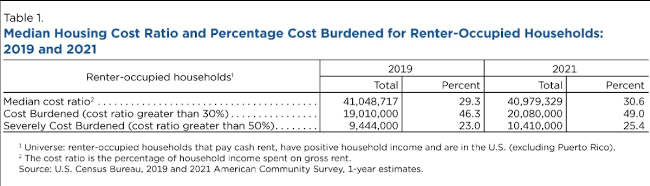
The percentage of household income renter households spent on gross rent (rent plus utilities) — the housing cost ratio — increased nationwide from 2019 to 2021, according to recently released data from the U.S. Census Bureau’s 2021 American Community Survey (ACS).
But renter households with the lowest annual incomes, a population that traditionally has less income available for other essential goods, experienced the largest percentage point increases.
Renters spent more on rent since 2019
The U.S. Census Bureau calculates housing cost ratios for all renter-occupied units that pay cash rent and have positive household income.
When a household has a cost ratio of over 30%, it is considered cost-burdened, according to the Department of Housing and Urban Development (HUD). Severely cost-burdened households have cost ratios of over 50%.
Cost-burdened households have less money to spend on other critical needs such as food, transportation and child care.
The median cost ratio for all renter-occupied households increased from 29.3% in 2019 to 30.6% in 2021 (Table 1).
This increase shifted the number of households considered cost burdened from 46.3% to 49.0% of all renter-occupied units. That means just under half of all renter-occupied households in the United States were cost burdened in 2021.
In 2021, 20.1 million renter-occupied households met the over 30% income threshold and were cost burdened, an increase of about 1 million households since 2019.
The number of severely burdened households rose to 25.4% (about 10.4 million renter-occupied units) from 23.0% in 2019 (9.4 million).
Renters’ household incomes lower than homeowners
Renter-occupied households historically have lower household incomes than owner-occupied households and may be more affected by changes in household income and rental prices.
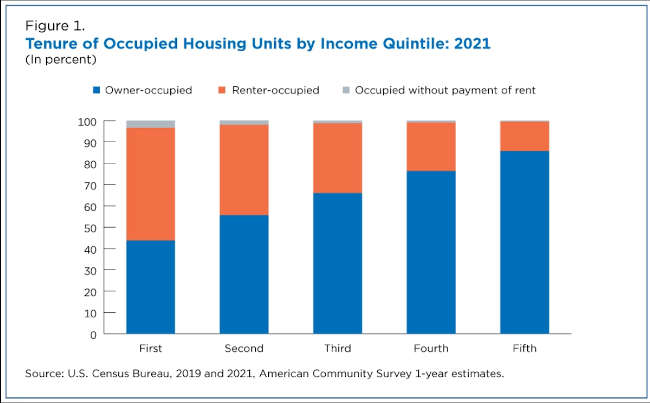
Categorizing households into five equally sized groups (known as quintiles) from those with the lowest to highest incomes showed that renter-occupied households were more likely than owner-occupied households to be in the lowest income quintiles (Figure 1).
Renter-occupied households made up 52.9% of households in the lowest income quintile and 42.4% of households in the second lowest income quintile. In contrast, only 13.8% of households in the top income quintile were in renter-occupied units.
Low-income renters hardest hit
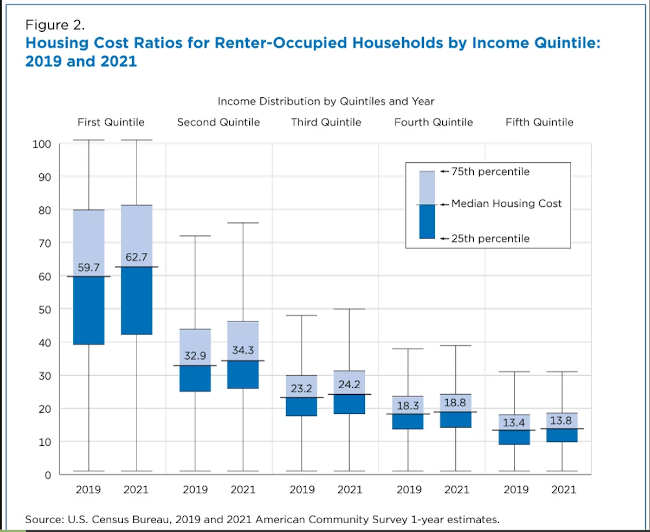
Renter-occupied households in the lowest income quintile had a median cost ratio of 62.7% in 2021. That means that half of the renter-occupied households in this quintile paid gross rent that was more than 62.7% of their total household income, 3 percentage points higher than in 2019. (A cost ratio of 62.7% is over twice the HUD cost burden threshold.)
This was the largest percentage-point increase in median rental cost ratio of any income quintile (Figure 2). The second income quintile went up 1.4 percentage points and the third income quintile by 1.0 point. The top two income quintiles had the smallest increases (0.6 and 0.4 percentage points).
For low-income renter households, even a small change in rental costs can have a significant impact on their cost ratios.
For example, while the median housing cost ratio was higher for renter households in the lowest income quintile, the cost ratios were also much more variable for this group than the higher-income quintiles (Figure 2).
This variability reflects the outsized impact of small changes in housing costs and incomes on the cost ratio for those in the lowest-income group compared to those in higher-income groups.
Renter households at all income levels more likely to be cost burdened
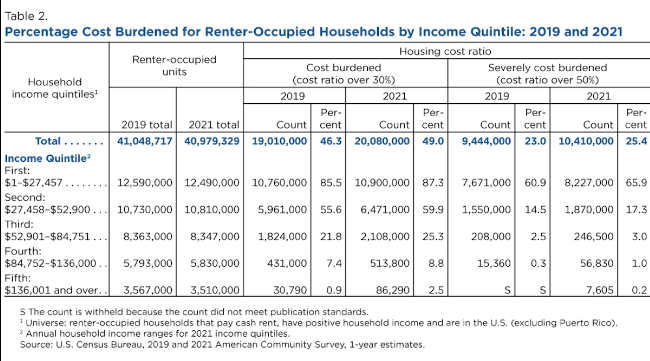
Statistics on the number of renter households cost burdened, in addition to the median housing cost ratio, are useful because renters who meet or exceed these thresholds may face hardships meeting basic needs (Table 2).
The lowest-income quintile had the largest number (10.8 million) of cost-burdened renter occupied households, which climbed from 85.5% in 2019 to 87.3% or 10.9 million in 2021.
The numbers were even more striking for the severely cost burdened with a substantial increase in renters in the lowest income quintile paying more than half their income for rent. In 2021, 65.9% of renter-occupied households in the lowest-income quintile were severely cost burdened, an increase of over 500,000 households from 60.9% in 2019.
In addition, 59.9% of renter-occupied households in the second quintile were cost burdened in 2021, up from 55.6% in 2019; 17.3% of them were severely burdened, up from 14.5% in 2019.
In the third quintile, 25.3% were cost burdened, up from 21.8%. Only 3.0% of households in the third income quintile were severely cost burdened in 2021, but that was still higher than the 2.5% in 2019.
Though renter-occupied households in the top income groups were far less likely to be cost burdened, they still experienced significant increases.
The fourth quintile went from 7.4% burdened in 2019 to 8.8% in 2021, and the fifth quintile went from 0.9% to 2.5%. But renter-occupied households in the fourth and fifth income quintiles were rarely severely cost burdened.
Peter J. Mateyka is a statistician and Jayne Yoo is an economist in the Census Bureau’s Social, Economic, and Housing Statistics Division.
- Details
- Written by: Kimberley Davis, United States Forest Service; Jamie Peeler, University of Montana, and Philip Higuera, University of Montana
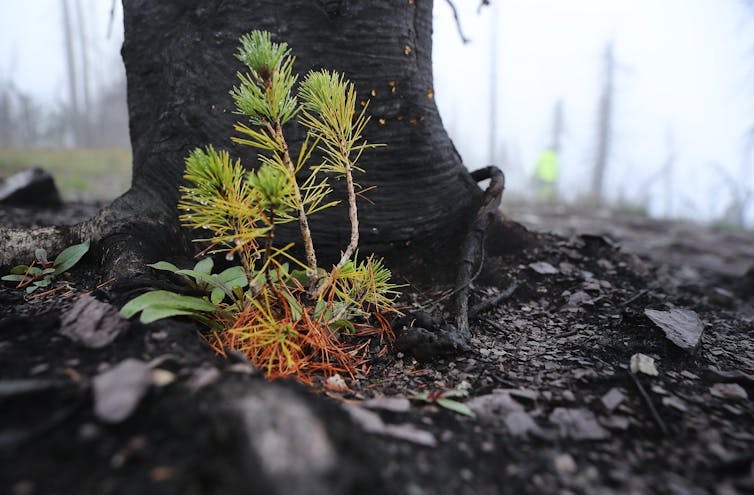
Wildfires and severe drought are killing trees at an alarming rate across the West, and forests are struggling to recover as the planet warms. However, new research shows there are ways to improve forests’ chances of recovery – by altering how wildfires burn.
In a new study, we teamed up with over 50 other fire ecologists to examine how forests have recovered – or haven’t – in over 10,000 locations after 334 wildfires.
Together, these sites offer an unprecedented look at how forests respond to wildfires and global warming.
Our results are sobering. We found that conifer tree seedlings, such as Douglas-fir and ponderosa pine, are increasingly stressed by high temperatures and dry conditions in sites recovering from wildfires. In some sites, our team didn’t find any seedlings at all. That’s worrying, because whether forests recover after a wildfire depends in large part on whether new seedlings can establish themselves and grow.
However, our team also found that if wildfires burn less intensely, forests will have a better shot at regrowing. Our study, published March 6, 2023, highlights how proactive efforts that modify how wildfires burn can help buffer seedlings from some of the biggest stressors of global warming.
Intense fires overwhelm trees’ protective traits
Forests and wildfire have coexisted in the West for millennia.
Typically, forests have regrown after wildfires, thanks to an amazing set of traits that trees possess. Lodgepole pine, for example, stores thousands of seeds in closed cones sealed with resin, that only open in the presence of high heat from flames, triggering abundant regrowth. Other tree species, like ponderosa pine, have thick bark that helps them survive low-intensity wildfires.
Intense or very large “megafires” can overwhelm those traits, though. Most conifer tree species in the West depend on seeds from surviving trees to jump-start recovery following wildfire. So when intense wildfires kill most of the trees, entire expanses of forest can be lost.
Even if some trees do survive a wildfire and can provide seeds, seedlings require favorable climate conditions to establish and grow. Unlike adult trees with deep root systems, seedlings have short roots that only reach water in the top layer of soil. Seedlings are also more sensitive to summer temperatures because hot temperatures can actually kill their live cells.
Seedlings struggling to establish after wildfires
Hotter and drier conditions due to global warming are leading to more area burning. Global warming is also interacting with over a century of wildfire suppression and restrictions on Indigenous fire stewardship, which has left denser forests and more underbrush as fuel. And that is leading to more severe wildfires.
It’s also becoming harder for seedlings to establish and grow after wildfires.
We found that from 1981 to 2000, 95% of our study region had climate conditions suitable for seedlings to establish and grow after wildfires. Fast forward to 2050 and this decreases to 74%, even under modest warming where global average temperatures increase by around 2 degrees Fahrenheit (1.1 Celsius).
How these changes unfold varies across the West. Today, seedlings are least likely to establish and grow after wildfires in the Southwest and California. However, the wetter and cooler regions of the northern Rocky Mountains and Pacific Northwest still support seedling establishment and growth.
Survivor trees are crucial for sheltering seedlings
By studying both how severely wildfires burn – for example, how many trees are killed – and how climate conditions after a wildfire affect new seedlings, our team found a surprising and hopeful result.
Even when summers are hotter and drier after a wildfire than in the past, just having trees around that survived a fire helps new seedlings establish and grow.
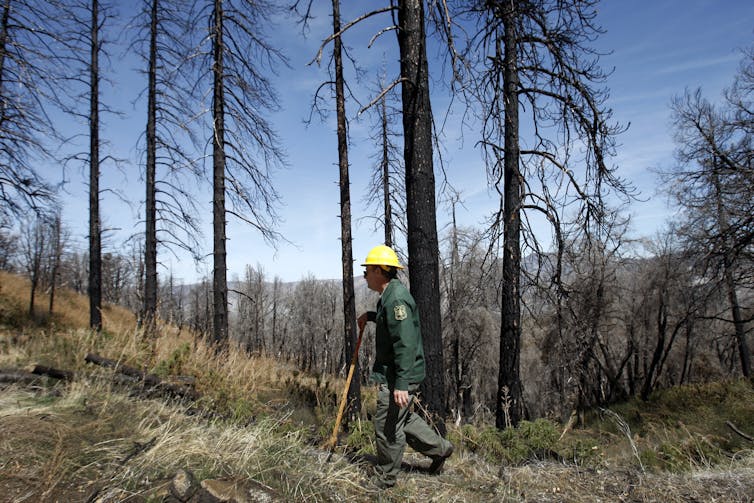
Besides providing seeds, surviving trees reduce temperatures on the ground, where it matters most to seedlings. In some cases, temperatures can be 4 to 5 degrees Fahrenheit cooler (2.2 to 2.8 C) around surviving trees, giving seedlings the edge needed to germinate and survive.
In our study, projections of future forests varied dramatically, depending on how many trees we assumed survived future wildfires.
Altering how wildfires burn can boost recovery
This means there is an opportunity to help offset some climate-driven declines in tree recovery – by reducing the number of trees killed in wildfires.
Reversing global warming is a long-term challenge for society, and some near-term impacts are already irreversible. But reducing the number of trees killed in wildfires can help maintain future forests. In regions where seedlings are already struggling after wildfire, such actions are needed sooner rather than later.
Science supports the use of a number of tools, or forest treatments, that can help decrease the number of trees killed by wildfires.
Controlled burning with forest thinning or cultural burning by local Indigenous groups removes small trees and brush. That leads to fewer trees killed in subsequent fires, especially in forests that historically burned frequently. In high-elevation forests that historically experienced less frequent but more severe wildfires, planting trees after wildfires can help jump-start forest recovery.
Although forest treatments are effective, wildfires burn much more area than can be feasibly treated. Given this, fire scientists suggest letting some wildfires burn when conditions are safe and more likely to leave surviving trees on the landscape.
Expanding the use of wildfires and controlled burning as management tools is challenging, but the evidence suggests it may be one of the most effective and economical ways to reduce the number of trees killed by future wildfires.
There are clear ways to lessen the impacts of global warming and wildfires on seedlings and future forests. But in some areas, even as we work to reverse global warming, the window of opportunity is short. In these areas, forest treatments that modify wildfire or jump-start recovery will be most effective in the next few decades, setting up seedlings to better withstand near-term warming.
Kimberley Davis, Research Ecologist, United States Forest Service; Jamie Peeler, Postdoctoral Research Fellow, University of Montana, and Philip Higuera, Professor of Fire Ecology, University of Montana
This article is republished from The Conversation under a Creative Commons license. Read the original article.