 How to resolve AdBlock issue?
Recreation
- Details
- Written by: Editor
“This temporary closure is being implemented due to limited staffing at this location. We are working to remedy the situation and reopen the office as quickly as possible,” said District Ranger Frank Aebly.
Aebly advises visitors to check for information about the forest before traveling to the area.
Forest maps may be found at the National Forest Map Store at http://www.nationalforestmapstore.com/ and campfire permits may be obtained at http://www.preventwildfireca.org.
Forest product permits, maps and recreation passes may be purchased at the Mendocino National Forest Supervisor’s office, 825 N. Humboldt Ave. in Willows, at the Upper Lake Ranger District office, 10025 Elk Mountain Road in Upper Lake and the Stonyford Work Center in Stonyford.
- Details
- Written by: California Department of Fish and Wildlife
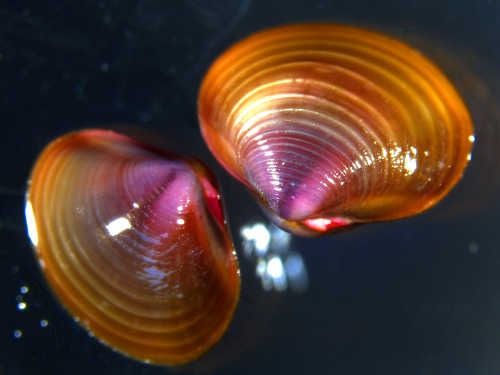
Identifying clams in the Delta
Question: What type of clams are in the Sacramento-San Joaquin Delta? I see the small blackish ones and sometimes a type of razor clam. I grew up using them for bait, but now I hear that people eat them. Are they safe to eat? Is there a season or limit on them? (Kathleen B.)
Answer: The types of clams found in the Sacramento-San Joaquin Delta are the Amur River clam (Corbula amurensis) and the Asian clam (Corbicula fluminea).
The Amur River clam is found in saltier portions of the Delta, while the Asian clam inhabits freshwater sections. Both are safe to eat in accordance with safe-eating guidelines found in the 2017/2018 Freshwater Sport Fishing Regulations, beginning on page 45.
A sport fishing license is required to harvest clams and the daily bag limit for clams taken in inland waters is 50 pounds in the shell (California Code of Regulations Title 14, section 5.20).
The season is open all year and clams may only be taken by hand, or by spade, shovel, hoe, rake or other appliance operated by hand.
Please note that the Office of Environmental Health Hazard Assessment, which issues safe eating advisories, has a standing advisory from 2013 to avoid fish and shellfish from the Port of Stockton due to mercury and other chemicals in the water.
Which wildlife legally taken in other states can be brought into California?
Question: I know it is illegal to bring a legally taken mountain lion into California, but is it legal to bring a swan legally taken in Nevada into California? Is there a list of other wildlife which can be legally hunted in other states that cannot be transported into the state? (Leonard, Merced)
Answer: A very limited swan hunting season is authorized in Nevada by the annual federal Frameworks for Migratory Bird Hunting Regulations, published each year in the Federal Register under section 50 of the Code of Federal Regulations, Part 20. However, the same Framework does not authorize swan hunting in California.
If the swan, or another bird or mammal was legally taken, a declaration of entry form is required to provide you with a document to cover the bird or mammal that may not be legal to hunt in California, pursuant to Fish and Game Code (FGC), section 2353.
One copy of the declaration should be delivered to the U.S. Department of Agriculture entry point, one copy is mailed to the California Department of Fish and Wildlife, one copy is delivered with the animal to a taxidermist (if you have it mounted) and one copy is kept for your records.
The exception to this law is the mountain lion, which can be legally taken in some states but cannot be brought into California, pursuant to Proposition 117, enacted by the voters of California in 1990 and the subsequent FGC, section 4800.
In addition, fully protected mammals, such as bighorn sheep (except Nelson bighorn sheep, as authorized by the Commission for hunting), ring-tailed cat and wolverine, may not be taken or possessed at any time, pursuant to FGC, section 4700. However, a legally imported fully protected mammal may be possessed under a permit issued by CDFW.
What is the ‘safety zone’?
Question: I have been looking in the regulations and can't find any language stating I can't hunt near a road. The "safety zone" as referenced in the regulations does not specifically include "roads." The only thing I can find pertaining to roads is that one cannot shoot from or across one. I ask because I belong to a hunting club that borders a public road. (Albert)
Answer: That is a very good and quite commonly asked question. Nothing in the FGC defines a specific no shoot buffer along public roads.
However, according to FGC, section 3004 and Penal Code, section 374c, it is unlawful to discharge a firearm from on or over a "public road."
This term is defined as the area improved, designed or ordinarily used for vehicle travel pursuant to the California Vehicle Code, section 530.
Although the FGC does not specifically define a safety zone other than what is referenced in section 3004 (see next question), your local county or municipality may have an ordinance that does. Thanks for your question, and stay safe.
Is a house considered ‘occupied’ if no one is home?
Question: I have a question about the 150-yard safety zone and how it reads as "occupied."
I have some instances where there are cabins that are owned or leased on land within the Cleveland National Forest. Most are vacant almost all year long (emphasis during hunting season). If they are not "occupied" at the time, does the safety zone move down to the closest occupied dwelling and its associate outbuilding of that property? (James V., San Diego)
Answer: FGC, section 3004 states that it is unlawful for a person, other than the owner, person in possession of the premises or a person having the express permission of the owner or person in possession of the premises, while within 150 yards of an occupied dwelling house, residence or other building, or within 150 yards of a barn or other outbuilding used in connection with an occupied dwelling house, residence or other building, to either hunt or discharge a firearm or other deadly weapon while hunting.
This 150-yard area is a "safety zone." You should treat every one of those houses as if it is occupied.
If you have a question for the California Department of Fish and Wildlife, email
- Details
- Written by: Editor
- Details
- Written by: California Department of Fish and Wildlife
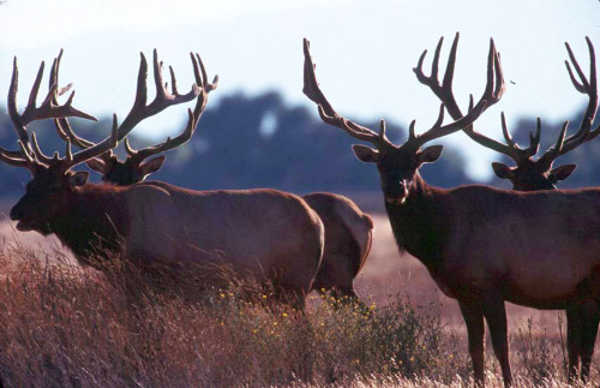
What's the purpose of the New Elk Management Plan?
Question: I have been elk hunting with my father and brother out of state for years. My father was drawn for an elk hunt in California in the 1990s but none of us have been drawn since. We have been putting in for the draw since the preference point system started.
What is the new elk management plan for, and is there a way it will help our chances of being drawn? (Cody)
Answer: If you are an elk hunter, you should definitely download the recently released draft Statewide Elk Conservation and Management Plan and read through it.
All hunters in California should understand the basics of wildlife management, life history, habitat, migratory patterns and so forth.
Hunting is a wildlife management tool and there is scientific rationale behind hunt programs for each species, including elk.
The plan covers all of these topics and then solicits feedback, with public comments due by Jan. 29.
Generally speaking, California's wildlife policy emphasizes three goals: to maintain sufficient wildlife resources for their intrinsic values, to provide for diverse public uses and economic contribution to citizens, and to alleviate economic losses and public health/safety problems (FGC, section1801).
The recently released draft Statewide Elk Conservation and Management Plan addresses each of these goals and emphasizes enhancing and maintaining sufficient populations of all three of California's subspecies of elk in perpetuity, as per FGC, section 3952.
This overview of how elk are managed will help you understand the rationale for and methodology of elk management in California, and will help you answer questions from non-hunters about hunting and wildlife management.
You'll no doubt find the history of elk in California fascinating. You are probably aware that California hosts three of the four North American elk subspecies, including Roosevelt, Rocky Mountain and tule elk.
Tule elk are found nowhere in the world other than California. We as a society, could have lost tule elk to extinction had it not been for aggressive conservation efforts in the latter part of the 1800s.
As to the question of whether the new plan under development will help your odds of being drawn, your success is largely based upon what you put in for as opposed to any major change in the way elk are managed.
For those who wish to hunt elk in California, the simplest way to increase the odds of being drawn are to put in for antlerless hunts. Most people want to hunt bulls, so the antlerless hunts have better odds.
Since you mentioned you have been putting in for the elk draw since the preference point system started, the next most important thing you can do to improve your odds of being drawn is to never break the cycle and continue putting in every year.
Those with maximum preference points have the greatest chance of being drawn for any of the lottery hunts.
Can I sell antler sheds?
Question: Can I sell these deer antlers legally? I picked them up at a storage auction. (Dave F.)
Answer: Generally, the sale of any wild bird or mammal or the parts thereof is prohibited by law pursuant to Fish and Game Code (FGC), section 3039, which says, with some exceptions, that it is unlawful to sell or purchase a bird or mammal found in the wild in California.
However, one of those exceptions are shed antlers, which are antlers that have naturally fallen from the animal.
Shed antlers, or antlers taken from domestically reared animals that have been manufactured into products or handicraft items (or cut into blocks or units which are to be manufactured into handicraft items) may be bought or sold at any time per FGC, section 3039(c).
The intent of the law is to prevent the sale of antlers from wild California deer. This means it is unlawful to sell antlers cut off a wild deer from California – even a deer lawfully harvested by a hunter. It is also unlawful to buy or sell deer taxidermy mounts with a minor exception in FGC, section 3087 and CCR Title 14, section 695(d).
The antlers in the photo appear to have an abscission line from where the antler formerly attached to the pedicle. The pedicle is the part of a deer skull where an antler attaches.
The abscission line on the antler has a rough feeling at the detachment point which is evidence the antler fell off naturally and one of the characteristics a wildlife officer will look for when conducting an investigation. Because these antlers fell off naturally, they are exempt per FGC, section 3039(c) and are legal to buy or sell.
If you have a question for the California Department of Fish and Wildlife, email