 How to resolve AdBlock issue?
Recreation
- Details
- Written by: California Department of Fish and Wildlife
Small game hunting restrictions
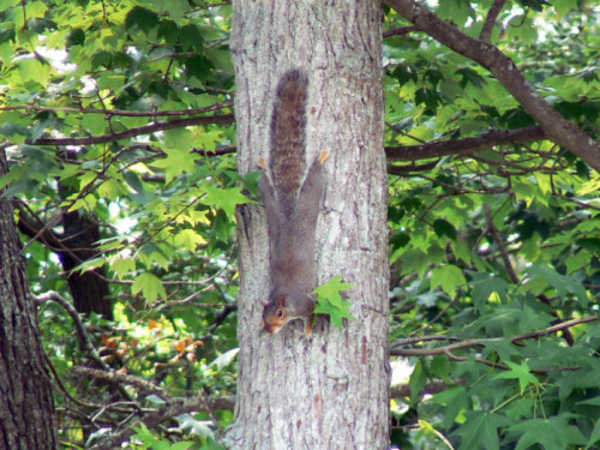
Question: What is the reasoning for not allowing small game (squirrel and rabbit) hunting in the Sacramento River National Wildlife Refuge units?
The California squirrel hunting map indicates that the entire north state is an open squirrel zone and the California Department of Fish and Wildlife (CDFW) Web site does not say anything about not being able to hunt these areas.
There is a list of "huntable" game at www.fws.com, but it does not say what you cannot hunt in those units. It is very confusing. (Trevor)
Answer: Although much of northern California is seasonally open to squirrel hunting, there may be areas that are either closed or have additional restrictions. California Code of Regulations Title 14, section 552(a)(6) refers to the Sacramento River National Wildlife Refuge and lists the species for which take is allowed.
These species include goose, duck, coot, moorhen, dove, snipe, turkey, pheasant, quail, deer and wild pig from Sept. 1 to March 15. Section 552(a)(6) goes on to clarify that "...hunting of all other species is prohibited ..."
For additional information, please refer to page 49 of the 2017-2018 Waterfowl and Upland Game regulations booklet or the U.S. Fish and Wildlife ServiceWeb site at www.fws.gov/refuge/Sacramento_River/Hunting.html .
OK to transport crayfish?
Question: Can crayfish be caught in one lake and transported to another lake? Can they be frozen and used for bait later? (Raleigh)
Answer: Yes, for the most part, provided the crayfish were legally caught.
Crayfish are a freshwater crustacean, and legally acquired and possessed crustaceans can be used for bait in almost all inland waters in California (CCR Title 14, section 4.00).
There are regulations governing the method of take. Crayfish may be taken only by hand, hook and line, dip net or with traps not over three feet in greatest dimension.
Any other species taken need to be returned to the water immediately. Traps need not be closely attended. Crayfish can be caught year-round, and there is no bag limit on them. (CCR Title 14, section 5.35).
There are special protections in place to safeguard the Shasta crayfish, California's only native crayfish and an endangered species that lives in the northeastern part of the state.
There are restrictions on catching crayfish and using them for bait on parts of the Fall River, Pit River and Hat Creek, for example (CCR Title 14, sections 4.30(c) and 5.35).
There are also special laws and rules in place throughout the state to prevent the spread of quagga and zebra mussel infestations.
The use of crayfish caught in contaminated water for bait may not be prohibited, but it is illegal to move adult or larval quagga and zebra mussels from infested waters.
Is it illegal for a minor to sell his catch to the neighbors?
Question: Before I throw cold water on a neighborhood kid's moneymaking scheme, please advise me if what he is doing is legal.
He regularly fishes in Half Moon Bay and is advertising through email to sell the catch to neighbors on an ongoing basis, depending on what he catches.
I suspect that he needs a commercial fishing license to engage in this commerce, but I don't have the regulations to back up my belief. What does such a license entail, by the way? (Anonymous)
Answer: Where to start! What that young person is doing is illegal – likely on many different fronts.
First and foremost, it is unlawful to sell or purchase any sport-caught fish or amphibians taken in the waters of California (Fish and Game Code, section 7121).
A commercial fishing license is required for any resident 16 years of age or older to take fish for commercial purposes or otherwise contribute materially to the activities onboard a commercial fishing vessel (FGC, section 7850).
Furthermore, there is a whole host of additional permits, licenses and stamps required of commercial fishermen depending on where they fish, how they fish and what they fish for.
You can see a complete listing of descriptions and fees at the CDFW Web site at www.wildlife.ca.gov/Licensing/Commercial/Descriptions.
Additionally, there are regulations for commercial take that often involve different seasons and size limits than what is required of recreational anglers.
These commercially caught fish then have to be "landed" by a licensed receiver before they are sold (FGC, section 8033).
As you can see, it's no simple undertaking to be a commercial fisherman in California, but these regulations are meant to help conserve the state's fisheries.
The illegal activities you've described need to stop. If the individual does not stop, please call our CalTIP number (888-334-CalTIP) so that our wildlife officers can educate this young person.
If you have a question for the California Department of Fish and Wildlife, please email
California Outdoors: Using photo of a fishing license, concealment of a weapon while legally hunting
- Details
- Written by: California Department of Fish and Wildlife
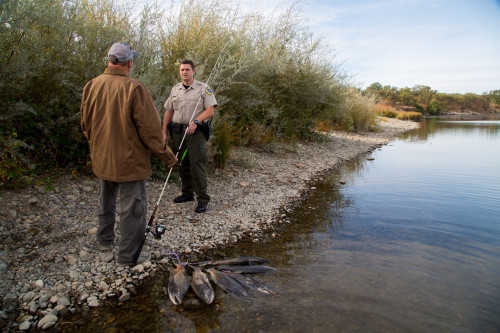
Is a photo of my fishing license good enough?
Question: I have a picture of my current fishing license and hunting license on my phone (as well as my driver's license). That shows all of the legal stamps, stars and stripes that might be required for what I am doing legally.
As far as a game warden is concerned, would that work as proof that I have a license? It worked with the California Highway Patrol and I wasn't cited for driving without a license.
Before you say "no," realize that California only requires sportsmen to buy a state duck stamp, not to have it on them. Why wouldn't the same be true for a photo of the license?
If the department won't accept a photo on my phone, what channels do we go through to make it legal? (Bob)
Answer: The California Fish and Game Code (FGC), section 7145 (a) requires that every person aged 16 and older who takes any fish, reptile, or amphibian must have a valid sport fishing license on his or her person or in his or her immediate possession.
FGC, section 3700.1 provides that it is unlawful for any person, except a person licensed pursuant to section 3031, paragraph (2) of subdivision (a), to take any migratory game bird, except jacksnipe, coots, gallinules, western mourning doves, white-winged doves, and band-tailed pigeons, without first procuring a state duck hunting validation as provided in subdivision (b), and having that validation in his or her possession while taking those birds. FGC, section 3031 generally addresses the requirements and fees for obtaining a hunting license, and provides, at paragraph (2) of subdivision (a) special requirements for obtaining a junior hunting license.
Under the existing requirements, you must have your hunting or fishing license in your immediate possession, and not just a photograph of the license.
Any request to change the regulations or law should be addressed through your state legislator, and, ultimately, the California Fish and Game Commission. Complete details and procedures can be found at www.fgc.ca.gov .
Can't an officer ‘radio in’ my license info?
Question: I often fish off the dock where my boat is in a slip. My fishing license is in a folder on my boat with all the other required legal documents. I also have a photo of my license in my cell phone that clearly shows the license number on a valid license.
If I am contacted by a CDFW officer, will I receive a citation for not having the piece of paper in my possession? He could certainly check the number via his radio and see that it's valid, or walk over to my boat and view the license. (Dave M.)
Answer: As explained above, FGC, section 7145 (a) specifies that you must have your license with you while fishing.
There are a few exceptions – you don't need a license if you're fishing from a public pier (FGC, section 7153), and if you're diving, it's fine to keep your license in the boat or within 500 yards of the shore, as applicable (FGC, section 7145(a)).
Except for the diving exemption, when required, you must have your valid fishing license in your immediate possession when fishing, not just a photograph of the license. It's an urban legend that "wardens can look it up on the radio."
Concealment of a weapon while legally hunting
Question: If I am otherwise legally hunting (hunting license, lead-free ammo, legal magazine capacity, unincorporated public land, proper distance from roads, bodies of water, etc.) in California with a handgun or pistol, do I need to ensure that I don't conceal it while loaded if I do not have a CCW permit?
Is the answer different depending on the land management agency? I don't want to commit a felony or otherwise run afoul of the state gun laws. (Travis)
Answer: Your question relates to California Penal Code (PC), sections 25400 and 25850. Although section 25400 generally prohibits carrying a concealed firearm, there is an exemption that applies to hunters. Section 25640 provides that section 25400 "does not apply to, or affect, licensed hunters or fishermen carrying pistols, revolvers or other firearms capable of being concealed upon the person while engaged in hunting or fishing, or transporting those firearms unloaded when going to or returning from the hunting or fishing expedition."
Similarly, section 25850 generally prohibits carrying a loaded firearm "on the person or in a vehicle while in any public place or on any public street in an incorporated city or in any public place or on any public street in a prohibited area of unincorporated territory."
However, section 26040 includes a hunting exemption. This section provides, "Nothing in section 25850 shall prevent any person from carrying a loaded firearm in an area within an incorporated city while engaged in hunting, provided that the hunting at that place and time is not prohibited by the city council."
These exemptions do not apply to individuals who are otherwise prohibited from possessing firearms.
Be sure to comply with any restrictions relating to your location, including any rules or ordinances of a land management agency or local government pertaining to firearms.
Additionally, it is not lawful to carry a firearm when hunting under an archery-only tag or during some archery-only seasons.
If you have a question for the California Department of Fish and Wildlife, email
- Details
- Written by: Editor
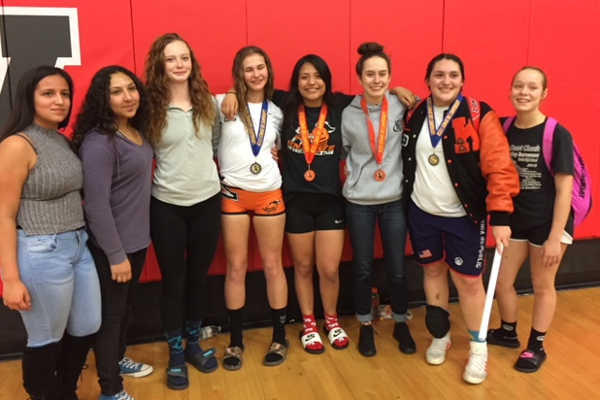
KELSEYVILLE, Calif. – Kelseyville High School’s girls wrestling team had a very busy and successful North Coast Section wrestling championships last weekend.
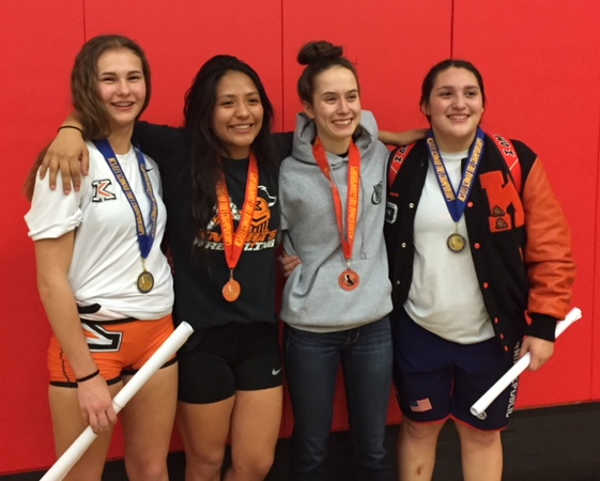
Kelseyville has never had an NCS wrestling champ but after last weekend they have two – Bailey Huggins and Jasmin Clarke. As a team Kelseyville finished in fifth place out of more than 55 teams, according to Coach Orlando Zarate.
Huggins, a sophomore, won the 116-pound weight class. She came in as the No. 1-seeded wrestler in her weight class and she lived up to her seed. Zarate said she wrestled extremely hard and had a drive and a focus the entire tournament. She pinned her way into the finals and had one of the most exciting finals matches of the night.
Huggins wrestled Katelyn Pham of Deer Valley who was the No. 2 seed. The finals match came down to the final 30 seconds where Huggins scored a last takedown to take the lead and win 5-4. The match has some early scrambles that had the entire crowd into it.
Zarate said Bailey improves last year from her seventh place medal as a freshman. It will be her first time qualifying for the CIF State Wrestling Championships.
Clarke, a junior, won the 189-pound weight class in which she was the No. 1 seed. Zarate said she looked good throughout the entire tournament, constantly getting takedowns and controlling the offense. “She was clicking on all cylinders.”
Clarke pinned her way into the finals but her finals match against Hollie Espinoza from Rancho Cotate was closer and came to a 4-2 decision win. Zarate said Clarke improves from her third place finishes as a freshman and sophomore but after last weekend she is now a three-time state qualifier.
Kylie Marlin, a senior, medaled with an eighth place finish at 101 pounds. Zarate said she had a great tournament and made it to the quarter finals where she lost to the No. 1 seed, Lizette Rodriguez, from James Logan.
Zarate said Marlin battled back tough through consolation and made it to the medal rounds.
“I’m really happy Kylie was able to get that NCS medal her senior year,” he said. “She’s worked so hard to achieve the goal and to see her receive it was a great feeling. “
Vanessa Gonzalez, a junior, placed eighth at 143 pounds. Like Marlin, Gonzalez reached the quarterfinals and ultimately lost but worked her way through the consolation to land in the medal rounds.
Zarate said it was extremely gratifying to see Gonzalez finally compete in the section finals, which she missed her freshman and sophomore year due to injury, “so for her first time to compete and come away with a medal makes us really happy.”
Senior Korbyn Marlin, 106 pounds, missed medaling by a match.
Brianna Thomas, a junior, also missed medaling but still had a good tournament.
Sophomore Melanie Guerrero went 0-2 and did not make it to the second day or medal.
Elisa Jaquez a freshman, missed medaling by a match.
“She put on such a strong performance and definitely turned some heads into the process. We are really excited what she can accomplish in the future she has so much potential and we’re lucky that we get to have three more years with her,” said Zarate.
- Details
- Written by: Editor
This is always a great walk with the likelihood of seeing numerous songbirds and wildfowl as well as raptors, great blue herons and egrets.
Please check in at the gate and pay the entry fee.
Participants will meet in the parking lot area near the visitor’s center and begin the walk at 9 a.m.
As with all Audubon events, the public is cordially invited to join them.
For information call 707-263-4977.