 How to resolve AdBlock issue?
Recreation
- Details
- Written by: California Department of Fish and Wildlife
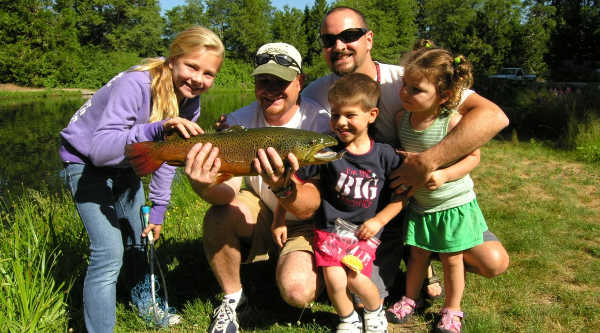
Every year, California Department of Fish and Wildlife (CDFW) trout hatcheries release trophy-sized trout to approved waters for public recreational angling and a chance to “catch a big one.”
Trophy trout are categorized by CDFW as larger than 2.99 pounds each, but can be much larger.
Another category of large trout released by CDFW each year is “super-catchable,” which are fish between 1.1 and 2.99 pounds each.
Some of these large fish are raised specifically to provide public anglers with a chance to catch a big one, and others are released to approved waters once they have fulfilled their role in providing fertilized eggs for populating fish of all life stages in CDFW’s statewide program of trout hatcheries.
Trophy and super-catchable trout require more resources than catchable-size trout. Younger trout (fingerling to catchable size) grow quickly and efficiently convert fish food to body size, and that efficiency drops with age.
By weight, 93 percent of all trout released by CDFW trout hatcheries are in the “catchable” size category (most often 1/2 pound fish, or approximately 12 inches in length). In 2018, approximately 100,000 pounds of trout released for public recreational angling will be in the trophy or super-catchable size.
The following locations are scheduled for trophy and super-catchable size trout releases in 2018:
Northern releases
Hat Creek, Shasta County (late April to early May)
Burney Creek, Shasta County (late April to early May)
Baum Lake, Shasta County (late April to early May)
Iron Canyon Reservoir, Shasta County (May)
Browns Pond, Modoc County (May)
Rainbow Pond, Modoc County (May)
Ash Creek, Lassen County (May)
Shasta Lake, Shasta County (May through August)
Lake Siskiyou, Siskiyou County (May through August)
Juanita Lake, Siskiyou County (May through June)
North central releases
Red Lake, Alpine County (May)
Indian Creek Reservoir, Alpine County (May)
Sawmill Pond (children’s fishing pond), El Dorado County (May)
Pillsbury Reservoir, Lake County: (May)
Various locations for Kid’s Fishing Day events (November through May)
Central releases
Kern River, Tulare County (February through April)
Kings River, Fresno County (January through April)
Stanislaus River, Tuolumne County (June and July)
Pinecrest Lake, Tuolumne County (June and July)
Shaver Lake, Fresno County (February through March)
South Coast Releases
Pyramid Lake, Los Angeles County (November through May)
Inland deserts releases
35 waters in Inyo and Mono counties, including but not limited to Bishop Creek, Bridgeport Reservoir, Convict Lake, Diaz Lake, Ellery Lake, the June Lake Loop, Lake Sabrina, Lee Vining Creek, Lundy Lake, the Mammoth Lakes, the Owens River, Pleasant Valley Reservoir, Twin Lakes Bridgeport, Rock Creek Lake, Saddlebag Lake, South Lake, Tioga Lake, Virginia Lakes and the West Walker River (March through September)
Silverwood Lake, San Bernardino County (November through May)
Trophy fish are regularly added to weekly plants of regular sized “catchable” fish in Inyo and Mono counties.
The trophy sized fish are tagged for identification as originating from CDFW hatcheries and released to approved waters determined to have the ability to sustain the larger fish.
Trophy fish will be stocked in Diaz Lake for the early trout opener and in Pleasant Valley Reservoir and in Owens River Section II for the Blake Jones Derby.
Trophy fish have been stocked in Pleasant Valley Reservoir, Owens River Section II, Owens River below Tinemaha and Diaz Lake since January and these waters will continue to receive trophy fish over the next few months.
Updated information on trophy and super-catchable trout releases for recreational angling is released early each calendar year and will be posted to the CDFW fish stocking Web site (http://nrm.dfg.ca.gov/FishPlants/).
Anglers can also call the following lines for region-specific information:
Northern Region: 530-225-2146
North Central Region: 916-351-0832
Central Region: 559-243-4005, Extension 183
South Coast Region: 855-887-1275
Inland Deserts Region: 855-887-1275
CDFW trout hatcheries are dedicated to providing millions of additional trout angling opportunities in approved, public waters throughout the state every year, using the best available science, and ecological, hatchery and resource management principles.
- Details
- Written by: Editor
The closure will take effect from Nimbus Dam on the lower American River to the U.S. Geological Survey (USGS) gauging station cable crossing approximately one-half mile downriver (California Code of Regulations Title 14, sections 7.50(b)(5)(A) and (B).
Under current regulations, the American River from Nimbus Dam to the Hazel Avenue bridge piers is open to fishing all year (CCR Title 14, section 7.50 (b)(5)(A)), and from the Hazel Avenue bridge piers to the USGS gauging station cable crossing about 300 yards downstream from the Nimbus Hatchery fish weir from Jan. 1 through Aug. 15 (section 7.50(b)(5)(B)).
Closure of the Nimbus Basin to fishing is part of the Nimbus Hatchery Fish Passage Project, which involves reorienting the hatchery’s fish ladder into the Nimbus Basin and removing the existing fish weir.
This project will create and maintain a reliable system of collecting adult salmon and steelhead broodstock for the hatchery and increase the amount of natural spawning and rearing habitat available in the lower American River.
The changes will also minimize American River flow fluctuations associated with installation and removal of the hatchery’s weir and eliminate health and safety concerns relative to the deterioration of the existing weir structure.
The new spawning habitat opened up by the permanent removal of the weir will improve juvenile salmon production and increase harvest opportunities downstream.
The U.S. Bureau of Reclamation and the California Department of Fish and Wildlife completed a joint Environmental Impact Statement/Environmental Impact Report (EIR/EIS) for the Nimbus Hatchery Fish Passage Project in 2011.
Planning is currently under way and construction is scheduled to begin in federal fiscal year 2019.
The EIR/EIS is available for download from www.usbr.gov/mp/ccao/hatchery.
- Details
- Written by: Editor
The archery-only hunting season follows immediately afterward, running from May 7 to 20.
Young hunters will have additional opportunities to bag a spring tom turkey. Junior Hunting License holders may hunt the weekend before the general opener, March 24 and 25, and the two weeks after the general season closes, May 7 to 20, using shotguns or any other legal method of take.
Shooting hours for spring turkeys are from one-half hour before sunrise to 5 p.m. Both a hunting license and an upland game bird stamp validation are required to hunt wild turkeys, although an upland stamp is not required of Junior Hunting License holders.
Nonlead shot is required when taking wild turkeys with a shotgun anywhere in the state except when hunting on licensed game bird clubs.
These regulations apply to both public and private land, including all national forests, Bureau of Land Management, and California Department of Fish and Wildlife (CDFW) properties.
For more information on nonlead ammunition regulations, please visit www.wildlife.ca.gov/Hunting/Nonlead-Ammunition.
CDFW is offering 89 separate special turkey hunting opportunities throughout the state. Starting this year, application for these special hunting opportunities must be made through CDFW's Automated License Data System.
Hunts are grouped into three separate drawings: Junior hunts, general opening weekend hunts and balance of season hunts.
There is a $2.42 application fee and only one application per hunter is allowed for each drawing.
Applications allow hunters to select their top three hunt choices in order of their preference. Hunters may only be drawn once per application.
The application deadlines for these hunts are as follows:
– Junior hunts: Saturday, March 3.
– Opening weekend general season hunts: Saturday, March 10.
– Balance of the season hunts: Wednesday, March 14.
To apply for these hunts, please visit www.ca.wildlifelicense.com/internetsales, sign into your account, select the "Purchase Licenses" link and select "2017 - Hunting" from the menu on the left side of the page.
Spring turkey hunt application items will be available under the "Drawings" section on the right side of the page.
After submitting your application, checking out and completing payment, you will be able to download a receipt confirming your entries into the drawing.
For more details and descriptions of these hunts, please visit www.wildlife.ca.gov/turkey-hunts.
- Details
- Written by: Editor
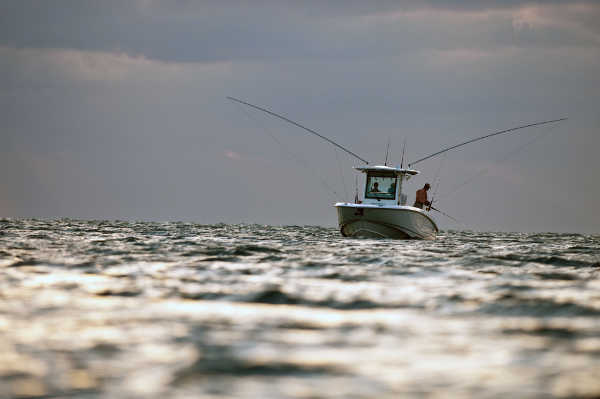
WASHINGTON, DC – Boat Owners Association of The United States (BoatUS) urges recreational boaters and anglers residing in states with U.S. Senate Commerce Committee members to speak up now in favor of passing the Modern Fish Act.
The bill, which will be voted on Wednesday, Feb. 28, aims at improving federal marine fisheries management for recreational anglers. If the bill passes the committee, it will go to the full Senate floor for a vote.
“The bill corrects a long-running mistake of regulating recreational fishing in the same way as we do commercial fishing,” said BoatUS Manager of Government Affairs David Kennedy. “They are simply not the same, and the Modern Fish Act recognizes that. It’s smart legislation.”
Since 1976, saltwater recreational fishing in federal waters has been regulated by the Magnuson-Stevens Act (MSA) which is credited with achieving success in managing commercial fishing. However, MSA never adequately accounted for recreational fishing.
The goal of the Modern Fish Act - S.1520 - is to finally address the needs of the nation’s 11 million saltwater recreational anglers, improve access to federal waters and promote marine resource conservation.
It will ensure exempted fishing permits help fisheries management and conservation, rather than the status quo that can hinder both, and support new data collection methods.
The legislation also modifies annual catch limit requirements to allow for more adaptive approaches, and it’s also designed to give federal resource managers access to more data and perform long-overdue examinations of fishery allocations.
States with U.S. Senate Commerce Committee members include Alaska, Colorado, Connecticut, Florida, Hawaii, Illinois, Indiana, Kansas, Massachusetts, Michigan, Minnesota, Missouri, Mississippi, Montana, Nebraska, New Hampshire, Nevada, Oklahoma, South Dakota, Texas, Utah, Washington, Wisconsin and West Virginia.
Boaters and anglers can take action today to contact their senator by going to www.goo.gl/2HXryk.
For more information on the benefits of the act, go to https://keepamericafishing.org/wp-content/uploads/2018/01/HR-200-Onesheet.pdf.
Fifty-nine percent of the more than half-million members of BoatUS fish aboard their boat.