 How to resolve AdBlock issue?
Recreation
- Details
- Written by: Editor
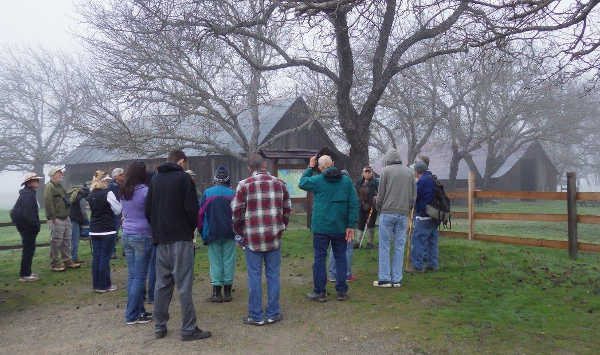
LOWER LAKE, Calif. – Anderson Marsh State Historic Park will resume holding free monthly guided Nature Walks starting in February.
The next walk will be at 8:30 a.m. Saturday, Feb. 10.
There will be a tour of the historic ranch house after the February walk. Rain will cancel the walk. If rain cancels the walk, the tour will begin at 8:30 a.m.
Guided nature walks at Anderson Marsh State Historic Park will be held in 2018 on the second Saturday of the month, with the exception of September and December.
All walks begin at 8:30 a.m. There will be a tour of the historic Anderson Ranch House after many of these walks.
The nature walk in January was held on New Year’s Day as part of the national First Day Hikes program.
The Fifth Annual First Day Hike at Anderson Marsh attracted more than 150 people and everyone had a chance to enjoy the park on a clear winter day.
February’s nature walk will be led by park docent Roberta Lyons, who asks that participants arrive at the parking lot by 8:15 a.m. so they can have time to explore the wildlife found in the ranch house yard.
Winter is a great time to visit the park because the trees are bare, allowing a better view of the birds.
The route taken will depend on the weather and the condition of the trails. Participants should bring binoculars if they have them, and wear sturdy shoes and a hat.
Anderson Marsh State Historic Park is located on Highway 53, between Lower Lake and Clearlake.
For more information about the walk, email
- Details
- Written by: Editor
ANNAPOLIS, Md. – “Boating safety” usually means preventing injuries or accidents while on the water.
Boats in winter storage have some unique safety concerns for boat owners who make periodic checkups over the long winter season.
Here are five tips from the BoatUS Foundation for Boating Safety and Clean Water to help boaters stay safe while visiting the boat this winter.
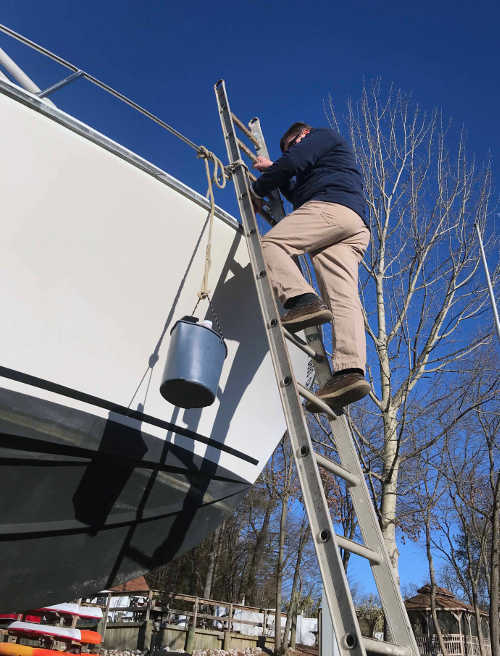
1. Injuries from ladder falls can be severe but are preventable. When using a ladder to climb aboard your frozen boat, be sure it is firmly planted, secure it with a line to avoid shifting, and have someone hold the base. Never descend a ladder facing forward or with your arms full. If moving tools, supplies or other objects to and from the deck, lower or raise them in a bucket using a rope.
2. Don’t trust the nonskid to do its job. Nonskid decks are slippery when covered by snow or encrusted with ice. Brush away any buildup on the deck where you plan to step, and always hold onto something, just as you would if you were underway. In warmer winter climates, decaying leaves and algae can also make decks slippery.
3. Snow and ice are heavy. One square foot of dense, wet snow can weigh more than 20 pounds, so use caution when going underneath a tarp or winter cover that’s loaded with snow. For even a small boat stored outside, over a ton of weight can be added after a storm, so brush off what you can before climbing aboard.
4. Check your jackstands for proper support. Jackstands or blocking can shift as the boat gets laden with snow and ice, or due to repeated freeze/thaw cycles. Never adjust jackstands yourself. Have marina personnel adjust and move supports.
5. Trailer boat frames should be supported at the rear cross beam. This prevents the tongue from lifting off the ground like a seesaw when climbing aboard from the stern.
- Details
- Written by: California Department of Fish and Wildlife
Question: At the recent International Sportsmen's Exposition in Sacramento, I stopped by the California Sportsmen's Theater to hear the California Department of Fish and Wildlife leadership panel discussion.
During the presentation, I heard the chief of law enforcement say that the most common citation issued for fishing violations is fishing without a license.
This piqued my curiosity as to what the most commonly cited hunting violation is. (Steven P., Elk Grove)
Answer: Thank you for taking the time to stop by and hear the panel presentation at the show.
This question came up amongst a couple of wildlife officers recently who took a couple guesses before running the query to get the statistical facts.
They speculated that the most common hunting violation would be either hunter trespassing or having a loaded long gun in a motor vehicle. Both of these violations are far more common than they should be, since they both require a conscious decision and show a dangerous disregard for safety and ethics.
Ultimately, the statistics show the latter – having a loaded long gun in a vehicle – is the most common.
The vast majority of hunters and anglers are law abiding. Only a small percentage hunt or fish in violation.
In 2017, California wildlife officers issued 11,693 citations, 139 of which were for having a loaded rifle or shotgun in or on a vehicle.
This troubling reality is reckless and extremely dangerous to everyone in or around the vehicle.
Accidental firearm discharge within a vehicle will always have significant consequences – damage to property, loss of life, or both.
It is the goal of our hunter education program and department to see this senseless violation avoided. We encourage everyone to be sure to unload their firearms before climbing in or upon any vehicle to avoid risk of a tragedy, or at minimum, a citation.
If you have a question for the California Department of Fish and Wildlife, email
- Details
- Written by: Editor
The lands pass requirement is suspended indefinitely at the following CDFW properties:
Batiquitos Lagoon Ecological Reserve
Bolsa Chica Ecological Reserve
Buena Vista Lagoon Ecological Reserve
Crescent City Marsh Wildlife Area
Eel River Wildlife Area
Elk Creek Wetlands Wildlife Area
Elk River Wildlife Area
Elkhorn Slough Ecological Reserve
Fay Slough Wildlife Area
Grizzly Island Wildlife Area
Honey Lake Wildlife Area
Imperial Wildlife Area
Lake Earl Wildlife Area
Mad River Slough Wildlife Area
Mendota Wildlife Area
Napa-Sonoma Marshes Wildlife Area (Green Island Unit)
North Grasslands Wildlife Area
San Elijo Lagoon Ecological Reserve
Tehama Wildlife Area
Upper Newport Bay Ecological Reserve
Yolo Bypass Wildlife Area
Lands pass implementation has also been postponed at the Cache Creek Wildlife Area, in Lake County, during an adjustment of management responsibilities between CDFW and federal government.
The following CDFW areas will continue implementing the lands pass requirement:
Ash Creek Wildlife Area
Bass Hill Wildlife Area
Battle Creek Wildlife Area
Boden Canyon Ecological Reserve
Butte Valley Wildlife Area
Canebrake Ecological Reserve
Gray Lodge Wildlife Area
Hollenbeck Canyon Wildlife Area
Hope Valley Wildlife Area
Horseshoe Ranch Wildlife Area
Los Banos Wildlife Area
Mouth of Cottonwood Creek Wildlife Area
North Table Mountain Ecological Reserve
San Felipe Valley Wildlife Area
San Jacinto Wildlife Area
Shasta Valley Wildlife Area
Upper Butte Basin Wildlife Area
Volta Wildlife Area
Willow Creek Wildlife Area
Woodbridge Ecological Reserve
CDFW's Lands Pass Program began in 1988 as a way to broaden the funding base beyond hunters and anglers to pay for conservation and habitat improvement on some of the state's most popular and frequently visited wildlife areas and ecological reserves.
In 2012, the California Legislature directed CDFW to expand the program to more properties as a way for all visitors to contribute to the management of the places they enjoy and appreciate.
CDFW is working to gather information and determine the next steps in resolving the questions and concerns.
For more information on the CDFW lands pass or to purchase a lands pass, please go to www.wildlife.ca.gov/licensing/lands-pass.
Anyone with a valid California fishing or hunting license may use any of the lands areas without paying the additional fees, however you must have your license in your possession.