 How to resolve AdBlock issue?
Recreation
- Details
- Written by: Editor
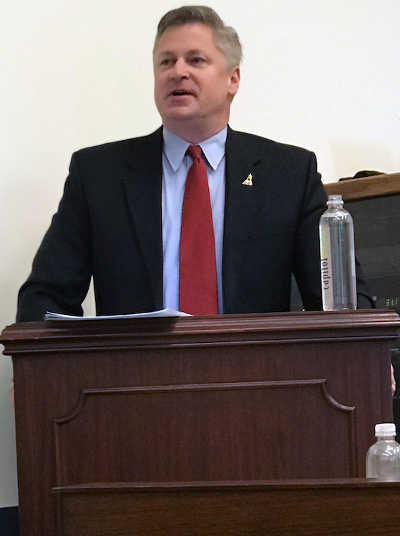
WASHINGTON, DC – Boat Owners Association of The United States (BoatUS) in partnership with the National Marine Manufacturers Association and Marine Retailers Association of the Americas went to Capitol Hill on Wednesday to address Congressional Boating Caucus members and invited legislative staff for the annual State of the Industry briefings at the Russell Senate and Rayburn House office buildings.
The caucus is an informal bipartisan group of US senators and representatives formed in 1989 to advocate for the interests of the recreational boating industry.
Speaking to the groups gathered, National Marine Manufacturers Association President Thomas J. Dammrich reported on the recreational boating industry’s financial rebound, or “long road back,” said Dammrich, since the Great Recession.
With the economy doing well, sales are up and reports from winter boat shows are positive. He also shared ideas on what Congress can do to support this important sector of US manufacturing.
Marine Retailers Association of the Americas President Matt Gruhn spoke to the shortage of qualified marine service workers, and the need for elected leaders to continue to broaden their thinking about what education means in America.
“We need more support for apprenticeship and other technical trade programs, and encourage more people to make recreational boating their career,” said Gruhn.
As the boat owner’s advocate, BoatUS Vice President of Government Affairs Chris Edmonston spoke about the need for legislator support for recreational boating access, and specifically, the Water Resources Development Act which helps maintain the navigability of waterways by providing funds for dredging.
Edmonston also spoke to the success of boating safety education in reducing accidents and fatalities, and the need to revamp US Coast Guard licensing to better address the needs of recreational boaters.
“The current licensing system was never intended for recreational boaters,” said Edmonston.
- Details
- Written by: Editor
CDFW will be holding the limited-entry, permit-only hunts to control a small population of wild pigs on the Joice Island Unit of the Grizzly Island Wildlife Area.
Joice Island is a 2,150-acre wetland area consisting of thick cattails, tules, brush and standing water.
Three hunters will be drawn for eight consecutive weekends for a total of 24 hunters. The first hunt weekend, March 3 to 4, will be reserved for apprentice hunters holding junior licenses, ages 12 to 17.
The following seven weekends – March 10 to 11, March 17 to 18, March 24 to 25, March 31 to April 1, April 7 to 8, April 14 to 15 and April 21 to 22 – will be open to both adult license holders and junior license holders. There is no charge to apply.
To apply for both the apprentice and general hunts, please visit CDFW's Apprentice Hunts webpage and either log in or create a new account. Once you navigate the drop-down menus, apply for the weekend of your choice.
Applications must be submitted by 4 p.m. on Wednesday, Feb. 14. Permits with maps and additional information will be emailed to successful applicants.
Permit holders may bring one non-hunting partner. Junior license holders receiving a permit must be accompanied by an adult 18 or older. Hunters may only use shotguns with nonlead slugs or archery equipment. Dogs and bicycles will not be allowed.
CDFW reserves the right to cancel any of these hunts and close the area to the public without prior notification in the event of unforeseen circumstances or emergencies.
For more information, please contact CDFW at 707-425-3828.
- Details
- Written by: Editor
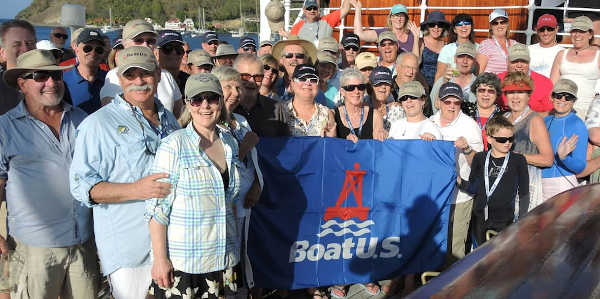
ALEXANDRIA, Va. – With the adage that “all politics is local,” Boat Owners Association of The United States, or BoatUS, offers a new online Advocacy Tool for recreational boaters.
The tool serves as a one-stop shop for federal and state recreational boating issues and gives recreational boaters the option to track relevant bills by state, find contact information for elected officials, speak to policymakers to express their views, and advocate for boating issues in their community.
As the boater’s voice in Washington, D.C., BoatUS closely follows federal legislation and regulations that matter to boaters and boating. Using the Federal Action Alerts tool, boaters can find out if action is needed on a particular bill or rule that would impact boating.
A State Action Alerts tool tracks bills relevant to recreational boating by state as well as their status and sponsor, providing a simple and effective way to be kept informed of upcoming legislation and alerts that matter.
A key to affecting change is knowing your elected representatives and learning how to contact them. Using the Find your Elected Officials search box, boaters will get a complete list of contact information for federal, state and local elected officials.
“At the federal level, when we speak to Congress, BoatUS represents more than a half-million dues-paying members,” said BoatUS Government Affairs Manager David Kennedy. “Our new Advocacy Tool magnifies that strength and brings it to the state level, giving boaters the chance to have their voices heard when boating issues are being debated.”
“With significant issues, such as the mandate for more ethanol in gasoline or funding for dredging and infrastructure improvements to protect our waterways, boaters can use the BoatUS Advocacy Tool to remain engaged,” added Kennedy.
BoatUS is the nation’s only recreational boat owners group with a dedicated government affairs team speaking up for boaters.
For more go to www.Advocacy.BoatUS.com.
- Details
- Written by: California Department of Fish and Wildlife
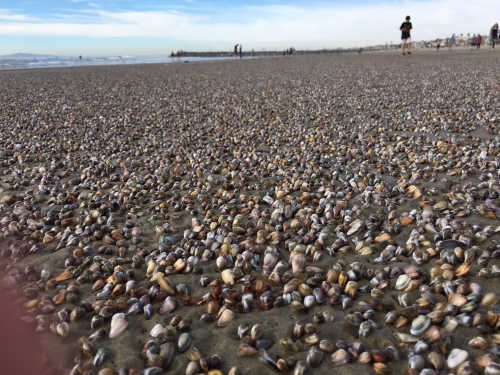
Clams everywhere
Question: What causes thousands and thousands of tiny clams to be left on shore at Newport Beach as far as the eye can see? This was Sunday, Jan. 14. Does this happen regularly, and if so, why? (Edwin Marcus)
Answer: Those appear to be bean clams (Donax gouldii). This is a Southern California clam species found on sandy shores from Point Conception to southern Baja.
Bean clams are known for their large, observable population fluctuations. In fact, population surveys conducted by a researcher at Scripps Coastal Reserve from 1949 to 1952 showed densities peaking at 20,000 clams per square meter, while in years preceding and following this boon, densities fell below one clam per square meter. These population resurgences were found to occur every two to 14 years.
Female bean clams reach sexual maturity after their first year and sometimes spawn more than once a year. They are broadcast spawners, producing up to 50,000 eggs each spawning event. They can reach a maximum length of one-and-a-half inches, and they can live up to three years.
Bean clams bury themselves in the sand, but when extreme low tide conditions combine with wind and swell, they can become exposed. The good news is that as long as the shells remain closed, they will likely survive and get pushed out to sea when the tide returns.
The time stamp on your photo shows that it was taken around 2 p.m. on Jan. 14. There was a low, minus tide at Newport Beach at that time, which would explain why so many were left exposed in the intertidal zone where they reside.
Pintail possession
Question: When I was hunting ducks at Gray Lodge Wildlife Area last weekend, a guy who was hunting nearby shot a pintail and it came down right in my decoys. My dog Charlie, doing what labs do, was on it in an instant and within seconds delivered it back to me. I quickly euthanized it.
I looked up and the hunter was coming my way. I gave him the bird and he was thankful. I am just curious, what does the law require in that scenario? (Michael)
Answer: You did the right thing, legally and ethically. Fish and Game Code (FGC), section 2011 sums it up succinctly. It is unlawful for any person to take, mutilate or destroy any bird or mammal lawfully in the possession of another. Section 2011 further states a bird or mammal shall be deemed in possession when he or she physically possesses it or when it is wounded or otherwise maimed and the person who wounded or otherwise maimed it is in hot pursuit.
The other hunter clearly shot the bird and was in hot pursuit. You did the right thing by quickly euthanizing it, then giving it to your fellow Gray Lodge hunter. You can tell Charlie he's a good boy!
Leave the honking to the geese
Question: On the last weekend of duck season last year, right in broad daylight, I watched some guys at the duck club next to ours drive their pickup on the outer perimeter road, which is right next to our club, blaring their horn in an effort to get a group of ducks and geese off a pond to fly over where their friends were hunting.
This can't be legal and seems to violate fair chase principles. Is there actually a law that prohibits it? Is there anything I can do about it? (Jeremy)
Answer: You are correct – this behavior is not legal. FGC, section 3501 very clearly states that it is unlawful to use any powerboat, motor vehicle or airplane to drive any game bird toward another person with the intent that the other person shall take the bird.
There are a few things you can do. If you see this behavior again, get the license plate number of the vehicle and, if you can, a description of the driver. If you are able to take photos or shoot video with your cell phone, even better.
Gather as much information as possible and call CalTIP (1-888-334-2258). The number is on the back of every hunting and fishing license so you'll always have it with you.
If you have a question for the California Department of Fish and Wildlife, email