 How to resolve AdBlock issue?
Recreation
- Details
- Written by: Editor
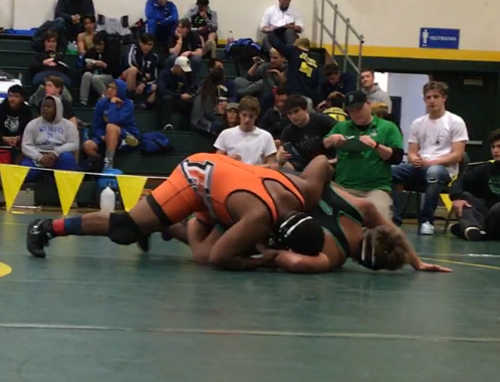
KELSEYVILLE, Calif. – The Kelseyville High School wrestling team sent its boys and girls squads to separate competitions last Saturday.
The boys went to San Marin High School for the Green & Gold wrestling tournament while the Lady Knights traveled to El Dorado High School for the Queen of the Mountain tournament.
At the Green & Gold tourney, Kelseyville’s team placed ninth overall.
“I was pleased to see our top wrestlers as medalists with the other team members contributing to our team score,” said Coach Adam Garcia. “We have some new faces to our lineup that added some points but battled close in all of their matches and lost from some mistakes.”
He said the group is eager to learn from their mistakes and work on improving it going forward. “I'm really pleased with the work ethic our whole team has brought to our wrestling room,” he said.
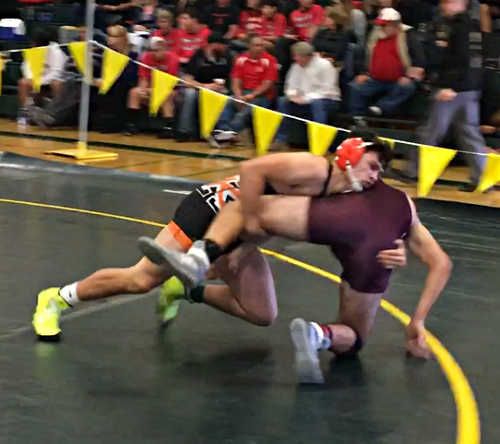
Alex Garcia ran through all of his opponents with an emphasis on scoring bonus points for the team scores.
Bryan Carrillo's lone loss was a 1-0 decision in the semifinal match vs Ukiah.
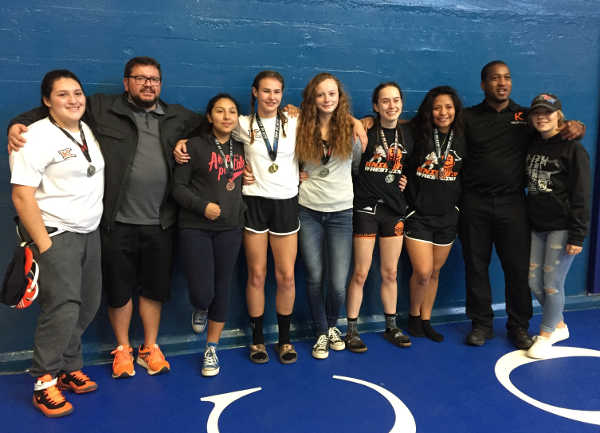
Garcia said the Lady Knights also had a strong showing in Placerville.
Kylie Marlin Ambriz’s only loss was a 9-7 decision that went back in forth and wasn't decided until the final seconds. Bailey Huggins cruised to another first place medal.
Jasmin Clarke is trying to return to form and was pinned in her championship match.
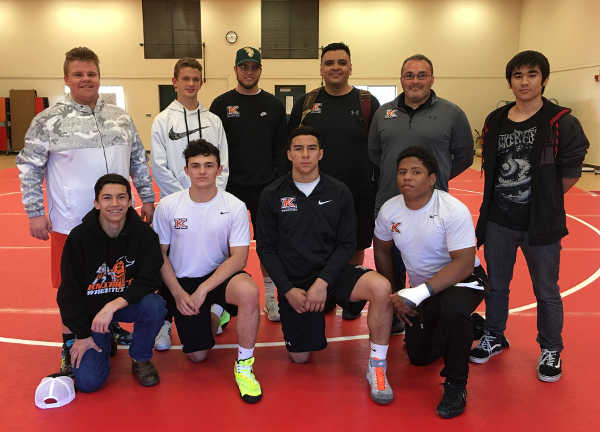
Placers were as follows.
Boys
– Alex Garcia, 4-0, first place, 160 pounds.
– Bryan Carrillo, 4-1, third place, 180 pounds.
– Javante Gregoire, 3-1, third place, 220 pounds.
– Jacob Jensen, 1-2, DNP, 132 pounds.
– Jayto Bonson, 1-2, DNP, 145 pounds.
– Micheal Beverlin, 1-2, DNP, 126 pounds.
– Justin Gentle, 0-2, DNP, 170 pounds.
– Tyler Stottsberry, 0-2, DNP, 285 pounds.
Lady Knights
– Bailey Huggins, 3-0, first place, 126 pounds.
– Brianna Thomas, 2-1, second place, 126 pounds.
– Kylie Marlin-Ambriz, 2-1, second place, 105 pounds.
– Elisa Jaquez, 2-1, second place, 137 pounds.
– Vanessa Gonzalez, 1-2, third place, 160 pounds.
– Jasmine Clarke, 2-1, second place, 235 pounds.
- Details
- Written by: California Department of Fish and Wildlife
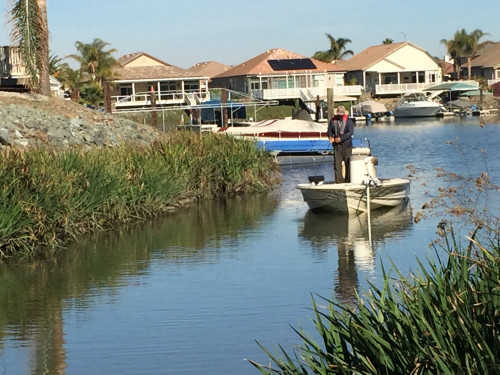
What's up with all the salmon in Kellogg Creek?
Question: In the 17 years I have lived and fished in Discovery Bay, I have never seen anything like the number of salmon being caught this year.
I have caught 10 salmon over 20 pounds incidentally while fishing for stripers and largemouth bass as you can't fish for salmon in this part of the Delta, and have observed seals catching an unbelievable amount of salmon. This has all occurred in Kellogg Creek in Contra Costa County.
Are these salmon confused and doomed as there is no place for them to spawn? (David)
Answer: David, what you've been seeing in Kellogg Creek – and what many others have seen and reported to us at other small tributaries in the San Francisco Bay Area and the Delta this year – likely are the consequences of many factors in the past few years, including the prolonged drought, stream flows and water management in the Central Valley and adjustments in fisheries practices and salmon behavior that resulted from the drought.
During the drought years, larger-than-normal numbers of juvenile Chinook Salmon were trucked from Central Valley hatcheries and placed in net pens in San Pablo Bay to improve their survival upon release.
Hatchery salmon smolts are released every year from San Pablo Bay net pens, but the drought necessitated higher numbers of salmon be delivered there in order to reduce mortality in the rivers from low flows, warmer temperatures and poor water quality as a result of the drought.
Consequently, it is possible that some of these young salmon were not able to imprint on their native rivers as salmon do when they naturally make their way down their home waters out to sea.
Although the majority of these hatchery-raised salmon migrate back to their natal rivers with no problem, some may be returning to freshwater to spawn after years in the ocean and straying to the wrong river.
As the California Department of Fish and Wildlife works to evaluate fish returning to Kellogg Creek and other tributaries, we will have a better idea of the origin of those salmon.
A percentage of hatchery fish have their adipose fin clipped and a small coded tag inserted into their body. CDFW will look for these elements in returning fish to evaluate if the salmon were raised at any one of the state's hatcheries.
Are they doomed? Pacific salmon die after they spawn. It is part of their natural life cycle. The salmon you see returning to freshwater throughout California to spawn are also in the process of dying, including those in Kellogg Creek. Spawning is the last act of their lives.
Over many decades of fishery management, state and federal biologists have recovered carcasses from some of these wayward salmon containing coded-wire tags with their age and origin that have helped shed light on what is happening, which has influenced hatchery practices of the past and will continue to influence hatchery practices in the future.
Even if the salmon do not spawn successfully in Kellogg Creek, they recycle nutrients back into the freshwater upon their deaths. Their carcasses also provide a food source for many insects, birds and animals.
The information about Kellogg Creek will be integrated into the broader evaluation of salmon returns to Bay and Central Valley rivers and creeks and to hatcheries.
The health of salmon spawning in their natal creeks and rivers is critical to the future health of salmon populations. Evaluations of salmon returning to the hatcheries in the Central Valley is occurring now.
Preliminary assessment shows below-average to above-average returns of fall-run Chinook salmon across the hatcheries. Overall, these returns should allow for collection of sufficient eggs and milt from returning fish to spawn another generation of hatchery salmon.
Hunting with lead in a national forest
Question: I was wondering if you can still hunt with lead .22 caliber rimfire or .17 HMR rimfire in a lead-free zone like Lassen National Forest or El Dorado National Forest. I've read that effective July 2017, you have to use nonlead shotgun ammunition, but can you still use lead ammunition to hunt for tree squirrels if you are not hunting on CDFW lands? Is the national forest a part of CDFW land? (Thong Yang)
Answer: You are still allowed to hunt tree squirrels with centerfire or rimfire lead ammunition in Lassen and El Dorado national forests, which are not CDFW lands.
Beginning July 1, 2019, nonlead ammunition will be required when taking any animal statewide including private lands and all national forests (California Code of Regulations Title 14, section 250.1).
Collecting abalone shells
Question: When abalone diving, is it legal to collect the old shells of abalone that are on the ocean floor or on the beach?
Also, how long do I need to keep the tags on my legally harvested shells after the meat of the abalone is consumed? (Grant Newnom)
Answer: Fish and wildlife laws generally don't prohibit the collection of shells from the bottom of the ocean or on land.
However, a specific diving area (for example, a county or state park) may have restrictions, so it's a good idea to check local rules and regulations.
Remember that abalone tags "must be left affixed to the shell, including while stored at a residence or non-transient location, until the abalone is processed for immediate consumption." (CCR Title 14, section 29.16(e)). And while collecting the shells is generally allowed, selling the shells is illegal.
If you have a question for the California Department of Fish and Wildlife, email
- Details
- Written by: Editor
The closure affects next year's recreational abalone season, which was scheduled to open on April 1, 2018.
The commission's 4-0 decision (Commissioner Jacque Hostler-Carmesin was absent) upholds the policies of the Abalone Recovery and Management Plan, which was adopted by the Commission in December 2005.
Over the past several years, the commission has taken several actions to reduce take and shorten the season to protect abalone from the unprecedented environmental conditions.
The commission directed the California Department of Fish and Wildlife to work with stakeholders to deliver a new fishery management plan that includes guidance on navigating these unprecedented conditions.
The commission also directed CDFW to consider how the new fishery management plan can inform the potential reopening of some fishing opportunity for the 2019 season.
More information about California's recreational abalone fisheries can be found on the CDFW Web site, https://www.wildlife.ca.gov/.
- Details
- Written by: Editor
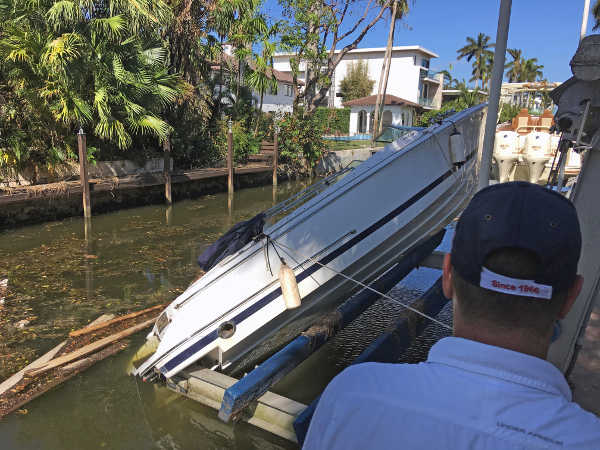
While many of the more than 63,000 boats damaged as a result of 2017 hurricanes will be repaired and have more years of life on the water, some used boat buyers in 2018 could end up with storm-damaged lemons.
The nation’s largest advocacy, services and safety group for recreational boaters, Boat Owners Association of The United States (BoatUS), cautions used boat buyers that some boats affected by Hurricanes Harvey and Irma are beginning to hit the market, and that getting a prepurchase survey (called a Condition and Value survey) is very important.
“It’s not that you don’t want to buy a boat that’s been repaired, but you should have full knowledge of the repairs and know they were done correctly. It’s a transparency issue that will help you negotiate a fair price,” said BoatUS Consumer Affairs Director Charles Fort.
The boating group offers eight tips to help you spot a boat that might have been badly damaged in a storm.
Trace the history
When a car is totaled, the title is branded as salvaged or rebuilt, and buyers know up front that there was major damage at some point in the car's history. But only a few states brand salvaged boats – Florida and Texas do not – and some states don't require titles for boats.
Anyone wishing to obscure a boat's history need only cross state lines to avoid detection, which can be a tipoff. Look for recent gaps in the boat's ownership, which may mean that it was at an auction or in a repair yard for a long time.
Look for recent hull repairs
Especially on older boats, matching gelcoat is very difficult. Mismatched colors around a repaired area are often a giveaway and may signal nothing more than filler under the gelcoat, rather than a proper fiberglass repair.
Look for new repairs or sealant at the hull-to-deck joint
Boats that bang against a dock during a storm often suffer damage there.
Evidence of sinking
Check for consistent corrosion on interior hardware, such as rust on all hinges and drawer pulls. You might be able to spot an interior waterline inside a locker or an area hidden behind an interior structure.
Corrosion in the electrical system
Corrosion on electrical items, such as lamps, connectors and behind breaker panels might mean the boat sank recently. Does the boat have all new electronics? Why?
Look for evidence of major interior repairs
Fresh paint or gelcoat work on the inside of the hull and engine room is usually obvious. All new cushions and curtains may be a tipoff, too.
Look for fresh paint on the engine
It may be covering exterior rust as well as interior damage.
Ask the seller
In some states, a seller isn't required to disclose if a boat was badly damaged unless you ask. If the seller hems and haws, keep looking.
Visit www.BoatUS.com/marine-surveys to learn more about marine surveys and access a free online boat-buying guide from BoatUS.