 How to resolve AdBlock issue?
Recreation
- Details
- Written by: California Department of Fish and Wildlife
Is a license needed to fish from the alameda rock wall?
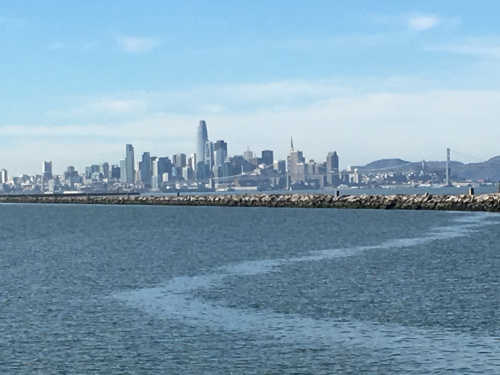
Question: My questions have to do with the Alameda rock wall located behind Encinal High School in Alameda (Alameda County).
Is a California fishing license required at the Alameda rock wall? I've heard some say that it is considered a public pier and would not require a license.
Also, how many poles (lines) are you allowed to have per angler at the rock wall? Some have said one because Alameda is part of the San Francisco Bay. Others have said that the Alameda rock wall is a jetty, so therefore two poles are allowed. I want to make sure that I'm following all Department of Fish and Wildlife laws when I want to bring new friends into the sport. (Luan T.)
Answer: We appreciate the efforts of experienced fishers to teach their friends and younger generations about fishing and help them gain an appreciation for the outdoors. Public piers are excellent places to take beginners who may be apprehensive about trying to go fishing for the first time.
No license is needed when fishing off the Alameda rock wall as it is considered a public pier. In fact, a fishing license is not needed when fishing recreationally from any public pier in California's ocean waters.
A public pier is defined in the sport fishing regulations as a publicly owned, man-made structure that has the following characteristics: is connected, above the mean high tide, to the main coastline or to the land mass of a named and charted natural island; has unrestricted free access for the general public; and has been built or currently functions for the primary purpose of allowing angling access to ocean waters (California Code of Regulations Title 14, section 1.88).
Additionally, publicly owned jetties or breakwaters that are connected to land, as described above, that have free unrestricted access for the general public and whose purpose it is to form the most seaward protective boundary of an ocean harbor are public piers.
Jetties, breakwaters, promenades, sea walls, moles, docks, linings, barriers and other structures that are not the most seaward protective boundary of an ocean harbor, are not public piers.
You are correct that the Alameda rock wall is within the San Francisco Bay (see California Code of Regulations Title 14, section 27.00 for the definition) and therefore has the restriction of only allowing one line with not more than three hooks when fishing for finfish (CCR Title 14, section 28.65(a)).
Furthermore, the Alameda rock wall is a publicly accessible jetty so it falls under the definition of public pier. If you are fishing for finfish from the Alameda rock wall, you can use one line with not more than three hooks, and a second line attached to a net or trap to take other fish, such as rock crab.
Even though a fishing license is not required on a public pier, all other regulations (including minimum size, bag limits, seasons and report card requirements) apply. Good luck and have fun fishing with your friends!
Is portion of Kern River open to year-round fishing?
Question: I'm from Bakersfield and I see in the regulations that there is a portion of the Kern River that is open to fishing year-round. Does this also include streams that flow into the Kern River? Also, if you are practicing catch-and-release, can you fish for trout when the season is closed? (Cody G.)
Answer: Cody, you are correct in that the portion of the Kern River from Lake Isabella north to the Johnsondale Bridge is open to trout fishing year-round. However, the other waters in that part of Tulare County, including the streams that flow into the Kern River, fall under the general regulations for the Sierra Sport Fishing District and are only open the last Saturday in April through Nov. 15.
If you have specific questions about particular streams, you can always check the Trout, Salmon and Special Regulations portion of the 2017-18 Freshwater Sport Fishing Regulations, which will list individual waters, such as the Kern River, with special fishing regulations. If the specific stream you are curious about is not listed, then that stream falls under the general regulations of that particular sport fishing district.
Please be aware that the Kern River above the Johnsondale Bridge is a special regulation water that is open to trout fishing the last Saturday in April to Nov. 15 with restricted limits and minimum size requirements, and only artificial lures with barbless hooks may be used.
In regard to your other question, you cannot fish for trout in any fashion when the season is closed to trout fishing. The portions of the Kern River that close to trout fishing are also closed to fishing for all other fish species with the exception of fishing for amphibians, freshwater clams, crayfish and lampreys. When fishing for these other species, however, no hook-and-line methods are allowed during the closed trout season.
If you have a question for the California Department of Fish and Wildlife, please feel free to email
- Details
- Written by: Editor
The card verifies that its holder has successfully taken and passed an approved boater safety education course.
Once issued, the California Boater Card remains valid for an operator’s lifetime.
On Sept. 18, 2014, Gov. Edmund G. Brown Jr. signed into law Senate Bill 941, which prohibits the operation of motorized vessels in California without a valid boater card developed and issued by DBW.
The new mandatory boating safety education law will go into effect Jan. 1, 2018.
The law will be phased in by age. The first group required to take the exam are boaters 20 years of age and younger. Each year after January 2018, a new age group will be added to those who are required to possess a valid card.
By 2025, all persons who operate a motorized vessel on California waters will be required to have one.
The cost of the lifetime card is $10, and all the money goes toward developing and operating the program. By law, DBW cannot profit from the program.
“California and U.S. Coast Guard accident data show that states with some form of boating safety education have fewer accidents and fatalities than states without any boater education requirements,” said DBW Acting Deputy Director Ramona Fernandez. “This new law will help make boating safer for all families on California’s waterways.”
California is one of the last states to implement some sort of mandatory boating education requirement. Repeatedly, recreational boating accident data shows that many operators involved in accidents have not taken a boating safety course.
For example, last year’s statistics showed that more than 800 California recreational vessels were involved in reported accidents, resulting in 50 deaths.
Only one of the boat operators involved in the fatal accidents had taken an approved boating safety course.
Applying for the California Boater Card is easy. Boaters have an option to apply before or after taking an approved boating safety course.
You can find the list of options at www.CaliforniaBoaterCard.com. A toll-free telephone support line is also available at 844-421-8333.
There is good news for boaters who have already taken an approved course between Jan. 1, 2015 and Dec. 31, 2017.
Persons who have passed an approved examination during this timeframe will have until Dec. 31, 2018, to apply for their California Boater Card to receive the “grandfathering” exemption regardless of their age.
Older courses will not be accepted since they may not include recent state or national changes to navigation law.
Boating safety course providers must be approved not only by the state of California, but by the National Association of State Boating Law Administrators. Courses may be classroom, home study or online.
It is important to note there are exemptions to the new law. For example, those operating a rental vessel or possess a current commercial fishing license do not need to obtain a California Boater Card.
For more information on the new mandatory boating safety education law, including a current list of approved California boating courses and exemptions to the law, please visit www.CaliforniaBoaterCard.com.
- Details
- Written by: Editor
The ACCESS Act expands access for fishing, hunting, and other recreational activities on public lands and addresses numerous priorities of the sporting and conservation communities.
The bill reauthorizes and fully funds several popular conservation programs that protect wildlife and habitat through long-term conservation, land acquisition, and public-private partnerships.
It also includes a permanent reauthorization of the Land and Water Conservation Fund and the Federal Land Transaction Facilitation Act, key programs for sportsmen’s access to public lands that have broad bipartisan backing.
“As a lifelong hunter and sportsman, I’m proud to introduce the ACCESS Act, a true sportsmen’s bill that would make a real difference for sportsmen and women across the country,” Thompson said. “Participation in hunting and fishing has declined over the years and we should be working to get more young folks outdoors, expanding access to these recreational opportunities. The programs in this bill have bipartisan support in both the House and the Senate, and I look forward to working with my colleague to move them forward.”
“We need to stop letting the gun lobby and its partners in Congress use sportsmen as a shield to advance their agenda. Instead of catering to National Rifle Association lobbyists, our bill expands access to public lands and protects America’s outdoor heritage,” Grijalva said. “Conserving wildlife and habitat while opening up new opportunities for hunters, anglers and other outdoor enthusiasts is a win for everyone. It may not be how the gun pushers in D.C prefer to do business, but it’s a welcome step forward for sportsmen tired of seeing their priorities hijacked.”
Sporting and conservation groups including the National Wildlife Federation, Trout Unlimited, and Backcountry Hunters and Anglers support the ACCESS Act.
Collin O’Mara, president and CEO of the National Wildlife Federation, praised the bill, saying, “America’s sportsmen and sportswomen are among the finest wildlife conservationists in our nation. The ACCESS Act demonstrates the inextricable role that restoring wildlife habitat and expanding outdoor opportunities play in increasing wildlife populations and preserving our outdoor heritage, from protecting the coldwater streams that trout depend upon, the wetlands and grasslands that waterfowl and upland birds need, and the forests where deer, elk, and turkeys roam. At a time when America’s waterways and wildlife habitat are more at risk than ever from encroaching development, nutrient runoff, invasive species, climate impacts and other threats, this bill will put people to work in communities across the country making sure America’s great outdoors – and the women, men, and wildlife that depend on them – continue to thrive.”
Among other measures, the bill:
– Reauthorizes funding for key conservation programs: North American Wetlands Conservation Act, Federal Land Transaction Facilitation Act, Land and Water Conservation Fund, National Fish and Wildlife Foundation, Neotropical Migratory Bird Conservation Act, Partners for Fish and Wildlife Act, African Elephant Conservation Act, Rhinoceros and Tiger Conservation Act of 1994, Asian Elephant Conservation Act of 1997, Great Ape Conservation Act of 2000, and Marine Turtle Conservation Act of 2004.
– Ensures recreational access for hunting, fishing, and recreational shooting on public lands and clarifies land acquisition and conservation easements for recreational use under existing laws.
– Encourages fish habitat and aquatic ecosystem conservation by addressing invasive species and establishing partnership grants.
– Authorizes a prize competition for wildlife conservation technology aimed to prevent wildlife trafficking, promote wildlife conservation, manage invasive species, protect endangered species, and promote non-lethal management of human-wildlife conflicts.
- Details
- Written by: Carrie Wilson
Is lobster poaching from commercial traps a felony?
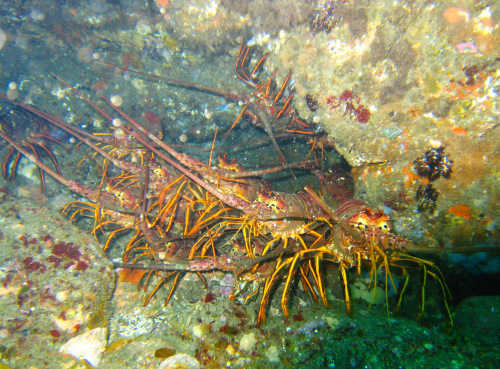
Question: I recently heard that a recreational lobster diver who takes lobster from a commercial lobster trap could be arrested and booked into jail on felony charges. Is this true? (Anonymous diver, Orange County)
Answer: Yes, it's true. California Penal Code, section 487 includes several subsections that describe grand theft, which is in fact, a felony.
A recreational diver who steals fish, shellfish, mollusks, crustaceans, kelp, algae or other aquacultural products from a commercial or research operation which is producing that product of a value exceeding $250, has committed a felony.
So in addition to theft from commercial lobster traps, this also covers theft from commercial crab traps, and theft from an aquaculture facility.
You'd be surprised how easily the value of those lobsters can add up. The per pound price of California harvested spiny lobsters is as much as $32 per pound in November 2017. But even theft of less than $250 worth of lobster from a commercial trap potentially involves misdemeanor-level violations, including theft, and disturbing another person's traps (California Fish and Game Code, section 9002).
Technically the penalties and fines for each misdemeanor conviction could amount to a sentence of six months in jail and a fine of up to $1,000.
Another important note: two or more recreational divers who conspire together to commit the misdemeanor violation of stealing lobsters from a commercial trap, and steal a total amount of lobsters that exceed the $250 threshold, are also both potentially guilty of felonies.
California law and California wildlife officers take the violation of stealing from commercial fishermens' traps very seriously. In addition to being illegal, this behavior is unethical and unsportsmanlike.
If you come across an underwater trap, leave it alone!
Using a rangefinder on a compound bow
Question: Is it legal to mount a rangefinder on a compound bow when hunting deer or bear? (Roger)
Answer: Scopes with laser rangefinders are not prohibited. Just be sure the device does not project any visible light or electronically intensified light for the purpose of either visibly enhancing an animal or providing a visible point of aim on an animal (California Code of Regulations Title 14, section 353(i)).
These devices may be used only for the take of nongame and furbearing mammals as provided in the Mammal Hunting Regulations (CCR Title 14, section 264.5).
Trapping minnows for bait
Question: Is it legal under a California fishing license to trap minnows using basic minnow traps? The minnows would be used for targeted game fish (striped bass). I see regulations for commercial minnow trapping but not non-commercial. (Michael N.)
Answer: The term "minnow" often is used to refer to many different species of small baitfish, some of which belong to the minnow family.
Depending upon where in the state you plan to use the minnows and, more specifically, which species of minnow (e.g. longjaw mudsucker, fathead minnow, Mississippi silverside, etc.), you will need to check the appropriate baitfish regulations that apply to the specific waters where you intend to fish (CCR Title 14, section 4.25).
That said, approved baitfish may be taken by hand, with a dip net, or with traps not over three feet in greatest dimension (CCR Title 14, section 4.05).
If you have a question for the California Department of Fish and Wildlife, email