 How to resolve AdBlock issue?
News

LAKE COUNTY, Calif. – It's another quintessential storybook spring day, replete with green growth aplenty.
Grapevines are budding out, oaks and alders are starting their showy spring displays of living art in the form of catkins.
Catkins are the long, dangling male flowers which release pollen into the wind in order to wind-pollinate.
Along with the impressionistic haze of green in every shade imaginable now, are wildflowers in an incredible array of colors that are popping in patches of soil nearly everywhere.
With all of the lush bounty in orchards, valleys and woods, land managers of all ilk are putting elbow-grease into mowing and removing potentially flammable material.
You may have seen some of the “live lawnmowers” around the county in the form of goats or sheep corralled together munching and crunching on grass and shrubs.
These industrious creatures are helpful in reducing fuel loads to a manageable level.
Sheep are known to feed on herbaceous growth, while goats will consume woody material.
Some farmers have found that grazing on large tracts of the landscape is even more advantageous than simply mowing, and usually turns out to be quite cost-effective.
Demand for renting grazing goats is a growing business across California and the West, with homeowners, golf courses, government agencies and even some fire departments such as those in Ventura County making use of the goats' clearing abilities.
Thanks to the goats' voracious appetites they can chomp up to 12 pounds of vegetation per day, all while navigating those hard-to-reach places on hilly terrain.
Goats consume a wider variety of growth than do cattle, which prefer grasses and sedges.
A herd of 170 goats is recorded as consuming 2,000 pounds of green brush in a single day.
The strong animals are able to extend themselves up on their back legs and reach leaves and branches up to 7 feet high.
An added advantage goats present is that unlike us, they do not mind going into stands of poison oak, and they may be good at ridding the land of invasive species.
A disadvantage to running goats is that they are not allowed into areas where rare and endangered plants are known to thrive.
Running a goat-rental business takes some investment and planning strategies. Goat herds require livestock trailers, portable fencing and folks to attend to the goats and oversee them for safe-keeping.
Goats aren't said to solve every problem, but they are definitely a great tool in the kit that includes regular mowing, clearing and where deemed necessary, prescribed burns.
For a list of Lake County agriculture members, some of whom hire out their goats, visit http://www.lakecountyfarmersfinest.org/agricultural_members.html .
Kathleen Scavone, M.A., is a retired educator, potter, freelance writer and author of “Anderson Marsh State Historic Park: A Walking History, Prehistory, Flora, and Fauna Tour of a California State Park” and “Native Americans of Lake County.”

While the shelter has moved most of its dogs into foster, potential adopters can make appointments to meet and adopt available dogs.
The following dogs are ready for adoption or foster.

‘Lady’
“Lady” is a female German Shepherd mix.
She has been spayed.
She is dog No. 3683.

‘Princess’
“Princess” is a female German Shepherd with a black and tan coat.
She has been spayed.
Princess is young and energetic. She previously lived around a smaller dog and has been around the office cat. She will benefit from training and attention.
She is dog No. 3669.

‘Spud’
“Spud” is a male American Staffordshire Terrier with a short brindle and white coat.
He has been neutered.
He is dog No. 3733.

‘Tyson’
“Tyson” is a male American Staffordshire Terrier with a short gray and white coat.
He has been neutered.
He is dog No. 1863.
Clearlake Animal Control’s shelter is located at 6820 Old Highway 53, off Airport Road.
Hours of operation are noon to 4 p.m. Tuesday through Saturday. The shelter is closed Sundays, Mondays and major holidays; the shelter offers appointments on the days it’s closed to accommodate people.
Call the Clearlake Animal Control shelter at 707-273-9440, or email
Visit Clearlake Animal Control on Facebook or at the city’s website.
Email Elizabeth Larson at

LAKEPORT, Calif. – “You’re more creative than you think.”
Creativebug is your go-to resource for high-quality, on-trend arts and crafts instructional videos.
Free with your Lake County Library card you get on-demand access to our full library more than 1,000 art and craft classes for artists and makers of all levels.
With your library card, you’ll enjoy award-winning HD instructional videos on drawing, painting, sewing, knitting, crochet, quilting, baking and more.
Creativebug.com offers classes to appeal to all ages of creative people. All classes are taught by experts, with new classes added daily.
Creativebug delivers expert instruction and inspiration straight to your favorite device so you can learn at your own pace – anytime and anywhere. Benefits include downloadable patterns, templates and recipes, access to Creativebug’s community galleries and forum, and one class each month to keep forever.
Daily Practice videos are 5-10 minute creative exercises and projects designed to keep your creative skills sharp and your creativity inspired even when you only have a few minutes a day.
Join thousands of like-minded creatives taking a few minutes every day to experience the satisfaction and joy of exercising their creative muscles. Check out all the beautiful work by Creativebug members in the gallery and on Instagram #cbdrawaday
Creativebug.com is optimized for mobile and tablet, so it's easy to use and enjoy from all of your favorite devices. The Creativebug app is available via iTunes and Google Play. With the Creativebug App you can download your favorite class and take it on the go!
In the Double Wedding Ring Quilt class, quilter Tara Faughnan, known for her vibrant and harmonious use of color, shares her technique for hand-piecing a double wedding ring quilt block.
Faughnan begins by showing how to create your own arc templates that utilize small scraps of fabric.
She goes on to teach hand-sewing techniques for piecing and shares loads of information along the way about how colors interact. See how this centuries-old block pattern comes together to create a colorful quilt top with a fresh, modern twist.
With a library card, patrons can access the library’s array of digital services without the need to visit a local branch. If you need a library card, you can create an online card with the application form on the library website.
If you have a question about an existing library account, call 707-263-8817 and leave a message. Library staff will be available by phone during normal operating hours to assist with the digital resources.
The Lake County Library continues to offer services during the COVID-19 stay at home. If you want to keep up with library news, sign up for free weekly email updates on the library’s homepage.
Jan Cook is a library technician for the Lake County Library.
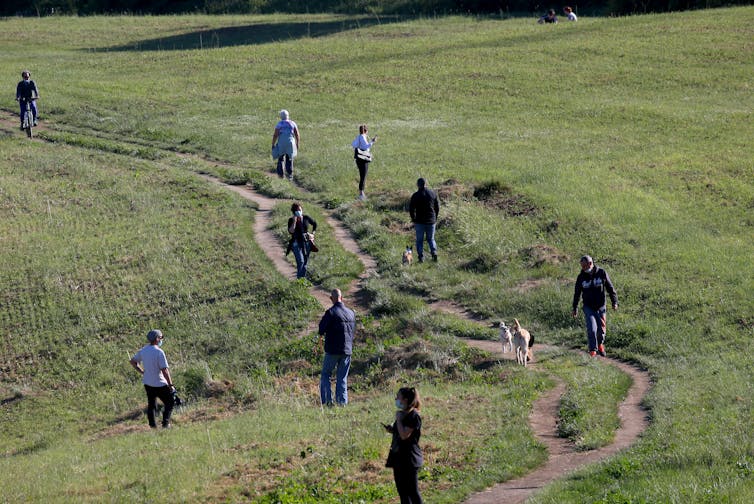
It has been less than two months since the world scrambled to go into the “Great Lockdown” to slow the spread of COVID-19. Now, many countries are considering their exit strategies. Some have already eased up.
The push is largely economic. There is a lot scientists don’t yet understand about the novel coronavirus, and there is no known cure or vaccine. Many countries are still experiencing a rise in infections. But the lockdowns have played havoc with people’s livelihoods. Entire economies are in meltdown: The International Monetary Fund predicts the worst economic downturn since the Great Depression.
Just as each nation chose a different route into lockdown, each is likely to choose its own exit path. I have launched a research initiative, “Imagining a Digital Economy for All 2030,” with a focus on the post-pandemic global economy. We have been studying the characteristics of 40 countries that help explain how governments and citizens have acted to contain the COVID-19 outbreak and their preparedness to take an economy online. Our analysis offers ways to gauge which countries are best prepared for a safe exit.
It seems clear that the safest idea is to reopen slowly, in phases, while remaining ready to reenter lockdown in case of new outbreaks. By looking at how well a nation managed the first wave of the pandemic, and how ready it is to work remotely by falling back onto the online economy, we now understand how prepared nations are to restart economic activity without triggering fresh rounds of public health disasters.
Public health and technology
Not every country is well equipped to ease itself out of a lockdown safely.
A nation’s ability to manage the outbreak relies on many factors: the willingness of governments to take decisive action; citizen compliance in staying home and social distancing; and capacity for adequate testing for the disease, including “contact tracing” – tracking down the people who have been in contact with those infected. Those characteristics are also key to managing future outbreaks.
In parallel, not every country is ready to shift much of its economic activity online. Around the world, not everyone has affordable, reliable internet service; or the jobs, devices and digital apps that would let them work productively from home; or ways to make payments and get public services online. In some countries – though not all – workers who can’t do their jobs remotely can reduce their in-person contact by using digital transactions, whether it is for carry-out food, e-commerce or receiving bailout checks and unemployment benefits.
Countries such as Germany, New Zealand and South Korea are strong in both disease-fighting and digital-economy preparedness. Their economic activity isn’t as dependent on in-person interactions, and authorities can respond quickly if loosened rules result in a spike in cases. In contrast, the U.S., Italy and Japan face different challenges before they can safely lift lockdowns.

Difficulties ahead for the US
Compared to countries worldwide, the U.S. is more prepared to operate parts of its economy online, but its response to the outbreak indicates there may be difficulties after reopening. States were inconsistent in issuing stay-at-home orders, and citizens’ compliance with the rules has varied widely.
Officials have been unable to test in large numbers, and only four states meet, or are on track to meet, the contact-tracing required to control future outbreaks.
The results are evident in the mortality rates in the U.S. and other, better-prepared countries: On May 5, the key statistic shows the U.S. death rate was more than three times that of Germany, nearly 200 times those in New Zealand and South Korea.
What made the difference?
The countries that more efficiently managed this first outbreak and its consequences capitalized on their public health preparation to get a grip on the infection quickly. Germany has a high volume of infections but low mortality. The country only knows this because it had tested extensively – at a rate of 21 people per 1,000, as compared with 9.8 per 1,000 in the U.S.
New Zealand’s government proved willing to rapidly impose severe restrictions on movement and found the public largely supportive and ready to comply.
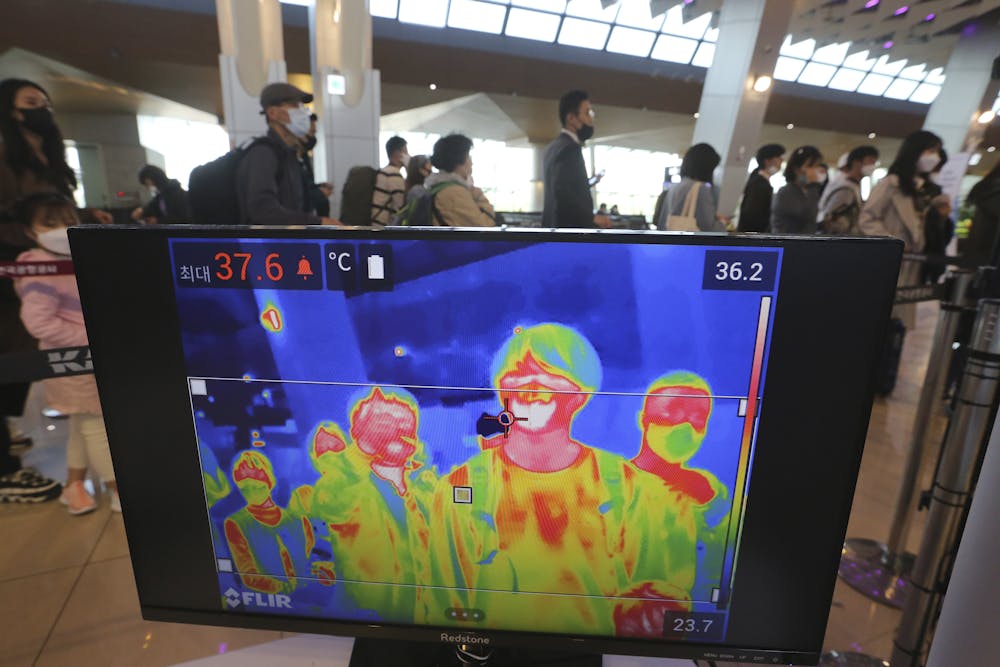
South Korea, while among the earliest countries affected, kept its mortality among the lowest in the world through widespread testing and deploying technology for widespread contact tracing. Infected individuals’ interactions were retraced using cellphone location data, surveillance camera footage and credit card records. Websites and apps offer details on infected people’s travel and exposure risks.
These approaches may prove hard for the U.S. to replicate. The country is far from having testing rates like Germany’s. New Zealand has a much less polarized citizenry and far more trust in its national leadership than the U.S. The South Korean technology-intensive approach to contact tracing would be considered too intrusive on individual privacy for the U.S.
Troubles for other nations, too
Italy initially underestimated the severity of its outbreak, but then imposed a strict lockdown with high citizen compliance and widespread testing and tracing. However, we found in our study that Italy is among the least prepared European Union members for a shift to a digital economy. Germany, New Zealand and South Korea all have higher levels of internet access and service, digital payments and public services, and employers ready to handle remote work.
Japan’s situation is particularly challenging because it eased up its restrictions too early and then had to impose an emergency to stem additional outbreaks. It is also relatively unprepared in digital terms because of a host of factors, ranging from peer pressure to come into the office, to security concerns, transactions that require a paper trail, often requiring official corporate seals, missing digital infrastructure and a continued aversion to digital payments.
Each of these countries is a wealthy, developed nation, so the differences are not due to affordability. Our research has found that preparedness requires not just funding but also farsighted, credible and transparent leadership and citizens’ trust in that leadership. The first leads to timely and firm decisions, and the second contributes to citizens’ willingness to cooperate with those decisions.
For instance, German Chancellor Angela Merkel’s background as a trained scientist gave her powerful credibility when facing a scientific crisis. New Zealand Prime Minister Jacinda Ardern clearly explained her “go early, go hard” approach to lockdown restrictions, and her citizens agreed. In South Korea, authorities controlled the virus through “decisive and transparent leadership based on data, not emotion.”
As governments seek their own exit pathways, and aim to strengthen areas where they are weak, there’s no way to be completely certain or fully prepared for what might happen next.
In our research, we’ve found one principle that governments might find useful to guide them through the uncertainty. It’s from a former New Zealand prime minister, Helen Clark: “Economies can recover; the dead can’t.”
[You need to understand the coronavirus pandemic, and we can help. Read The Conversation’s newsletter.]
Bhaskar Chakravorti, Dean of Global Business, The Fletcher School, Tufts University
This article is republished from The Conversation under a Creative Commons license. Read the original article.
Billions of years ago, the Martian surface could have supported microbial life as we know it. But did such life ever actually exist there?
NASA and its Mars 2020 mission hope to find out with the Perseverance rover, which launches to the Red Planet this summer.
Scientists have sought answers to astrobiological questions on Earth, studying regions similar enough to Mars to understand what the Red Planet's microscopic fossil record might look like. One research trip late last year involved fossilized microbes in the Australian Outback.
Earlier this year, seven mission scientists headed to a dry lakebed in Nevada as 150 worked with them remotely for the Rover Operations Activities for Science Team Training, aka the ROASTT.
Rather than bringing a car-sized rover, the seven field team members stood in for it. Wielding cameras and portable spectrometers during simulated operations spread out over a two-week period, they received instructions from the scientists located elsewhere, just as the rover will after it lands on Feb. 18, 2021.
Like all Mars rovers, Perseverance will be run by a distributed team of scientists and engineers — some located in the operations center at NASA's Jet Propulsion Laboratory, which leads the new mission, and some located at research institutions around the world. They will discuss where to go, which samples to study, and — for the first time — which rocks to collect in metal tubes for eventual return to Earth for deeper study.
The Nevada exercise not only helped team members practice what to look for with Perseverance; it helped them get used to working with one another and with the rover. The field site was also an opportunity for research: Besides simulating a rover, the field team members were studying the field site, providing insights that could help shape the search for past life on Mars.
If a cliffside seemed promising, scientists on conference lines around the globe debated whether the field team should "drive" closer; if a set of rocks appeared ideal for preserving fossils, they would order close-up images from the field team.
A ray-gun-like laser instrument mimicked Perseverance's rock-analyzing SuperCam; another handheld tool shot X-rays like the rover's Planetary Instrument for X-ray Lithochemistry, or PIXL, will; a ground-penetrating radar was carted around in what looked like a jogger stroller to peer below the surface, mimicking the Radar Imager for Mars' Subsurface Experiment, or RIMFAX.
The field team also had an important low-tech tool: a cheap broom used to sweep away their footprints, both to preserve the Martian feel of the landscape and to avoid providing the remote scientist a sense of scale in the rock images they were providing.
A patch of Mars in Nevada
Walker Lake is an ideal training ground for spotting ancient microscopic life. The lake once extended much farther than it does today; the parts of it that dried up tens of thousands of years ago are now studded with stromatolites — collections of fossilized microbes and sediment that have hardened into what often look like bulbous, moundlike growths. It remains to be seen whether Jezero Crater, Perseverance's landing site, has anything akin to stromatolites, but it, too, is an ancient lakebed.
Besides helping scientists think about biosignatures, or signs of ancient life, the training also demonstrated how working with Perseverance will take teamwork and careful coordination.
"It's especially important for scientists who are new to Mars rovers," said JPL scientist Raymond Francis, who led the field team. "It's a team effort, and everyone has to learn how their roles fit into the whole mission."
One rover, many decisions
Lisa Mayhew, a geochemist and geomicrobiologist at the University of Colorado Boulder, is one of those newcomers.
To study the relationship between water, rocks and microbial life in extreme environments, she's worked with deep-sea remotely operated vehicles, like the Woods Hole Oceanographic Institution's Jason.
In places such as the Lost City, located at the bottom of the Atlantic Ocean, she's watched Jason explore craggy mineral towers.
Microbes in and on these towers thrive by metabolizing energy-rich gases, like hydrogen and methane, produced from reactions between water and rock. Some scientists think life on Earth may have originated in such places.
Similarly to a Mars rover, Jason sends back images, and its robotic arms can be deployed to move rocks and take samples. But Mars is much farther away than the ocean floor. Only so many commands can be sent to Perseverance each day, and only so much data can be sent back.
That's why every rover mission has to balance the desire to deepen the team's understanding of one site with the need to sample the geologic diversity available down the road.
The Walker Lake exercise underscored for Mayhew just how many decisions go into managing a Mars rover. "While it's similar in many ways to operating and directing Jason, it's happening on a much larger scale and you're pretty clueless until you're actually planning a rover drive," she said. "You have to learn all the different software tools and understand the distinction between different roles."
At the end of the training, participating scientists said they had a much better idea of how a rover team works. What's more, the scientists had chosen a sample that was rich with biosignatures.
"The next time we do this will be on Mars," said JPL's Ken Williford, one of the mission's deputy project scientists. "We've got to get the right samples. Let's bring them back."
Perseverance is a robotic scientist weighing about 2,260 pounds (1,025 kilograms). The rover's mission will search for signs of past microbial life. It will characterize the planet's climate and geology, collect samples for future return to Earth, and pave the way for human exploration of the Red Planet.
No matter what day Perseverance launches during its July 17 to Aug. 5 launch period, it will land at Mars' Jezero Crater on Feb. 18, 2021.
The Mars 2020 Perseverance rover mission is part of a larger program that includes missions to the Moon as a way to prepare for human exploration of the Red Planet.
Charged with returning astronauts to the Moon by 2024, NASA will establish a sustained human presence on and around the Moon by 2028 through NASA's Artemis lunar exploration plans.
For more information about Perseverance, visit https://mars.nasa.gov/mars2020/ and https://www.nasa.gov/perseverance .
On Thursday, Gov. Gavin Newsom issued new orders that direct the state’s “Stage 2” response to the COVID-19 pandemic.
Dr. Gary Pace said Friday that he issued a new order to align with Newsom’s action.
Pace said that, at the same time, the shelter in place order remains in effect. Previously, Lake County’s order extended through May 17, but Pace’s latest order aligns with the state’s, which has no specific end date.
Lake County’s new health order removes previous discrepancies between state and local orders and makes clarifications specific to Lake County, which Pace said include exemptions for people staying in hotels.
At the same time, because Pace said all confirmed infections in both Lake and Mendocino counties have originated from out-of-county contact with known positive cases, local hotels and vacation rentals will remain closed for nonessential stays.
Newsom’s Stage 2 allows some “low-risk” retail businesses to reopen with phone and online sales and curbside pickup, with the logistics and manufacturing sectors also allowed to resume, along with office-based businesses, personal services such as car washes, pet grooming, tanning facilities and landscape gardening, dine-in restaurants, and outdoor museums and open gallery spaces.
According to the state guidelines, those businesses and establishments must qualify to reopen upon certification that the county meets the California Department of Public Health’s criteria and implement the relevant industry guidelines.
Sector-specific guidance for businesses from the California Department of Public Health and the Department of Industrial Relations’ Cal/OSHA Division is available here.
In Lake County’s case, Pace said restaurants will remain closed for the time being, except for take-out.
Pace said that with the movement toward reopening now happening more rapidly, businesses should not wait to undertake planning efforts.
Resources for business owners, including a reopening plan template, social distancing protocols and business certification forms, are available at the county’s website.
As sectors are authorized to resume business activities, Pace said all reopening businesses must post the social distancing protocol checklist and business certification document provided by the county in a visible location near the entrance to all facilities.
He said there is an opportunity to open local businesses more quickly than the governor’s orders, and plans are being developed to facilitate that. Those proposals will be discussed at the Board of Supervisors meeting on Tuesday.
Since his last shelter in place order modifications, which included allowing people to fish and use nonmotorized boats on the lake, Pace said there has not been a rise in COVID-19 cases, so the county is going forward with opening the lake and other local waterways this weekend to local residents, consistent with state orders.
Pace said boat ramps will be open and quagga mussel program monitors will be in place.
He continued to urge people to follow social distancing practices, wear masks in public and practice good hygiene, and discouraged out-of-area residents from visiting Lake County yet.
Pace also said that people over the age of 65, or those who are otherwise vulnerable to severe complications of COVID-19 infection, need to continue to take precautions.
For more information, or if businesses want Public Health to review their reopening plan reviewed, email
This article has been clarified regarding the county shelter in place order aligning with the state’s.
Email Elizabeth Larson at
HO Order C20-5_Fully Executed by LakeCoNews on Scribd