 How to resolve AdBlock issue?
News
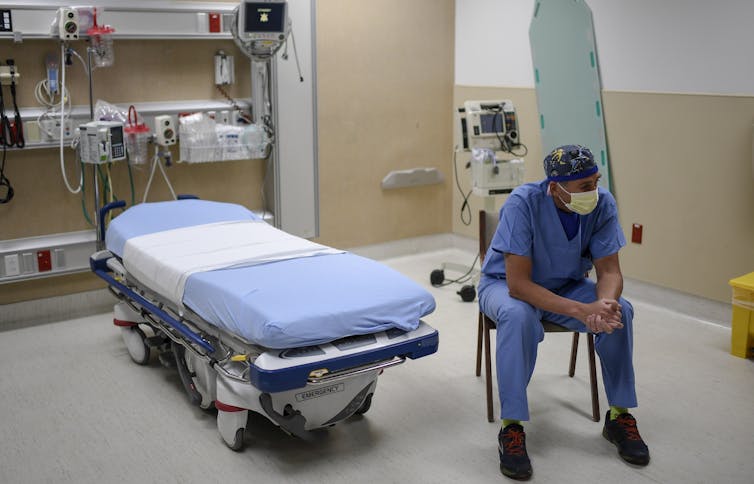
“Where have all the patients gone?” That’s what doctors in our West Virginia University hospitals began asking as the coronavirus pandemic spread.
We were prepared for a rise in COVID-19 patients, but we didn’t expect the sharp decline we saw in everyday cases. Our emergency department visits fell by half in early April, a time when we would normally see growth as flu season overlaps with an increase in trauma as the weather improves. Inpatient stays fell by nearly two-thirds during the same time period.
Did the population of a state that ranks in the bottom of most health indicators suddenly get better? Did their lung disease, heart disease and vascular disease improve?
In the emergency room, we heard the real reason: “I thought I could wait this out,” patients told us.
In hospitals across the U.S. and Europe, people fearing contracting COVID-19 have been choosing not to seek the emergency treatment they need. One survey conducted in April found that nearly a third of U.S. adults had delayed medical care or avoided seeking care because they were concerned about getting COVID-19.
A study in Spain found a 40% drop in the number of patients undergoing emergency cardiac catherization for a dangerous type of heart attack known as STEMI between the late February and mid-March. A similar study in the U.S. found a 38% drop in heart catherization for STEMI cases from January to March. Children’s vaccinations also dropped off significantly, according to the Centers for Disease Control and Prevention, raising new concerns after last year’s measles outbreak.
This has certainly been our experience as physicians and faculty at the West Virginia University School of Medicine. The patients we saw in the emergency room in April were a lot sicker, and the proportion of emergency room patients who needed hospitalization increased.
The costs of delaying emergency care
Delaying treatment for acute and chronic conditions comes at a cost, both human and financial.
A patient with appendicitis who gets treatment early will usually undergo laparoscopic surgery, using small incisions and a camera, and can go home two days later. If the same patient waits too long, however, and a pocket of infection known as an abscess forms, that means more complex surgery. We will have to insert a tube for several days to drain the abscess, and the patient will be hospitalized longer, in addition to going on antibiotics. In the worst case, the appendix could burst and lead to diffuse peritonitis and sepsis, a medical emergency with severe abdominal pain and low blood pressure.
Similarly, if a diabetic with a foot infection that is early in the stages of cellulitis, a painful localized skin infection, waits a week to two longer than usual, there’s a greater chance the infection has reached the bone, becoming an osteomyelitis that could require amputation.
The ultimate cost for delaying treatment can be loss of life. Data from the CDC shows the U.S. had 66,000 more deaths than expected from January through the end of April, with only about half of those linked to COVID-19.
In some cases, clinics are trying to balance the risks. For example, many clinics have delayed preventative care such as cancer screenings because of the risk of COVID-19. One U.S. study found an abrupt drop in preventative cancer screenings of between 86% and 94% through April. Treatments for cancer patients are continuing, with hospitals taking extra precautions to protect patients while their immune systems are compromised.
The hospital experience is changing
COVID-19 is not going away anytime soon, nor will heart attacks, strokes or appendicitis.
If you feel you need to see your doctor, go. If you feel you need to go to the emergency department, call 911. It’s better than the pain and costs that can come with delay.
Your experiences during hospital visits going forward will definitely be different for a while. People arriving for hospital care that doesn’t require staying overnight should expect some kind of screening process to make sure that they are not ill with COVID-19. The health care system will encourage social distancing at check-ins, as well as in the waiting rooms, and everyone will be wearing face masks.
As a patient, you might not be allowed to have visitors, but you will receive the health care that you need.
While these certainly unprecedented times have upended our care processes, they also offer patients and health care systems new opportunities.
When we talk to our patients, many of them appreciate the opportunity for virtual visits, especially those at highest risk for complications from COVID-19 infection. The ability to establish virtual urgent care as well as offer many clinical services through virtual visits is here to stay.
The past few weeks have seen very significant changes at all points of patient entry into a hospital or clinic. However, clinical medicine’s fundamental principle of primum non nocere, “first do no harm,” prevails, and we remain committed to making sure that patients that need care get it on time and do not have to delay their visits or ignore their symptoms.
[You need to understand the coronavirus pandemic, and we can help. Read The Conversation’s newsletter.]
Arif R. Sarwari, Physician, associate professor of infectious diseases, chair of Department of Medicine, West Virginia University and Christopher Goode, Emergency medicine physician, chair of Emergency Medicine, West Virginia University
This article is republished from The Conversation under a Creative Commons license. Read the original article.
On Friday California officially moved into Stage 2 of Gov. Gavin Newsom’s roadmap to modify the statewide stay-at-home order.
State officials are allowing counties to apply for variances to move more quickly through the process as long as they can attest to a number of requirements, including having no new cases and deaths to testing and hospital capacity, being able to protect essential workers, and the ability to shelter a portion of the homeless population.
On Tuesday, Lake County Public Health Officer Dr. Gary Pace said he intended to bring his plans for a variance to the Board of Supervisors at its meeting next week in order to submit the plan to the state, as Lake County News has reported.
The California Department of Public Health reported on Tuesday that variances for Butte and El Dorado counties were approved.
By Wednesday night, CDPH said 16 more counties had their variances approved.
Those counties are Amador, Calaveras, Colusa, Glenn, Lassen, Mariposa, Nevada, Placer, Plumas, San Benito, Shasta, Sierra, Tehama, Tuolumne and Yuba-Sutter.
CDPH said the counties have attested that they meet the criteria necessary to move further into Stage 2.
That allows them to reopen various parts of the economy with modifications implemented to prevent the spread of COVID-19.
State officials said the goal is to reopen California in a way that minimizes the risk for transmitting COVID-19 to the extent possible.
That goal includes limiting nonessential movement and mixing of populations, especially within jurisdictions with higher confirmed cases, and delaying the opening of environments in which there is prolonged and close contact as part of the way business must operate.
Statewide guidance for these sectors is available here.
CDPH said its website will continue to be updated in real-time when attestation forms for additional counties are approved.
Email Elizabeth Larson at
On Tuesday, Lake County Treasurer-Tax Collector Barbara Ringen updated the Board of Supervisors on the sale, reporting its cancellation and plans to reschedule.
Ringen’s written report to the board said that in a March 30 letter the State Controller’s Office had “strongly recommended” to county tax collectors that such tax sales be canceled or postponed until the governor provided further guidance.
While such land sales take place under statutory requirements, Ringen’s report said the governor can suspend statutory provisions as necessary. At the same time, Gov. Gavin Newsom “has moved to protect citizens from being displaced due to their financial situation related to the COVID-19 crisis.”
“Tax Defaulted Land Sale 157 is cancelled due to the Governor's executive order,” Ringen said in her written report.
That also was her message to the board during its meeting on Tuesday.
Ringen said she is planning to reschedule the sale for October. Once she has a date set, she said she will come back to the board for approval.
Ringen’s previous reports to the board stated that 240 properties were to be auctioned off.
In addition to a new date in October, Ringen said she is looking at conducting another tax sale in March 2021.
The county has thousands of properties in tax default, totaling millions of dollars in uncollected revenue.
The city of Clearlake and the county have been at loggerheads over the tax sales, which have not happened as frequently under Ringen’s tenure, a fact she has attributed to issues including staffing.
Earlier this year, the city threatened the county with legal action if Ringen’s office didn’t make additional efforts to hold more sales.
Those issues didn’t arise directly during Tuesday’s board meeting, although Ringen told the board that her office is working to reduce the number of parcels that are in tax default. She said she doesn’t know if they will be able to catch up any time soon.
Supervisor Tina Scott asked Ringen how many properties have been redeemed ahead of the tax sale.
Ringen estimated 25 to 30 properties had been redeemed, noting the majority of redemptions happen in the 30 days before a sale. She said that the county has so far collected $350,000 in delinquent taxes in relation to parcels listed in the recent sale.
She also reported that her department will be closely tracking properties impacted by COVID-19.
Last month, the board approved a process for waiving late fees and penalties for property owners who cannot pay on time due to impacts of the pandemic, as Lake County News has reported.
Email Elizabeth Larson at
The California Department of Finance’s latest population report, released this month, contains preliminary year over year January 2020 and revised January 2019 population data for California cities, counties and the state.
The agency said the estimates are based on information through Jan. 1 and do not include adjustments for potential effects of the COVID-19 pandemic.
The report said California added 87,494 residents to bring the state’s estimated total population to 39,782,870 people as of Jan. 1.
California’s population grew by only 0.2 percent, continuing a historically slow growth trend
since the Great Recession, the report said.
Lake County’s population dropped by 0.4 percent over the past year, going from 64,268 residents in January 2019 to the January 2020 estimate of 64,040.
The 64,040 residents reported in January is the lowest population estimate recorded for Lake County since 2007. The county’s highest population in that time was 65,131 in 2014.
The city of Clearlake had the largest overall reduction in the past year, -0.5 percent, from 14,363 to 14,297, followed by the city of Lakeport, -0.4, 4,698 to 4,677. For the balance of the county, the reduction was -0.3, dropping from 45,207 to 45,066.
Lake is among the rural counties impacted by wildfires that experienced population loss, according to the report.
Neighboring counties showed the following numbers:
– Colusa: -0.4, year-over change, 21,990 to 21,902.
– Glenn: 2.5, year-over change, 28,695 to 29,400.
– Mendocino: -0.5, year-over change, 88,388 to 87,946.
– Napa: -0.6, year-over change, 139,970 to 139,088.
– Sonoma: -0.8, year-over change, 496,947 to 492,980.
– Yolo: 0.4, year-over change, 220,896 to 221,705.
Over the past year, 256 cities gained population, 225 lost population and one had no change, the report said.
The report shows that growth has remained strong over the past year in the Central Valley’s interior counties and the Inland Empire. At the same time, growth has continued but remained modest in the Bay Area, and slowing to near zero and even negative in most of the coastal counties.
The report showed that seven counties had growth rates over 1.0 percent: Glenn, 2.5 percent; Yuba, 2 percent; Placer, 2 percent; El Dorado, 1.7 percent; San Benito, 1.4 percent, which was the notable Bay Area exception gaining over 1 percent due to increased housing construction; San Joaquin, 1.1 percent; and Kern, 1 percent.
California's statewide housing growth, as measured by net unit growth in completed housing
units for 2019, was 94,662 units making 2019 the first time the state has added more housing units than people. Total housing in California reached 14,329,863 units, a 0.7 -percent increase, according to the report.
Of the 14,329,863 housing units in California, the report said 9,228,303 are single-family and 4,540,850 are multi-family with 560,817 mobile homes. Multi-family housing growth outpaced single-family housing by almost 8,695 net units – meaning, new construction minus demolition – continuing an eight-year trend.
The California Department of Finance produces the population estimates annually as part of calculating its annual appropriations limit.
The State Controller’s Office uses the Department of Finance's estimates to update its population figures for distribution of state subventions to cities and counties, and to comply with various state codes.
Email Elizabeth Larson at

NORTH COAST, Calif. – As the largest hunger-relief organization serving north coastal California, the Redwood Empire Food Bank is in dire need of food, funds, and volunteers.
The organization said the daily increase in the number of unemployed in the community is skyrocketing, and with fire season looming, the need for food will continue to increase at an exceptional rate.
“Over the past couple of months, our community has endured unprecedented challenges. The threat of COVID-19, and the shelter in place orders that blanket our state, have changed our lives in unimaginable ways. Yet the crisis we are facing is not just a public health one – it is a food crisis. And much like the disease itself, this food crisis knows no boundaries,” said Redwood Empire Food Bank CEO David Goodman.
Even in the best of times, food banks and food pantries are a bright spot in this community for neighbors struggling to make ends meet. Now more than ever, the food being provided by the Redwood Empire Food Bank is a lifeline.
In recent weeks, many of the Redwood Empire Food Bank’s partners have been forced to close their doors or limit their services, driving even more people to their doorstep.
“Since the start of this crisis, participation at our distribution sites has increased by up to 200 percent. Over the coming weeks and months, the number of people we serve in an average year will double, from 82,000 to 164,000,” said Goodman.
As an essential service provider, the Redwood Empire Food Bank has been on the frontlines of this crisis from the very beginning.
In the face of an extremely fluid situation, the organization has adapted and revamped operations to meet the drastically increased need.
Activating its emergency response program, Station 3990, has allowed more flexibility in the assistance provided, establishing temporary distributions whenever and wherever needed in addition to the food bank’s regular services.
Despite school closures, the Redwood Empire Food Bank continues to provide food to children and their families at more than 20 school sites. Thousands of new, more robust food boxes (each with enough food for 16 meals) are being safely packed every day with the help of the National Guard and a host of dedicated community volunteers.
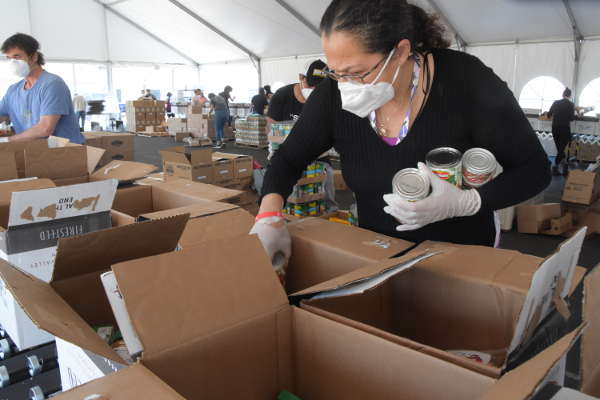
“Each day, we are providing the equivalent of more than 80,000 meals to our neighbors in need – nearly 50 percent more than at this same time last year,” said Redwood Empire Food Bank’s marketing and PR manager, Rachelle Mesheau.
“As we always have, the Redwood Empire Food Bank stands ready to see our neighbors through the end of this crisis. But we need the help of our community. Every dollar, every minute, and every food donation makes a difference,” Mesheau said.
What can you do to help?
– Donate money. When you donate to the Redwood Empire Food Bank, your money helps purchase food, pay staff, fuel trucks and keep the lights on – distributing food to those in need.
– Donate food. Food donations help keep warehouse shelves stocked with non-perishable staple groceries for distribution through Redwood Empire Food Bank programs and partner organizations.
– The most needed items include Tuna and Canned Meat, Peanut Butter, Canned Soups, Stews, and Chili, Rice and Dry Beans, Cereal, Canned Fruits and Vegetables, High Protein Granola Bars, Trail Mix or Nut.
– Donate time. Throughout the year, the Redwood Empire Food Bank relies on 8,500 volunteers. With the shelter in place order, many volunteers are having to stay home and they're working hard to keep up with demand.
Most distribution sites have been turned into drive-thrus to accommodate safe social distancing practices. Volunteers are packing food boxes for participants to grab and go.
Dedicated community volunteers, Team Rubicon, and the National Guard are packing food boxes at the Redwood Empire Food Bank’s Sonoma County Day School outpost. Together, they are kitting approximately 5,000 food boxes a day.
“The sheer number of people falling into our safety net requires that it be broadened, fortified and maintained,” said Goodman. “With our community’s generous support, we can ensure that nobody experiences hunger.”
Donations can be made through the Redwood Empire Food Bank’s website at www.refb.org .
Anyone seeking food assistance can call the Redwood Empire Food Bank Food Connections Office at 707-523-7903 or visit http://getfood.refb.org .
Since 1987, the Redwood Empire Food Bank has provided food and nourishment to those facing hunger – currently serving 82,000 children, families and seniors in Sonoma, Mendocino, Humboldt, Del Norte and Lake County.
The Redwood Empire Food Bank collaborates with local and regional partners to obtain and distribute the equivalent of more than 40,000 meals every day. Through more than 200 direct service distributions and partnerships with 170 other hunger-relief organizations, the food bank forms a network of more than 450 weekly and monthly distribution sites serving all residents facing food insecurity.

Dr. Gary Pace spoke with the Board of Supervisors on Tuesday morning about the next steps as Lake County moves into Stage 2 of the governor’s reopening guidelines. Stage 2 began on Friday.
The county has been under Pace’s shelter in place order since March 19. Pace changed the shelter in place order last week to be in alignment with the state shelter in place order, which remains in effect until further notice.
Pace told the board, “There’s caution and optimism at the same time,” as he speaks to schools and businesses about reopening while balancing a return to routines with efforts to keep the community safe.
As of Tuesday, Lake County’s confirmed COVID-19 cases remained at eight, all of them recovered, Pace said.
He said none of those eight individuals are contagious any longer, explaining that scientists have not been able to confirm the virus can grow in people after they come out of isolation.
Lake County has now tested more than 1,000 people, starting additional testing last week at two sites in Lakeport. Testing also is taking place this week in Clearlake, Pace said.
He said it’s important to reopen slowly, carefully and thoughtfully so there isn’t a need to shut down again.
As the county seeks an accelerated opening under the state’s rules, Pace said he wants to make masking mandatory in county businesses, with both workers and patrons to be required to use facial coverings.
He said he’s not interested in making masking mandatory when people are out walking, but he said that as people are mixing in the community, they need protections.
During the meeting Supervisor Rob Brown said he didn’t think mandatory masking was the way to go and that he opposed a “mandatory feel good requirement” that would be selectively enforced. He suggested it could be a good marketing tool and would be enforced by the market.
Pace said masking is about courtesy and taking care of your neighbor. He said that masking, social distancing and handwashing work to fight the virus.
As for enforcement, Pace said the county will ask businesses to follow a plan. Public Health won’t be approving or disapproving businesses’ plans, but businesses that are allowed to open in Stage 2 will need to follow state requirements and document that they have plans to follow health guidelines. They will need to post those requirements by their doors.
The certifications and guidance are available on the Lake County Public Health website.
If Public Health starts to get complaints, Pace said its Environmental Health Division will go out and visit businesses and educate them about the requirements. He said there is no interest in issuing fines.
“We’re not going to be able to keep the public safe if people don’t comply,” Pace said.
Gov. Gavin Newsom’s reopening plan allows counties to move at an accelerated pace through the stages if they can attest to certain requirements.
Pace said Public Health intends to apply for a variance to follow that accelerated process.
On Tuesday afternoon, after the board meeting, the Governor’s Office announced that the state’s first two counties, Butte and El Dorado, attested that they have met certain criteria necessary to move further into Stage 2.
Butte has 20 confirmed cases and El Dorado has 60, with neither reporting any deaths to date, according to reports from their respective health departments on Tuesday.
Butte County has 210,291 residents and El Dorado 193,227, according to population estimates released this month by the California Department of Finance.
The California Department of Public Health reported that Butte and El Dorado can begin reopening dine-in restaurants and shopping malls, with modifications.
The state reported that several other counties also have applied for the accelerated process: Amador, Lassen, Nevada, Placer and Shasta.
Steps to seeking a variance
Health Services Director Denise Pomeroy told the board that her department has notified the California Department of Public Health of the county’s intent to seek a variance, meeting with the agency on Monday.
She said the county must be certified through a written attestation by the Public Health officer and supported by letters from the Board of Supervisors and local hospitals.
The state’s requirements for adjusting modifications include the epidemiological stability of COVID-19 cases, which Pomeroy explained means that there are no more than one case per 10,000 residents and no more deaths in the 14 days prior to the county’s attestation submission to the state.
Other requirements include providing copies of guidance to protect essential workers and availability of personal protective gear and cleaning supplies; a testing capacity of 1.5 tests per 1,000 residents, which Pomeroy said totals 700 per week in Lake County, and testing availability for 75 percent of county residents within a 60-minute drive; containment capacity; capacity of local hospitals to be able to handle a minimum 35-percent surge in COVID-19 patients in addition to handling normal care levels for non-COVID-19 patients; and the ability to shelter at least 15 percent of county residents experiencing homelessness, which totals about 86 people.
Pomeroy said the county must also be able to detail the county’s plan on which sectors and spaces will be opened, in what sequence, on what timeline, and indicate where its plan differs from the state’s timeline.
Additionally, the county must inform the state of emerging concerns and how it will implement early containment measures.
Pace said he wanted to have the plan ready for the board to review at its meeting next Tuesday, with plans to submit it to the state by the end of next week so the county could enter into an accelerated reopening the following week. He said mandatory masking in the stores and an enforcement framework would be included in the plan.
Supervisor Bruno Sabatier said he hoped the board on Tuesday would be able to give the plan final approval so it could be submitted as soon as possible to the state. “Let us know how we can help.”
Pomeroy said the goal is to have the plan read ahead of the Tuesday meeting, as early as Saturday or Monday, at the latest.
This article has been corrected to show that Pace’s most recent health order aligns with the state order and therefore doesn’t have a stated end date.
Email Elizabeth Larson at