 How to resolve AdBlock issue?
News
LAKE COUNTY, Calif. – The National Weather Service is predicting chances of thunderstorms over the weekend and on Monday.
Lake County and other parts of northwest California remain under a hazardous weather watch through next week.
Forecasters said there are chances of rain during the day on Saturday, with a 100-percent chance on Saturday night.
Rainfall totals on Saturday night are estimated at between a quarter and a half an inch, and between a tenth and quarter of an inch on Sunday, according to the forecast.
Thunderstorms are possible on Sunday and Sunday night, as well as on Monday morning, with more rain expected on Monday night and into Tuesday. Conditions are then forecast to clear until Friday.
Winds of up to 14 miles per hour are forecast on Saturday and Sunday, with gusts of above 20 miles per hour on Monday.
Daytime temperatures will range from the high 50s to high 60s through Wednesday, rising into the low 70s on Thursday and Friday. Nighttime temperatures will range from the low 40 to low 50s.
Email Elizabeth Larson atThis email address is being protected from spambots. You need JavaScript enabled to view it. . Follow her on Twitter, @ERLarson, or Lake County News, @LakeCoNews.
Lake County and other parts of northwest California remain under a hazardous weather watch through next week.
Forecasters said there are chances of rain during the day on Saturday, with a 100-percent chance on Saturday night.
Rainfall totals on Saturday night are estimated at between a quarter and a half an inch, and between a tenth and quarter of an inch on Sunday, according to the forecast.
Thunderstorms are possible on Sunday and Sunday night, as well as on Monday morning, with more rain expected on Monday night and into Tuesday. Conditions are then forecast to clear until Friday.
Winds of up to 14 miles per hour are forecast on Saturday and Sunday, with gusts of above 20 miles per hour on Monday.
Daytime temperatures will range from the high 50s to high 60s through Wednesday, rising into the low 70s on Thursday and Friday. Nighttime temperatures will range from the low 40 to low 50s.
Email Elizabeth Larson at
MENDOCINO NATIONAL FOREST, Calif. – The Mendocino National Forest will provide additional developed recreational opportunities to the public on Saturday, May 16.
“We continue to recommend that you follow local shelter in place orders and recreate close to home,” Mendocino National Forest Supervisor Ann Carlson said. “All visitors should practice self-sufficiency during their visit to the Mendocino National Forest. Recreating responsibly will help ensure that expanded access to recreational facilities, services, and opportunities continues. All services may not be available, so please plan accordingly.”
Responsible recreation practices include:
• Maintaining at least 6 feet distancing from others.
• Not gathering in groups and following the latest guidance from officials.
• Communicating with others as you pass, alerting users of your presence and stepping aside to let others pass.
• Packing out your trash and leaving with everything you bring in and use.
• Bringing your own water, soap, sanitizer and toilet paper.
Please check the forest website and social media pages for the most up-to-date information on what is open so that you can plan your visit. You can call the Supervisor’s Office at 530-934-3316 during regular business hours Monday through Friday, 8 a.m. to 4:30 p.m.
The following sites will open on the Mendocino National Forest beginning Saturday, May 16:
Grindstone – open:
OHV trails
Boating sites
Sacramento River Boat Launch and Day Use Area
Campgrounds
Davis Flat – OHV
Fouts – OHV
Kingsley Glade
Little Stony – OHV
Mill Creek – OHV
Mill Valley – OHV
North Fork – OHV
Old Mill – OHV
Rocky Cabin
South Fork – OHV
Sugarfoot
Sugar spring
Three Prong
Toomes Camp
Whitlock
Group campgrounds
Grey Pine – OHV
Info site/fee station
Wolf Creek Vis – OHV
Interpretive site
Firefighter memorial
Nye cabin site
Upper Lake OPEN
Pine Point Picnic Area
Covelo OPEN
Hammerhorn Lake Day Use Area and Campground
Eel River Campground
Howard Meadow CG
Howard Lake CG
Little Doe
Atchison Campground
Closed recreation sites:
Grindstone Ranger District
Camp Discovery Group Camp
Masterson Group Camp
Plaskett Meadows Campground and Day Use Area
Sycamore Grove Campground
Wells Cabin Campground
West Crockett Campground
Upper Lake Ranger District
Bear Creek Campground
Deer Valley Campground
Fuller Grove Campground
Middle Creek Campground
Navy Campground
Oak Flat Campground
Penny Pines Campground
Pine Mountain Lookout Rental Cabin
Pogie Point Campground
Sunset Campground
The following remain closed by the Ranch fire, Forest Order No. 08-20-02:
Cedar Camp
Dixie Glade
Main Letts Lake
Saddle Camp Loop
Spillway
Stirrup
Big Springs
Summit Springs Th
Various OHV trails on Upper Lake Ranger District
For more information, visit the Mendocino National Forest on the Web, Facebook or Twitter.
“We continue to recommend that you follow local shelter in place orders and recreate close to home,” Mendocino National Forest Supervisor Ann Carlson said. “All visitors should practice self-sufficiency during their visit to the Mendocino National Forest. Recreating responsibly will help ensure that expanded access to recreational facilities, services, and opportunities continues. All services may not be available, so please plan accordingly.”
Responsible recreation practices include:
• Maintaining at least 6 feet distancing from others.
• Not gathering in groups and following the latest guidance from officials.
• Communicating with others as you pass, alerting users of your presence and stepping aside to let others pass.
• Packing out your trash and leaving with everything you bring in and use.
• Bringing your own water, soap, sanitizer and toilet paper.
Please check the forest website and social media pages for the most up-to-date information on what is open so that you can plan your visit. You can call the Supervisor’s Office at 530-934-3316 during regular business hours Monday through Friday, 8 a.m. to 4:30 p.m.
The following sites will open on the Mendocino National Forest beginning Saturday, May 16:
Grindstone – open:
OHV trails
Boating sites
Sacramento River Boat Launch and Day Use Area
Campgrounds
Davis Flat – OHV
Fouts – OHV
Kingsley Glade
Little Stony – OHV
Mill Creek – OHV
Mill Valley – OHV
North Fork – OHV
Old Mill – OHV
Rocky Cabin
South Fork – OHV
Sugarfoot
Sugar spring
Three Prong
Toomes Camp
Whitlock
Group campgrounds
Grey Pine – OHV
Info site/fee station
Wolf Creek Vis – OHV
Interpretive site
Firefighter memorial
Nye cabin site
Upper Lake OPEN
Pine Point Picnic Area
Covelo OPEN
Hammerhorn Lake Day Use Area and Campground
Eel River Campground
Howard Meadow CG
Howard Lake CG
Little Doe
Atchison Campground
Closed recreation sites:
Grindstone Ranger District
Camp Discovery Group Camp
Masterson Group Camp
Plaskett Meadows Campground and Day Use Area
Sycamore Grove Campground
Wells Cabin Campground
West Crockett Campground
Upper Lake Ranger District
Bear Creek Campground
Deer Valley Campground
Fuller Grove Campground
Middle Creek Campground
Navy Campground
Oak Flat Campground
Penny Pines Campground
Pine Mountain Lookout Rental Cabin
Pogie Point Campground
Sunset Campground
The following remain closed by the Ranch fire, Forest Order No. 08-20-02:
Cedar Camp
Dixie Glade
Main Letts Lake
Saddle Camp Loop
Spillway
Stirrup
Big Springs
Summit Springs Th
Various OHV trails on Upper Lake Ranger District
For more information, visit the Mendocino National Forest on the Web, Facebook or Twitter.

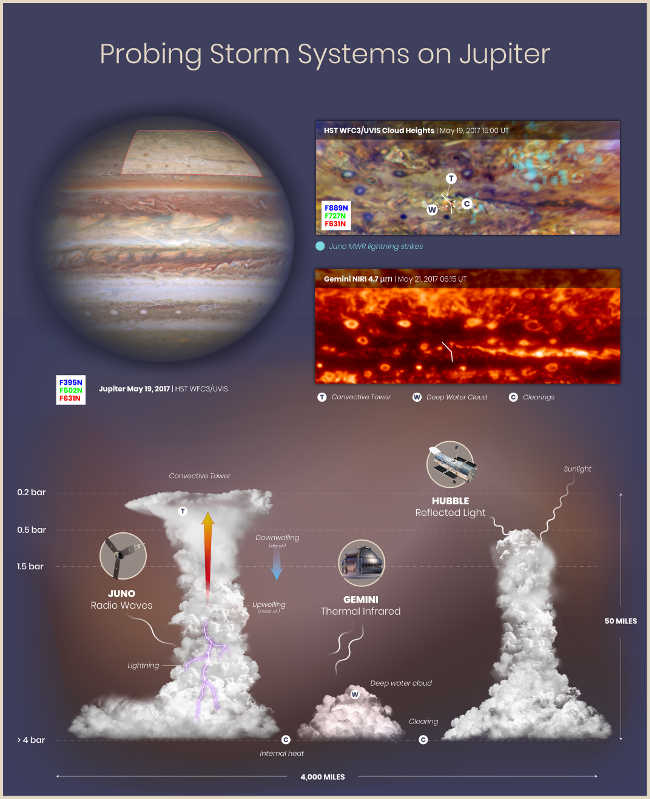
NASA's Hubble Space Telescope and the ground-based Gemini Observatory in Hawaii have teamed up with the Juno spacecraft to probe the mightiest storms in the solar system, taking place more than 500 million miles away on the giant planet Jupiter.
A team of researchers led by Michael Wong at the University of California, Berkeley, and including Amy Simon of NASA's Goddard Space Flight Center in Greenbelt, Maryland, and Imke de Pater also of UC Berkeley, are combining multiwavelength observations from Hubble and Gemini with close-up views from Juno's orbit about the monster planet, gaining new insights into turbulent weather on this distant world.
"We want to know how Jupiter's atmosphere works," said Wong. This is where the teamwork of Juno, Hubble and Gemini comes into play.
Radio 'light show'
Jupiter's constant storms are gigantic compared to those on Earth, with thunderheads reaching 40 miles from base to top — five times taller than typical thunderheads on Earth — and powerful lightning flashes up to three times more energetic than Earth's largest "superbolts."
Like lightning on Earth, Jupiter's lightning bolts act like radio transmitters, sending out radio waves as well as visible light when they flash across the sky.
Every 53 days, Juno races low over the storm systems detecting radio signals known as "sferics" and "whistlers," which can then be used to map lightning even on the day side of the planet or from deep clouds where flashes are not otherwise visible.
Coinciding with each pass, Hubble and Gemini watch from afar, capturing high-resolution global views of the planet that are key to interpreting Juno's close-up observations.
"Juno's microwave radiometer probes deep into the planet's atmosphere by detecting high-frequency radio waves that can penetrate through the thick cloud layers. The data from Hubble and Gemini can tell us how thick the clouds are and how deep we are seeing into the clouds," Simon explained.
By mapping lightning flashes detected by Juno onto optical images captured of the planet by Hubble and thermal infrared images captured at the same time by Gemini, the research team has been able to show that lightning outbreaks are associated with a three-way combination of cloud structures: deep clouds made of water, large convective towers caused by upwelling of moist air — essentially Jovian thunderheads — and clear regions presumably caused by downwelling of drier air outside the convective towers.
The Hubble data show the height of the thick clouds in the convective towers, as well as the depth of deep water clouds. The Gemini data clearly reveal the clearings in the high-level clouds where it is possible to get a glimpse down to the deep water clouds.
Wong thinks that lightning is common in a type of turbulent area known as folded filamentary regions, which suggests that moist convection is occurring in them. "These cyclonic vortices could be internal energy smokestacks, helping release internal energy through convection," he said. "It doesn't happen everywhere, but something about these cyclones seems to facilitate convection."
The ability to correlate lightning with deep water clouds also gives researchers another tool for estimating the amount of water in Jupiter's atmosphere, which is important for understanding how Jupiter and the other gas and ice giants formed, and therefore how the solar system as a whole formed.
While much has been gleaned about Jupiter from previous space missions, many of the details — including how much water is in the deep atmosphere, exactly how heat flows from the interior and what causes certain colors and patterns in the clouds — remain a mystery. The combined result provides insight into the dynamics and three-dimensional structure of the atmosphere.
Seeing a 'jack-o-lantern' red spot
With Hubble and Gemini observing Jupiter more frequently during the Juno mission, scientists are also able to study short-term changes and short-lived features like those in the Great Red Spot.
Images from Juno as well as previous missions to Jupiter revealed dark features within the Great Red Spot that appear, disappear and change shape over time. It was not clear from individual images whether these are caused by some mysterious dark-colored material within the high cloud layer, or if they are instead holes in the high clouds — windows into a deeper, darker layer below.
Now, with the ability to compare visible-light images from Hubble with thermal infrared images from Gemini captured within hours of each other, it is possible to answer the question.
Regions that are dark in visible light are very bright in infrared, indicating that they are, in fact, holes in the cloud layer.
In cloud-free regions, heat from Jupiter's interior that is emitted in the form of infrared light — otherwise blocked by high-level clouds — is free to escape into space and therefore appears bright in Gemini images.
"It's kind of like a jack-o-lantern," said Wong. "You see bright infrared light coming from cloud-free areas, but where there are clouds, it's really dark in the infrared."
Hubble and Gemini as Jovian weather trackers
The regular imaging of Jupiter by Hubble and Gemini in support of the Juno mission is proving valuable in studies of many other weather phenomena as well, including changes in wind patterns, characteristics of atmospheric waves and the circulation of various gases in the atmosphere.
Hubble and Gemini can monitor the planet as a whole, providing real-time base maps in multiple wavelengths for reference for Juno's measurements in the same way that Earth-observing weather satellites provide context for NOAA's high-flying Hurricane Hunters.
"Because we now routinely have these high-resolution views from a couple of different observatories and wavelengths, we are learning so much more about Jupiter's weather," explained Simon. "This is our equivalent of a weather satellite. We can finally start looking at weather cycles."
Because the Hubble and Gemini observations are so important for interpreting Juno data, Wong and his colleagues Simon and de Pater are making all of the processed data easily accessible to other researchers through the Mikulski Archives for Space Telescopes, or MAST, at the Space Telescope Science Institute in Baltimore, Maryland.
"What's important is that we've managed to collect this huge data set that supports the Juno mission. There are so many applications of the data set that we may not even anticipate. So, we're going to enable other people to do science without that barrier of having to figure out on their own how to process the data," Wong said.
The results were published in April 2020 in The Astrophysical Journal Supplement Series.
LAKE COUNTY, Calif. – Woodland Community College is preparing to celebrate its 12th commencement ceremony to honor the class of 2020 on Friday, May 15.
This year, due to the COVID-19 pandemic, the event is going online.
“Normally, our campus and our students would be in the midst of a multitude of celebrations as we near the end of the academic year and though we may not be able to celebrate as we normally would due to the pandemic, I want to congratulate our 2020 graduating class for their unwavering commitment to their education and tenacity to finish,” said College President Dr. Art Pimentel.
The WCC Commencement Planning Committee has been hard at work during the last month to
transition the college’s most important celebration to a virtual modality due to the ongoing COVID-19 and properly honor this year’s 344 WCC graduates.
YCCD Chancellor Douglas Houston, YCCD Trustee Susan Alves, Academic Senate President Christopher Howerton, ASWCC President Katrina Toups, and our Valedictorian Grace Matayoshi have recorded messages to the class of 2020 which will be streamed on Friday, May 15, at 6 p.m.
Community members who wish to view the ceremony can access the video on the college’s website at http://wcc.yccd.edu .
The Lake County Campus is taking the same approach and will be streaming its ceremony at the same time.
The LCC ceremony will be accessible at http://lcc.yccd.edu .
This year’s keynote address will be given by Dr. Cesar Cruz from Empowerment Homies.
Graduates were asked to submit a picture and short message that will be displayed along with their name, degree/certificate earned, transfer institution (if applicable) and honors.
“On behalf of all the Woodland Community College professional staff, faculty, and leadership, I would like to congratulate the class of 2020 and wish them the best of luck as they embark on the next phase of their education and life,” Pimentel said.
This year, due to the COVID-19 pandemic, the event is going online.
“Normally, our campus and our students would be in the midst of a multitude of celebrations as we near the end of the academic year and though we may not be able to celebrate as we normally would due to the pandemic, I want to congratulate our 2020 graduating class for their unwavering commitment to their education and tenacity to finish,” said College President Dr. Art Pimentel.
The WCC Commencement Planning Committee has been hard at work during the last month to
transition the college’s most important celebration to a virtual modality due to the ongoing COVID-19 and properly honor this year’s 344 WCC graduates.
YCCD Chancellor Douglas Houston, YCCD Trustee Susan Alves, Academic Senate President Christopher Howerton, ASWCC President Katrina Toups, and our Valedictorian Grace Matayoshi have recorded messages to the class of 2020 which will be streamed on Friday, May 15, at 6 p.m.
Community members who wish to view the ceremony can access the video on the college’s website at http://wcc.yccd.edu .
The Lake County Campus is taking the same approach and will be streaming its ceremony at the same time.
The LCC ceremony will be accessible at http://lcc.yccd.edu .
This year’s keynote address will be given by Dr. Cesar Cruz from Empowerment Homies.
Graduates were asked to submit a picture and short message that will be displayed along with their name, degree/certificate earned, transfer institution (if applicable) and honors.
“On behalf of all the Woodland Community College professional staff, faculty, and leadership, I would like to congratulate the class of 2020 and wish them the best of luck as they embark on the next phase of their education and life,” Pimentel said.
LAKE COUNTY, Calif. – New COVID-19 testing is now available in Lake County.
The county of Lake reported that Verily’s Project Baseline arrived in Lake County on Wednesday and began work to operate a mobile drive-thru testing site, in collaboration with Team Rubicon USA and Lake County Health Services staff.
Lake County’s Health Services Department’s Public Health Division has been working to increase COVID-19 testing opportunities within Lake County in order to protect communities and meet the governor’s required mandates for moving through the process of reopening the local economy.
Officials reported that surveillance testing is a must in Lake County, where a quarter of the population is at risk of severe complications.
Residents can now screen their symptoms and, if eligible, make an appointment for testing at various sites around the county, using Project Baseline’s COVID-19 Testing Program online screening tool and appointment scheduling system, found at www.projectbaseline.com/COVID19 .
This program will focus first on high-risk populations. Screening and testing criteria are based on public health guidelines, which may be updated to reflect the latest guidance from public health authorities.
Project Baseline’s COVID-19 Program provides a connected solution to support individuals from screening through testing and receipt of their test results.
Verily developed the Baseline COVID-19 Program working closely with state and local government health authorities and other private health organizations, with the goal of expanding access to COVID-19 screening and testing.
Based on the COVID-19 screener and testing appointment availability, individuals will learn whether they are eligible for testing through this program, and be provided a testing location and appointment.
Eligible persons must be 18 years or older and live in Lake County.
Project Baseline can take appointments up to 48 hours in advance. Testing sites will be rotated throughout the county.
Appointments will be scheduled Monday through Friday. Results are usually returned within two to five days. Times, dates and sites will be adjusted based on community need.
To complete a screening and schedule an appointment, please visit https://www.projectbaseline.com/study/covid-19/ .
For more information on Project Baseline, please see https://www.projectbaseline.com/ .
Information regarding Team Rubicon USA can be found at https://teamrubiconusa.org/ .
For Lake County-specific Coronavirus information, visit http://health.co.lake.ca.us .
The Lake County Coronavirus Response Hub has additional valuable resources at https://lake-co-ca-coronavirus-response-lakecoca.hub.arcgis.com/ .
If you still have questions, please send an email request toThis email address is being protected from spambots. You need JavaScript enabled to view it. or call 707-263-8174 during business hours.
The county of Lake reported that Verily’s Project Baseline arrived in Lake County on Wednesday and began work to operate a mobile drive-thru testing site, in collaboration with Team Rubicon USA and Lake County Health Services staff.
Lake County’s Health Services Department’s Public Health Division has been working to increase COVID-19 testing opportunities within Lake County in order to protect communities and meet the governor’s required mandates for moving through the process of reopening the local economy.
Officials reported that surveillance testing is a must in Lake County, where a quarter of the population is at risk of severe complications.
Residents can now screen their symptoms and, if eligible, make an appointment for testing at various sites around the county, using Project Baseline’s COVID-19 Testing Program online screening tool and appointment scheduling system, found at www.projectbaseline.com/COVID19 .
This program will focus first on high-risk populations. Screening and testing criteria are based on public health guidelines, which may be updated to reflect the latest guidance from public health authorities.
Project Baseline’s COVID-19 Program provides a connected solution to support individuals from screening through testing and receipt of their test results.
Verily developed the Baseline COVID-19 Program working closely with state and local government health authorities and other private health organizations, with the goal of expanding access to COVID-19 screening and testing.
Based on the COVID-19 screener and testing appointment availability, individuals will learn whether they are eligible for testing through this program, and be provided a testing location and appointment.
Eligible persons must be 18 years or older and live in Lake County.
Project Baseline can take appointments up to 48 hours in advance. Testing sites will be rotated throughout the county.
Appointments will be scheduled Monday through Friday. Results are usually returned within two to five days. Times, dates and sites will be adjusted based on community need.
To complete a screening and schedule an appointment, please visit https://www.projectbaseline.com/study/covid-19/ .
For more information on Project Baseline, please see https://www.projectbaseline.com/ .
Information regarding Team Rubicon USA can be found at https://teamrubiconusa.org/ .
For Lake County-specific Coronavirus information, visit http://health.co.lake.ca.us .
The Lake County Coronavirus Response Hub has additional valuable resources at https://lake-co-ca-coronavirus-response-lakecoca.hub.arcgis.com/ .
If you still have questions, please send an email request to
In the face of the COVID-19 pandemic which has triggered a global financial crisis, Gov. Gavin Newsom on Thursday submitted his 2020-21 May Revision budget proposal to the Legislature, which he said is a balanced plan to close a budget gap of more than $54 billion brought on swiftly by the COVID-19 recession.
“COVID-19 has caused California and economies across the country to confront a steep and unprecedented economic crisis – facing massive job losses and revenue shortfalls,” said Gov. Newsom. “Our budget today reflects that emergency. We are proposing a budget to fund our most essential priorities – public health, public safety and public education – and to support workers and small businesses as we restart our economy. But difficult decisions lie ahead. With shared sacrifice and the resilient spirit that makes California great, I am confident we will emerge stronger from this crisis in the years ahead.”
The May Revision proposes to cancel new initiatives proposed in the governor’s budget, cancel and reduce spending included in the 2019 Budget Act, draw down reserves, borrow from special funds, temporarily increase revenues and make government more efficient.
Due to the size of the challenge, there is no responsible way to avoid reductions, Newsom said.
The budget will show that the most painful cuts will only be triggered if the federal government does not pass an aid package that helps states and local governments.
The proposal responds to the dramatic economic and revenue changes since January, when prudent fiscal management was reflected in a multi-year balanced budget plan with a $5.6 billion surplus and record reserve levels.
The rapid onset of the COVID-19 recession in California has resulted in more than 4 million unemployment claims being filed since mid-March, the unemployment rate is now projected to be 18 percent for the year, and there is a $41 billion drop in revenues compared to January’s forecast.
With a higher demand for social safety net services increasing state costs, the $54.3 billion deficit is more than three times the size of the record $16 billion set aside in the state’s Rainy Day Fund.
This recession-induced swing of nearly $60 billion in just four months underscores the necessity of additional federal funds to protect public health and safety, public education and other core government functions, as well as to support a safe and swift economic recovery.
If additional federal funds are not forthcoming, the May Revision spells out spending cuts necessary to meet the constitutional requirement for a balanced state budget.
While difficult decisions are required to close this sudden deficit as the state navigates to recovery, the May Revision is guided by principles of prudent fiscal management to protect public health, public safety, and public education; provide assistance to Californians who have been hurt the most by the pandemic; and invest in a safe and quick economic recovery.
“We are in unprecedented times. Just two months ago, we had record low unemployment numbers and a growing economy. Gov. Newsom’s revised budget reflects the difficult situation we are in – but we planned for this day. For a decade, California has been making strategic moves to put billions in our rainy day fund – and that rainy day is here,” said State Sen. Mike McGuire, whose district includes Lake County.
"This Legislature will continue to move critical legislation to protect Californians during this pandemic, as well as continue our important work on wildfire prevention and preparation, holding Pacific Gas and Electric accountable during PSPS power shutdowns, and enhancing fire services personnel. We are grateful Governor Newsom is continuing to prioritize these wildfire preparedness and prevention strategies and look forward to working with him in the months to come.
As a member of the Senate Budget and Fiscal Review Committee, Sen. McGuire continued, “I look forward to working over the next month to pass a balanced budget that works for the people of California and tackles some of our toughest challenges.”
Key priorities are summarized below.
Protecting public health, public safety, and public education
The May Revision proposes $44.9 billion in General Fund support for schools and community colleges and $6 billion in additional federal funds to supplement state funding.
To address the decline in the constitutionally-required funding for schools and community colleges resulting from the COVID-19 recession, the May Revision proposes to reallocate $2.3 billion in funds previously dedicated to paying down schools’ unfunded liability to CalSTRS and CalPERS to instead pay the school employers' retirement contributions.
It also proposes a new obligation of 1.5 percent of state appropriation limit revenues starting in 2020-21 to avoid a permanent decline in school funding that grows to $4.6 billion in additional funding for schools and community colleges by 2023-24.
The May Revision prioritizes $4.4 billion in federal funding to address learning loss and equity issues exacerbated by the COVID-19 school closures this spring.
These funds will be used by districts to run summer programs and other programs that address equity gaps that were widened during the school closures. The funds also will be used to make necessary modifications so that schools are prepared to reopen in the fall and help support parents' ability to work. The May Revision also preserves the number of state-funded child care slots and expands access to child care for first responders.
The May Revision preserves community college free tuition waivers and maintains Cal Grants for college students, including the grants for students with dependent children established last year. Many workers return to higher education and job training after losing a job; continuing this initiative will prioritize affordability and access to these programs.
Supporting Californians facing the greatest hardships
With the COVID-19 recession hitting harder on families living paycheck to paycheck, the May Revision prioritizes funding for direct payments to families, children, seniors and persons with disabilities.
It maintains the newly expanded Earned Income Tax Credit, which targets $1 billion in financial relief to working families whose annual incomes are below $30,000 – and including a $1,000 credit for those families with children under the age of 6.
It maintains grant levels for families and individuals supported by the CalWORKs and SSI/SSP programs. It prioritizes funding to maintain current eligibility for critical health care services in both Medi-Cal and the expanded subsidies offered through the Covered California marketplace for Californians with incomes between 400 percent and 600 percent of the federal poverty level.
The revision also estimates unemployment insurance benefits in 2020-21 will be $43.8 billion – 650 percent higher than the $5.8 billion estimated in the governor's budget.
The May Revision targets $3.8 billion in federal funds to protect public health and safety. It also proposes $1.3 billion to counties for public health, behavioral health, and other health and human services programs, and also proposes $450 million to cities to support homeless individuals.
State government savings and efficiency
In addition to baseline reductions in state programs, savings in employee compensation are also necessary in the absence of federal funds.
Negotiations will commence or continue with the state’s collective bargaining units to achieve reduced pay of approximately 10 percent.
The May Revision includes a provision to impose reductions if the state cannot reach an agreement.
In addition, nearly all state operations will be reduced over the next two years, and nonessential contracts, purchases and travel have already been suspended.
The COVID-19 pandemic has required an unprecedented shift to telework for state government that has allowed state managers, led by the Government Operations Agency, to rethink their business processes. This transformation will result in expanded long-term telework strategies, reconfigured office space, reduced leased space, and flexible work schedules for employees when possible.
The administration also continues working with state departments in delivering more government services online – including expansion of the Department of Motor Vehicles’ virtual office visits pilot to other departments and agencies with more face-to-face interactions with Californians.
Supporting job creation, economic recovery, and opportunity
Given the critical role of small business in California’s economy, the May Revision proposes an augmentation of $50 million for a total increase of $100 million to the small business loan guarantee program to fill gaps in available federal assistance. This increase will be leveraged to access existing private lending capacity and philanthropy to provide necessary capital to restart California small businesses.
To support innovation and the creation of new businesses, the May Revision retains January proposals to support new business creation by exempting first-year businesses from the $800 minimum franchise tax.
During this time of unprecedented unemployment, the administration will work in partnership with the Legislature to help get people back to work and support the creation of good-paying jobs. It will develop proposals and actions to support a robust and equitable recovery both in the near term and the long term.
To this end, the administration is considering options to support job creation including: assistance to help spur the recovery of small businesses and the jobs they create, support for increased housing affordability and availability, and investments in human and physical infrastructure. Any investments and actions will focus on equity, shared prosperity and long-term growth.
The governor has convened a Task Force on Business and Jobs Recovery – a diverse group of leaders from business, labor, and the non-profit sector – to develop actionable recommendations and advise the state on how the state’s economic recovery can be expedited.
Newsom said his administration is committed to additional actions, informed by the task force and other stakeholders, to support a safe, swift, equitable and environmentally-sound economic recovery.
The administration is also committed to working with colleges and universities to build on their experience with distance learning and develop a statewide educational program that will allow more students to access training and education through distance learning.
More details on the May Revision are available online at www.ebudget.ca.gov .
“COVID-19 has caused California and economies across the country to confront a steep and unprecedented economic crisis – facing massive job losses and revenue shortfalls,” said Gov. Newsom. “Our budget today reflects that emergency. We are proposing a budget to fund our most essential priorities – public health, public safety and public education – and to support workers and small businesses as we restart our economy. But difficult decisions lie ahead. With shared sacrifice and the resilient spirit that makes California great, I am confident we will emerge stronger from this crisis in the years ahead.”
The May Revision proposes to cancel new initiatives proposed in the governor’s budget, cancel and reduce spending included in the 2019 Budget Act, draw down reserves, borrow from special funds, temporarily increase revenues and make government more efficient.
Due to the size of the challenge, there is no responsible way to avoid reductions, Newsom said.
The budget will show that the most painful cuts will only be triggered if the federal government does not pass an aid package that helps states and local governments.
The proposal responds to the dramatic economic and revenue changes since January, when prudent fiscal management was reflected in a multi-year balanced budget plan with a $5.6 billion surplus and record reserve levels.
The rapid onset of the COVID-19 recession in California has resulted in more than 4 million unemployment claims being filed since mid-March, the unemployment rate is now projected to be 18 percent for the year, and there is a $41 billion drop in revenues compared to January’s forecast.
With a higher demand for social safety net services increasing state costs, the $54.3 billion deficit is more than three times the size of the record $16 billion set aside in the state’s Rainy Day Fund.
This recession-induced swing of nearly $60 billion in just four months underscores the necessity of additional federal funds to protect public health and safety, public education and other core government functions, as well as to support a safe and swift economic recovery.
If additional federal funds are not forthcoming, the May Revision spells out spending cuts necessary to meet the constitutional requirement for a balanced state budget.
While difficult decisions are required to close this sudden deficit as the state navigates to recovery, the May Revision is guided by principles of prudent fiscal management to protect public health, public safety, and public education; provide assistance to Californians who have been hurt the most by the pandemic; and invest in a safe and quick economic recovery.
“We are in unprecedented times. Just two months ago, we had record low unemployment numbers and a growing economy. Gov. Newsom’s revised budget reflects the difficult situation we are in – but we planned for this day. For a decade, California has been making strategic moves to put billions in our rainy day fund – and that rainy day is here,” said State Sen. Mike McGuire, whose district includes Lake County.
"This Legislature will continue to move critical legislation to protect Californians during this pandemic, as well as continue our important work on wildfire prevention and preparation, holding Pacific Gas and Electric accountable during PSPS power shutdowns, and enhancing fire services personnel. We are grateful Governor Newsom is continuing to prioritize these wildfire preparedness and prevention strategies and look forward to working with him in the months to come.
As a member of the Senate Budget and Fiscal Review Committee, Sen. McGuire continued, “I look forward to working over the next month to pass a balanced budget that works for the people of California and tackles some of our toughest challenges.”
Key priorities are summarized below.
Protecting public health, public safety, and public education
The May Revision proposes $44.9 billion in General Fund support for schools and community colleges and $6 billion in additional federal funds to supplement state funding.
To address the decline in the constitutionally-required funding for schools and community colleges resulting from the COVID-19 recession, the May Revision proposes to reallocate $2.3 billion in funds previously dedicated to paying down schools’ unfunded liability to CalSTRS and CalPERS to instead pay the school employers' retirement contributions.
It also proposes a new obligation of 1.5 percent of state appropriation limit revenues starting in 2020-21 to avoid a permanent decline in school funding that grows to $4.6 billion in additional funding for schools and community colleges by 2023-24.
The May Revision prioritizes $4.4 billion in federal funding to address learning loss and equity issues exacerbated by the COVID-19 school closures this spring.
These funds will be used by districts to run summer programs and other programs that address equity gaps that were widened during the school closures. The funds also will be used to make necessary modifications so that schools are prepared to reopen in the fall and help support parents' ability to work. The May Revision also preserves the number of state-funded child care slots and expands access to child care for first responders.
The May Revision preserves community college free tuition waivers and maintains Cal Grants for college students, including the grants for students with dependent children established last year. Many workers return to higher education and job training after losing a job; continuing this initiative will prioritize affordability and access to these programs.
Supporting Californians facing the greatest hardships
With the COVID-19 recession hitting harder on families living paycheck to paycheck, the May Revision prioritizes funding for direct payments to families, children, seniors and persons with disabilities.
It maintains the newly expanded Earned Income Tax Credit, which targets $1 billion in financial relief to working families whose annual incomes are below $30,000 – and including a $1,000 credit for those families with children under the age of 6.
It maintains grant levels for families and individuals supported by the CalWORKs and SSI/SSP programs. It prioritizes funding to maintain current eligibility for critical health care services in both Medi-Cal and the expanded subsidies offered through the Covered California marketplace for Californians with incomes between 400 percent and 600 percent of the federal poverty level.
The revision also estimates unemployment insurance benefits in 2020-21 will be $43.8 billion – 650 percent higher than the $5.8 billion estimated in the governor's budget.
The May Revision targets $3.8 billion in federal funds to protect public health and safety. It also proposes $1.3 billion to counties for public health, behavioral health, and other health and human services programs, and also proposes $450 million to cities to support homeless individuals.
State government savings and efficiency
In addition to baseline reductions in state programs, savings in employee compensation are also necessary in the absence of federal funds.
Negotiations will commence or continue with the state’s collective bargaining units to achieve reduced pay of approximately 10 percent.
The May Revision includes a provision to impose reductions if the state cannot reach an agreement.
In addition, nearly all state operations will be reduced over the next two years, and nonessential contracts, purchases and travel have already been suspended.
The COVID-19 pandemic has required an unprecedented shift to telework for state government that has allowed state managers, led by the Government Operations Agency, to rethink their business processes. This transformation will result in expanded long-term telework strategies, reconfigured office space, reduced leased space, and flexible work schedules for employees when possible.
The administration also continues working with state departments in delivering more government services online – including expansion of the Department of Motor Vehicles’ virtual office visits pilot to other departments and agencies with more face-to-face interactions with Californians.
Supporting job creation, economic recovery, and opportunity
Given the critical role of small business in California’s economy, the May Revision proposes an augmentation of $50 million for a total increase of $100 million to the small business loan guarantee program to fill gaps in available federal assistance. This increase will be leveraged to access existing private lending capacity and philanthropy to provide necessary capital to restart California small businesses.
To support innovation and the creation of new businesses, the May Revision retains January proposals to support new business creation by exempting first-year businesses from the $800 minimum franchise tax.
During this time of unprecedented unemployment, the administration will work in partnership with the Legislature to help get people back to work and support the creation of good-paying jobs. It will develop proposals and actions to support a robust and equitable recovery both in the near term and the long term.
To this end, the administration is considering options to support job creation including: assistance to help spur the recovery of small businesses and the jobs they create, support for increased housing affordability and availability, and investments in human and physical infrastructure. Any investments and actions will focus on equity, shared prosperity and long-term growth.
The governor has convened a Task Force on Business and Jobs Recovery – a diverse group of leaders from business, labor, and the non-profit sector – to develop actionable recommendations and advise the state on how the state’s economic recovery can be expedited.
Newsom said his administration is committed to additional actions, informed by the task force and other stakeholders, to support a safe, swift, equitable and environmentally-sound economic recovery.
The administration is also committed to working with colleges and universities to build on their experience with distance learning and develop a statewide educational program that will allow more students to access training and education through distance learning.
More details on the May Revision are available online at www.ebudget.ca.gov .