How to resolve AdBlock issue?
News

Editor’s note: The Equal Employment Opportunity Commission, the federal agency in charge of enforcing laws prohibiting discrimination in the workplace, on Dec. 16 said that employers can require employees to get vaccinated before entering the workplace. Now that two COVID-19 vaccines have received emergency use authorization in the U.S., some people are concerned they could be fired if they don’t want to take the vaccine. We asked legal scholar Ana Santos Rutschman, who teaches a course on vaccine law at Saint Louis University, to explain the decision and the rights employees and employers have.
1. Can employers require employees to get a vaccine?
The general rule is yes – with some exceptions.
Under U.S. law, private employers have the ability to define general working conditions, including the adoption of health and safety within the workspace. Requiring employees to get vaccinated against diseases that could compromise health and safety in the workplace is viewed as part of that ability.
2. Does the rule apply to COVID-19 vaccines?
Earlier in the pandemic, there were some doubts about whether the general rule would apply to COVID-19 vaccines because the first vaccines that became available in the U.S. have not been fully approved by the Food and Drug Administration. They have received an emergency use authorization, which is temporary permission to commercialize the vaccines because of the public health crisis the U.S. is facing. This is the first time emergency use authorization has been granted to a new vaccine. For this reason, some legal scholars questioned whether existing laws applied to temporarily authorized vaccines.
That question was addressed when the Equal Employment Opportunity Commission issued guidelines that said employers have the right to impose a mandatory COVID-19 vaccination policy.
From a legal perspective, this view is based on the fact that the law allows employers to impose requirements to make sure that employees don’t pose threats to the “health or safety of other individuals in the workplace.” The EEOC treated emergency use vaccines as part of the sets of measures that employers are able to mandate in order to accomplish this goal.
Therefore, the general rule applies and employers should be able to require that employees get vaccinated against COVID-19, within certain limits. These limits – including the exceptions below – are the same as the general exemptions applicable to any employer-mandated vaccination.
3. Are there religious exemptions?
Title VII of the Civil Rights Act established that if an employee has a sincerely held religious belief incompatible with vaccination, the employer cannot require that employee to be vaccinated. The EEOC has traditionally interpreted the concept of “religious belief” very broadly. Vaccine refusal cannot, however, be a personal or politically motivated belief.
If an employee qualifies for a religious exemption, the employer must then try to reasonably accommodate the employee. An example of an accommodation would be for the employer to have the employee switch from in-person to remote work while COVID-19 poses risks to public health.
However, the employer does not have to grant an accommodation if doing so would result in “undue hardship.” Typical cases of undue hardship include situations in which the accommodation would compromise the health and safety of other employees or in which implementing the accommodation is too costly or logistically burdensome. In case of a dispute over what constitutes an undue hardship for the employer, a court would typically be asked to resolve it based on the cost of offering the accommodation, as well as how difficult it is for the employer to implement it.
4. How about disability-related exemptions?
The balance of rights between an employee with a disability and her employer is similar to the one described above. Under the Americans with Disabilities Act, if an employee has a disability and cannot safely receive a vaccine, that employee qualifies for an exemption and the employer has to provide reasonable accommodations. But the act also establishes that employers do not have to provide an accommodation that would result in undue hardship.
The technical question here was whether employers could impose COVID-19 vaccination because the Americans with Disabilities Act severely limits the ability of employers to require medical examinations. In its Dec. 16 guidance, the EEOC clearly stated that COVID-19 vaccines do not fall in the “medical examination” category.
Therefore, requiring employee vaccination does not violate federal disability law.
5. What if the employer cannot provide an accommodation?
If an employee qualifies for either a religious or disability-related exemption but the employer is unable to provide an accommodation because of undue hardship, then the employer has the right to exclude the employee from going to the workplace.
Given the broad set of rights that the law gives employers in order to promote health and safety, in some cases it is possible for an organization to go even further and terminate employment if a worker refuses vaccination and there is no reasonable way to provide an accommodation. For example, if there is no reasonable accommodation that an employer can provide a barista that would allow her to continue make lattes at the coffee shop where she works, the employer may be able to terminate her employment.
However, the EEOC guidelines explicitly say that the inability to reasonably accommodate an employee does not automatically give the employer the right to fire her. Finding out whether the coffee shop could indeed terminate its unvaccinated barista would depend on a variety of factors, including state law, union agreements and any other potentially applicable requirements at the federal level.
[Research into coronavirus and other news from science Subscribe to The Conversation’s new science newsletter.]
Ana Santos Rutschman, Assistant Professor of Law, Saint Louis University
This article is republished from The Conversation under a Creative Commons license. Read the original article.
Daniel King, 46, was found by Lake County Hill Road Correctional Facility staff shortly before midnight on Saturday, according to Lt. Corey Paulich of the Lake County Sheriff’s Office.
Paulich said other inmates who were sharing the cell with King called for help when they noticed he was not responding to them.
Deputies and medical staff responded to King’s cell and began CPR. Paramedics from the Lakeport Fire Department arrived and took over. However, shortly after 12 a.m. Sunday, King was determined to be deceased, Paulich said.
King had been in custody since late February 2020. Paulich said King was sentenced to four year in state prison in August for a violation of probation related to a domestic violence charge and was awaiting transfer to the California Department of Corrections and Rehabilitation.
Paulich said King had not been transferred to a state facility due to the state prison system’s COVID-19 policy of not accepting sentenced inmates at this time.
King had recently received advanced care from a local medical provider for a medical issue. Paulich said King was last seen by jail medical staff less than an hour before he was found unresponsive.
“King’s death was unexpected and he showed no signs of trauma. At this time there are no indications that COVID-19 was present or a factor in King’s death,” Paulich said.
In the fall, a COVID-19 outbreak was reported at the Lake County Jail, as Lake County News has reported.
In accordance with established in-custody death protocol, Paulich said detectives from the Lake County Sheriff’s Office Major Crimes Unit, as well as investigators from the Lake County District Attorney’s Office, responded to conduct the death investigation.
The investigation is ongoing and the cause of death is pending an autopsy that will be performed later this week, Paulich said.

LAKE COUNTY, Calif. – Citrus fruits, most of which ripen in the gloom of winter, can add a rainbow of color and bright flavor to the things we create in our kitchens when the skies are gray.
Can it be that the Earth understands that we need a little boost when the weather’s cold?
It would seem so, as many of our cheeriest fruits – both in color and flavor – arrive just in time to dispel the darkness of the fall and winter months.
Among these colorful offerings are persimmons, pomegranates, cranberries, and today’s topic, citrus fruits. Oranges of all types, lemons, tangerines, grapefruits, and the like provide a spectrum of flavor – from tart to sweet – to brighten both our mood and our food this time of year.
In my opinion, any array of citrus fruit is worthy of love – there are so many types! - but my heart has been known to especially skip a beat when I see a pile of Meyer lemons at the grocery store. They’re definitely a favorite of mine, as I love their delicate flavor.
They’re not as hardy in terms of shelf life as typical supermarket lemons, so (at least in our neck of the woods) they make a brief appearance when local growers have them available, which, depending on the characteristics of the season, can be any time between December and March.
It feels like their season is here for just a few minutes each year, and I try to take advantage of every second of it.
One of the loveliest attributes of citrus fruit, especially those in the orange family, is the scent of their skin. When I zest oranges and breathe in that sweet, energizing fragrance, I joke that if I were wealthy, I’d pay someone really well to walk near me zesting an orange at all times. It’s such a beautiful aroma and orange zest has become one of my go-to ingredients in cooking.
Eating oranges, grapefruits or tangerines unadorned and out of hand is a wonderful way to enhance one’s health. They’re rich in nutrients that support our immune system and stave off colds and flu, such as vitamin C. (Just one orange provides the daily dose of it.)
There is a plethora of ways to use them in cuisine, a number of which are listed below to get your creative juices (pun intended) flowing. With our global economy, most citrus is available year-round; however, they’re especially enjoyable now, at the peak of winter.
Use halved, whole, or in slices to enhance foods as they cook: Before cooking, stuff a fish with tarragon or thyme and sliced lemons or layer the lemon slices on top of fish fillets. A pork loin can be stuffed with grapefruit and fennel, or a chicken with lemon halves and rosemary. Get creative with your choices by trying different combinations - orange with chicken or lime with fish, for example. Be careful of the seeds, though, as they can impart a bitter taste. It’s best to remove them.
Juice to use as an acid: Release the flavorful juice in citrus – tangy or sweet, depending on the fruit – to use as an alternative to vinegar in salad dressings or marinades. Different citrus flavors can be combined and layered for interesting results – limes with lemons, for example, or a mixture of juices from different types of oranges. Feel free to mix citrus juice with other acids, such as vinegars made from apple cider, white wine, or rice. For best results, be sure your fruit is at room temperature and gently roll it a bit before pressing or squeezing by hand. This allows more juice to be released.
Add to sauces: Julia Child’s life was changed forever when she was in Paris and tasted beurre blanc, a lemony butter sauce. It so wowed her that she decided to learn to cook. Citrus adds tang to lift and enhance the flavor of a sauce, whether it’s just a squeeze at the end or a major ingredient. Be sure to add the citrus, especially lemon, at the end to keep it fresh. If your sauce contains dairy, be careful not to add too much as it may cause the sauce to curdle. (Milk with the addition of an acid creates cheese.)
Balance rich and creamy dishes with citrus: A bit of citrus juice or zest – most commonly lemon – can bring balance to heavy or overly rich dishes, like creamy soups, gratins and risottos. Even stews or heavily sauced pastas can benefit from a bit of citrus. (I like to add an orange studded with a few cloves to flavor beef stew.)
Zest for added flavor: Zest is the grated skin of citrus fruit. In addition to the benefit of its flavor, it packs an antioxidant and nutrient punch, as these health benefits tend to reside mostly just beneath the skin. Citrus zest can be added to so many things – pasta dishes, baked goods, sauces, vinaigrettes, breadcrumbs, mayo, and brines all benefit from its bright flavor. Be sure to wash and dry fruit before zesting (and if you’re both juicing and zesting the fruit, it’s much easier to do the zesting first). Use only the thin top layer of colorful skin and avoid the white pith beneath, as it can be bitter. The easiest way to zest citrus is to use a rasp grater, but if one isn’t available, a paring knife can be used to cut strips of peel, which can then be finely chopped. It’s best to prepare the zest just prior to using, as it can lose some of its flavor while sitting out.
Roast to intensify flavor: Roasting citrus intensifies its flavor and brings out its natural sweetness. Pieces of roasted citrus can flavor and sweeten breakfast dishes like yogurt, oatmeal, or pancakes, as well as add brightness to savory dishes like chicken or vegetables. To roast, cut citrus fruits into segments or slices, toss with a little olive oil, and roast at 425 degrees Fahrenheit until some of the juices have evaporated and the fruit is lightly caramelized. The skin may be left on if the fruit is thinly sliced; however, it’s best to remove the skin and white pith of the slices are thicker. For sweet applications, a sprinkle of cinnamon or drizzle of honey may be added before roasting. Roasted citrus may be enjoyed warm, room temperature, or cold. Toss the roasted pieces with winter vegetables like broccoli, Brussels sprouts or carrots, or add them to baked fish or chicken. Alternatively, the citrus pieces can be roasted in the oven on the same pan as whatever they’re paired with.
Segment to toss in salads: Segmented pieces of oranges or grapefruits make a nice addition to a fresh salad and other dishes. An efficient way to segment them is to cut a thick slice off the top and the bottom of the fruit with a sharp knife so the pulp is exposed. Hold the fruit upright and slice off the peel in thick strips, cutting around the contours of the fruit. Hold the peeled fruit over a bowl, and using the knife, carefully cut between the fruit and membrane on either side of each segment to free it, letting it drop into the bowl with the juices. Discard any seeds.
Finish with citrus: Like salt, citrus brings out the flavor of other ingredients. Finishing with a squeeze of citrus will brighten and enhance any dish, especially those that may taste dull.
Esther Oertel is a writer and passionate home cook from a family of chefs. She grew up in a restaurant, where she began creating recipes from a young age. She’s taught culinary classes in a variety of venues in Lake County and previously wrote “The Veggie Girl” column for Lake County News. Most recently she’s taught culinary classes at Sur La Table in Santa Rosa. She lives in Middletown.

LAKE COUNTY, Calif. – The Clearlake Police Department said Saturday that it is searching for the local man who was responsible for a New Year’s Day shooting.
Police said they are seeking Jose Ceja-Torres, 31, of Clearlake, for the felony violations of attempted murder and assault with a deadly weapon.
Sgt. Ryan Peterson said that on Friday at 4:30 p.m., officers responded to the area of Lakeshore Drive and Woodland Drive for a report of a gunshot victim. On their arrival, they located a male in his early 40s who had been shot.
In a separate report, police identified the shooting victim as 41-year-old Clearlake resident Arnulfo Barragan Garibo.
Medical personnel from the Lake County Fire Protection District arrived on scene and began treating Barragan Garibo, who Peterson said was eventually flown to an out-of-county medical facility for further treatment and released.
Peterson said the shooting is believed to have occurred at a residence in the 14900 block of Davis Avenue in Clearlake.
The Clearlake Police Department’s Investigations Bureau was contacted and arrived to assist with the investigation. Peterson said officers responded to the residence where the incident was reported to have occurred and located possible evidence.
Through the investigation, Ceja-Torres was identified as the person who shot the victim, Peterson said.
A record check of Jose Ceja-Torres revealed he also has an active $150,000 arrest warrant for being armed with a firearm while in possession of drugs and two $50,000 arrest warrants for possession of marijuana for sale and felony evading a police officer, Peterson said.
At noon on Saturday, Clearlake Police Officer Mauricio Barreto conducted a traffic stop on a black Ford F150 pickup in the 14100 block of Lakeshore Drive for a traffic violation, with the driver identified as Barragan Garibo, the shooting victim from the previous day.
During the stop, a large amount of ammunition, a large capacity magazine and an AR15 rifle hidden in the engine compartment were located. The serial number of the rifle had been removed, police said.
Barragan Garibo was arrested on probable cause for several felonies. Officers obtained a bail enhancement on Barragan Garibo from a judge with the Lake County Superior Court in the amount of $200,000.
Barragan Garibo was booked into the Lake County Jail and the truck towed, police said.
As of Saturday night, Peterson said Ceja-Torres’ whereabouts were unknown and he is considered armed and dangerous.
Anyone with information on his location is asked to not approach him and contact the Clearlake Police Department Investigation Bureau at 707-994-8251 or their local law enforcement agency.

Dogs available for adoption this week include mixes of German Shepherd, heeler, husky, Labrador Retriever, mastiff, pit bull, shepherd and Yorkshire Terrier.
Dogs that are adopted from Lake County Animal Care and Control are either neutered or spayed, microchipped and, if old enough, given a rabies shot and county license before being released to their new owner. License fees do not apply to residents of the cities of Lakeport or Clearlake.
The following dogs at the Lake County Animal Care and Control shelter have been cleared for adoption (additional dogs on the animal control Web site not listed are still “on hold”).
Call Lake County Animal Care and Control at 707-263-0278 or visit the shelter online at http://www.co.lake.ca.us/Government/Directory/Animal_Care_And_Control.htm for information on visiting or adopting.

Male mastiff
This young male mastiff has a short tan coat.
He is in kennel No. 18, ID No. 14240.

Male pit bull
This male pit bull has a short brindle and brown coat.
He is in kennel No. 20, ID No. 14218.

Male husky
This male husky has a medium-length black and white blue eyes.
He has been spayed.
He’s in kennel No. 21, ID No. 14194.

Male husky
This male husky has a long gray and white coat and blue eyes.
He is in kennel No. 23, ID No. 14247.

Female pit bull terrier
This female pit bull terrier has a short gray coat.
She is in kennel No. 24, ID No. 14248.

Male German Shepherd
This young male German Shepherd has a long black and tan coat.
Shelter staff said he should not go to a home with livestock.
He is in kennel No. 25, ID No. 14253.

Male Yorkshire Terrier
This male Yorkshire Terrier has a medium-length brown and black coat.
He has been neutered.
He is in kennel No. 27, ID No. 14244.

Male shepherd mix
This male shepherd mix has a medium-length tricolor coat.
He has been altered.
He’s in kennel No. 28, ID No. 14241.

Male heeler-Labrador Retriever
This male heeler-Labrador Retriever mix has a short black and white coat.
He is in kennel No. 29, ID No. 14178.
Email Elizabeth Larson at

It took 15 years of imaging and nearly three years of stitching the pieces together to create the largest image ever made, the 8-trillion-pixel mosaic of Mars’ surface.
Now, the first study to utilize the image in its entirety provides unprecedented insight into the ancient river systems that once covered the expansive plains in the planet’s southern hemisphere. These three billion-year-old sedimentary rocks, like those in Earth’s geologic record, could prove valuable targets for future exploration of past climates and tectonics on Mars.
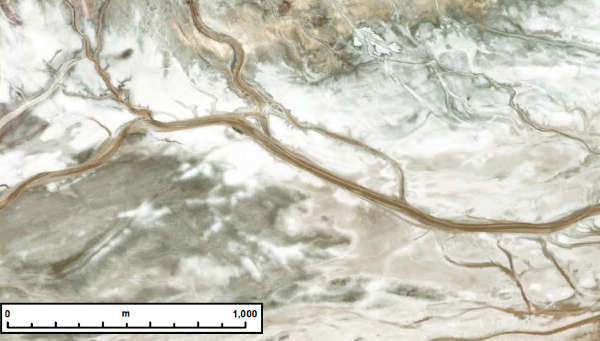
The work, published in December in Geology, complements existing research into Mars’ hydrologic history by mapping ancient fluvial (river) ridges, which are essentially the inverse of a riverbed.
“If you have a river channel, that’s the erosion part of a river. So, by definition, there aren't any deposits there for you to study,” Jay Dickson, lead author on the paper, explained. “You have rivers eroding rocks, so where did those rocks go? These ridges are the other half of the puzzle.”
Using the mosaic, as opposed to more localized imagery, let the researchers solve that puzzle on a global scale.
Mars used to be a wet world, as evidenced by rock records of lakes, rivers, and glaciers. The river ridges were formed between 4 and 3 billion years ago, when large, flat-lying rivers deposited sediments in their channels (rather than only having the water cut away at the surface).
Similar systems today can be found in places like southern Utah and Death Valley in the U.S., and the Atacama Desert in Chile. Over time, sediment built up in the channels; once the water dried up, those ridges were all that was left of some rivers.
The ridges are present only in the southern hemisphere, where some of Mars’ oldest and most rugged terrain is, but this pattern is likely a preservation artifact.
“These ridges probably used to be all over the entire planet, but subsequent processes have buried them or eroded them away,” Dickson said. “The northern hemisphere is very smooth because it’s been resurfaced, primarily by lava flows.”
Additionally, the southern highlands are “some of the flattest surfaces in the solar system,” said Woodward Fischer, who was involved in this work. That exceptional flatness made for good sedimentary deposition, allowing the creation of the records being studied today.
Whether or not a region has fluvial ridges is a basic observation that wasn’t possible until this high-resolution image of the planet’s surface was assembled. Each of the 8 trillion pixels represents 5 to 6 square meters, and coverage is nearly 100 percent, thanks to the “spectacular engineering” of NASA’s context camera that has allowed it to operate continuously for well over a decade.
An earlier attempt to map these ridges was published in 2007 by Rebecca Williams, a co-author on the new study, but that work was limited by imagery coverage and quality.
“The first inventory of fluvial ridges using meter-scale images was conducted on data acquired between 1997 and 2006,” Williams said. “These image strips sampled the planet and provided tantalizing snapshots of the surface, but there was lingering uncertainty about missing fluvial ridges in the data gaps.”
The resolution and coverage of Mars’ surface in the mosaic has eliminated much of the team’s uncertainty, filling in gaps and providing context for the features. The mosaic allows researchers to explore questions at global scales, rather than being limited to patchier, localized studies and extrapolating results to the whole hemisphere.
Much previous research on Mars hydrology has been limited to craters or single systems, where both the sediment source and destination are known. That’s useful, but more context is better in order to really understand a planet’s environmental history and to be more certain in how an individual feature formed.
In addition to identifying 18 new fluvial ridges, using the mosaic image allowed the team to re-examine features that had previously been identified as fluvial ridges. Upon closer inspection, some weren’t formed by rivers after all, but rather lava flows or glaciers.
“If you only see a small part of [a ridge], you might have an idea of how it formed,” Dickson said. “But then you see it in a larger context—like, oh, it’s the flank of a volcano, it’s a lava flow. So now we can more confidently determine which are fluvial ridges, versus ridges formed by other processes.”
Now that we have a global understanding of the distribution of ancient rivers on Mars, future explorations—whether by rover or by astronauts—could use these rock records to investigate what past climates and tectonics were like.
“One of the biggest breakthroughs in the last twenty years is the recognition that Mars has a sedimentary record, which means we’re not limited to studying the planet today,” Fischer said. “We can ask questions about its history.”
And in doing so, he says, we learn not only about a single planet’s past, but also find “truths about how planets evolved … and why the Earth is habitable.”
As this study is only the first to use the full mosaic, Dickson looks forward to seeing how it gets put to use next. “We expect to see more and more studies, similar in scale to what we're doing here, by other researchers around the world,” he said. “We hope that this ‘maiden voyage’ scientific study sets an example for the scale of science that can be done with a product this big.”
“The global distribution of depositional rivers on early Mars,” by J.L. Dickson; M.P. Lamb; R.M.E. Williams; A.T. Hayden; W.W. Fischer, can be found online at https://pubs.geoscienceworld.org/gsa/geology/article-abstract/doi/10.1130/G48457.1/593435/The-global-distribution-of-depositional-rivers-on.