 How to resolve AdBlock issue?
News

After a year of toxic stress ignited by so much fear and uncertainty, now is a good time to reset, pay attention to your mental health and develop some healthy ways to manage the pressures going forward.
Brain science has led to some drug-free techniques that you can put to use right now.
I am health psychologist who developed a method that harnesses our rip-roaring emotions to rapidly switch off stress and activate positive emotions instead. This technique from emotional brain training is not perfect for everyone, but it can help many people break free of stress when they get stuck on negative thoughts.
Why the stress response is so hard to turn off
Three key things make it hard to turn off stress-activated negative emotions:
-
First, our genes make us worrywarts. Our hunter-gatherer ancestors survived by assuming every rustle in the grasses was a lurking hungry lion, not harmless birds hunting for seeds. We’re essentially programmed to be hyperaware of threats, and our brains rapidly launch stress chemicals and negative emotions in response.
-
Second, the chemical cascade of stress hormones in the brain associated with negative emotions impairs cognitive flexibility, goal-directed behavior and self-control.
-
Third, our tendency to avoid dealing with negative emotions puts people in a perpetual cycle of ignoring unpleasant feelings, which amplifies stress and the risk of emotional health problems.
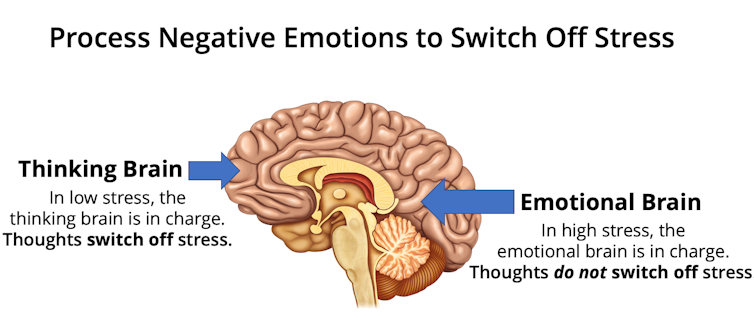
Traditional approaches for coping with stress were based on cognitive-behavioral therapy, which focuses on modifying patterns of thinking and behavior. It was developed before our modern understanding of stress overload.
Researchers at New York University discovered a paradox: Although cognitive methods were effective in low-stress situations, they were less effective when dealing with the high stress of modern life.
Emotional brain training works with these high-stress emotions in an effort to tame them, releasing negative emotions as the first of two steps in preventing stress overload.
Step 1: Release negative emotions
The only negative emotion in the brain that supports taking action rather than avoidance and passivity is anger.
Studies have shown that the suppression of anger is associated with depression and that suppressing anger doesn’t reduce the emotion. Healthy release of anger instead has been found to reduce other stress-related health risks.
Our technique is to switch off stress overload by using a controlled burst of anger to help the brain exert better emotional control and allow emotions to flow rather than become chronic and toxic. After that first short burst, other feelings can flow, starting with sadness to grieve the loss of safety, then fear and regret, or what we would do differently next time.
You can talk yourself through the stages. To experiment with the process, use these simple phrases to express the negative feelings and release your stress: “I feel angry that …”; “I feel sad that …”; “I feel afraid that …”; and “I feel guilty that …”
Step 2. Express positive emotions
After releasing negative emotions, positive emotions can naturally arise. Express these feelings using the same approach: “I feel grateful that …”; “I feel happy that …”; “I feel secure that …”; and “I feel proud that …”
Your mindset can quickly change, a phenomenon that has many potential explanations. One explanation is that in positive states, your brain’s neural circuits that store memories from when you were in the same positive state in the past can be spontaneously activated. Another is that the switch from negative to positive emotions quiets your sympathetic nervous system – which triggers the fight-or-flight response – and activates the parasympathetic system, which acts more like a brake on strong emotions.
Here’s what the whole stress relief process might look like like for me right now:
-
I feel angry that we’re all isolated and I can’t see my new grandson Henry.
-
I hate it that everything is so messed up! I HATE THAT!!!
-
I feel sad that I am alone right now.
-
I feel afraid that this will never end.
-
I feel guilty that I am complaining! I am lucky to be alive and have shelter and love in my life.
Then the positive:
-
I feel grateful that my daughter-in-law sends me photos of Henry.
-
I feel happy that my husband and I laughed together this morning.
-
I feel secure that this will eventually pass.
-
I feel proud that I am doing the best I can to cope.
After a daunting year, and with more challenges ahead in 2021, upgrading your approach to emotions can be a drug-free mood booster. Our COVID-19 fears need not consume us. We can outsmart the brain’s fear response and find moments that sparkle with promise.
[Get our best science, health and technology stories. Sign up for The Conversation’s science newsletter.]
Laurel Mellin, Associate Professor Emeritus of Family & Community Medicine and Pediatrics, University of California, San Francisco
This article is republished from The Conversation under a Creative Commons license. Read the original article.
Chief Justice Tani Cantil-Sakauye signed the order in response to Presiding Judge Michael Lunas’ request for emergency relief under Government Code section 68115(a)(10), which addresses court operations during a state of emergency.
The order extends the time in section 1382 of the Penal Code for the holding of a criminal trial by not more than 30 days. In this case, it’s applicable only to cases in which the statutory deadline otherwise would expire from Dec. 30. The deadline is now extended to Jan. 28.
Court officials reported that they sought the order “as a result of the increasing COVID-19 cases both locally and statewide.”
This is the fifth emergency order the state has approved for the Lake County Superior Court to allow for the adjustment of court operations during the pandemic. Previous orders were issued on March 16 and March 27, April 28 and Aug. 14, according to the order the chief justice signed Tuesday.
Earlier this month, Lunas also ordered that trials would not resume before Dec. 30 and moved most of the court proceedings – with few exceptions – online in the wake of Lake County moving into the most restrictive tier on the state’s Blueprint for a Safer Economy.
In the weeks since, the court has confirmed that two employees have tested positive for COVID-19.
Court officials said Tuesday that no jury trial will take place before Jan. 27, so anyone who has received a jury summons for any date prior to that is not required to appear.
As for the impact on court operations, Court Executive Officer Krista LeVier told Lake County News, “While there are other jury trials that will be continued, the emergency order only impacts two in-custody defendants who have not waived their right to a trial within the statutory time frames.”
The court said all safety measures remain in place, including mandatory remote appearances in nearly all proceedings.
Details about court operations are updated at the court’s website, www.lake.courts.ca.gov.
Email Elizabeth Larson at
The group said the primary reason is lack of volunteers to help with projects all year long.
The Hunger Task Force was formed in January 2001, the result of recommendations made following a hunger study conducted in Lake and Mendocino counties.
The first meeting was held in the board chambers of the courthouse in Lakeport, and there were 45 people in attendance.
That evolved into monthly meetings, throughout the years, held at various venues. Committees were formed, a mission statement and goal were decided upon.
Attendance soon slipped to about 20 people, as talking was the only activity. In October 2001 the garden committee created and planted the first community garden, at the former homeless shelter in Clearlake. This was accomplished on Make A Difference Day.
Following that time, membership slipped and only the garden committee survived. “We were led extremely capably for many years by Pete Johnson, then the leader for Habitat for Humanity in Lake County. He dedicated many years to our organization,” the group said.
Our other project that day was a food drive, with the food given to pantries around the lake. From that year on until 2019, the task force participated in the nationwide Make A Difference Day, which was accomplished with the help of volunteers from AmeriCorps, Kelseyville High School Interact students, K-Corps, and others from various organizations. This food drive morphed into the Stuff-A-Bus event at the urging and cooperation of Lake County Transit.
The task force extended its thanks to Lake Transit, Clearlake Grocery Outlet, Lakeport Grocery Outlet, and all who contributed items. “From 2000 until 2019, we collected and distributed 73,588 pounds of nonperishable food.”
In 2002 the task force held what is believed to have been the first-ever local "food summit," gathering all groups who had pantries and food programs. Another was held about four years later. “We hoped to coordinate information and schedules for the county, which proved to be only partially successful,” the task force said.
From 2002 until 2019, the group conducted canning lessons once a year. They were able to help 236 families and individuals learn the skills necessary to home can, and provided them with a canner, jars, books and a jar lifter to take home. These lessons were all hands-on, giving participants experience and confidence to do this on their own.
“We will forever be eternally grateful to the Kelseyville Presbyterian Church for the loan of their wonderful commercial kitchen,” the task force said.
Until the group was awarded a grant from the Lake County Wine Alliance in 2003 for $9,600, it relied on donations alone. “We applied for, and received, an additional $2,500 in 2009, for which we will always give kudos. They also donated $2,500 in 2019 to the Lake County Holiday Fund.”
In 2006, and again in 2012, the group conducted hunger surveys, which were compiled into booklets and disseminated throughout the county. Social work students from Pacific Union College conducted most of the surveys, and additional ones were done at food pantries and extended into the unhoused population. “Our gratitude is extended to Fiona Bullock, who led the students in these surveys, provided the compilation and conclusions,” the task force said.
Without the task force’s close alliance with North Coast Opportunities, including warehouse space, it would not have been able to conduct many of its activities.
North Coast Opportunities’ leader in Lake County, Tammy Alakszay, was a member of the task force since 2002. She originally came onboard as an employee of the Lake County Office of Education, working with the AmeriCorps volunteers.
“Over the years we participated in Hunger Action Day in Sacramento, tabled at the farmers market, talked with groups around the county, helped with school gardens, maintained and disseminated a food resource list, and helped feed people via other groups. Our most successful endeavor was our gardens,” the task force reported.
The group said it was fortunate to have landowners donate land and water for our gardens. The longest surviving garden was at Yoxagoi Farms, with Maile Field and Lars Crail supporting the efforts.
Later Bernie Butcher let the group use the Old Feed Mill property in Upper Lake. That garden is still operating and will be maintained by the Upper Lake High School FFA and 4H students, led by the extremely energetic Erica Boomer.
From 2010 until 2020, the task force’s gardens produced 68,584 pounds of produce. “We did not keep records until 2010, so the total is not really known,” the group said.
“No mention of our gardens would be complete without saying that without the mentorship and guidance of Sky Hoyt we could not have accomplished all we did. He taught us what grew best in Lake County, and helped us to achieve a high rate of production. He invented the waist-high tabletop growing system that we would incorporate in our gardens. He also allowed us to glean produce at his farm, as well as donating excess to the food pantries. We cannot thank him enough,” the task force said.
The task force said it was fortunate to have the loan of a greenhouse from the Lake County Office of Education, where it started all of its plants from seed. The money to buy all of the plant starts the group needed would have been impossible to sustain, so this greenhouse was integral to its garden projects. The garden alone had 98 tomato plants.
“We spent a lot of time gleaning in the late summer and fall. We gleaned pears, walnuts, and red flame seedless grapes. Our many, many thanks to Maile Field, Dan Goff, Nellie Dorn and Diane Henderson,” the task force said.
Beginning in about 2010, the task force participated in the holiday box program, at that time run by Lou Denny of the Lake County Community Action Agency. This role has been taken on by North Coast Opportunities, Community Action. Those boxes of food were provided by funds donated from citizens locally to the fund started years earlier by Judi Pollace of the Lake County Record-Bee.
In 2016 the group was asked to be the fiscal agent for the funds, and have been helping with it yearly. With eternal thanks to Scully Packing Co., which provided all of the boxes used – approximately 25,000 boxes over the years – along with Dennis Darling of Foods, Etc, Carlos Fagundes of Bruno's Shop Smart, Rotary Club of Lakeport, Beth Berinti of the Lake Family Resource Center, and Lou Denny of the Hunger Task Force. That program continues today.
Due to COVID, this year recipients were given gift cards to shop for themselves, 400 each in Lakeport and Clearlake.
The group offered a huge thank you to Dennis Darling for matching the funds to be used at Foods, Etc, and Carlos Fagundes, whose corporate offices donated an additional $5,000 to be spent at Bruno's Shop Smart.
That program will continue under the financial auspices of the Lake Family Resource Center. Donations to the Lake County Holiday Fund may be made at any time of year, either at Umpqua Bank or WestAmerica Bank.
In 2010 the task force began its most successful fundraising event, the Bountiful Boxes. The idea originated with Michelle Scully, and was carried out by group members, with help from other volunteers.
Yearly, due to the incredible generosity of Scully Packing Co. (primarily Toni and Pat Scully), the task force put together gift boxes full of Lake County products. The donation of premium Comice pears was the basis for the boxes, and all included a bottle of local wine or olive oil, wonderful walnuts, and a few years' delicious apples. The task force offered many thanks to all who donated, primarily Scully Packing Co., Six Sigma, Steele, Shannon, Chacewater, Lake County Walnut, Mike Marshall, Colleen Rentsch and Nellie Dorn.
For approximately four years the task force ran a backpack program for the children of Nice, Lucerne and Upper Lake, which is a very underserved population.
Every Friday selected children were sent home with a backpack full of food they did not have to cook, but could eat immediately. Many of those were latch key kids, so there was no one home to cook for them. This gave them some healthy, nutritious food to eat over the weekend when they were not getting lunch at school.
The task force ran this through the HUB in Upper Lake, and the group is deeply appreciative of their coordination with local families.
“There are many other accomplishments we achieved, but too numerous to mention here. As our final act, per our by-laws, all our remaining funds have been distributed to 14 other nonprofit organizations, to be used for food only,” the group said.
“It is with heavy hearts that we say goodbye. It seems that in 2020 there are fewer people with either the time or inclination to volunteer. People need to eat daily, not just during holiday seasons. We have spoken with many other groups that are having the same problem, from churches to fraternal organizations to food pantries. We are aging out of being volunteers,” the group said in a farewell message.
The group concluded, “A million thanks to all who supported us with our efforts, whether it be physical labor, distributing food or other items, serving on our board, donating money and time, attending meetings, or just providing us with moral support. We will all still volunteer in the communities, just not as an official group.”
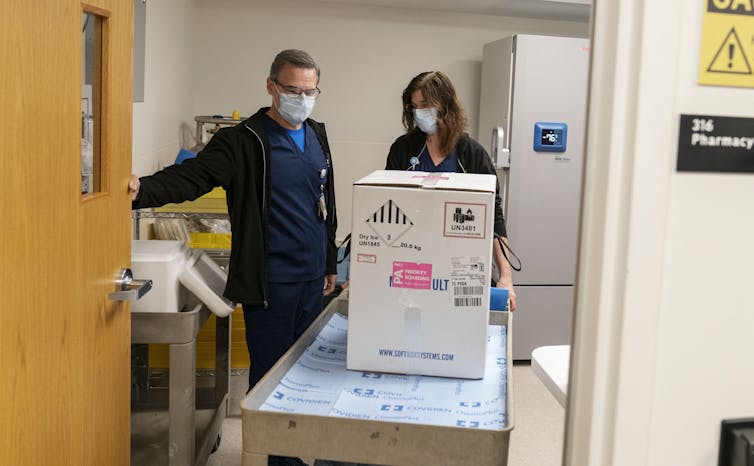
The enormous job of vaccinating the nation is underway, but for rural Americans, getting a COVID-19 vaccine becomes harder the farther they are from urban centers.
The current vaccines’ cold storage requirements and shipping rules mean many rural hospitals can’t serve as vaccination distribution hubs. That can leave rural residents – about 20% of the U.S. population in all – traveling long distances, if they’re able to travel at all.
Getting the word to rural residents about when they can be vaccinated isn’t easy either, and the extraordinary amount of misinformation downplaying the risk of the coronavirus this past year has had an impact on rural residents’ willingness to get the vaccine.
We work in rural health care settings and have been examining the barriers to health care for these patients to find ways to ensure health and safety.
The problem with big batches and cold storage
The first two authorized vaccines – one made by Pfizer and BioNTech and the other by Moderna – are mRNA vaccines. It’s a new type of vaccine that uses the molecular instructions for building virus proteins rather than injecting parts of the weakened virus itself. Both must be kept in very cold temperatures.
To ensure stability, the vaccine doses are shipped in special containers with dry ice, and for now, vaccines are being delivered only in large batches. The Pfizer vaccine is shipped in increments of 975 doses at a time, which creates a challenge for small hospitals.
Urban areas will be able to quickly distribute those doses, but finding enough patients to vaccinate quickly in rural areas may prove more difficult.
Moderna’s vaccine is somewhat more manageable, with a minimum order of 100 doses.
Both vaccines also require two doses per person, with the second dose of Pfizer’s vaccine given 21 days later and Moderna’s 28 days.
As a result, the vaccine distribution efforts will favor hubs that cater to more populated areas to avoid wasting any vaccine or leaving patients unable to get their second dose.

Cold storage is another challenge, since small hospitals are less likely to have expensive freezers. The Pfizer vaccine must be stored at minus 94 degrees Fahrenheit (minus 70 Celsius) and Moderna’s at minus 4 Fahrenheit. There are limits on how many times the vaccine shipping containers can be opened and how quickly the vaccines must be distributed. Once thawed and prepared, the Pfizer vaccine must be used within five days and Moderna’s within 30 days.
Each patient must receive both doses of the vaccine from the same manufacturer to ensure safety and effectiveness, adding to the challenge. Manufacturers have included personal dosing cards for patients to carry with them to help address this challenge.
Rural America’s take on COVID-19 and vaccines
Rural America already has difficult barriers to health care access.
It has fewer health care providers serving a more geographically diverse population than in metropolitan communities. And in many of these areas, rural hospitals have been closing at an alarming rate, leaving people to travel farther for care. The population is also older. Public transportation that could help poor or elderly residents reach hospitals is rare, and distance and geography, such as mountain roads, can mean driving to those sites takes time.
Getting accurate information about the vaccine and how to receive it into rural areas has also proved difficult. Many rural counties still have limited access to broadband internet connections, smartphone service and other technologies. That often means residents rely on television, newspapers and radio for news, which can limit the depth and scope of information.
While some rural counties have started getting the word out, many don’t not seem to have specific plans on how to inform their residents about how and when each person can get the vaccine, let alone specific plans for actually giving it. They often rely just on local press releases that many residents never see.
Rural nonprofit health care organizations have tried to bridge that gap and improve rural communications about vaccines and the pandemic. Care Compass Network, which coordinates organizations across southern New York, has offered educational webinars with the latest information about the virus and the vaccines, for example. But there is still much work to do.
[Get facts about coronavirus and the latest research. Sign up for The Conversation’s newsletter.]
Rural Americans’ views on vaccines are influenced by media and word of mouth, politics and religion, as well as previous experience with vaccinations and, perhaps most importantly, the difficulty of accessing health care.
In a survey conducted by the Kaiser Family Foundation in December, about 35% of rural Americans said they probably or definitely would not get the vaccine, higher than the 27% nationwide.
Small batches, new vaccines and pharmacies
Getting enough of the U.S. vaccinated to eventually end the pandemic will require more work in all of these areas. That includes improving shipping and storage processes so orders can be broken up and distributed to smaller hospitals, distributing more vaccine doses, and improving communication.
With Moderna’s vaccine arriving in smaller batches and not requiring such low temperatures for stability, it may prove to be more accessible for rural areas in the near future. Utah has already taken advantage of those characteristics to get initial doses to smaller hospitals outside its urban areas and has started vaccinating health care providers. Pfizer has said it may be able to offer smaller batches by April.
Other vaccines on the horizon are also expected to have less stringent storage requirements and may potentially be delivered in a one-shot method rather than a two-dose series. The falling number of rural hospitals still remains a challenge for getting vaccines to patients, though. Allowing community pharmacies to offer the vaccine – particularly if independent pharmacies are included – could eventually help expand the distribution network in rural areas.
Bennett Doughty, Clinical Assistant Professor, Pharmacy Practice, Binghamton University, State University of New York and Pamela Stewart Fahs, Professor of Rural Nursing, Binghamton University, State University of New York
This article is republished from The Conversation under a Creative Commons license. Read the original article.
The funding is the result of Proposition 64, the Control, Regulate and Tax Adult Use of Marijuana Act, which provided specified cannabis tax funding to the CHP to administer local grants for education, prevention, and enforcement programs regarding impaired driving.
Funding for the grants comes from a tax on the cultivation and sale of cannabis and cannabis products sold in California since January 2018.
For the current grant cycle, the CHP’s Cannabis Tax Fund Grant Program will be awarding grants based on a competitive process to California law enforcement agencies and local toxicology laboratories meeting the eligibility requirements described in the 2021 Request for Application, available on the CHP website.
The CHP will hold a virtual workshop on Jan. 6, 2021, to answer questions from potential grant applicants regarding the application process, the 2021 Request for Application, administrative program regulations, and other general questions.
Applications will be accepted beginning Jan. 7, 2021, through Feb. 23, 2021, for programs beginning on July 1, 2021.
These grants will enhance existing efforts to address impaired driving.
“These grants represent an opportunity for the CHP to work collaboratively with local traffic safety stakeholders to strategically address impaired driving issues while making California’s roadways a safer place to travel,” CHP Commissioner Amanda Ray said.
Those interested in this grant opportunity can learn more about the program, obtain workshop updates, and view the 2021 Request for Application by visiting the Cannabis Tax Fund Grant Program page on the CHP’s website, under the Programs and Services tab.
The mission of the CHP is to provide the highest level of safety, service and security.
Judge Andrew Blum handed down the sentence to 22-year-old Mavrick William Fisher on Dec. 21.
In November, a jury convicted Fisher of involuntary manslaughter for the death of 25-year-old Grant David Whitaker of Mackinaw, Illinois, on Aug. 20, 2019. They also found Fisher guilty of taking a vehicle without permission, as Lake County News has reported.
At the same time, the jury found Fisher not guilty of murder and hung on charges of voluntary manslaughter and assault with a deadly weapon with a special allegation of great bodily injury or death.
Fisher and Whitaker, both deaf, had been traveling around California in a car loaned to Whitaker by his grandmother when they had a physical confrontation while camping at Richardson Grove State Park in Humboldt County.
Fisher claimed he used a rock to hit Whitaker in self-defense. He then took Whitaker’s body to a ranch in Scotts Valley near Lakeport and disposed of it before he fled to Mexico, where he was arrested days later. Authorities extradited him to Lake County, where the criminal proceedings were transferred because Whitaker’s body was located here.
In a Dec. 11 hearing, Judge Blum had ruled against retrying Fisher for voluntary manslaughter, concluding from his research that the law does not allow for conviction of both voluntary and involuntary manslaughter.
Blum also dismissed the other charges the jury hung on, assault with a deadly weapon and the special allegation of great bodily injury or death, in the interest of justice, which is his prerogative under the state’s penal code.
Defendant’s mother appears at sentencing hearing
During the Dec. 21 sentencing hearing, District Attorney Susan Krones – who personally prosecuted the case – said 12 impact statements by Whitaker’s family and friends were read to the court and Fisher.
Defense attorney Tom Feimer said Fisher’s family and friends also submitted letters in support of him, but Feimer opted to not read them aloud in court since they were already made available to the judge.
The case’s unique nature – involving both a defendant and a victim who are deaf – has received a large amount of attention from the deaf community nationwide.
The Daily Moth, a news outlet serving the deaf community, covered the trial extensively and posted a video of the sentencing that included the reading of the victim impact statements.
Also appearing during the sentencing was Fisher’s mother, Michelina Fisher of Nevada, who described her son’s accomplishments both as a student and after his graduation.
Through an interpreter, Michelina Fisher told the court, “I would be thrilled to have him back home. He can work on his land again. So he can keep his dreams up.”
Part of the result of the nationwide attention for the case has been “a lot of terrible and untrue things” said about Mavrick Fisher in online comments, Feimer said.
“There was a level of vindictiveness to it” in the online attacks that Feimer said left a bad taste in everyone’s mouth.
Feimer said he understood why Whitaker’s family members feel the way they do. But he noted that his client’s reputation has been tarnished well beyond the charges, and some of the claims about him worked their way into the victim impact statements from people who Feimer said don’t know Fisher personally.
While Feimer said that as a defense attorney he can’t offer much in the way of response to victim impact statements, he said Judge Blum did respond to some of the comments in the statements that targeted the jury for criticism.
“This jury gave the case their full attention,” said Feimer. “I’ve rarely seen a jury so engaged in terms of questions asked.”
He said the jurors asked very good questions – as good or even better than the attorneys asked during the trial – and added that they deserve a lot of thanks for their performance under the unique circumstances of being involved in a trial during a pandemic.
Judge decides on maximum sentence
Blum gave Fisher a four-year state prison sentence, which Krones said is the maximum term.
“I am pleased that the court gave him the maximum sentence as that is what I had argued to the court and I feel that is appropriate given the facts of the crime in this case,” she said.
She explained that the four-year sentence requires Fisher to concurrently serve time for both charges for which he was convicted – the involuntary manslaughter and taking a motor vehicle without permission of the owner.
She said Blum found that Fisher’s use of great violence and use of a weapon – in this case, a rock – were aggravating factors that outweighed any mitigating factors including the fact that Fisher had no prior criminal record.
Blum also concluded that Fisher displayed a high degree of callousness by not going to get help for Whitaker. Instead, Fisher dumped Whitaker’s body a few days later and lied, telling people that Whitaker was still alive for several days after he had killed him.
Because Fisher has been in custody for over a year he received 965 days total credits as of Dec. 21, Krones said.
Based on her calculations, as of Monday Fisher should have about 240 days left to serve.
“After serving his sentence he will either be on parole or Post Release Community Supervision for a time period,” said Krones.
“He was obviously hoping for less,” Feimer said of Fisher’s response to the sentencing.
However, Feimer added, “He’s still relieved that there won’t be another trial,” and that he now has a date when he knows he’ll be out of prison and can start moving on with his life.
One part of the case that remains unresolved is where, exactly, Fisher will serve the remainder of his time in custody.
Feimer said that, generally, under California’s criminal realignment, involuntary manslaughter is considered a local offense and so the prison sentence is served in local jails.
However, there are certain circumstances in which such terms are served in state prison. Feimer said Krones had argued – and the judge agreed – that, in this case, the circumstances called for Fisher to go to state prison and not serve the remainder of the term in the county jail.
Feimer said that while Blum sentenced Fisher to serve the time in state prison, he will allow for Feimer to argue for serving his sentence locally since neither the judge nor Krones could find a case on point that spoke to similar circumstances.
If his research supports it, Feimer said he’ll file a motion to seek to keep Fisher in the Lake County Jail for the remainder of his prison term.
Even if Fisher has to go to state prison, it could be some time before he’s sent there.
For months, the California Department of Corrections and Rehabilitation has not been accepting new inmates due to COVID-19.
Krones said it’s unknown when Fisher may be transported to state prison due to the pandemic.
Feimer agreed.
“Right now, for the foreseeable future, he’ll be staying here,” Feimer said.
Email Elizabeth Larson at