 How to resolve AdBlock issue?
News
Dr. Gary Pace gave a Monday update on the local COVID-19 situation in a Facebook video.
Pace said that the statewide case growth curve is starting to flatten a little bit, which he attributed to the beginning of a decrease in the Thanksgiving surge and stay-at-home orders in other parts of the state having some effect.
He said that now that the Christmas weekend is past, there could be another case increase in the next few weeks.
The hospitalization rate usually lags a week or two behind the positive case rate, and Pace said the hospitalization curve is still on an upward swing.
Lake County is in the Northern California region, one of five regions the state is using to track case rates and hospitalizations. So far, that’s the only region not in a lockdown because of falling below a 15-percent intensive care unit bed availability.
Pace said Northern California still has about a 25-percent ICU bed capacity, while the Central Valley and Southern California are each under 5 percent and the Bay Area has about 10 percent.
He said Lake County’s case rate started rising in November and is now at 41 cases per 100,000, the highest it’s ever been.
Lake County’s testing positivity rate is now 11 percent, Pace said.
As of Monday, Lake County had a total caseload of 1,791 cases, 1,462 cases recovered and 23 deaths, according to Public Health.
Lake County on Monday had 300 active cases, which Pace said also is the highest ever for that measure.
Twelve residents currently are hospitalized with 98 total hospitalizations to date, the county reported.
Of those hospitalized cases, Pace said 50 have been transferred to other regional hospitals in Napa, Sonoma, San Francisco and Ukiah.
Pace expects to see increased pressure in trying to move people out of the county to other ICU beds in the region. “It’s a little bit of a tight situation we might find ourselves in in the coming weeks.”
New approach to case management
COVID-19 cases are now showing up all over Lake County, Pace said.
He said outbreaks in the tribal community and in local skilled nursing facilities appear to be slowing down, and while schools are closed now for winter break some were reporting cases as well.
There also are reports of positive cases amongst employees at small and large businesses alike, Pace said.
Pace said Public Health is taking a new approach to managing cases in businesses. “Our No. 1 goal is to protect the health of the public and decrease the spread out in the community.”
He said Public Health is not trying to close down businesses for the 24-hour disinfection period – which doesn’t appear to have been effective – but working directly with them on how to disinfect and do contact tracing.
So far, the business community has been very responsive, as it also wants to keep the community safe and stay open, he said.
Pace said his staff is focusing on community outreach as it doesn’t have enough staff for contact tracing on the very large number of cases and, in some instances, people are not being cooperative. The county also is still working to get enforcement officers in place to work on compliance with the county’s COVID-19 enforcement ordinance.
Vaccine update
Pace said that Lake County has received just over 1,000 doses of the COVID-19 vaccine, and as of Monday morning a little over 300 health care workers had been vaccinated.
He said the county is following the guidelines handed down from the state that prioritize the order of those who receive the vaccine. He said the first tier include staff at hospitals and nursing homes, EMS/first responders and then dialysis centers.
One of the challenges is that the state is not communicating with the county about how much of the vaccine it can expect to get. Pace said Lake County Public Health is ordering more vaccine doses every week, and sometimes they get the doses and sometimes they don’t.
He said the hospitals are supposed to be getting more vaccine shipments through their corporate structures, but there also is a breakdown in communication between the hospitals and the state.
Once the hospitals receive more of their own supply, Pace said the county can back off and redirect its vaccine supply elsewhere.
Two local skilled nursing facilities have an agreement with CVS, which Pace said will send out workers to vaccinate staff and residents.
However, Pace said he just got word a few days ago that those vaccinations won’t take place before the middle of January, so Public Health is going to start vaccinating skilled nursing facility staff as soon as possible.
Once CVS and Walgreens – which are partnering with the state of California to provide Pfizer vaccines to residents and staff in long-term care facilities – begin distributing the vaccines locally, Pace said Public Health will back off of its efforts for those facilities.
On Monday a vaccination clinic was held for EMS and first responders, and Pace said another clinic for that group will be held on Wednesday.
He expects that next week the next tier of vaccinations – for outpatient clinic workers and In-Home Supportive Services workers who are providing services in other people’s homes – could begin, with two standup clinics planned for that group.
The next group will be jail medical staff and those working in other congregate living facilities, and then toward the end of January the focus will move to dentists, labs, optometrists and residents of congregate living situations, he said.
Pace said the state is working on guidelines for the next tier after that, which is expected to include essential workers, people over age 74 and those with chronic medical illnesses.
“We’re really trying to support the medical community right now” because they’re needed to keep people safe during the outbreak, Pace said.
He reassured people about the vaccine’s safety, noting that while there have been some reports of people having allergic reactions to the vaccine, that on the local level they’re getting good results.
Both the Pfizer-BioNTech and Moderna vaccines require second vaccinations about three weeks apart. Pace said so far there have been no issues with the first shot but it’s possible that the second shots could have more of a side effect.
He said Dr. Anthony Fauci, director of the National Institute of Allergy and Infectious Diseases, is now estimating that up to 85 percent of the United States’ population will need to get the vaccine before the country can go back to normal.
As such, Pace encouraged people to get the vaccine as soon as it becomes available to them, both to protect against the virus and because there could be delays due to issues with the supply chain at various times.
Pace continued to warn that there are difficult months ahead and that the holidays could lead to another case surge.
“It’s a different landscape right now” due to more virus in the community, he said, cautioning that being in crowded stores right now is a bad idea.
Email Elizabeth Larson at
At no cost to the state or local government, CVS and Walgreens will administer the Pfizer vaccine to residents and staff in long-term care facilities.
Starting Monday, CVS and Walgreens began with nursing homes, which will take an estimated three to four weeks, and then vaccinate staff and residents in assisted living, residential care and other long-term care facilities.
“Vaccinating those most vulnerable among us is critical to fighting this virus,” said Gov. Newsom. “By leveraging CVS and Walgreens resources, we can effectively deploy vaccines to residents and staff at our long-term care facilities, which are at higher risk of Covid transmission – and do it at no cost to the state or local government.”
The program will enable counties to leverage CVS and Walgreens pharmacy staff to administer the vaccine more broadly with pharmacy staff going directly to care facilities.
Skilled nursing facilities will receive vaccine from staff from CVS and Walgreens. Approximately 499 nursing homes will be provided vaccine by CVS and 357 by Walgreens.
Lake County Public Health Officer Dr. Gary Pace confirmed to Lake County News that CVS and Walgreens will be providing the services to local skilled nursing facilities.
However, he noted, “Unfortunately they are slow.”
Separately, in a Monday COVID-19 update, Pace said Public Health will begin vaccinating skilled nursing facility staff ahead of the CVS and Walgreen vaccination program, which isn’t set to roll out until mid-January in Lake County.
The state program with CVS and Walgreens calls for the vaccines to be administered at skilled nursing facilities by pharmacists, pharmacy technicians and nurses.
Pharmacy technicians are participating under a recent waiver by the Board of Pharmacy that requires appropriate supervision under California law and specialized training.
“This partnership is an opportunity to augment other vaccination efforts at the local level to prioritize our most vulnerable Californians where we are seeing the most outbreaks, hospitalizations, and deaths,” said Interim State Public Health Officer Dr. Erica Pan. “The partnership also allows us to continue to vaccinate other high priority individuals such as our front-line health care workers who are critical to our ongoing response to a surge of cases.”
Specifically, the program:
– Schedules and coordinates on-site vaccine clinic dates directly with each facility. Pharmacy staff will visit each facility several times to ensure that all residents and employees who wish to be vaccinated get the vaccine.
– Orders vaccines and associated supplies (e.g. syringes, needles, personal protective equipment).
– Ensures cold storage for the vaccine.
– Provides on-site administration of the vaccine to all residents and staff.

When one of my co-workers found out about a tiny, orphaned kitten that needed a home a few months ago, he didn’t hesitate to adopt it. He says his new companion helped make the months of COVID-19 isolation at home much less stressful.
He is not alone. Animal shelters and breeders across the country have reported record numbers of dog and cat adoptions in recent months.
But after my co-worker returned to work, he says his adorable kitten started urinating on the kitchen counter while he was away.
Another friend is worried about how her dog will react when she returns to the office. Her big, goofy Labrador retriever follows her everywhere, even to the bathroom. When she leaves to run a quick errand, the dog sits by the back door and whines, awaiting her return.
What should these pet owners do?
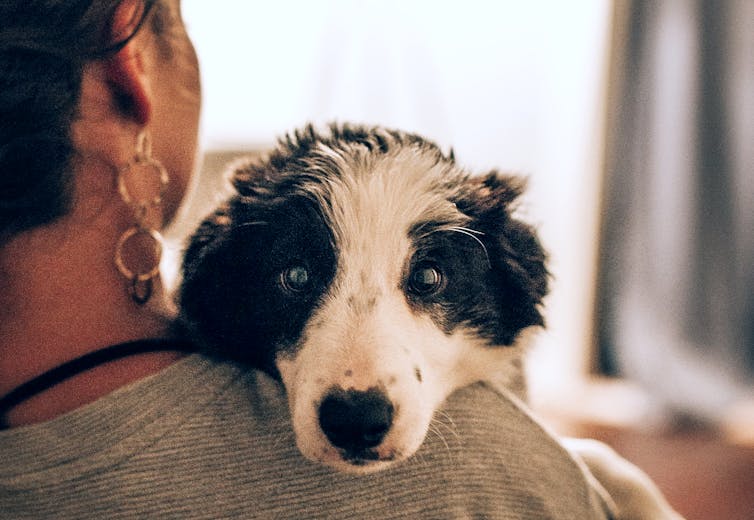
The problem with sudden changes in routine
A change in routine, such as suddenly being alone for many hours every day, is a major cause of separation anxiety for both dogs and cats.
Separation anxiety is more than a little whimpering when you head out the door. It’s major, unwanted behavior that happens every time you leave or are away.
For dogs and cats, this can mean excessive pacing, barking or howling, whimpering or self-grooming as you get ready to leave. In some cases it can mean urinating or defecating around the house, often in places where scents linger, such as on bedding or rugs, or destroying household items in your absence. Extreme clinginess or neediness is another symptom.

Separation anxiety won’t go away on its own, and it can be difficult to get rid of entirely. But there are ways to manage it. As a clinical veterinarian and professor, I am often asked to help people find ways to ease their pets’ anxiety.
What not to do
First, it’s important to understand that it’s not about you – it’s about your pet. Your dog or cat is not trying to teach you a lesson or get revenge. Animals don’t act out of spite.
Instead, it’s a signal of extreme distress and frustration that should be approached like any other medical ailment. Your pet doesn’t want to experience separation anxiety any more than you want to experience its consequences.
For this reason, punishment is never the answer. For one thing, your pet won’t connect the punishment with something that happened hours – or even a few minutes – earlier. And punishment may only exacerbate your pet’s anxiety and stress.
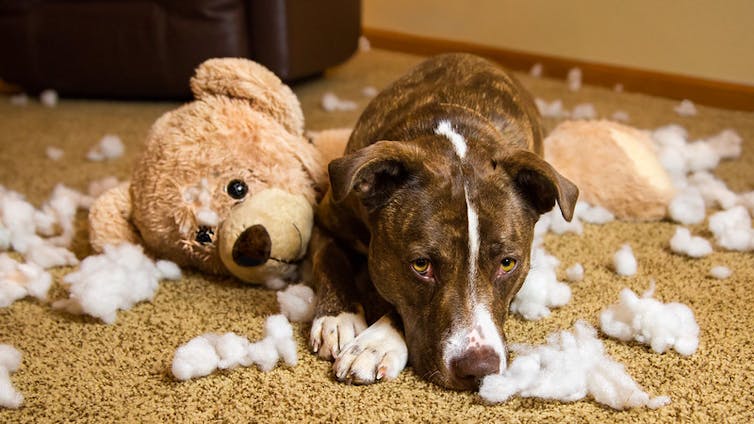
Similarly, going to the opposite extreme by praising or giving affection when your pet is suffering anxiety also will make the problem worse.
The goal is to create a balanced relationship so your pet tolerates being alone. First, get your pet checked out by a veterinarian to rule out physical conditions, such as a urinary tract infection if your pet urinates in inappropriate places.
Next, make sure your pet gets plenty of exercise and mental stimulation. For dogs, this may mean a long run or brisk walk every day. Getting exercise shortly before you leave the house may put your dog in a more relaxed state while you’re gone. It’s harder to feel stressed when the endorphin levels are elevated. For cats, this could mean a change of environment by being outdoors in a safe, enclosed area such as a “catio.”

Treating separation anxiety with behavior change
Here, we’re talking about your behavior. The goal is to make your absence seem like no big deal. Making a fuss over your pet when you leave or arrive home only makes matters worse. If you treat it like it’s routine, your pet will learn to do the same.
Try to figure out when your pet starts to show signs of anxiety and turn that into a low-key activity. If it’s when you pick up your handbag, for example, practice picking it up and putting it back down several times over a few hours. Similarly, get dressed or put on your shoes earlier than usual but stay home instead of leaving right away. Try starting your car’s engine and then turning it off and walking back inside.

Next, practice short absences. When you’re at home, make it a point to spend some time in another room. In addition, leave the house long enough to run an errand or two, then gradually increase the time that you’re away so that being gone for a full day becomes part of the family routine.
Changing the environment
Boredom makes separation anxiety worse. Providing an activity for your pet while you’re gone, such as a puzzle toy stuffed with treats, or simply hiding treats around the house will make your absence less stressful. Other options for dogs and cats include collars and plug-in devices that release calming pheromones.

To maintain your bond while you’re gone, place a piece of clothing that you have worn recently in a prominent place, such as on your bed or couch, to comfort your pet. Similarly, you can leave the TV or radio on – there are even special programs just for pets – or set up a camera so you can observe and interact with your pet remotely. Some of these come equipped with a laser pointer or treats you can dispense.
Using supplements or medication
In some severe cases, when the animal harms itself or causes property damage, medication or supplements might be necessary. These alter the brain’s neurotransmitters to create a sense of calm.
[Deep knowledge, daily. Sign up for The Conversation’s newsletter.]
While some are readily available without a prescription, it’s a good idea to get advice from your veterinarian to determine which are safest and most effective for your pet’s situation. Medication can help reduce the anxiety, making it easier for the pet to learn new coping skills. A behavior modification plan accompanying the use of medication can help manage this problem.
Separation anxiety is difficult for both you and your pet. But a few simple changes can make a huge difference as life returns to some semblance of normal.
Lori M Teller, Clinical Associate Professor, Veterinary Telehealth, Texas A&M University
This article is republished from The Conversation under a Creative Commons license. Read the original article.
Jameson Humane receives grant to help low-income Clearlake residents with spaying and neutering pets

CLEARLAKE, Calif. – A newly awarded grant will help address canine overpopulation in the city of Clearlake.
Dogs Trust USA, based in New York, has awarded $30,000 to Jameson Humane to help fund its “Neuter Now Lake County Project,” which was launched in November 2020 and will last until October 2021.
Jameson Humane, headquartered in Napa Valley, has begun allocating spay/neuter vouchers, microchipping and vaccinations for dogs of low-income residents from Clearlake.
The group, founded in 2014, offers spay/neuter assistance across nine counties in the Bay Area and beyond.
Jameson Humane representatives said the group was honored to accept this funding so it could continue to directly impact the lives of animals by working with the community and collaborating across multiple organizations to offer financial assistance for those in need.
“Every day in the United States, 70,000 dogs and cats are born against only 10,000 humans – we will never rescue our way out of the problem if we don’t look at the systemic problem - overpopulation,” said Monica Stevens, Jameson Humane president and cofounder. “This is why Jameson Humane funds and facilitates lifesaving spay/neuter surgeries, necessary vaccinations and microchips throughout our extended community. By funding to date 5,000 lifesaving spay/neuter surgeries, Jameson continues to stem the tide of overpopulation, thus addressing the root of the problem.”
Over the past six years, the organization has provided the community with nearly 5,000 vouchers, resulting in an estimated 1,875,000 animal lives saved.
Since its inception, Jameson Humane has offered key assistance to local animal rescue organizations and animal control agencies in Lake County.
In 2015, just a year after its founding, Jameson Humane played a major role in assisting in the response to the Valley fire, helping evacuees and pets and gathering donations.
The following year, it was part of a team – including the SPCA of Lake County – that opened the “Pet Pantry” in Lower Lake to support Clayton fire survivors and their pets.
The group has continued to support and co-sponsor free spay and neuter and vaccination clinics in Lake County, particularly in Clearlake, in the years since.
Familiar with the continuing need to address pet overpopulation within Lake County specifically, Jameson Humane said it was primed to respond.
The city of Clearlake has a high poverty rate relative to the rest of the county – about 34 percent – which is why it is the top priority for the distribution of vouchers, Jameson Humane siad.
With the dog population in Clearlake estimated at around 8,900, this project contributes to Jameson Humane’s overarching goal to further increase the live-release rate at the two local shelters while also decreasing intake at a rate of 10 percent by 2022.
Jameson Humane representatives Amanda Vollstedt and Alyx Redmayne-Titley, who are part of the community animal assistance program, visited with Clearlake Animal Control staff and toured the new animal shelter on Dec. 17.
Charmaine Weldon, animal control technician as well as the adoption and rescue coordinator for Clearlake Animal Control, estimated that of the dogs that come through the shelter, 99 percent of them have not been spayed or neutered.
Vollstedt said Jameson Humane continues to want to assist Lake County, noting that about 50 percent of its requests for assistance come from here.
“We know the resources are limited,” Vollstedt said.
Jameson Humane estimated that the grant-funded 200 vouchers, some of which have already been distributed, will help prevent thousands of dogs being born who might have otherwise faced euthanasia.
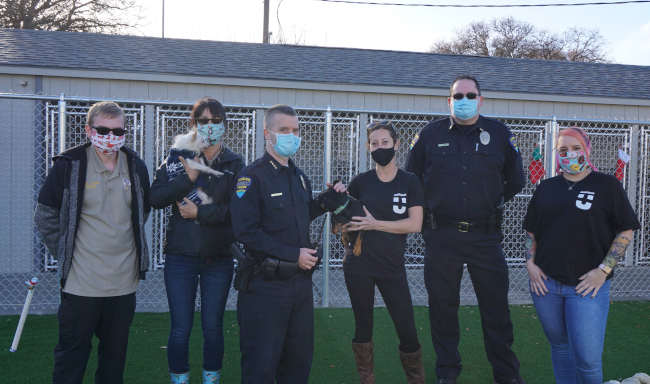
“We are incredibly grateful to Jameson Humane for the ongoing partnership and collaboration the past five years. It takes a community and the success is attributed to the belief in the work that the city of Clearlake is doing for its animals. We thank Dogs Trust and Jameson Humane for making these 200 dog spay and neuters available to our community and keeping their pets healthy,” said Clearlake Police Chief Andrew White.
Ensuring that qualifying residents are aware of the opportunity to get their dog spayed/neutered, Jameson Humane has begun working directly with the SPCA in Lake County in Kelseyville and Totem Animal Small Animal Veterinary Practice in Napa County, which are the two designated clinics where the spay/neuter surgeries take place.
The veterinarians carry out an average of five surgeries per week, or 20 per month, Jameson Humane said.
"As president of the SPCA of Lake County, I am all too aware of the tremendous need in this county of pet owners. Lake County is large in geographical area, yet small in population, in a fairly remote area. Many of the people that live here are retired or disabled and living on a fixed income. The basic needs/expenses of companion animals such as vaccines, spay and neuter are often a financial stretch for this population,” said Brenda Crandall, SPCA of Lake County’s immediate past president.
“Jameson Humane has recognized that need and stepped in repeatedly to assist, through yearly vaccination clinics and through providing free spay/neuter vouchers to be used throughout the year. Because of Jameson’s assistance, the SPCA of Lake County is able to render assistance to a larger number of animals than would be possible without Jameson, and it is my firm belief that through this ongoing process, Lake County will have a reduced number of homeless dogs and cats in the coming years,” Crandall said.
“Totem Small Animal is greatly looking forward to helping the dogs and their guardians of lake county with this spay/neuter project,” said Dr. Katy Wilson of Totem Small Animal.
Impact is measured through shelter data from the two public shelters in Lake County – Lake County Animal Care and Control in Lakeport and the shelter in the city of Clearlake.
Jameson Humane said it focused on intake rates as a measurement metric for this project and obtained data on litters too to better represent the effects of its efforts.
Thanks to its collaborative relationship with local authorities, Jameson Humane also tracks the number of calls to animal control to report stray dogs and expect them to decrease over time.
A limited amount of vouchers are still available, so low-income Clearlake residents are encouraged to email
The requests for vouchers are approved based on a series of questions on income, proof of receipt of government assistance or other type of financial aid.
Those who are allocated a voucher receive instructions on how to schedule an appointment and drop off pets at the hospital.
If it weren't for this award, cross collaboration, and participation by the residents, these dogs’ health would remain at risk, including being more susceptible to cancer and pyometra, Jameson Humane reported.
“The education that results from such a service such as this, helps affect real change and save animal lives,” the organization said.
Email Elizabeth Larson at
License points for distracted driving (AB 47, Daly; 2019): Using a cell phone in a handheld manner while driving is currently punishable by a fine. Beginning July 1, 2021, violating the hands-free law for a second time within 36 months of a prior conviction for the same offense will result in a point being added to a driver’s record. This applies to the violations of talking or texting while driving (except for hands-free use) and to any use of these devices while driving by a person under 18 years of age.
Unattended children in motor vehicles (AB 2717, Chau): Exempts a person from civil or criminal liability for trespassing or damaging a vehicle when rescuing a child who is 6 years old or younger and who is in immediate danger from heat, cold, lack of ventilation, or other dangerous circumstances. The law takes effect Jan. 1, 2021.
“Move Over, Slow Down” amendments (AB 2285, Transportation Committee): Extends the provisions of the “Move Over, Slow Down” law currently in place on freeways to also apply to local streets and roads so drivers approaching a stationary emergency vehicle displaying emergency lights, including tow trucks and Caltrans vehicles, must now move to another lane when possible, or slow to a reasonable speed on all highways, not just freeways. The law is effective Jan. 1, 2021.
Emergency vehicles (SB 909, Dodd): Allows authorized emergency vehicles to use a “Hi-Lo” warning sound. This distinctive sound, different than a siren, would be used to notify the public of an immediate need to evacuate an area in an emergency. The CHP is currently developing regulations to standardize the Hi-Lo warning sound statewide. Until the regulations are adopted, law enforcement agencies can use the Hi-Lo warning sound by obtaining a permit from the CHP. The law went into effect Sept. 29, 2020.
The mission of the CHP is to provide the highest level of safety, service and security.
Census Bureau’s characteristics of new housing offers a peek into the nation’s new homes this decade
The average square footage of new homes sold in the United States increased from 2,457 in 2010 to 2,724 in 2015 but dropped in 2019 to 2,518, according to the U.S. Census Bureau’s Characteristics of New Housing.
The report is based on data collected in the Survey of Construction (SOC) which is partially funded by the Department of Housing and Urban Development (HUD). It provides national and regional details on new privately owned single-family and multifamily residential structures.
Characteristics include square footage, number of bedrooms and bathrooms, types of wall material, parking, sales prices and more.
No downsizing
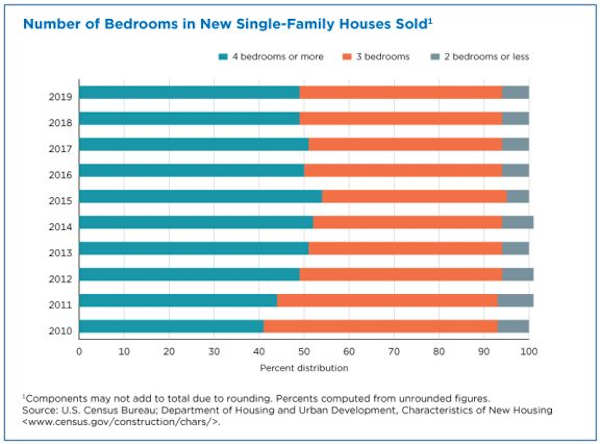
Despite the decline in average square footage, the share of homes with four bedrooms or more that were sold increased from 41 percent in 2010 to 49 percent in 2019.
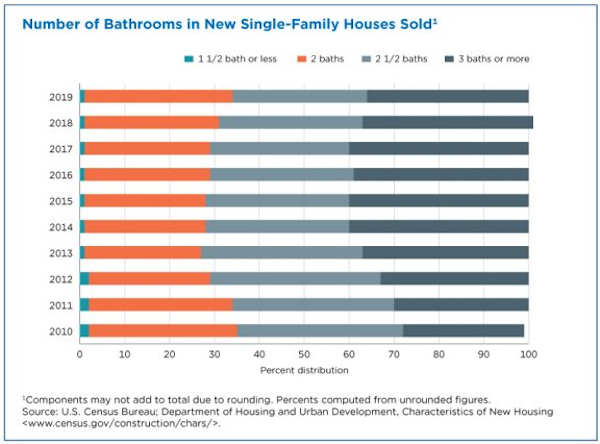
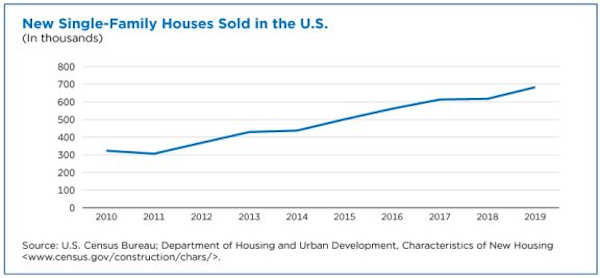
In 2010, 27 percent of the 323,000 new single-family homes sold in the United States had three or more bathrooms. In 2019, 36 percent of the 683,000 U.S. homes sold had three or more bathrooms.
Rising prices
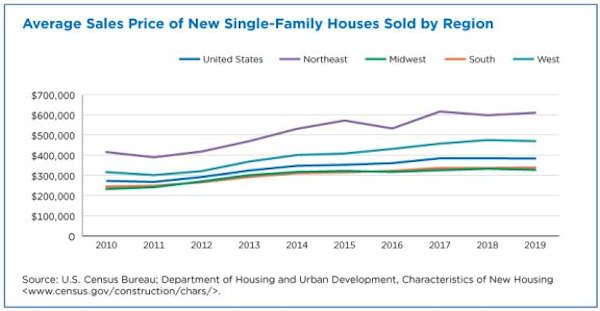
The average sales price of new single-family homes sold in 2019 was $383,900, up from $272,900 in 2010. Prices are not adjusted for inflation.
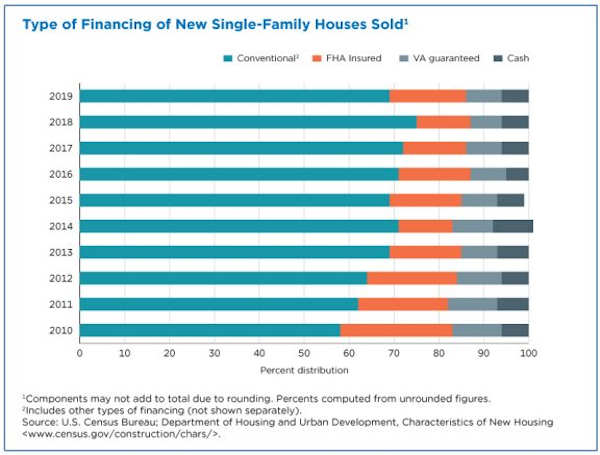
In 2019, 69 percent of new single-family houses sold were purchased using conventional financing – and other types of financing excluding Federal Housing Administration, or FHA, Veteran’s Administration, VA, or cash purchases – up from 58 percent in 2010.
Conventional financing, the primary way new home buyers paid for their purchases, is a mortgage loan not guaranteed by any government agency, such as the VA or FHA.
Features of new homes
Of all the 903,000 new single-family homes completed in 2019:
– 849,000 (or 94%) had air-conditioning.
– 102,000 (11%) had two or fewer bedrooms and 386,000 (43%) had four or more bedrooms.
32,000 (3%) had one and one-half or fewer bathrooms and 296,000 (33%) had three or more bathrooms.
– 366,000 (41%) had a heat pump. Of these, 352,000 were air-source and 14,000 were ground-source.
– 814,000 (90%) were framed in wood and 86,000 (10%) were framed using concrete.
– 296,000 (33%) had a patio and a porch, while 71,000 (8%) had no outdoor features.
– 549,000 (61%) had no fireplace.
In 2019, 683,000 new single-family homes were sold, up 111% from 2010.
A virtual tour of America’s new homes
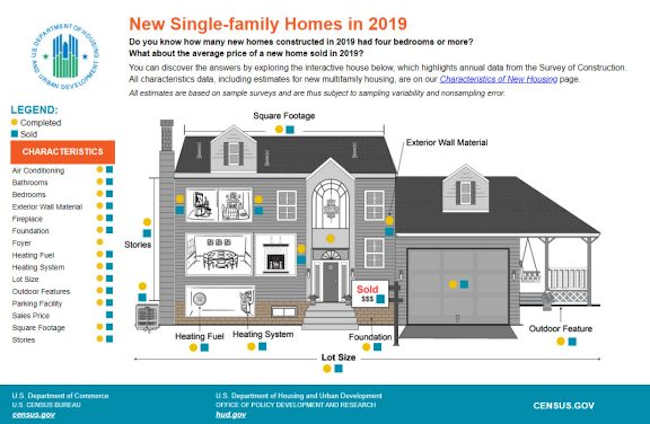
A fun and easy way to get more details on new single-family homes is through this infographic.
Simply hover for a quick fact on completed or sold homes and click on the legend to go to the tables with the information.
Multifamily housing
The Characteristics of New Housing report also provides information on multifamily housing.
Multifamily housing is defined as residential buildings containing units built one on top of another and those built side-by-side without a ground-to-roof wall and/or common facilities, such as attic, basement, heating system and plumbing.
There were 352,000 new multifamily units completed in the United States in 2019, compared to 155,000 in 2010. The numbers include units for sale as condominiums or cooperatives.
What new multifamily units look like:
– 149,000 (42%) had one bedroom and 40,000 (11%) had three or more bedrooms.
– 349,000 (99%) were conventional apartments and 3,000 (1%) were townhouses.
– 203,000 (58%) were in buildings with four or more floors.
– 304,000 (86%) had individual laundry facilities and 29,000 (8%) had shared laundry facilities.
– 251,000 (71%) were in buildings framed in wood and 33,000 (9%) were in steel-framed buildings.
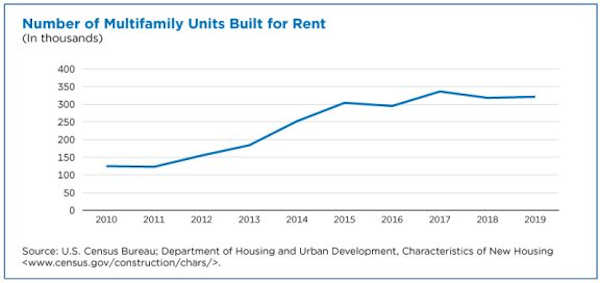
There were 321,000 multifamily units built for rent, a 157% jump from 2010.
Note: Differences between estimates may be attributed to sampling or nonsampling error, rather than to differences in underlying economic conditions. Caution should be used in drawing conclusions from the estimates and comparisons shown. Additional information on the survey methodology, including sampling error (e.g., standard errors and relative standard errors) and nonsampling error, is available at www.census.gov/construction/nrc/how_the_data_are_collected/soc.html.
Philip Thompson is a special projects and outreach coordinator in the Census Bureau’s Economic Management Division.