 How to resolve AdBlock issue?
News
“The number of active COVID-19 cases remains high in our area, and local hospitals are feeling the strain,” said Dr. Gary Pace.
Pace said both of Lake County’s hospitals are at capacity most days. The state’s Blueprint for a Safer Economy places Lake County in the Northern California region, which as of Friday had a 27.5-percent intensive care unit bed availability.
The other regions in the blueprint are all below 15 percent capacity, meaning they remain under regional stay at home orders.
Public Health departments statewide reported a total of 2,621,215 cases and 29,238 deaths as of Friday night.
In Lake County, Public Health reported that cases on Friday totaled 2,120, with another death, bringing the total to 26. Fifteen people are now hospitalized.
“With the virus widespread in our communities, you are likely to be in contact with people who are contagious any time you are out in public. Go to stores early in morning or late, when the numbers of people are much lower. Work from home, if possible. Avoid socializing with people outside of your household for the next few weeks,” Pace said.
He added that, if we all take these steps, “the current surge should start going down by the end of the month.”
More vaccine arrives
The first and second doses of the Pfizer vaccine for 975 residents have been received through the Health Department, and 900 doses of the Moderna vaccine, Pace said. Another 500 doses have been received via community healthcare partners.
“Over half of the initial doses have been administered in just three weeks, despite overlap with holidays and COVID cases surging,” Pace said. “We are working hard to ensure Lake County residents get every dose we can access.”
He said getting as many people vaccinated as possible will allow us to resume a more normal rhythm of life.
Pace said people frequently ask Public Health when they can get the vaccine.
Public Health is currently managing an unknown supply schedule, which includes about 300 vaccine doses a week – “not nearly enough,” Pace said – and setting up the infrastructure to provide the vaccine to the community, including outreach to medical partners and pharmacies.
State guidelines determine the priority, with the first tier, Phase 1a, including health care workers and residents of skilled nursing facilities, assisted living facilities and similar long-term care settings for older or medically vulnerable individuals.
This week, the California Department of Public Health issued updated recommendations for moving through the vaccine phases and tiers, encouraging local health departments and health care providers to immediately administer COVID-19 vaccines to individuals in all tiers of Phase 1a in order to reduce the potential for vaccine wastage.
Pace said that Phase 1a will be finished by the end of next week, except for nursing home residents, who will be vaccinated through a partnership with pharmacies in the coming weeks.
He said those 75 years and older and some essential workers will receive the vaccine next; the goal is to do those vaccinations the week of Jan. 18.
“Teachers and school staff who have contact with kids will be prioritized, in the interest of getting schools open as soon as possible,” he said. “Once this plan is functioning, we will expand to childcare workers and essential workers in food and agriculture.”
At Thursday evening’s Clearlake City Council meeting, City Manager Alan Flora told the council about efforts to set up vaccination clinics in the city. The Clearlake Community Center is expected to host the clinics in weeks to come.
Pace said more information about the upcoming steps in the vaccination effort will be available next week.
Email Elizabeth Larson at
Lake County officials on Friday were not prepared to comment on the contents of the voluminous new document.
With the end of the COVID-19 pandemic in sight, the governor’s budget prioritizes key actions that will urgently help the California families and businesses impacted most.
It proposes $372 million to speed up administration of vaccines across all of California’s 58 counties, bolstering the state’s all-hands-on-deck approach to swift and safe vaccine distribution.
It also includes a $14 billion investment in economic recovery and the Californians who most need relief – those who have lost their jobs or small businesses, or are facing eviction – advancing direct cash supports of $600 to millions of Californians through the Golden State Stimulus, extending new protections and funding to help keep people in their homes and investing in relief grants for small businesses.
As part of this investment in California’s future, the budget intensifies the governor’s commitment to equity in and for our school communities, reflected by the highest levels of school funding – approximately $90 billion total – in California’s history.
The commitment includes investments to target the inequitable impacts of the pandemic on schools and families, including $2 billion to support and accelerate safe returns to in-person instruction, $4.6 billion to help students bounce back from the impacts of the pandemic and $400 million for school-based mental health services.
In addition to these measures to support Californians through the end of the COVID-19 pandemic, the budget also advances long-term strategies for an equitable, broad-based economic recovery so the state can emerge from the pandemic stronger than before.
Building on actions the state has taken to support California’s businesses throughout the pandemic, including emergency aid and regulatory relief, the 2021-22 State Budget makes investments across sectors and proposes supports for businesses of all sizes, including $777.5 million for a California Jobs Initiative, which focuses on job creation and retention, regional development, small businesses and climate innovation.
The budget recognizes how COVID-19 has disproportionately impacted Californians who were already struggling before the pandemic, exacerbating decades-long inequalities. Accordingly, it works to expand opportunities for some of the hardest hit Californians and help them get ahead.
The budget also proposes one-time and ongoing investments totaling $353 million to support California’s workers as they adapt to changes in the economy brought about by COVID-19. It lifts up proven, demand-driven workforce strategies like apprenticeship and High-Road Training Partnerships and advances collaboration between higher education and local workforce partners.
“In these darkest moments of the COVID-19 pandemic, this budget will help Californians with urgent action to address our immediate challenges and build towards our recovery,” said Gov. Newsom. “As always, our budget is built on our core California values of inclusion, economic growth and a brighter future for all. The budget makes progress towards the goal I set when taking office to harness California’s spirit of innovation and resilience and put the California Dream within reach of more Californians. I look forward to working with the Legislature to enact these critical immediate and longer-term priorities for our state for the 40 million who call the Golden State home.”
Newsom’s office said this new budget is built on the prudent fiscal management that has helped the state weather the COVID-19 Recession in 2020, and with an improved revenue forecast entering 2021.
Through the end of this pandemic and beyond, it advances the governor’s sustained focus on increasing opportunity through education, including early education; increasing the affordability of health care and housing, and effective governance.
The budget makes new proposals to address the affordability of health care and housing, and supports the increase in the state's minimum wage to $14 per hour. It includes significant new strategies to reduce the impacts of climate change, with focused investments to support the state's zero-emission vehicle goals and an additional $1 billion to address a comprehensive wildfire and forest resilience strategy.
State Sen. Mike McGuire, who represents Lake County, highlighted that funding to address wildfires.
“Today’s budget reflects desperately needed funding on fire prevention and response, helping to keep millions of Californians safe. This budget also builds on past years’ significant investments including hundreds of millions for vegetation management and fire prevention, $143 million to support 30 new CalFire crews and $48 million to continue phasing in Black Hawk helicopters and large air tankers,” he said Friday.
“And, we look forward to working with the administration in the coming weeks to enhance this overall proposal. There’s still more work to do on wildfire prevention, which is why we’ll be moving with urgency to bolster this portion of the state’s budget,” McGuire said.
For over a year, McGuire has been working with tribal leaders and the administration, advocating for California’s Native American tribes, ensuring tribes are able to access state grant funding for vegetation management and fire prevention programs on tribal lands.
McGuire said the budget includes $20 million that has been set aside to fund these critical tribal fire programs and he will be working collaboratively with tribal leaders and administration officials to hammer out the final details.
Finally, the budget promotes effective government with additional investments to improve the state's ability to respond rapidly to emergencies and continues the critical work to improve government efficiency and bring government services into the digital age.
The budget reflects $34 billion in budget resiliency – budgetary reserves and discretionary surplus – including: $15.6 billion in the Proposition 2 Budget Stabilization Account (Rainy Day Fund) for fiscal emergencies; $3 billion in the Public School System Stabilization Account; an estimated $2.9 billion in the state’s operating reserve; and $450 million in the Safety Net Reserve. The state is operating with a $15 billion surplus.
The budget continues progress in paying down the state's retirement liabilities and reflects $3 billion in additional payments required by Proposition 2 in 2021-22 and nearly $6.5 billion over the next three years. In addition, the improved revenue picture allows the state to delay $2 billion in scheduled program suspensions for one year.
Additional detail on the 2021-22 State Budget is below.
Immediate actions to provide relief and safely reopen schools
The budget reflects the governor’s call for immediate legislative action to provide rapid relief to individuals, families and small businesses hit hardest by the COVID-19 pandemic, as well as funding needed to begin a return to in-person learning starting next month. These actions include:
– $2.4 billion for the Golden State Stimulus: A $600 state payment to low-income workers who were eligible to receive the Earned Income Tax Credit in 2019, as well as 2020 Individual Taxpayer Identification Number filers.
– $575 million to more than double this year’s funding for grants to small businesses and small nonprofit cultural institutions disproportionately impacted by the pandemic.
– $70 million to provide immediate and targeted fee relief for small businesses including personal services and restaurants.
– $2 billion targeted specifically to support and accelerate safe returns to in-person instruction starting in February, with priority for returning the youngest children (transitional kindergarten through 2nd grade) and those with the greatest needs first
Initial $372 million set aside for COVID-19 vaccinations
The budget sets aside an initial $372 million in state funds, which can be allocated immediately as needed, for expenses to expedite the delivery of COVID-19 vaccinations.
Accelerating economic recovery and job creation
The budget builds on actions taken in 2020 to support small businesses, including the elimination of the first year of the minimum franchise tax, expansion of small business loan guarantees and creation of a new Main Street hiring tax credit.
It also proposes $4.5 billion for the Governor’s Equitable Recovery for California’s Businesses and Jobs plan, including the following actions to accelerate economic recovery and job creation:
– $1.5 billion for the infrastructure and incentives to implement the state's zero-emission vehicle goals;
– $1.1 billion immediate relief for small businesses;
– $777.5 million for a California Jobs Initiative to provide incentives targeted at accelerating investment and job creation;
– $353 million for workforce development;
– $300 million for deferred maintenance and greening of state infrastructure.
The budget also invests $385 million for targeted investments to build a more sustainable agricultural industry.
The budget reflects key investments in the following areas.
K-14 education
The budget reflects the state’s highest-ever funding level for K-14 schools – approximately $90 billion total, with $85.8 billion under Proposition 98. The historic investment centers on equity in and for our school communities, especially as they navigate the inequitable impacts of the pandemic.
It continues to expand on the governor’s multi-year investments for greater equity for students and the broader school community. Targeted investments in special education include $545 million in ongoing funds – building on $1.5 billion over the last two years – and $300 million in ongoing funds for early intervention for infants, toddlers and preschoolers.
The budget also continues to build on the governor’s long-term commitment to equity for the entire school community – including all school staff – with over $475 million to ensure teachers and classified staff have the opportunities, funding and preparation they need as professionals.
The budget also reflects key investments targeted to address the impacts of the pandemic on students, especially those inequitably impacted.
Recognizing the value of in-person settings for both social-emotional and academic development, $2 billion is proposed for immediate action to support and accelerate safe returns to in-person instruction beginning in February, based on a phased-in approach that starts with our youngest students.
Because students will need support that extends beyond the traditional school day or year, $4.6 billion is proposed for action this spring to expand learning opportunities for students, including summer and after-school programs.
To address the mental health needs of our students, especially as a consequence of trauma and the pandemic, $400 million is proposed for school-based mental health. All of these funds will prioritize students and communities disproportionately impacted by the pandemic, with funds strongly weighted toward schools serving students from low-income families, foster youth, homeless students, English learners and others disproportionately impacted by the pandemic.
The budget also directs a significant portion of additional funding to paying down nearly two-thirds of the deferrals implemented last year and provides a 3.84-percent cost-of-living adjustment to the Local Control Funding Formula.
Growth in capital gains and overall revenues triggers deposits of roughly $3 billion into the Public School System Stabilization Account, resulting in a statutory cap of 10 percent on local school district reserves in 2022-23.
Early education and child care
The COVID-19 pandemic has disrupted the state’s child care system, and federal funding has been critical to reducing long-term losses in this system.
Building on the state’s $400 million investment since 2019 in expanded early education and child care, and based on recommendations made in the Master Plan for Early Learning and Care, the Budget expands high-quality transitional kindergarten programs for all four-year-olds through $250 million in incentive funds for districts that expand these programs.
The budget also includes a $200 million one-time General Fund for transitional kindergarten and kindergarten facilities and $50 million one-time Proposition 98 General Fund for professional development focused on preparing teachers for early childhood programs. It builds on the governor's previous investments of $1.5 billion over the last two years in special education, with $545 million ongoing funding and adding $300 million for additional special education for infants, toddlers and preschoolers this year.
The administration has already begun the collective bargaining process with representatives of child care providers to negotiate a memorandum of understanding that governs the payments made to these providers.
The budget also reflects $44 million ongoing cannabis funds for 4,500 more child care vouchers, including $21.5 million in 2020-21.
Higher education and workforce
The budget proposes a general fund increase of $786 million for the University of California and the California State University with an expectation that they focus on measurable goals to address equity gaps, further maintain online educational opportunities and expand dual admissions and other innovative strategies that reduce time to degree completion. The budget also assumes resident tuition and fees remain flat in 2021-22.
The governor’s budget proposes an overall $353 million investment in workforce development. It includes a $250 million one-time General Fund to support workforce development and better linkages between higher education and gainful employment, focusing on communities that have been systematically excluded from opportunities to build skills and create wealth. The budget also proposes early action for $25 million to immediately expand existing High Road Training Partnership Program apprenticeship programs, and additional funding for the California Apprenticeship Initiative work-based learning opportunities through the community colleges.
It proposes early action on a portion of these incentives in the spring to accelerate recovery before the 2021-22 fiscal year begins in July.
Addressing health care affordability and aging
The COVID-19 pandemic has accentuated the need for health care for all. While responding to the COVID-19 pandemic, the state continues to work on long-term plans to reduce the costs of health care by lowering prescription drug costs; the budget includes the creation of a new Office of Health Care Affordability. The office will increase quality and cost transparency, develop cost targets and evaluate consequences for entities that fail to meet the targets.
The budget proposes to implement the California Advancing and Innovating Medi-Cal, or CalAIM, initiative to reduce variation and complexity in the state's Medi-Cal program, manage member risk and need and improve outcomes through payment reform.
CalAIM will target and coordinate care for vulnerable populations with complex health needs that currently drive high costs. The effort will include housing-related services and flexible wraparound services so health plans may avoid costlier alternatives to hospitalization, skilled nursing facility admission and/or discharge delay.
The budget recognizes the extraordinary challenges older Californians and their families face during the COVID-19 pandemic, and proposes a range of investments to increase opportunities for Californians to age well over the next decade, including developing new strategies with the federal government to leverage Medicare to provide additional long-term services and support.
Housing and homelessness
The state continues to make progress in addressing the housing availability and affordability crisis that has been exacerbated by the COVID-19 pandemic. In addition to the $500 million for infill infrastructure, the budget also proposes an additional $500 million in low-income housing tax credits to support low-income housing development. The administration is streamlining and reorganizing state housing programs to maximize housing production, while also continuing to support below-market rate housing.
Through Homekey – a nation-leading effort to acquire motels for homeless housing to respond to the COVID-19 pandemic – the state has awarded $846 million to 51 local agencies to secure over 6,000 units of permanent housing for individuals and families who had been homeless. The budget includes a $1.75 billion one-time General Fund to purchase additional motels, develop short-term community mental health facilities and purchase or preserve housing dedicated to seniors. The budget also proposes changes to the state's Medi-Cal system to better support behavioral health and housing services that can help prevent homelessness.
Emergency response and preparedness
In 2020, the state experienced catastrophic wildfires that consumed over four million acres, far more than any previous year in the state's history. The historic emergency response, while combating the COVID-19 pandemic at the same time, strained the state's emergency response capabilities.
The administration is developing a spring proposal to strengthen the Governor’s Office of Emergency Services' ability to respond to emergencies and support recovery efforts, especially in vulnerable communities.
Building on significant investments in the state's firefighting capabilities, the budget adds $143 million General Fund to support 30 new fire crews, and also includes $48 million to continue phasing in Black Hawk helicopters and large air tankers.
Additionally, the budget proposes $17.3 million for earthquake early warning.
Climate change action
The budget proposes an additional $1 billion to support a coordinated forest health and fire prevention strategy that maximizes technology and science-based approaches to protect state forestlands, including $39 million for LiDAR remote sensing and research. The budget proposes $323 million for early action in the spring to start these forest health and fire prevention projects before the next fire season.
The budget proposes a $1.5 billion comprehensive strategy to achieve the state’s zero-emission vehicle goals by 2035 and 2045, including securitizing up to $1 billion to accelerate the pace and scale of the infrastructure needed to support zero-emission vehicles.
Environmental justice
The budget includes a $300 million one-time General Fund for toxic site cleanup and investigations of high-priority contaminated properties in impacted communities across the state, which will be prioritized based on public health risk criteria.
Further, the budget creates incentives to clean up and develop these sites for future housing. The budget also proposes comprehensive governance and fiscal reform for the Department of Toxic Substances Control that will provide for the support needed in the long term to address future cleanups of orphan sites and the reduction of harmful toxic substances in the environment.
The budget includes a multi-faceted approach to reducing harmful pesticides and supports the transition of the agricultural industry to integrated pest management and more regenerative practices.
Results-oriented government and digital transformation
The COVID-19 pandemic has required many businesses to be flexible, creative and innovative. As the employer of a workforce of over 250,000, the state also responded immediately by putting in place a statewide telework program and new ways to conduct state business. This shift has meant the state must also evaluate its portfolio of state leases to determine spaces that can be released and/or consolidated.
The budget assumes a five-percent permanent reduction in state operations expenditures, challenging departments and agencies to find more efficient means to provide services to Californians.
The budget also makes major investments to provide additional support to the California Department of Technology to bolster its ability to review and improve upon critical state information technology systems before a failure occurs. In addition, the Office of Digital Innovation continues to lead state government in the transformation of consumer-facing services.
For further information on these and other items in the Governor’s Budget, the full Governor’s Budget Summary is available at www.ebudget.ca.gov.
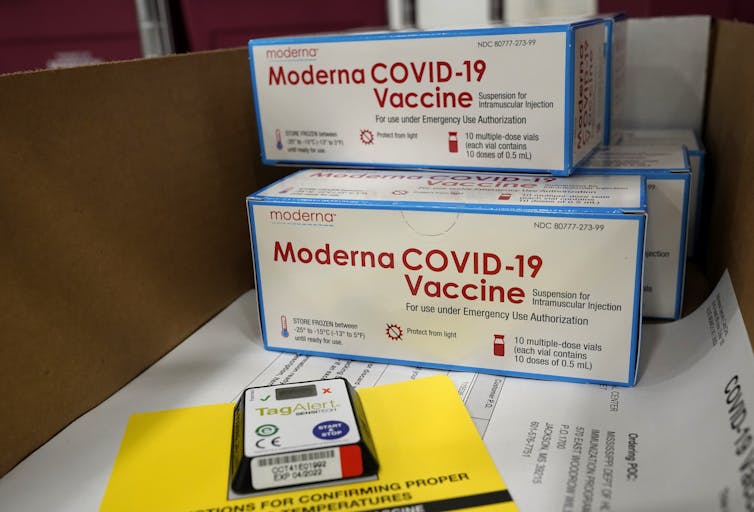
It has been clear for a while that, at least in the U.S., the only way out of the coronavirus pandemic will be through vaccination. The rapid deployment of coronavirus vaccines is underway, but how many people need to be vaccinated in order to control this pandemic?
I am a computational biologist who uses data and computer models to answer biological question at the University of Connecticut. I have been tracking my state’s COVID-19 epidemic with a computer model to help forecast the number of hospitalizations at the University of Connecticut’s John Dempsey Hospital.
This type of computer model and the underlying theory can also be used to calculate the vaccination rates needed to break the chain of transmission of the coronavirus. My estimate is that for the entire U.S., roughly 70% of the population needs to be vaccinated to stop the pandemic. But variation in how people behave in different parts of the country, as well as open questions on whether the vaccine prevents infection entirely or just prevents people from getting sick, add a degree of uncertainty.

Cutting off transmission
Clinical trials have shown that once a person gets vaccinated for the coronavirus, they won’t get sick with COVID-19. A person who doesn’t get sick can still be infected with the coronavirus. But let’s also assume that a vaccinated person can’t spread the virus to others, though researchers still don’t know if this is true.
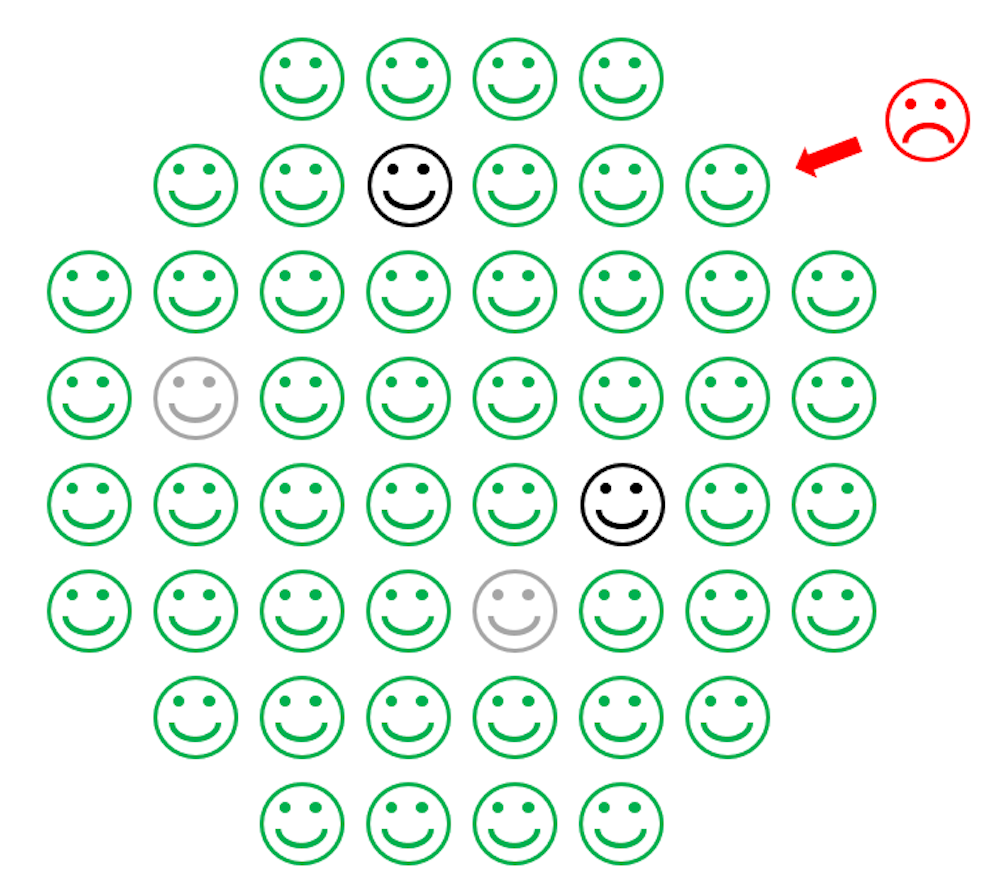
When enough of the population is vaccinated, the virus has a hard time finding new people to infect, and the epidemic starts dying out. And not everyone needs to be vaccinated, just enough people to stop the virus from spreading out of control. The number of people who need to be vaccinated is known as the critical vaccination level. Once a population reaches that number, you get herd immunity. Herd immunity is when there are so many vaccinated people that an infected person can hardly find anyone who could get infected, and so the virus cannot propagate to other people. This is very important to protect people who cannot get vaccinated.
The critical vaccination level depends on how infectious the disease is and how effective the vaccine is. Infectiousness is measured using the basic reproduction number – R0 – which is how many people an infected person would spread the virus to on average if no protective measures were in place.
The more infectious a disease is, the larger the number of people who need to be vaccinated to reach heard immunity. The higher the effectiveness of the vaccine, the fewer people need to be vaccinated.

Not the same everywhere
R0 values differ from place to place because their populations behave differently – social interactions are not the same in rural and urban locations, nor in warm climates compared to cold ones, for example.
Using the data on positive cases, hospitalizations and deaths, my model estimates that Connecticut currently has an R0 of 2.88, meaning that, on average, every infected person would pass the virus on to 2.88 other people if no mitigation measures were in place. Estimates at the county level range from 1.44 in rural Alpine, California to 4.31 in urban Hudson, New Jersey.
But finding an R0 value for the entire U.S. is especially tricky because of the diversity of climates and because the virus has affected different areas at different times – behavior has been far from uniform. Estimates vary from 2.47 to 8.2, though most researchers place R0 for the entire U.S. around 3.
While R0 varies by location and between estimates, the effectiveness of the vaccines is constant and well known. The Pfizer-BioNTech and Moderna vaccines are 95% and 94.5% effective at preventing COVID-19, respectively.
Using values for vaccine effectiveness and the R0, we can calculate the critical vaccination level. For Connecticut, with an R0 of 2.88, 69% of the population needs to be vaccinated. For the entire U.S., with R0 of 3, this would be 70%. In New York City, with an estimated R0 of 4.26 this would be 80%.
A lot of uncertainty
While the math is relatively simple, things get complicated when you consider important questions for which epidemiologists still have no answers.
First, the formula for critical vaccination level assumes that people interact randomly. But in the real world, people interact in highly structured networks depending on work, travel and social connections. When those contact patterns are considered, some researchers found critical vaccination levels to be considerably smaller compared to assuming random interactions.
Unfortunately, other unknowns could have an opposite effect.
Vaccine trials clearly show that vaccinated people don’t get sick with COVID-19. But it is still unknown whether the vaccines prevent people from getting mild infections that they could pass on to others. If vaccinated people can still be infected and pass on the virus, then vaccination will not provide herd immunity – though it would still prevent serious disease and reduce mortality drastically.
A final question that remains to be answered is how long immunity to the coronavirus lasts after a person is vaccinated. If immunity wanes after a few months, then each individual will need repeated vaccinations.
It is hard to say with certainty how many people need to be vaccinated in order to end this pandemic. But even so, the arrival of COVID-19 vaccines has been the best news in 2020. In 2021, as a large proportion of individuals in the U.S. get the vaccine, the country will be heading toward the critical vaccination level – whatever it may be – so that life can start to return to normal.
[You need to understand the coronavirus pandemic, and we can help. Read The Conversation’s newsletter.]
Pedro Mendes, Professor of Cell Biology, University of Connecticut
This article is republished from The Conversation under a Creative Commons license. Read the original article.
What's up for January? Getting close to the Sun, some easy outer-planet spotting, and a chance to catch quick-moving Mercury.
The new year began with planet Earth at the closest point in its orbit around the Sun, called perihelion, on Jan. 2. Now you may have learned in school that Earth orbits a certain distance from the Sun and that its orbit is nearly circular. The average distance from Earth to the Sun is called an astronomical unit, but since our orbit is not a perfect circle, it means sometimes we're a bit closer to the Sun, and sometimes farther away.
In fact, our distance from the Sun varies by around 3 million miles over the course of the year. That's nearly 13 times the distance from Earth to the Moon.
At perihelion, Earth is about 91.5 million miles from our local star. And when we're at the farthest point, it's called "aphelion." That happens this year on July 5, when we'll be about 94.5 million miles away.
If you have access to binoculars or a telescope, then you might want to haul them out on Jan. 20, which offers an easy opportunity to view the planet Uranus.
The distant, outer planet is too faint for most of us to see with the unaided eye, and it can be tough to locate in the sky without a computer-guided telescope.
But on Jan. 20, Uranus will be located right between the Moon and Mars. That evening, find the crescent moon and the red planet in the couple of hours after it gets dark. Scan your way over from Mars toward the moon, and you should be able to find the faint, bluish disk of Uranus.
Along with Neptune, Uranus has only been visited by a single spacecraft so far, that being NASA's Voyager 2, more than 30 years ago. And as more recent telescope views have revealed the active atmosphere beneath its hazy, blue exterior, scientists are eager to one day return for a closer look.
The last two weeks of January offer opportunities to catch a glimpse of the fast-moving planet Mercury. Look for the innermost planet of our solar system just after sunset beginning mid-month. You'll need a clear view toward the west, as Mercury will appear just a few degrees above the horizon (about the width of your outstretched fist).
This little planet orbits much closer to the Sun than Earth, meaning it also goes around the Sun much faster, completing its "year" in about a quarter of the time it takes Earth to go around once. And that's why we have a chance to view Mercury in the sky every three months or so, as it appears to dart back and forth from one side of the Sun to the other. But Mercury never gets too far away from the Sun from our vantage point, and thus we only see the little planet just before or after the Sun rises or sets.
Last visited by NASA's MESSENGER spacecraft, which ended its mission in 2015, Mercury is slated to see a new visitor in orbit in 2025, when the joint European and Japanese mission BepiColombo arrives there.
You can catch up on all of NASA's missions to explore the solar system and beyond at www.nasa.gov.
Preston Dyches works for NASA's Jet Propulsion Laboratory.
On Tuesday, the Lakeport City Council presented a proclamation to Victim Services Program Director Sheri Young of Lake Family Resource Center, declaring January as Human Trafficking Awareness Month.
In thanking the council, Young said it was the first proclamation recognizing Human Trafficking Awareness Month that they’ve received in Lake County.
The Clearlake City Council would follow up with its own proclamation on Thursday.
In 2019, Lake Family Resource Center announced a new initiative to offer services and support to victims of human trafficking.
At the end of that year, the organization received a three-year grant of $550,000 to support its efforts from the Office for Victims of Crime, part of the U.S. Department of Justice.
Young said the grant-funded program has been very successful, even with the sheltering in place required by COVID-19.
She said she believes that, together, we can put an end to the heinous crime of human trafficking.
The proclamations explain that human trafficking “is a borderless crime against individuals that violates the most basic human rights and deprives victims of human dignity and denies freedom to 32 million people around the world.”
It’s the fastest-growing criminal industry globally, and California ranks third among the states in the number of potential reports of human trafficking.
Because it can involve the exploitation of children and youth for commercial sex acts, the proclamations say that “it’s imperative that our young people and their families learn how to recognize risks and resist predators who use coercion and threats to manipulate children and young adults into sex and labor trafficking.”
Lake Family Resource Center’s services to address human trafficking include 24-hour hotline services and continuing support, advocacy and accompaniment to survivors.
In January and beyond, community members are “urged to support the efforts of the agencies assisting victims of human trafficking and urges all local governments, schools, businesses and community members to be aware and report any suspicious activity to local police departments and help shine the light on trafficking.”
Young also encouraged people to wear blue on Jan. 11, which is a day of action and National Human Trafficking Awareness Day.
Email Elizabeth Larson at
The following dogs are ready for adoption or foster.
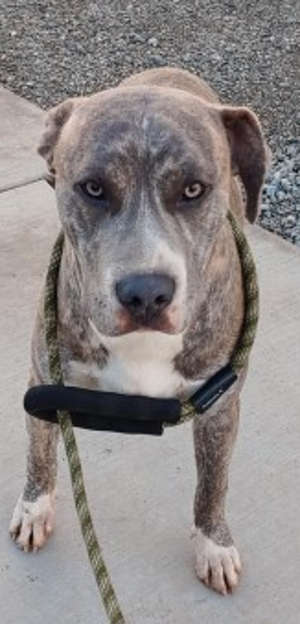
‘Ben’
“Ben” is a male American Pit Bull terrier mix.
He has a short brindle coat.
He is dog No. 4454.

‘Breeze’
“Breeze” is a female American Pit Bull Terrier mix.
She has been spayed.
She is dog No. 4445.
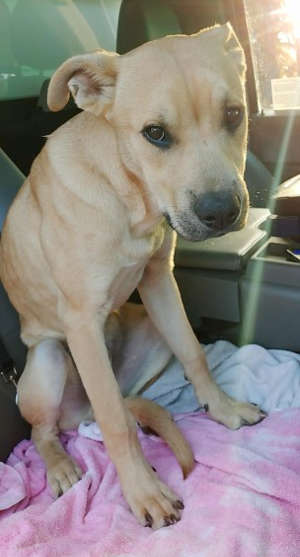
‘Bruce’
“Bruce” is a male American Staffordshire Terrier mix puppy.
He has a short smooth yellow coat.
He is dog No. 4383.

‘Bumble’
“Bumble” is a male Siberian Husky with a gray and black coat.
He is dog No. 4452.

‘Inky’
“Inky” is a male German Shepherd mix.
He has a long smooth black coat.
He is dog No. 4324.

‘Jerry’
“Jerry” is a male American Pit Bull terrier with a short brindle coat.
He is dog No. 4455.

‘Rudolph’
“Rudolph” is a male shepherd mix.
He has a short tan and black coat.
He is dog No. 4436.

‘Tinsle’
“Tinsle” is a female American Pit Bull Terrier mix puppy.
She has a short brindle and brown coat.
She is dog No. 4433.

‘Toby’
“Toby” is a male boxer mix.
He has a short tan and white coat.
He is dog No. 4389.

‘Yule’
“Yule” is a husky of undetermined gender with a black and white coat.
Yule is dog No. 4432.
Call the Clearlake Animal Control shelter at 707-273-9440, or email
Visit Clearlake Animal Control on Facebook or on the city’s website.
Email Elizabeth Larson at