 How to resolve AdBlock issue?
News
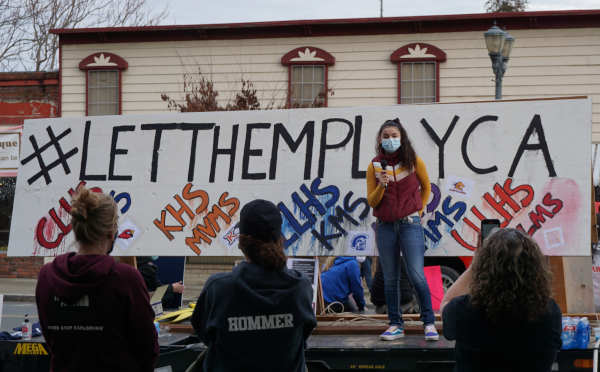
LAKEPORT, Calif. – A large group of parents, students, coaches and other community members gathered in Lakeport Friday afternoon to rally for reopening school sports.
The “Let Them Play” rally, held at Courthouse Museum Park in downtown Lakeport, was one of dozens coordinated to take place across the state on Friday.
For nine months, school sports have been shut down due to COVID-19, and the rallies were meant to bring attention to what supporters say is the need for young people to be able to have sports available to them once again.
Most of Lake County’s schools remain closed to in-person learning due to being in the highest tier, purple, on the state’s Blueprint for a Safer Economy.
Under guidelines issued by the state and the California Interscholastic Federation, the only sport offered at local schools at this time of year that would be allowed is cross country.
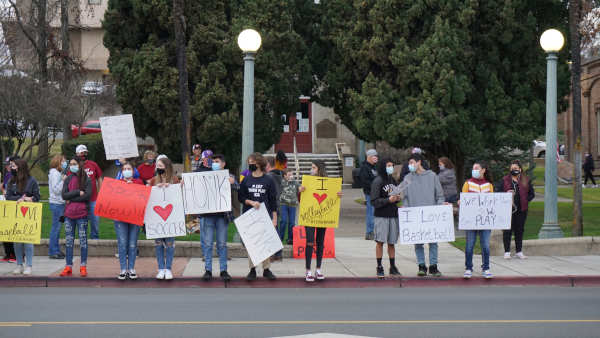
A big crowd was on hand Friday afternoon, lining Main Street between Second and Third Streets.
Lake County News counted close to 120 people in the rally area, and Gerard Fowler, one of the event organizers, estimated there were more than 150 participants at the event’s peak.
“For such a short planning time frame I was pleasantly pleased with the turnout,” Fowler said.
Students and their supporters carried signs with messages including “Let us play,” “I love wrestling,” “Put me in, Coach,” “I love volleyball,” “I love softball” and “Science supports sports.”
A flatbed trailer was parked on the street as a stage, and passing motorists honked in support.
Madeline Young, a sophomore and honor roll student at Upper Lake High School, thanked people for coming.
Young said not having school sports is hurting students.
“Let us play,” she said.
Fowler said those participating came from areas including Kelseyville, Lakeport, Lower Lake, Middletown, Ukiah, Upper Lake and Willits, with all local school districts represented.
It was a peaceful rally with no political agendas, he said.
“It was nice to stand united for our children,” Fowler said.
Email Elizabeth Larson at
In Washington, DC, heightened security already is in place following last week’s attack on the U.S. Capitol Building.
In an interview with Lake County News on Thursday, Congressman Mike Thompson described how the U.S. Capitol Building is now surrounded by an 8-foot-tall fence topped with razor wire, with the National Mall closed.
“It’s a pretty heartbreaking situation,” Thompson said.
Earlier this week, the California Highway Patrol, the Governor’s Office of Emergency Services and the California National Guard said they want to assure Californians that their collective agencies are working together and remain vigilant to respond to potential threats that may occur anywhere in the state, including the State Capitol.
“Collectively, we maintain strong relationships with our security and intelligence partners at the local, state and federal levels and are continually monitoring and sharing information about possible emerging threats to the state,” the agencies reported in a joint statement.
“Together, our role is to safeguard lives and property and ensure that California remains a safe place for those who live, work, and travel within the state while ensuring the ability of individuals and groups to lawfully exercise their First Amendment rights,” the statement added.
Gov. Gavin Newsom followed up by announcing a series of actions to bolster security in advance of the presidential inauguration.
“In light of events in our nation’s capital last week, California is taking important steps to protect public safety at the State Capitol, and across the state,” said Newsom. “Our State Operations Center is actively working with federal, state and local law enforcement partners in assessing threats and sharing intelligence and information to ensure those disgraceful actions are not repeated here.”
Newsom on Thursday signed a general order authorizing the deployment of 1,000 California National Guard personnel to protect critical infrastructure, including the State Capitol.
To prepare for and respond to any credible threats, the State Operations Center will coordinate 24-hour operations and requests for mutual aid for the coming days, Newsom’s office said. The Law Enforcement Coordination Center will be activated to its highest level to orchestrate overall law enforcement and physical security needs.
Officials said the CHP and Department of General Services have installed a 6-foot chain link fence around the perimeter of the State Capitol to ensure the safety of the Capitol grounds.
Newsom’s office said the administration, through the Governor’s Office of Emergency Services, California Highway Patrol and California National Guard, maintains strong relationships with security and intelligence partners around the country and is continually monitoring for possible emerging threats to the state.
“We are prepared to address any potential threats that may arise. The Administration is also preparing to provide additional law enforcement resources through the Mutual Aid System as needed,” Newsom’s office said.
The governor and his team are also coordinating closely with local, state and federal law enforcement as well as the private sector – including social media companies – to make sure that their platforms are not used by hate groups or domestic terrorists to organize or spread misinformation, disinformation or propaganda.
On Friday, the state took another step to heighten security, with CHP Commissioner Amanda Ray announcing the CHP would go on tactical alert ahead of the presidential inauguration.
Ray said the CHP is prepared to respond to any potential threats which may arise statewide. “The protection of California highways and state buildings, including the Capitol, are the primary responsibility and jurisdiction of the CHP.”
She added, “Due to the potential for civil unrest related to the 2021 Presidential Inauguration, I have placed uniformed CHP personnel on tactical alert for an indefinite period. This allows for the maximization of resources to protect public safety as well as state buildings and infrastructure. The CHP will continue to monitor the situation and plan our resources accordingly.”
Email Elizabeth Larson at
That network has helped reduce the size of each public safety power shutoff, or PSPS, event in 2020 on average by 55 percent, or more than 800,000 customers, PG&E spokesperson Deanna Contreras told Lake County News.
Last year, far fewer Lake County residents were involved in PSPS events when compared to late 2019; at one point during that time, the entire county was out for nearly a week.
In 2020, PG&E installed 400 new weather stations and 216 HD cameras as part of its Community Wildfire Safety Program.
These high-tech tools provide better situational awareness and more precise weather monitoring and forecasting that allow for more precision in determining where a PSPS is needed, the company reported.
As of the end of 2020, PG&E had 1,000 weather stations and 340 cameras in operation throughout Northern and Central California, providing more precise weather data to the company’s team of meteorologists and outside agencies, the company reported.
Contreras said more than 30 of those weather stations and seven cameras are in Lake County.
“We did expand our network in 2020 with several additions in Lake County,” Contreras said.
She said 12 weather stations were installed in 2020 in Lake County, with the last one being placed in October.
The stations allow PG&E to more accurately pinpoint conditions with microlocal forecasting. Contreras said they are able to use the data right away and eliminate an area from PSPS scope.
“As a real-time situational awareness tool, we’re able to use our high-density weather observation network at the start of a PSPS event to assess if forecasted critical fire weather conditions are materializing or not,” explainedAshley Helmetag, PG&E senior meteorologist. “In a PSPS event, if the conditions are not materializing above risk thresholds, then we’re able to use this data as a one of our decision-making support tools to significantly shrink or eliminate an area that was originally in scope for power shut off.”
In addition to PG&E’s in-house meteorology team, the expert staff in the company’s Wildfire Safety Operations Center rely on this real-time information, as well as outside agencies and first-responders as they make critical decisions during wildfire season.
PG&E has been adding to its network of weather stations and cameras since 2018, mostly in high fire-threat areas in Northern and Central California.
The program, which plans to install 1,300 weather stations by the end of 2021, is designed to create a density of roughly one weather station for every 20 miles of electric lines in high fire-threat areas.
By the end of 2022, PG&E plans to have nearly 600 cameras installed. When complete, PG&E expects to have the ability to see in real-time roughly 90 percent of the high fire-risk areas it serves.
The stations provide temperature, wind speed and humidity data that is monitored, tracked and evaluated by PG&E’s meteorology team and analysts in the WSOC.
The WSOC is the hub from which PG&E detects, evaluates and monitors wildfire threats across its service area. It’s also where the company instigates responses to those threats and a center for coordination with first responders and public safety officials.
Weather station observations are available to state and local agencies as well as the public, through PG&E’s website at www.pge.com/weather and through MesoWest.
The WSOC staff also use PG&E’s network of fire-watch cameras to monitor and respond to wildfires. These resources are also available to Cal Fire and other fire agencies, as needed.
You can see the data from the weather stations on www.pge.com/weather and the live pictures from the cameras through the Alert Wildfire Network at http://www.alertwildfire.org/northbay/index.html?v=7a7f1bd.

The Research Brief is a short take about interesting academic work.
The big idea
We found that schools can reopen for in-person instruction without further spreading COVID-19 in nearby communities if the number of people with the disease is relatively low. But if there are more than 21 cases per 100,000 people, COVID-19 spread may increase.
To reach this conclusion, we used data from September through December 2020 in Michigan and Washington states – both of which allowed districts to decide whether or not to offer in-person schooling at that time – to analyze how these different instructional decisions affect COVID-19 case rates.
It’s hard to figure this out because other factors, such as social distancing and the use of masks, could be to blame. So it might appear that going to school in person makes COVID-19 spread, but really it is due to safety habits – or the lack thereof – especially if those same communities are more likely to send students back to school in person.
We tried to address this concern by including information in our statistical analyses on such practices as mask-wearing in a community and how a county voted in 2016. Political preference was an important factor to consider, because Republicans appear less likely than Democrats to comply with COVID-19 safety measures. Republicans are also more likely to encourage in-person instruction during the pandemic.
Despite our findings, coronavirus very likely does transmit in schools to some degree. But the spread of COVID-19 there may simply reflect what’s going on in the surrounding community.
Kids and educators may be just as safe in school buildings – or possibly even safer – than they would be elsewhere.
Why it matters
Most districts closed the doors of their school buildings in March and did not reopen them for the remainder of the school year, instead offering students remote instruction.
But evidence is growing that remote instruction isn’t working well, especially for low-income students and students of color.
Given these challenges, many districts chose to offer in-person or hybrid instruction last fall. But as the number of COVID-19 cases rises, districts like Chicago’s and others are facing the difficult decision of whether to open schools – or to keep them open. To date there has been little data to guide them. Our study provides some of the first U.S.-based evidence to policymakers as they make these difficult choices.
What still isn’t known
While we provide specific estimates of when COVID-19 rates are high enough that the virus will likely spread as a result of opening schools, they should be treated with caution because statistical estimates are subject to error. The takeaway is not to focus on specific thresholds but rather to understand that levels exist at which in-person schooling contributes to community spread.
Moreover, how schools open and the safety measures they take are likely to play a role in terms of what happens with COVID-19 cases. Schools can, for example, bring back only some students, require masks and keep desks spaced several feet apart from one another. These practices probably reduce transmission of the disease.
However, we are not able to assess how much these steps might help because we do not have information on safety protocols in individual schools or whether schools are following those protocols.
What other research is being done
So far, while there are some studies on how COVID-19 has affected learning, especially how the pandemic may be disproportionately harming the education of low-income and minority students, there is not much research about how the disease is spreading in U.S. schools. One study found associations between school closures in the spring of 2020 and reductions in COVID-19 deaths. However, other social distancing policies were enacted at the same time, making the contribution of schools unclear.
A new study found results similar to ours when examining hospitalizations – that in-person instruction was associated with more nearby hospitalizations when existing COVID-19 rates were high, but that there was no such correlation when rates were low.
Scott A Imberman, Professor of Economics and Education Policy, Michigan State University; Dan Goldhaber, Director, Center for Education Data & Research, University of Washington, and Katharine O. Strunk, Professor of Education Policy and Economics, Michigan State University
This article is republished from The Conversation under a Creative Commons license. Read the original article.
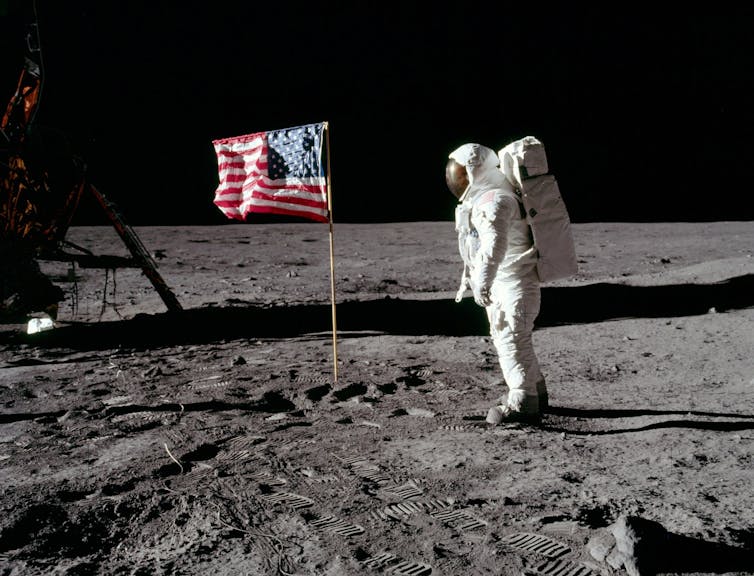
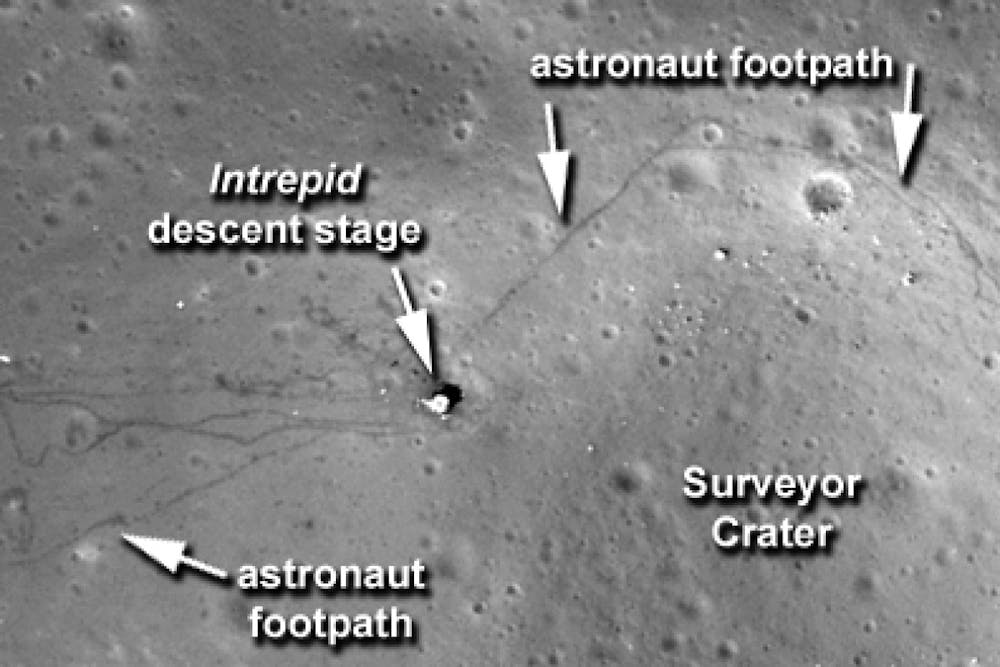
It’s hard to care about bootprints sunk in soil 238,900 miles away as humanity suffers the combined burden of an unforgiving virus and a political unease. But how humans treat those bootprints and the historic lunar landing sites upon which they are found will speak volumes about who we humans are and who we seek to become.
On Dec. 31, the One Small Step to Protect Human Heritage in Space Act became law. As far as laws go, it’s pretty benign. It requires companies that are working with the National Aeronautics and Space Administration on lunar missions to agree to be bound by otherwise unenforceable guidelines intended to protect American landing sites on the Moon. That’s a pretty small pool of affected entities. However, it is also the first law enacted by any nation that recognizes the existence of human heritage in outer space. That’s important because it reaffirms our human commitment to protecting our history – as we do on Earth with sites like the Historic Sanctuary of Machu Picchu, which is protected through instruments like the World Heritage Convention – while also acknowledging that the human species is expanding into space.
I am a lawyer who focuses on space issues that seek to ensure the peaceful and sustainable exploration and use of space. I believe that people can achieve world peace through space. To do so, we must recognize landing sites on the Moon and other celestial bodies as the universal human achievements they are, built on the research and dreams of scientists and engineers spanning centuries on this globe. I believe that the One Small Step Act, enacted in a divisive political environment, demonstrates that space and preservation truly are nonpartisan, even unifying principles.

The Moon is getting crowded, fast
It is only a matter of decades, perhaps just years, before we see a continuous human presence on the Moon.
While it would be nice to think that a human community on the Moon would be a collaborative, multinational utopia – albeit located in what Buzz Aldrin famously described as a “magnificent desolation” – the fact is people are once again racing one another to reach our lunar neighbor.
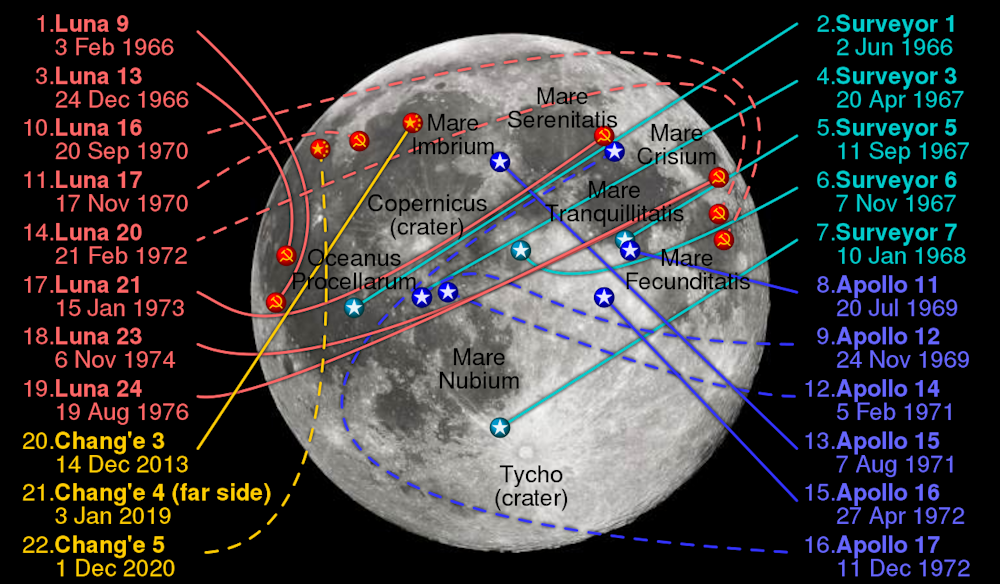
The U.S. Artemis project, which includes a goal of sending the first woman to the Moon in 2024, is the most ambitious mission. Russia has reinvigorated its Luna program, setting the stage to put cosmonauts on the Moon in the 2030s. However, in a race once reserved for superpowers, there are now multiple nations and multiple private companies with a stake.
India is planning to send a rover to the Moon this year. China, which in December implemented the first successful lunar return mission since 1976, has announced multiple lunar landings in the coming years, with Chinese media reporting plans for a crewed mission to the Moon within the decade. South Korea and Japan are also building lunar landers and probes.
Such private companies as Astrobotic, Masten Space Systems and Intuitive Machines are working to support NASA missions. Other companies, such as ispace, Blue Moon and SpaceX, while also supporting NASA missions, are preparing to offer private missions, including for tourism. How are all these different entities going to work around one another?
Space is not lawless. The 1967 Outer Space Treaty, now ratified by 110 nations, including all of the current spacefaring countries, offers guiding principles supporting the concept of space as the province of all humankind. The treaty explicitly indicates that all countries and, by implication, their nationals have the freedom to explore and free access to all areas of the Moon.
That’s right. Everyone has the freedom to roam wherever they want – over Neil Armstrong’s bootprint, close to sensitive scientific experiments or right up to a mining operation. There is no concept of property on the Moon. The only restriction on this freedom is the remonstration, found in Article IX of the treaty, that all activities on the Moon must be carried out with “due regard to the corresponding interests of” all others and the requirement that you consult with others if you might cause “harmful interference.”
What does that mean? From a legal standpoint, no one knows.
Outstanding universal value
It can reasonably be argued that interfering with an experiment or a lunar mining operation would be harmful, cause quantifiable damage and thus violate the treaty.
But what about a derelict spacecraft, like the Eagle, the Apollo 11 lunar lander? Do we really want to rely on “due regard” to prevent the intentional or inadvertent destruction of this inspiring piece of history? This object memorializes the work of the hundreds of thousands of individuals who worked to put a human on the Moon, the astronauts and cosmonauts who gave their lives in this quest to reach the stars, and the quiet heroes, like Katherine Johnson, who fueled the math that made it so.
The lunar landing sites – from Luna 2, the first human made object to impact the Moon, to each of the crewed Apollo missions, to Chang-e 4, which deployed the first rover on the far side of the Moon – in particular bear witness to humanity’s greatest technological achievement thus far. They symbolize all we have accomplished as a species, and hold such promise for the future.
[Deep knowledge, daily. Sign up for The Conversation’s newsletter.]
The One Small Step Act is true to its name. It’s a small step. It applies only to companies that are working with NASA; it pertains only to U.S. lunar landing sites; it implements outdated and untested recommendations to protect historic lunar sites implemented by NASA in 2011. However, it offers significant breakthroughs. It is the first legislation from any nation to recognize an off-Earth site as having “outstanding universal value” to humanity, language taken from the unanimously ratified World Heritage Convention.
The act also encourages the development of best practices to protect human heritage in space by evolving the concepts of due regard and harmful interference – an evolution that will also guide how nations and companies work around one another. As small a step as it may be, recognizing and protecting historic sites is the first step to developing a peaceful, sustainable and successful lunar governance model.
The bootprints are not protected – yet. There is a long way to go toward an enforceable multilateral/universal agreement to manage the protection, preservation or memorialization of all human heritage in space, but the One Small Step law should give us all hope for the future in space and here on Earth.
Michelle L.D. Hanlon, Professor of Air and Space Law, University of Mississippi
This article is republished from The Conversation under a Creative Commons license. Read the original article.
David Leonard Surak, 61, of Williams died in the crash, according to Lt. Corey Paulich of the Lake County Sheriff’s Office.
California Highway Patrol Officer Joel Skeen told Lake County News that the crash occurred at 4:36 p.m. Wednesday on Highway 20 near mile post marker 21.10, east of Lucerne.
Skeen said Surak was driving a Ford Focus sedan westbound on Highway 20.
Surak’s Ford Focus crossed over the double yellow lines and collided head-on with a Ford Escape SUV, Skeen said.
Radio reports from the scene stated that the crash happened on a blind curve and blocked both lanes of the highway. Traffic was backed up as firefighters worked to care for patients at the scene.
Skeen said Surak was transported to Adventist Health Clear Lake Hospital in Clearlake where he succumbed to his injuries and was pronounced deceased.
The driver and passenger of the Ford Escape SUV sustained moderate injuries and were transported to a local hospital for treatment, Skeen said.
Skeen said it’s not yet known if alcohol and/or drugs are factors that affected Surak.
Email Elizabeth Larson at