 How to resolve AdBlock issue?
News
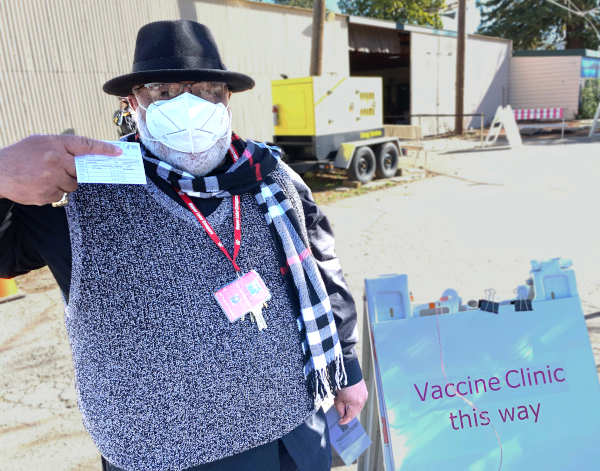
LAKE COUNTY, Calif. – Lake County school employees began receiving COVID-19 vaccinations this week.
“I wish to thank Public Health staff for their engagement and leadership. Based on our current planning we expect to have all interested Lake County school staff vaccinated by mid-February,” said Superintendent of Schools Brock Falkenberg.
Phase 1b in Lake County includes people 65 and older and workers in education. Teachers and school staff who have contact with students will be prioritized.
Over the last three weeks, the Office of Education has coordinated with the school districts to focus on vaccination planning.
Konocti Unified School District Superintendent Becky Salato said for her staff that have chosen to receive the vaccine there is an additional sense of security and safety as they work towards balancing what they want to do, and what they can do safely.
“As superintendent, I am very hopeful that the vaccines will help us get our students back in school safely and soon. I think for all of us, the vaccine brings hope that we are closer to returning to some new form of normal,” Salato said.
Reggie Gee, a special education teacher from Upper Lake Unified School District, said he does not normally get sick or get the flu vaccination, but receiving the COVID-19 vaccine was important to him.
“I think it is important for two reasons. One is to set an example for the staff and the students I work with. The other is for safety,” Gee said.
A paraeducator from Lakeport Unified School District, Angeles Espinoza, said getting the vaccine did not hurt at all and was an easy process to go through.
“Getting the vaccine and creating a herd of immunity is important to stopping the spread of COVID,” Espinoza said. “It is also important to spread awareness about the vaccine and create trust in the community about getting vaccinated.”
According to Lake County Public Health, COVID-19 activity is more widespread than it has ever been in Lake County and they ask to please take extra precautions.
This includes the Three Ws:
· Wear a mask.
· Wash your hands.
· Watch your distance.
These are all important strategies to protect against community spread.
“Getting our students safely back into schools is one of our top priorities,” Falkenberg said.
To learn more about the Lake County Office of Education, visit www.lakecoe.org.
In 2007, the United States Senate ratified the resolution establishing Jan. 11 as National Human Trafficking Awareness Day.
President Barack Obama first declared January as National Slavery and Human Trafficking Prevention Month in 2010.
Since then, January has been a time to acknowledge those experiencing enslavement and those who have escaped.
During the month of January, Lake Family Resource Center will be sharing educational social media posts. Visit its Facebook page for more information.
The best action you can take to help expand awareness in our community is to learn what human trafficking is and how to spot the signs of trafficking.
Human trafficking is one of the fastest-growing illegal industries in the world. It involves the use of force, fraud or coercion to obtain some type of labor or commercial sex act.
Every year, millions of men, women and children are trafficked worldwide – including right here in the United States.
It can happen in any community and victims can be any age, race, gender or nationality.
Traffickers use violence, manipulation or false promises of well-paying jobs or romantic relationships to lure victims into trafficking situations.
Globally, human trafficking produces roughly $150 billion a year in profits for traffickers, $99 billion of which comes from commercial sexual exploitation.
An estimated 71 percent of enslaved people are women and girls, while men and boys account for 29 percent. The average age of recruitment into the sex trade, is 12 to 14 years old.
Commercial sexual exploitation of children, or CSEC, is a commercial transaction that involves the sexual exploitation of a child, such as the sale of children for sex acts, pornography, including live streaming sexual abuse.
Additionally, CSEC involves coercion and violence against children, economic exploitation, forced labor, and contemporary slavery.
Due to unstable living environments, foster youth and runaways are one of the most vulnerable populations for recruitment.
Human trafficking is often a crime that is hidden in plain sight. It is important to be aware of warning signs.
Some indications that a person may be a victim of human trafficking include appearing malnourished, tattoos/ branding on the neck and/or chest, avoiding eye contact and interaction with authority figures/law enforcement, possessing large sums of cash, hotel keys or are often unaware of their location.
Commonly, victims will show signs of physical injuries and abuse, as well as having long term untreated sexually transmitted diseases.
When interacting with victims, their responses will seem scripted or rehearsed. Often, victims are not allowed to speak for themselves and have been stripped of identification documents.
Accepting this terrible crime exists, understanding what human trafficking is, knowing how to recognize the signs, and knowing who to call for assistance, is crucial in reducing the number of victims.
Lake Family Resource Center’s Human Trafficking Program offers free and confidential services including a 24/7 Community Crisis Line (1-888-485-7733) answered by trained advocates.
The Human Trafficking Program also provides individual counseling, support, safety plans, education, hospital accompaniment, law enforcement advocacy and court advocacy.
During the COVID-19 pandemic, our crisis line is a vitally important way for survivors and others impacted by violence to access support and safety when it is not possible to meet face-to-face.,
Lake Family Resource Center works closely with our community partners such as law enforcement and hospitals to provide the best services available.
Lake Family Resource Center provides a multitude of services to build family stability and strength.
The agency supports Lake County residents in achieving stable, self-sufficient and healthy families and communities.
Call 707-279-0563 today to find out more about what we offer and how you can help.
Kara Roberts is Lake Family Resource Center’s Human Trafficking Program coordinator.

LAKE COUNTY, Calif. – The Bureau of Land Management Ukiah Field Office invites the public to the Berryessa Snow Mountain National Monument’s BLM Trails and Travel Management Workshop on Thursday, Jan. 28, from 5:30 to 8 p.m.
This virtual workshop will provide an overview of the BLM travel management process, which is scheduled to begin later in 2021, and invite participants to provide comment.
The BLM and Mendocino National Forest co-manage the Berryessa Snow Mountain National Monument and believe partnerships and inclusion are vital to managing sustainable, working public lands.
This workshop and associated planning efforts are specific to travel management within public lands administered by the BLM within the monument.
The BLM Trails and Travel Management Workshop is designed to engage stakeholders and members of the public on the vision for travel management at the Berryessa Snow Mountain National Monument.
The plan will be important for designating a wide variety of roads and trails for motorized, non-motorized and non-mechanized recreational opportunities.
The BLM will use an online map and survey tools, provide an overview of roads and trails within the monument, detail the current status of travel management, present an overview of the BLM travel management process, and offer opportunities to provide input.
To access the workshop, please register at https://register.gotowebinar.com/register/1478865541170293776 or by clicking the link below at least 30 minutes prior to the event: “Berryessa Snow Mountain National Monument’s BLM Trails and Travel Management Workshop.”
A second BLM Trails and Travel Management Workshop will be announced at a later date.
For more information on the workshop, please contact Rebecca Carr Wong at 707-468-4023 or

A fast-spreading variant of the coronavirus that causes COVID-19 has been found in at least 20 states, and people are wondering: How do I protect myself now?
We saw what the new variant, known as B.1.1.7, can do as it spread quickly through southeastern England in December, causing case numbers to spike and triggering stricter lockdown measures.
The new variant has been estimated to be 50% more easily transmitted than common variants, though it appears to affect people’s health in the same way. The increased transmissibility is believed to arise from a change in the virus’s spike protein that can allow the virus to more easily enter cells. These and other studies on the new variant were released before peer review to share their findings quickly.
Additionally, there is some evidence that patients infected with the new B.1.1.7 variant may have a higher viral load. That means they may expel more virus-containing particles when they breathe, talk or sneeze.
As professors who study fluid dynamics and aerosols, we investigate how airborne particles carrying viruses spread. There is still a lot that scientists and doctors don’t know about the coronavirus and its mutations, but there are some clear strategies people can use to protect themselves.
Airborne particles are still the biggest problem
The SARS-CoV-2 variants are believed to spread primarily through the air rather than on surfaces.
When someone with the coronavirus in their respiratory tract coughs, talks, sings or even just breathes, infectious respiratory droplets can be expelled into the air. These droplets are tiny, predominantly in the range of 1-100 micrometers. For comparison, a human hair is about 70 micrometers in diameter.
The larger droplets fall to the ground quickly, rarely traveling farther than 6 feet from the source. The bigger problem for disease transmission is the tiniest droplets – those less than 10 micrometers in diameter – which can remain suspended in the air as aerosols for hours at a time.
With people possibly having more virus in their bodies and the virus being more infectious, everyone should take extra care and precautions. Wearing face masks and social distancing are essential.
Spaces and activities that were previously deemed “safe,” such as some indoor work environments, may present an elevated infection risk as the variant spreads.
The concentration of aerosol particles is usually highest right next to the individual emitting the particles and decreases with distance from the source. However, in indoor environments, aerosol concentration levels can quickly build up, similar to how cigarette smoke accumulates within enclosed spaces. This is particularly problematic in spaces that have poor ventilation.
With the new variant, aerosol concentration levels that might not have previously posed a risk could now lead to infection.
What can you do to stay safe?
1) Pay attention to the type of face mask you use, and how it fits.
Most off-the-shelf face coverings are not 100% effective at preventing droplet emission. With the new variant spreading more easily and likely infectious at lower concentrations, it’s important to select coverings with materials that are most effective at stopping droplet spread.
When available, N95 and surgical masks consistently perform the best. Otherwise, face coverings that use multiple layers of material are preferable. Ideally, the material should be a tight weave. High thread count cotton sheets are an example. Proper fit is also crucial, as gaps around the nose and mouth can decrease the effectiveness by 50%.
2) Follow social distancing guidelines.
While the current social distancing guidelines are not perfect – 6 feet isn’t always enough – they do offer a useful starting point. Because aerosol concentrations levels and infectivity are highest in the space immediately surrounding anyone with the virus, increasing physical distancing can help reduce risk. Remember that people are infectious before they start showing symptoms, and they many never show symptoms, so don’t count on seeing signs of illness.
3) Think carefully about the environment when entering an enclosed area, both the ventilation and how people interact.
Limiting the size of gatherings helps reduce the potential for exposure. Controlling indoor environments in other ways can also be a highly effective strategy for reducing risk. This includes increasing ventilation rates to bring in fresh air and filtering existing air to dilute aerosol concentrations.
On a personal level, it is helpful to pay attention to the types of interactions that are taking place. For example, many individuals shouting can create a higher risk than one individual speaking. In all cases, it’s important to minimize the amount of time spent indoors with others.
The CDC has warned that B.1.1.7 could become the dominant SARS-CoV-2 variant in the U.S. by March. Other fast-spreading variants have also been found in Brazil and South Africa. Increased vigilance and complying with health guidelines should continue to be of highest priority.
[Deep knowledge, daily. Sign up for The Conversation’s newsletter.]
This story was updated Jan. 18 with latest CDC count and map showing B.1.1.7 cases now found in 20 states.
Suresh Dhaniyala, Bayard D. Clarkson Distinguished Professor of Mechanical and Aeronautical Engineering, Clarkson University and Byron Erath, Associate Professor of Mechanical Engineering, Clarkson University
This article is republished from The Conversation under a Creative Commons license. Read the original article.
That’s what Public Health Officer Dr. Gary Pace told the Board of Supervisors during a special Tuesday morning meeting and the Lakeport City Council at its Tuesday evening meeting.
On Tuesday, Lake County’s COVID-19 cases had risen to 2,612 – nearly 200 new cases since Friday – with two new deaths reported, bringing total deaths to 30.
Pace said Lake County is continuing to have widespread transmission of the virus.
“There's so much virus out in the community right now that you will be in contact with it if you're out and about,” he told the council.
Last week, Lake County recorded the highest new case numbers than it ever has, and this week it’s on pace to do the same, he said.
Public Health records showed that, on Tuesday, the cases had risen by 356 over the previous week.
Both of the county’s hospitals are pretty full, with the eight local intensive care unit beds mostly filled with COVID-19 patients, Pace reported.
Pace noted that, overall, the state’s case and hospitalization numbers are starting to flatten out, with the case surge following Christmas and New Year’s not turning out to be as bad as previously thought.
However, in Lake County, the surge isn’t yet flattening out, although Pace expects to turn the corner in the next week or two.
“Certainly we are often lagging a little behind the rest of California because of our rural nature,” Pace told the council.
He told both the board and the council that Lake County currently is in the most challenging part of the pandemic. Over the next two to three weeks he expects to see the results of the surge include more hospitalizations, which usually follow case increases by a few weeks.
As case numbers continue to rise and vaccinations are still rolling out, Pace encouraged people to continue to lay low and have as little public contact as possible.
Emphasis on vaccinations
In his appearances before the county and city leaders, Pace focused most on the process of rolling out the vaccinations.
Since Lake County received its initial doses of vaccines a month ago, Pace said between 1,500 and 2,000 people have been vaccinated. He said Public Health plans to soon start reporting on vaccination numbers.
Pace said the county currently is getting, at most, about 400 doses of vaccine a week and is focusing on administering those doses before receiving the next shipment.
He said the vaccine supply is extremely limited. While thousands of local residents want it – he said his email inbox is full of messages every day from people seeking to get the vaccine – Public Health is not receiving enough to meet the demand.
Based on the current supply – which the state is providing to the county based on an algorithm – Pace estimated it could take until the end of 2022 to vaccinate half of Lake County’s population, which tops 64,000.
He said there is a lot of frustration in the community because of the speed of vaccinations. “I don’t blame people. It’s very frustrating for me, too.”
The two hospitals and Lake County Tribal Health are getting separate supplies of the vaccine. “Nobody’s getting nearly enough to do what they need to do,” he said.
Pharmacies are supposed to be getting their own doses soon as well, Pace said.
The county recently received a shipment of 400 doses of the Moderna vaccine. Before it could open the shipment, Pace said the state notified the county not to use those doses as they are concerned that they are from a batch that is connected to allergic reactions.
Meantime, the state is trying to figure out what to do with that suspect batch. “So at this point we're just holding on to it,” with no replacement doses for it yet, Pace said.
Based on state guidelines, Pace said Public Health focused its initial efforts on vaccinating health care workers. It’s now focusing on those aged 65 and above, and teachers and school staff so schools can reopen.
Pace said the best way for seniors to get in line for the vaccine is to contact their medical providers. Public Health also had asked senior centers to do outreach to vulnerable seniors. The centers, in turn, have been overwhelmed with calls from people wanting to be vaccinated.
He told the supervisors that the vaccine rollout is complicated, frustrating “and very imperfect,” adding he didn’t have a good solution for it yet.
Later, he told the council that the rollout has been “very chaotic,” and the situation isn’t yet under control.
He said the state may be changing its guidelines for distributions in the coming weeks and loosening up its vaccine release.
Lakeport City Councilman Michael Froio noted that, two months ago, pharmaceutical companies said they would be putting out enough of the vaccine. He asked Pace where the logjam was.
“That is the million dollar question right now,” said Pace.
The state is saying it doesn’t have enough of the vaccine. “If you look around the country everyone is having the same problem,” Pace added.
Earlier this week, it was reported that there is no federal vaccine stockpile as the federal government had told governors.
Froio asked Pace if Public Health is holding back enough vaccine for the second doses, and Pace said yes, adding that the state is considering changing its guidelines to push out more initial doses rather than holding the second doses in reserve.
Looking ahead
Pace said Public Health is currently doing stand up clinics for the seniors and teachers who have been given appointments through their current process. The clinics are running six days a week – three in Clearlake, three in Lakeport.
They’re also looking at getting some mobile vaccination sites to go to employers or agricultural workers. However, he said they don’t yet have the staff to do that.
“That’s ultimately where we hope to go with this,” he said.
Once they get more vaccine doses, Pace said Public Health will do mass vaccination clinics such as has been done for flu shots through events like the Heroes of Health and Safety Fair.
While Pace hopes the vaccine supply will soon open up significantly, he said state officials are “not really telling us” if and when that will happen.
“This is going to be a big, long term rollout, I think, over months, and we’ll need a lot of people and a lot of coordination to get these pieces in place in a good way,” he told the supervisors.
Email Elizabeth Larson at
The action to authorize the temporary reduction of county services to the public will potentially take the county back to how it operated in the initial months of the pandemic last year, and follows the board’s decision on Jan. 5 to temporarily close its chambers to the public.
Prior to the discussion on Tuesday, Public Health Officer Dr. Gary Pace told the board that last week saw the largest number of new COVID-19 cases to date, with this week on track to do the same.
The numbers posted by Public Health showed that COVID-19 cases totaled 2,612 on Tuesday, up by 356 cases over the previous week.
In her written report, County Administrative Officer Carol Huchingson, also noted “dramatically” worsening pandemic conditions in recent weeks, “with an increasing number of COVID-19 positive cases impacting the County workforce.”
On Tuesday, Huchingson reviewed the board’s action on Jan. 5 to create an ad hoc committee to work with department heads in the efforts to comply with the county’s COVID-19 Public Health Emergency - Worksite Protection Protocol.
Supervisors Tina Scott and Moke Simon were appointed to represent the board on the committee.
Huchingson said the committee has met several times. “We were a bit surprised by the discussion,” she said, adding they were appreciative of the department heads for their candor.
Department heads told county leadership that they support rolling back in-person services right now in favor of pivoting back to how they operated in the spring, when many services were provided without in-person contact, she said.
The resolution directs department heads to immediately replicate steps taken during the earlier closure of county offices “by temporarily providing for service delivery to the public without in-person contact except in situations where in-person contact is unavoidable due to court obligations and state law requirements, or where limited in-person contact is necessary for purposes of service of process, recordation of property-related documents, and/or providing fiscal services to public entities and independent special districts.”
When in-person contact is unavoidable, the resolution directs department heads to ensure full compliance with all provisions of the COVID-19 Worksite Protection Protocol.
Department heads also need to determine how best to provide limited access to allow those functions, notify the public by posting signage at the departmental office as to the method in which services will be delivered and the limited circumstances in which in-person
contact will be permitted.
The resolution also directs department heads to support remote work assignments for county employees to the greatest extent possible, gives them the continuing authority to define essential and non-essential workers and said they shall direct nonessential workers to shelter in place or provide remote work assignments when possible.
The board will review the resolution at least once every 30 days “until pandemic conditions improve to the extent that regular service delivery can be resumed.”
Scott said they didn’t want to wait another Tuesday to bring the matter to the board because of their concerns for the workforce.
“If COVID goes through one of our departments, then that department gets completely shut down,” she said, adding that they want to provide services while keeping staff safe.
“Protecting our workforce should be No. 1 for us,” said Simon.
He said they heard from department heads about their concerns as well as wanting to continue to serve the community as much as possible.
Simon said they have had cases of COVID-19 in departments and, like Scott, pointed out that an entire department could be shut down because of the virus.
Board Chair Bruno Sabatier said he had conflicts over the proposal.
“We are not leading with the best of examples for everyone to follow,” he said, explaining that he doesn’t see county departments doing exactly what local businesses are being asked to do.
“We need to step up our game,” he said. “We need to set the rules and set the tone.”
He also was concerned that some members of the public might not have access to the necessary technology to meet virtually with county staff.
Simon said the topic of tightening up protocols and having the county set an example was a topic of discussion with department heads.
Scott De Leon, who heads Community Development, Public Works and Water Resources, said all three of those departments work with the public a lot and he realizes the inconvenience.
On Jan. 8, he said the line of people who came to the courthouse to speak to Community Development staff at the county extended way down the hallway. “Frankly, it’s very disturbing to see that.”
De Leon said they have made dropboxes available, staff is working on FAQs for the website, they are planning to add cameras for every workstation so staff can have virtual consultations with the public and they are going to implement electronic building applications.
“We’re already working towards making it as efficient as we possibly can,” he said, adding, “We’ve encouraged working from home as much as possible.”
De Leon said some building inspectors will probably be working remotely soon as well.
Assessor-Record Richard Ford said his staffers already are doing telework, they have a dropbox outside of their office and they make appointments with title companies to come in and do recording work. He said they plan to improve their previous logistics.
The board ultimately approved the resolution 5-0.
Date to resume Friday office hours to public may be pushed back
In November, the board had directed staff to phase out a temporary policy instituted in 2018 that closed county offices to the public on Fridays. The board wanted a soft reopening to start in January, with offices to be reopened on Fridays by April 1.
However, considering the current circumstances, Sabatier asked Huchingson to put the matter back before the board for further discussion.
Sabatier said by having closed the board chambers and reducing in-person services, the county is sending conflicting messages and contradicting safety protocols by still moving forward with its previous plans for the Friday reopening.
Rather than saying the transition back to full Friday openings needs to be done by March 31, he suggested a compromise to say that the process won’t start until that date, with the board to review progress in the coming months.
“I’m in complete agreement right now,” said Simon.
Ford told the board his department will probably continue with its soft opening plans as Fridays tend to have far less traffic than the rest of the week.
Huchingson suggested having the ad hoc committee discuss the reopening with department heads next week and then come back to the board with a resolution to fit the situation better.
The board agreed and reached consensus to pursue that suggestion.
In other business on Tuesday, the board approved updates to the county’s COVID-19 Return to Work Protocol including aligning the county’s policy with Cal OSHA Emergency Temporary Standards, and also adding new information regarding testing, training, handling multiple infections and outbreaks, exclusion of COVID-19 cases investigation of workplace COVID-19 cases, correction of hazards and OSHA FAQs, and a requirement for department heads to certify their compliance and post it with update certificates.
At Sabatier’s request, the board also took up an additional item regarding state Senate Bill 74, the Keep California Working Act, which would provide another $2.6 billion in grants for businesses.
The board voted to give the bill its support and to ask the two cities to sign on and provide a united front.
Email Elizabeth Larson at