 How to resolve AdBlock issue?
News
The following cats at the shelter have been cleared for adoption.
Call Lake County Animal Care and Control at 707-263-0278 or visit the shelter online at http://www.co.lake.ca.us/Government/Directory/Animal_Care_And_Control.htm for information on visiting or adopting.

‘Scamp’
“Scamp” is a senior male domestic short hair cat with gold eyes.
He has been neutered.
Scamp is in cat room kennel No. 135, ID No. 14280.

‘Bam-Bam’
“Bam-Bam” is a male domestic medium hair kitten with a gray tabby and black coat and green eyes.
He has been neutered.
He’s in cat room kennel No. 66, ID No. 14233.

‘Gremlin’
“Gremlin” is a young male domestic medium hair cat with a gray and torbie coat and green eyes.
He’s in cat room kennel No. 36, ID No. 14283.
Email Elizabeth Larson at
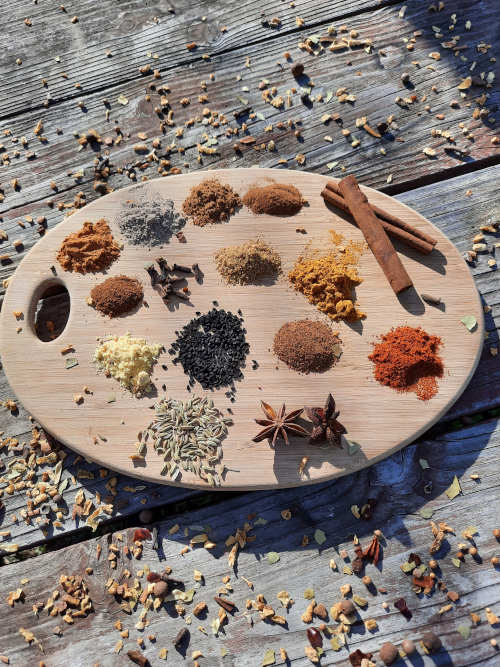
LAKE COUNTY, Calif. – It’s hard to believe that the stuff of spices – bits of bark, roots, and seeds – inspired war, but they did.
Such flavorings were the source of bloody battles fought hundreds of years ago by Europeans for control of the lands where they grew. Command of this lucrative trade went back and forth over the centuries.
Frank Herbert wrote in his novel Dune, “He who controls the spice controls the universe.” Perhaps he received inspiration from the spice wars of long ago.
One thing is certain – spices infuse passion into the foods we eat, propelling our taste buds into song, both strong and subtle.
In addition to enhancing flavor, numbers of spices are known to have health-boosting properties. For example, studies have shown that cinnamon lowers blood pressure, turmeric fights inflammation, ginger relieves nausea, garlic benefits the heart, and cayenne pepper eases pain.
But what makes an herb an herb and a spice a spice?
It depends on the part of the plant used.
Herbs are the edible leaves or stems of plants, and spices are their dried seeds, pods, buds, roots, fruits or bark.
Online encyclopedia Wikipedia adds the phrase “vegetative substance” to their definition of spice, and truly spices are composed of a wide variety of plant components.
Let’s look at a few examples to prove this point.
Ginger is a rhizome and turmeric a root. Mustard, fennel, caraway, fenugreek and cumin are seeds.
Cloves are dried buds, chili peppers are fruits, and cardamom and star anise are seed pods. Cinnamon is bark, and nutmeg is the kernel of a fruit, with mace being its lacy covering.
Black pepper and pink peppercorns are both dried berries but are not related to each other.
I’m extremely grateful for the people long ago who decided to taste bark, roots, seeds and the like so that the generations of humankind who followed them could eat their meals with blissful flavor.
Some plants bless us with both herbs and spices.
For example, dill weed is an herb since it’s composed of the leaves of the dill plant, while dill seed used in pickling or to flavor some rye bread is a spice.
Cilantro (also known as coriander or Chinese parsley) is another example. When we use the leaves and stems, it’s considered an herb, while whole or ground coriander seeds are a spice.
Some spices, though not many, are known as being “hot” because of chemicals they contain. Capsaicin in chili peppers and piperine in black pepper berries irritate the tissues of our mouth, giving us the burning sensation that we refer to as “hot” or “spicy.”
It’s estimated that spices have been used to enhance foods since about 50,000 B.C., with local spice trading developing as early as 2,000 B.C.
In the Middle East, such trading was centered on cinnamon and pepper, and in East Asia, herbs and pepper. Ancient Egyptians used spices in embalming, and their need for them encouraged broad trade.
During the middle ages in Europe, spices were among the most expensive and sought-after products. While some spices of this era – grains of paradise, spikenard and galangal, for example – have gone out of fashion, others, like black pepper, cinnamon, nutmeg, cumin and cloves, are still in popular use today.
Today our spice shelves are easily stocked. We have a wide variety of herbs and spices at our fingertips, and, with little effort, more exotic spices are available.
In recent months I ordered a berbere spice blend and nigella seeds online, and presto – I have ingredients for Ethiopian dishes.
I love broadening my spice horizons by going to specialty shops that carry little-known flavors from around the world. I get excited learning while I browse.
Sometimes it’s tough not to bring something home.
Past acquisitions include such things as mahlab from Turkey, used to add a sweet-sour, nutty taste to sweet breads and desserts; charnushka from India, tiny black seeds that top rye bread or flavor sausages; and ground Mediterranean sumac berries, popular as a tabletop condiment in that region, which add fruity sourness and a soft red color to foods.
Ground spices deteriorate far more quickly than those in whole form. About six months is the average “flavor life” of a ground spice, while whole spice holds its flavor for up to two years.
Whole spice may be ground just before use in a spice grinder or dedicated coffee grinder. For smaller batches, a fine grater may be used. (My favorite is a rasp-style zester, such as the one made by Microplane.)
An old school method of grinding spices is crushing them via a mortar and pestle. Since this method has come into vogue in recent years, a well-stocked kitchen store will have a few different styles of this ancient implement from which to choose.
Some spices, like nutmeg, don’t lend themselves to grinding whole and will always need to be grated; however, it goes quickly and is easily done.
Toasting whole spices in a dry skillet just before grinding intensifies their flavor and, as an added bonus, makes your kitchen smell absolutely heavenly.
As to storage, keep dried herbs and spices in tightly closed containers in a relatively cool, dark, dry place. Humidity, heat, and light are their flavor enemies.
Spice blends have evolved in different areas of the world depending on what was grown or traded there, giving each region its own unique flavor profile.
In the African counties of Ethiopia and Eritrea, for example, superhot spice blend berbere is used to flavor dishes. It can be a powder or a puree, and is a blend of fenugreek, cardamom, lots of hot cayenne pepper, and an array of optional ingredients. (To tone down the heat, paprika can be substituted for much of the cayenne.)
Ras el hanout is an exotic spice blend from Morocco. It’s sweet and spicy-hot, containing up to as many as 50 flavors, including some rare items not found at the local grocery. Floral notes can come from such ingredients as dried rosebuds and aniseed.
The Indian spice blend we’re most familiar with here is curry, despite the fact that premade curry powder is nonexistent in that country, being an invention of the west.
Instead, Indian cooks make their own blends for each recipe, grinding small batches frequently.
Garam masala, a standard Indian spice blend, is the inspiration for our curry powder; however, it’s made without the yellow color supplied by turmeric and nutty flavor from fenugreek in our versions of the blend.
It’s a somewhat sweet mixture containing coriander, ginger, cardamom, cloves and cinnamon. Other spices are blended in according to the cook’s taste and whim.
A favorite spice blend of mine is Chinese five spice, which contains star anise, cinnamon, cloves, fennel and black pepper. It adds a sweet-spicy-savory note to dishes and is featured in today’s recipe, a couscous salad I created some years ago to demonstrate the use of Lake County ingredients at a local event.
The ingredients marry warm winter flavors with fresh elements that are reminiscent of summer.
I hope your new year is full of spice, both literal and figurative!
Easy Minted Couscous Salad with Lake County Pears and Walnuts
1 cup couscous
1 cup apple juice plus ¼ cup water
½ tsp Chinese Five Spice blend
To cook couscous, bring apple juice and water to a boil in a medium pot; add the Chinese Five Spice and blend in. Turn off heat and add couscous. Cover and allow to sit for five minutes. Fluff with a fork.
Meanwhile, prepare the following ingredients for the salad:
½ cup diced dried Lake County pears (use fresh pears if dried are unavailable; sweet apples may also be substituted)
½ cup coarsely chopped toasted Lake County walnuts
½ cup diced red bell pepper
½ cup chopped fresh mint leaves
½ cup chopped fresh Italian parsley
¼ cup (or more, to taste) finely chopped scallions
Juice of one fresh lemon (Meyer lemons are recommended)
¼ cup Lake County extra virgin olive oil (a light and fruity variety recommended)
Blend non-liquid ingredients with couscous in a large bowl and stir to blend. Squeeze in lemon juice and add olive oil. Stir to blend and taste. Since lemons have varying amounts of acidity, more olive oil many need to be added to round out the lemony taste.
This should make enough salad for a generous side dish for four. Enjoy!
Recipe by Esther Oertel.
Esther Oertel is a writer and passionate home cook from a family of chefs. She grew up in a restaurant, where she began creating recipes from a young age. She’s taught culinary classes in a variety of venues in Lake County and previously wrote “The Veggie Girl” column for Lake County News. Most recently she’s taught culinary classes at Sur La Table in Santa Rosa. She lives in Middletown.
The meeting will take place at 4 p.m. Thursday, Jan. 21, via Zoom.
The meeting can be accessed at https://zoom.us/j/91777629308 or accessed at +1 669 900 9128. The webinar ID is 917 7762 9308.
The city of Lakeport is eligible to apply for Community Development Block Grant, CDBG, for Coronavirus Round 2 and 3 funding.
The purpose of the funds is to provide assistance for persons of low and moderate income affected by COVID-19.
City officials said they are seeking input on the best use of these funds.
There are specific guidelines to apply, but the city said potential uses could include rental assistance, public improvements, business loans for local businesses and more.
The community is encouraged to participate and share its feedback.
Email Elizabeth Larson at
Dogs available for adoption this week include mixes of Belgian Malinois, dachshund, husky, mastiff, pit bull and shepherd.
Dogs that are adopted from Lake County Animal Care and Control are either neutered or spayed, microchipped and, if old enough, given a rabies shot and county license before being released to their new owner. License fees do not apply to residents of the cities of Lakeport or Clearlake.
The following dogs at the Lake County Animal Care and Control shelter have been cleared for adoption (additional dogs on the animal control Web site not listed are still “on hold”).
Call Lake County Animal Care and Control at 707-263-0278 or visit the shelter online at http://www.co.lake.ca.us/Government/Directory/Animal_Care_And_Control.htm for information on visiting or adopting.
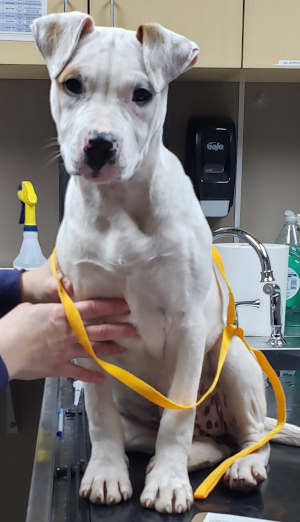
Pit bull puppy
This female pit bull terrier puppy has a short white and tan coat and floppy ears.
She is in kennel No. 9, ID No. 14279.

Male Belgian Malinois
This young male Belgian Malinois has a medium-length red and black coat.
He is in kennel No. 15, ID No. 14269.

‘Daisy’
“Daisy” is a senior female dachshund with a short black and tan coat.
She is in kennel No. 19, ID No. 14270.

Pit bull terrier-mastiff mix
This male pit bull terrier-mastiff mix has a short gray and brown coat.
He is in kennel No. 25, ID No. 14286.

Pit bull-mastiff mix
This male pit bull-mastiff mix has a short chocolat coat.
He is in kennel No. 26, ID No. 14287.

‘Amira’
“Amira” is a female husky mix with a medium-length black and white coat and blue eyes.
She is in kennel No. 31, ID No. 14277.

Male pit bull terrier
This male pit bull terrier has a short gray coat.
He has been neutered.
He is in kennel No. 32, ID No. 14271.
Email Elizabeth Larson at
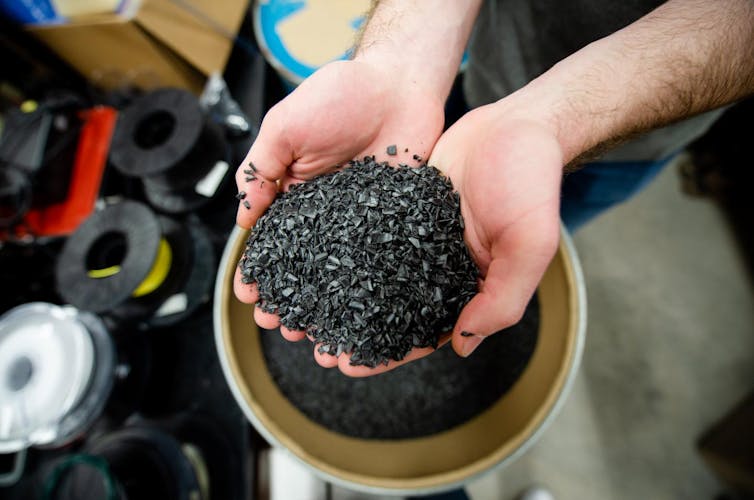
People will recycle if they can make money doing so. In places where cash is offered for cans and bottles, metal and glass recycling has been a great success. Sadly, the incentives have been weaker for recycling plastic. As of 2015, only 9% of plastic waste is recycled. The rest pollutes landfills or the environment.
But now, several technologies have matured that allow people to recycle waste plastic directly by 3D-printing it into valuable products, at a fraction of their normal cost. People are using their own recycled plastic to make decorations and gifts, home and garden products, accessories and shoes, toys and games, sporting goods and gadgets from millions of free designs. This approach is called distributed recycling and additive manufacturing, or DRAM for short.
As a professor of materials engineering at the forefront of this technology, I can explain – and offer some ideas for what you can do to take advantage of this trend.
How DRAM works
The DRAM method starts with plastic waste – everything from used packaging to broken products.
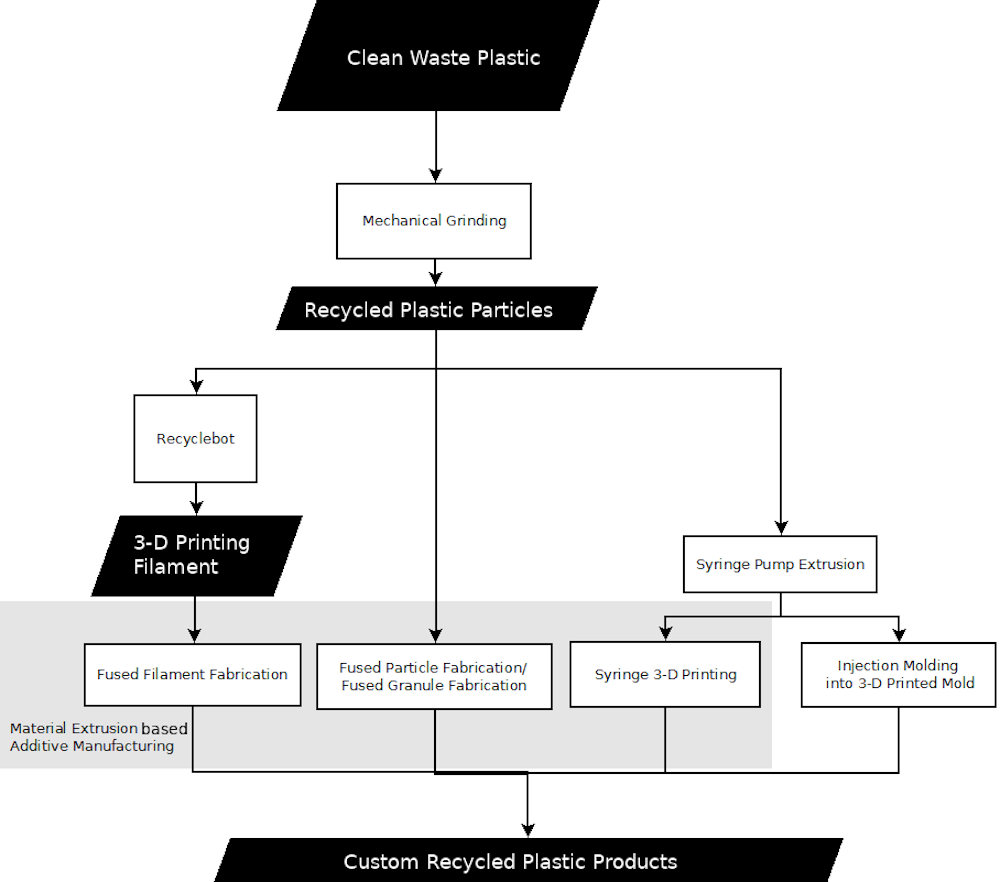
The first step is to sort and wash the plastic with soap and water or even run it through the dishwasher. Next, the plastic needs to be ground into particles. For small amounts, a cross-cut paper/CD shredder works fine. For larger amounts, open-source plans for an industrial waste plastic granulator are available online.
Next you have a few choices. You can convert the particles into 3D printer filament using a recyclebot, a device that turns ground plastic into the spaghetti-like filaments used by most low-cost 3D printers.
Filament made with a 3D-printable recyclebot is incredibly cheap, costing less than a nickel per pound as compared to commercial filament, which costs about US$10 per pound or more. With the pandemic interrupting global supply chains, making products at home from waste is even more appealing.
The second approach is newer: You can skip the step of making filament and use fused particle fabrication to directly 3D-print granulated waste plastic into products. This approach is most amenable to large products on larger printers, like the commercial open source GigabotX printer, but can also be used on desktop printers.
Granulated plastic waste can also be directly printed with a syringe printer, although this is less popular because print volume is limited by the need to reloading the syringe.
My research group, along with dozens of labs and companies throughout the world, has developed a wide array of open source products that enable DRAM, including shredders, recyclebots and both fused filament and fused particle 3D printers.
These devices have been shown to work not only with the two most popular 3D printing plastics, ABS and PLA, but also a long list of plastics you likely use every day, including PET water bottles. It is now possible to convert any plastic waste with a recycling symbol on it into valuable products.
Furthermore, an “ecoprinting” initiative in Australia has demonstrated DRAM can work in isolated communities with no recycling and no power by using solar-powered systems. This makes DRAM applicable anywhere humans live, waste plastic is abundant and the Sun shines – which is just about everywhere.
Toward a circular economy
Research has shown this approach to recycling and manufacturing is not only better for the environment, but it is also highly profitable for individual users making their own products, as well as for small- and medium-sized businesses. Making your own products from open source designs simply saves you money.
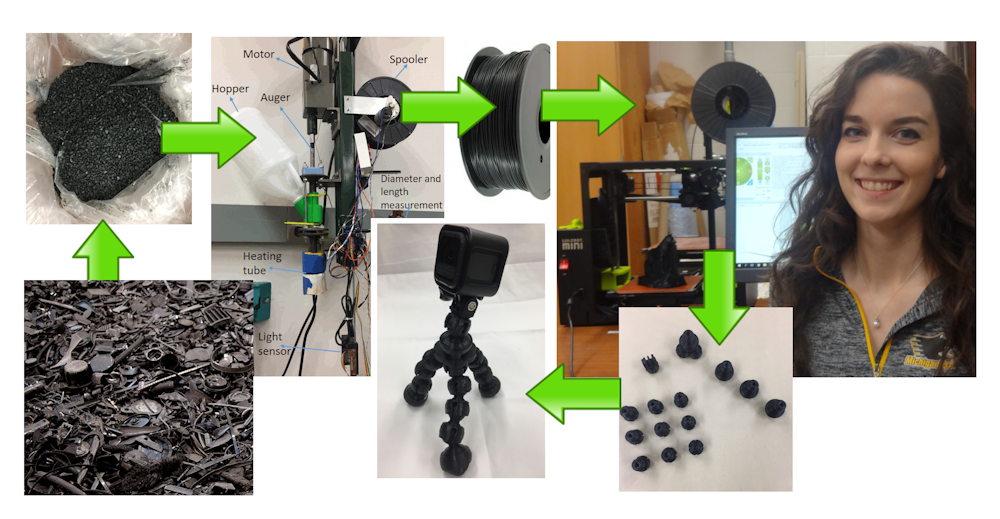
DRAM allows custom products to be made for less than the sales tax on conventional consumer products. Millions of free 3D-printable designs already exist – everything from learning aids for kids to household products to adaptive aids for arthritis sufferers. Prosumers are already 3D-printing these products, saving themselves collectively millions of dollars.
One study found MyMiniFactory users saved over $4 million in one month alone in 2017 just by making toys themselves, instead of purchasing them. Consumers can invest in a desktop 3D printer for around US$250 and earn a return on investment of over 100% by making their own products. The return on investment goes higher if they use recycled plastic. For example, using a recyclebot on waste computer plastic makes it possible to print 300 camera lens hoods for the same price as a single one on Amazon.
Individuals can also profit by 3D-printing for others. Thousands are offering their services in markets like Makexyz, 3D Hubs, Ponoko or Print a Thing.
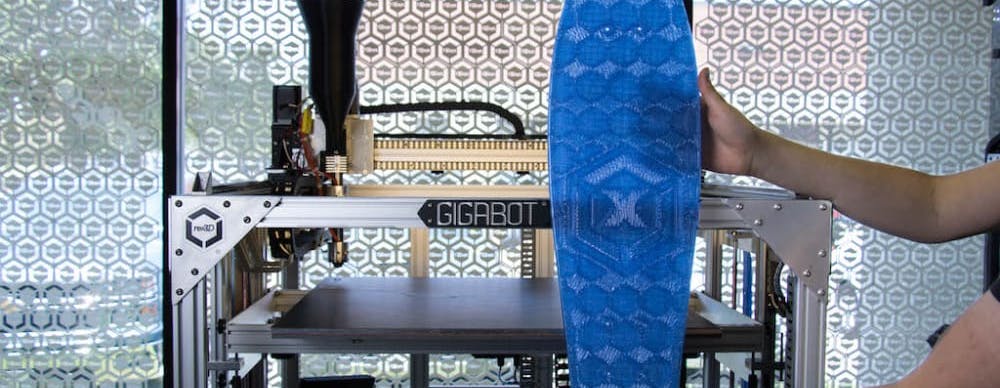
Small companies or fab labs can purchase industrial printers like the GigabotX and make high returns printing large sporting goods equipment like snowshoes, skateboard decks and kayak paddles from local waste.
Scaling up
Large companies that make plastic products already recycle their own waste. Now, with DRAM, households can too. If many people start recycling their own plastic, it will help prevent the negative impact that plastic is having on the environment. In this way DRAM may provide a path to a circular economy, but it will not be able to solve the plastic problem until it scales up with more users. Luckily we are already on our way.
3D printer filament is now listed in Amazon Basics along with other “everyday items,” which indicates plastic-based 3D printers are becoming mainstream. Most families still do not have an in-home 3D printer, let alone a reyclebot or GigabotX.
For DRAM to become a viable path to the circular economy, larger tools could be housed at neighborhood-level enterprises such as small local businesses, makerspaces, fabrication labs or even schools. France is already studying the creation of small businesses that would pick up plastic waste at schools to make 3D filament.
I remember saving box tops to help fund my grade school. Future students may bring leftover plastic from home (after making their own products) to help fund their schools using DRAM.
[Like what you’ve read? Want more? Sign up for The Conversation’s daily newsletter.]
Joshua M. Pearce, Wite Professor of Materials Science & Engineering, and Electrical & Computer Engineering, Michigan Technological University
This article is republished from The Conversation under a Creative Commons license. Read the original article.
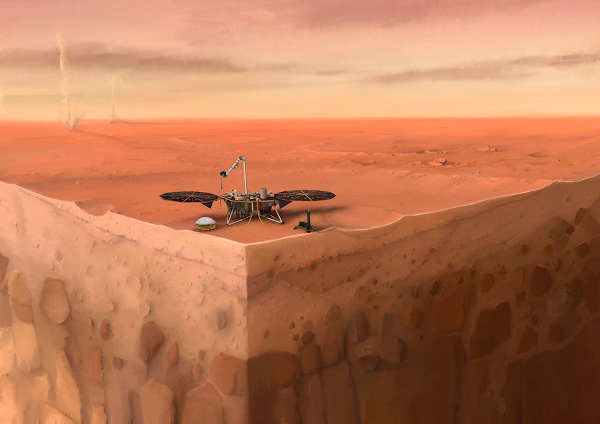
The heat probe hasn’t been able to gain the friction it needs to dig, but the mission has been granted an extension to carry on with its other science.
The heat probe developed and built by the German Aerospace Center and deployed on Mars by NASA’s InSight lander has ended its portion of the mission.
Since Feb. 28, 2019, the probe, called the “mole,” has been attempting to burrow into the Martian surface to take the planet’s internal temperature, providing details about the interior heat engine that drives the Mars’ evolution and geology.
But the soil’s unexpected tendency to clump deprived the spike-like mole of the friction it needs to hammer itself to a sufficient depth.
After getting the top of the mole about 2 or 3 centimeters under the surface, the team tried one last time to use a scoop on InSight’s robotic arm to scrape soil onto the probe and tamp it down to provide added friction. After the probe conducted 500 additional hammer strokes on Saturday, Jan. 9, with no progress, the team called an end to their efforts.
Part of an instrument called the Heat Flow and Physical Properties Package (HP3), the mole is a 16-inch-long (40-centimeter-long) pile driver connected to the lander by a tether with embedded temperature sensors. These sensors are designed to measure heat flowing from the planet once the mole has dug at least 10 feet (3 meters) deep.
“We’ve given it everything we’ve got, but Mars and our heroic mole remain incompatible,” said HP3’s principal investigator, Tilman Spohn of (DLR). “Fortunately, we’ve learned a lot that will benefit future missions that attempt to dig into the subsurface.”
While NASA’s Phoenix lander scraped the top layer of the Martian surface, no mission before InSight has tried to burrow into the soil. Doing so is important for a variety of reasons: Future astronauts may need to dig through soil to access water ice, while scientists want to study the subsurface’s potential to support microbial life.
“We are so proud of our team who worked hard to get InSight’s mole deeper into the planet. It was amazing to see them troubleshoot from millions of miles away,” said Thomas Zurbuchen, associate administrator for science at the agency’s headquarters in Washington. “This is why we take risks at NASA – we have to push the limits of technology to learn what works and what doesn’t. In that sense, we’ve been successful: We’ve learned a lot that will benefit future missions to Mars and elsewhere, and we thank our German partners from DLR for providing this instrument and for their collaboration.”
Hard-earned wisdom
The unexpected properties of the soil near the surface next to InSight will be puzzled over by scientists for years to come. The mole’s design was based on soil seen by previous Mars missions – soil that proved very different from what the mole encountered. For two years, the team worked to adapt the unique and innovative instrument to these new circumstances.
“The mole is a device with no heritage. What we attempted to do – to dig so deep with a device so small – is unprecedented,” said Troy Hudson, a scientist and engineer at NASA’s Jet Propulsion Laboratory in Southern California who has led efforts to get the mole deeper into the Martian crust. “Having had the opportunity to take this all the way to the end is the greatest reward.”
Besides learning about the soil at this location, engineers have gained invaluable experience operating the robotic arm. In fact, they used the arm and scoop in ways they never intended to at the outset of the mission, including pressing against and down on the mole. Planning the moves and getting them just right with the commands they were sending up to InSight pushed the team to grow.
They’ll put their hard-earned wisdom to use in the future. The mission intends to employ the robotic arm in burying the tether that conveys data and power between the lander and InSight’s seismometer, which has recorded more than 480 marsquakes. Burying it will help reduce temperature changes that have created cracking and popping sounds in seismic data.
There’s much more science to come from InSight, short for Interior Exploration using Seismic Investigations, Geodesy, and Heat Transport. NASA recently extended the mission for two more years, to Dec. 2022.
Along with hunting for quakes, the lander hosts a radio experiment that is collecting data to reveal whether the planet’s core is liquid or solid. And InSight’s weather sensors are capable of providing some of the most detailed meteorological data ever collected on Mars.
Together with weather instruments aboard NASA's Curiosity rover and its new Perseverance rover, which lands on Feb. 18, the three spacecraft will create the first meteorological network on another planet.
More about the mission
JPL manages InSight for NASA’s Science Mission Directorate. InSight is part of NASA’s Discovery Program, managed by the agency’s Marshall Space Flight Center in Huntsville, Alabama. Lockheed Martin Space in Denver built the InSight spacecraft, including its cruise stage and lander, and supports spacecraft operations for the mission.
A number of European partners, including France’s Centre National d’Études Spatiales, or CNES, and the German Aerospace Center, are supporting the InSight mission. CNES provided the Seismic Experiment for Interior Structure, or SEIS, instrument to NASA, with the principal investigator at the Institut de Physique du Globe de Paris, or IPGP.
Significant contributions for SEIS came from IPGP; the Max Planck Institute for Solar System Research in Germany; the Swiss Federal Institute of Technology in Switzerland; Imperial College London and Oxford University in the United Kingdom; and JPL.
DLR provided the Heat Flow and Physical Properties Package instrument, with significant contributions from the Space Research Center of the Polish Academy of Sciences and Astronika in Poland. Spain’s Centro de Astrobiología supplied the temperature and wind sensors.