 How to resolve AdBlock issue?
News
NORTHERN CALIFORNIA – The public is invited to submit comments on the proposed Plaskett-Keller August Complex Phase 1 project on the Mendocino National Forest.
This proposed project covers approximately 4,500 acres in the middle of the Forest about 15 miles from Covelo and 36 miles from Willows.
The proposed Plaskett-Keller project crosses multiple jurisdictional lines – ranger districts, counties and land ownership – and is an excellent area for partnerships and collaboration on land management. It also contains several campgrounds and major roads used frequently by the public and Forest Service employees.
The proposal includes post-fire recovery activities to remove fire-killed and fire-injured trees in order to improve employee and public safety, capture remaining economic value of dead trees, and reduce post-fire fuels to prevent the excessive accumulation of fuels.
The August Complex burned a total of 1,032,648 acres, including 612,634 acres on the Mendocino National Forest.
For post-fire recovery, forest resource specialists considered the rapid assessment conducted by the Mendocino, Shasta-Trinity and Six Rivers national forests as a foundation to develop a three-phase approach for restoration.
Phase 1 will address time-sensitive safety concerns along roadways and campgrounds as well as economic recovery.
Phase 2 involves restoration activities such as reforestation, additional fuels reduction work, habitat enhancement, recreation site improvements, and more.
Phase 3 will focus on long-term recovery across the landscape using the Watershed Condition Framework approach.
A scoping letter with additional details and maps are available for download from the project website: https://www.fs.usda.gov/project/?project=59444.
The participation of interested persons, organizations, state and local governments, and tribes is encouraged throughout the process of developing this project.
Forest officials said their desire is to receive comments on the merits of the proposed action, as well as comments that address concerns.
Public questions and comments regarding this proposal are an integral part of the environmental analysis process. Comments will be used to identify issues and develop alternatives to the proposed action. To best assist the Forest Service in developing this project, comments should be as specific as possible.
Comments would be the most useful if they are received by Wednesday, March 17.
All comments, including source information, will become part of the public record, and therefore will be subject to release upon request.
How to comment: Comments may be submitted via email toThis email address is being protected from spambots. You need JavaScript enabled to view it. (include “Plaskett-Keller” in the subject line); via mail to Mendocino National Forest: Attn: Plaskett-Keller. 825 N Humboldt Ave., Willows, CA 95988; or via facsimile to 530-934-7384.
This proposed project covers approximately 4,500 acres in the middle of the Forest about 15 miles from Covelo and 36 miles from Willows.
The proposed Plaskett-Keller project crosses multiple jurisdictional lines – ranger districts, counties and land ownership – and is an excellent area for partnerships and collaboration on land management. It also contains several campgrounds and major roads used frequently by the public and Forest Service employees.
The proposal includes post-fire recovery activities to remove fire-killed and fire-injured trees in order to improve employee and public safety, capture remaining economic value of dead trees, and reduce post-fire fuels to prevent the excessive accumulation of fuels.
The August Complex burned a total of 1,032,648 acres, including 612,634 acres on the Mendocino National Forest.
For post-fire recovery, forest resource specialists considered the rapid assessment conducted by the Mendocino, Shasta-Trinity and Six Rivers national forests as a foundation to develop a three-phase approach for restoration.
Phase 1 will address time-sensitive safety concerns along roadways and campgrounds as well as economic recovery.
Phase 2 involves restoration activities such as reforestation, additional fuels reduction work, habitat enhancement, recreation site improvements, and more.
Phase 3 will focus on long-term recovery across the landscape using the Watershed Condition Framework approach.
A scoping letter with additional details and maps are available for download from the project website: https://www.fs.usda.gov/project/?project=59444.
The participation of interested persons, organizations, state and local governments, and tribes is encouraged throughout the process of developing this project.
Forest officials said their desire is to receive comments on the merits of the proposed action, as well as comments that address concerns.
Public questions and comments regarding this proposal are an integral part of the environmental analysis process. Comments will be used to identify issues and develop alternatives to the proposed action. To best assist the Forest Service in developing this project, comments should be as specific as possible.
Comments would be the most useful if they are received by Wednesday, March 17.
All comments, including source information, will become part of the public record, and therefore will be subject to release upon request.
How to comment: Comments may be submitted via email to
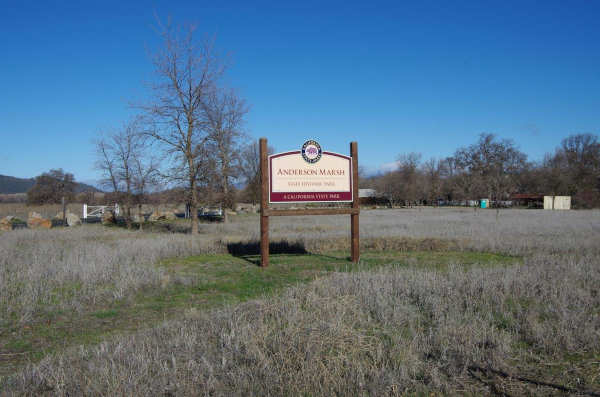
LAKE COUNTY, Calif. – Anderson Marsh Interpretive Association is among 15 state parks and park partners receiving grants to help restore fragile habitats, rebuild parks and create a climate-resilient state park system.
The California State Parks Foundation is awarding $135,000 in grants from its new Wildfire Resiliency and Prevention Fund to help 15 parks – 10 of which are in the Northern California region – recover from devastating wildfires.
The Anderson Marsh Interpretive Association, or AMIA, will receive $9,026, with the grant term running for a year, beginning March 1, the foundation reported.
The grant will allow AMIA to partner with the Department of Parks and Recreation in restoring and rehabilitating the three-acre entrance meadow that first greets visitors to Anderson Marsh State Historic Park, which burned in the 2016 Clayton fire, the association reported.
“AMIA is grateful for the financial support of CSPF that will allow this project to help protect the park’s historic ranch house and barn complex, as well as creating an opportunity to educate the public about the benefits of native plants in reducing the risk of wildfire,” said AMIA President Roberta Lyons.
The nonprofit California State Parks Foundation, which advocates for and supports California state parks, created the Wildfire Resiliency and Prevention Fund in 2020, a record-setting year for wildfires in California.
“The 2020 California wildfires were horrifically destructive, and our beloved state parks have undergone devastating damage. There is a real need to restore fragile habitats and rebuild parks, while building climate resiliency to mitigate the impact of climate change,” said Rachel Norton, executive director of California State Parks Foundation.
The Wildfire Resiliency and Prevention Grant opportunity includes $135,917 in grant funding that supports activities resulting in outcomes including assessment, restoration, preparedness and education.
AMIA, a nonprofit association cooperating with State Parks to support and promote educational and interpretive activities at Anderson Marsh State Historic Park, said its project will begin with a prescribed burn at the park.
The project focuses on making the park more resilient to the ever-increasing wildfires that are being caused by climate change, as well as educating the public about what can be done to reduce the risk from wildfire, including the planting of native plants.
“The project will help create a defensible space around the park's historic ranch house and barns through the clearing of non-native species and overgrowth and the replanting of native grasses, shrubs, and trees,” said AMIA Grant Director Henry Bornstein. “At the end of the project, the entrance meadow will be restored to a more natural state and a native plant demonstration area will be created where visitors can compare the treated native entrance meadow to the adjacent untreated areas, and learn about the advantages of native plants in the control of wildfires.”
“State Parks and AMIA have continued to work together on projects which further enhance visitor experiences at Anderson Marsh State Historic Park,” said State Parks Northern Butte District Superintendent Matt Teague. “This project will provide an excellent opportunity to educate users of the park on the benefits of native habitat as it relates to wildfire intensity and management.”
In addition to Anderson Marsh, other grant winners are the California Native Plant Society for the Big Basin Redwoods State Park and Henry W. Coe State Park; California State Parks for Mount Diablo State Park; California State Parks, Bay Area District Natural Resource Management Program for Trione-Annadel State Park and Sugarloaf Ridge State Park; California State Parks, Sierra District for Ed Z'Berg Sugar Pine Point State Park; Gold Country Avian Studies for Big Basin Redwoods State Park; Sonoma Ecology Center for Sugarloaf Ridge State Park; South Yuba River Citizens League for South Yuba River State Park; Stewards of the Coast and Redwoods for Armstrong Redwoods State Natural Reserve and Austin Creek State Recreation Area; Anahuak Youth Sports Association for Rio de Los Angeles State Park and Los Angeles State Historic Park, Bowtie Parcel; California State Parks/Poppy Reserve Mojave Desert Interpretive Association for Arthur B. Ripley Desert Woodland State Park; California State Parks in partnership with Chino Hills State Park Interpretive Association and Hills For Everyone for Chino Hills State Park; and Los Angeles Audubon Society for Baldwin Hills Scenic Overlook State Park and Kenneth Hahn State Recreation Area.
AMIA has received previous grants for projects from the California State Parks Foundation, including $5,000 in 2020 to repair the wooden boardwalk on Cache Creek Nature Trail; $3,000 in 2015 for purchasing interpretive equipment for nature walks, school field trips and senior tours; and $6,000 in 2014 for general operations.
For information about Anderson Marsh State Historic Park or AMIA, visit www.andersonmarsh.org or contact AMIA at either
Email Elizabeth Larson at
CLEARLAKE, Calif. – The Clearlake City Council this week will hold its midyear budget review, discuss a proposal for a memorial for COVID-19 victims, conduct a public hearing for grant funding, consider declaring some city-owned properties surplus and discuss committee appointments.
The council will meet for a budget workshop at 5 p.m. and the regular meeting at 6 p.m. Thursday, Feb. 18.
Because of the county’s shelter in place order, Clearlake City Hall remains closed to the public, however, the virtual meeting will be broadcast live on the city's YouTube channel or the Lake County PEGTV YouTube Channel. Community members also can participate via Zoom.
The agenda can be found here.
Comments and questions can be submitted in writing for City Council consideration by sending them to Administrative Services Director/City Clerk Melissa Swanson atThis email address is being protected from spambots. You need JavaScript enabled to view it. . You can also visit the city’s town hall site and submit written comments at https://www.opentownhall.com/portals/327/forum_home. Identify the subject you wish to comment on in your email’s subject line or in your town hall submission.
To give the council adequate time to review your questions and comments, please submit your written comments prior to 4 p.m. on Thursday, Feb. 18.
Each public comment emailed to the city clerk will be read aloud by the mayor or a member of staff for up to three minutes or will be displayed on a screen. Public comment emails and town hall public comment submissions that are received after the beginning of the meeting will not be included in the record.
During its workshop, the council will hold a midyear budget review for the time period through Dec. 31.
Andrew White, the city’s police chief and its interim finance director, said in his report to the council that, overall, “revenues are exceeding projections and we are cautiously optimistic that the trend will continue. The trend is primarily being driven by higher than expected sales tax revenue, fees and permits and fines related to code enforcement violations. There was also a significant one-time revenue from the settlement of litigation related to the Sulphur Fire.”
White added, “The higher-than-expected sales tax revenue is also benefitting the Measure V and Measure P special revenue funds. However, based on economic uncertainties, staff is only recommending conservative increases to revenues to cover additional expenses.”
White said it’s also important to remember that this year’s budget relied on fund balance and coming into the year, Measure P had a negative fund balance.
“Overall, expenses are on track with budgetary projections. There was a significant increase in
health insurance costs resulting in an over $50,000 increase to the employer share of said costs, though based on projected salary savings, a budget increase is not being proposed,” White wrote.
During the regular portion of the meeting, the council will consider a request from Councilwoman Joyce Overton to establish a memorial to COVID-19 victims in Austin Park.
Overton’s report to the council said that she is proposing a small cross with the name of each individual who died from the coronavirus to be placed within the fenced rose garden in Austin Park. The garden is maintained and used to honor local Soroptimists.
She said the memorial is currently proposed to be temporary, and would be funded by private donations.
The council also will meet one of February’s adoptable dogs before holding a public hearing to consider projects and authorize the application for funding through the Community Development Block Grant Mitigation Program.
In other business, the council will consider declaring various small city-owned properties as surplus in order to offer them to the state Housing and Community Development Department for use in affordable housing in accordance with AB 1486.
Also on Thursday, the council will consider appointing a person to succeed Councilmember David Claffey on the Clearlake Marketing Committee. The two applicants are Susan Bloomquist and Kristina Nelson.
On the meeting's consent agenda – items that are not considered controversial and are usually adopted on a single vote – are warrants; authorization for the city manager to execute a license agreement with Mudslingers Coffee for a drive-thru coffee Facility at 14760 Olympic Drive; the Lake County Vector Control District Board minutes for Dec. 9; minutes of the January meetings; consideration of a resolution rescinding Resolution No. 2009-51, establishing purchasing procedures; and rejection of all bids for the Austin Park Bus Stop and Promenade Project.
Email Elizabeth Larson atThis email address is being protected from spambots. You need JavaScript enabled to view it. . Follow her on Twitter, @ERLarson, or Lake County News, @LakeCoNews.
The council will meet for a budget workshop at 5 p.m. and the regular meeting at 6 p.m. Thursday, Feb. 18.
Because of the county’s shelter in place order, Clearlake City Hall remains closed to the public, however, the virtual meeting will be broadcast live on the city's YouTube channel or the Lake County PEGTV YouTube Channel. Community members also can participate via Zoom.
The agenda can be found here.
Comments and questions can be submitted in writing for City Council consideration by sending them to Administrative Services Director/City Clerk Melissa Swanson at
To give the council adequate time to review your questions and comments, please submit your written comments prior to 4 p.m. on Thursday, Feb. 18.
Each public comment emailed to the city clerk will be read aloud by the mayor or a member of staff for up to three minutes or will be displayed on a screen. Public comment emails and town hall public comment submissions that are received after the beginning of the meeting will not be included in the record.
During its workshop, the council will hold a midyear budget review for the time period through Dec. 31.
Andrew White, the city’s police chief and its interim finance director, said in his report to the council that, overall, “revenues are exceeding projections and we are cautiously optimistic that the trend will continue. The trend is primarily being driven by higher than expected sales tax revenue, fees and permits and fines related to code enforcement violations. There was also a significant one-time revenue from the settlement of litigation related to the Sulphur Fire.”
White added, “The higher-than-expected sales tax revenue is also benefitting the Measure V and Measure P special revenue funds. However, based on economic uncertainties, staff is only recommending conservative increases to revenues to cover additional expenses.”
White said it’s also important to remember that this year’s budget relied on fund balance and coming into the year, Measure P had a negative fund balance.
“Overall, expenses are on track with budgetary projections. There was a significant increase in
health insurance costs resulting in an over $50,000 increase to the employer share of said costs, though based on projected salary savings, a budget increase is not being proposed,” White wrote.
During the regular portion of the meeting, the council will consider a request from Councilwoman Joyce Overton to establish a memorial to COVID-19 victims in Austin Park.
Overton’s report to the council said that she is proposing a small cross with the name of each individual who died from the coronavirus to be placed within the fenced rose garden in Austin Park. The garden is maintained and used to honor local Soroptimists.
She said the memorial is currently proposed to be temporary, and would be funded by private donations.
The council also will meet one of February’s adoptable dogs before holding a public hearing to consider projects and authorize the application for funding through the Community Development Block Grant Mitigation Program.
In other business, the council will consider declaring various small city-owned properties as surplus in order to offer them to the state Housing and Community Development Department for use in affordable housing in accordance with AB 1486.
Also on Thursday, the council will consider appointing a person to succeed Councilmember David Claffey on the Clearlake Marketing Committee. The two applicants are Susan Bloomquist and Kristina Nelson.
On the meeting's consent agenda – items that are not considered controversial and are usually adopted on a single vote – are warrants; authorization for the city manager to execute a license agreement with Mudslingers Coffee for a drive-thru coffee Facility at 14760 Olympic Drive; the Lake County Vector Control District Board minutes for Dec. 9; minutes of the January meetings; consideration of a resolution rescinding Resolution No. 2009-51, establishing purchasing procedures; and rejection of all bids for the Austin Park Bus Stop and Promenade Project.
Email Elizabeth Larson at
LAKE COUNTY, Calif. – The Board of Supervisors is continuing, for the time being, policies of limiting the county government’s in-person delivery of services to the public and a closure of its chambers during meetings because of COVID-19.
At its meeting last week – the board did not meet this week because of the Presidents Day holiday – the supervisors agreed to keep in place the resolution authorizing temporary reduction of in-person delivery of county services while increasing alternative methods for service delivery.
The board passed the resolution during a special meeting in January following an increase in COVID-19 cases.
The resolution has to be reviewed every 30 days, which the board did at its Feb. 9 meeting. At that time, the board took no action to change it, so the monthly reviews will continue until the board decides it’s safe to reopen.
It was noted during the discussion by County Administrative Office Carol Huchingson that so far very few county employees have been vaccinated against the virus.
That discussion was followed by the weekly review of the board’s decision to keep its chambers closed for in-person meetings.
Board members supported the chambers remaining closed for the time being. While new case numbers are dropping, supervisors didn’t want to change that trend by reopening too soon.
Supervisor Jessica Pyska said that when they do reopen the chambers, they need to look at ways to protect the staff that work in the room during the meetings and enforcing the masking ordinance needs to be part of that discussion.
Board Chair Bruno Sabatier said that, rather than having the chambers situation reviewed weekly, they should have a trigger to bring it back, such as the county dropping out of the purple tier on the state’s Blueprint for a Safer Economy and into the red tier, or when the county reaches a certain number of cases.
Supervisor Tina Scott agreed with the trigger, but noted that the state is revamping its tier system so they need to determine what that trigger might be.
Pyska also agreed to a trigger and then asked how to enforce masking in the chambers.
Sabatier said the county offers alternative models to access the meeting virtually so if the board chose to take a hard line and require masking – which he said he personally didn’t support doing – he would be willing to draw that hard line.
He suggested dropping into the red tier as a trigger to allowing the public back into the chamber.
Supervisor Moke Simon said the board has done a great job with the hybrid meeting models, and when reopening for public participation, he suggested they could rotate and have some board members present for the meetings with others on Zoom.
Sabatier said he didn’t want to force board members to be in the environment, adding he wanted to to have a place for members of the public to go to express themselves.
The board ultimately reached consensus to bring the chambers reopening matter back for discussion next after Lake County has dropped into the red tier or the state comes up with other guidelines, with the mask requirement to be included.
The next board meeting takes place virtually on Feb. 23.
Email Elizabeth Larson atThis email address is being protected from spambots. You need JavaScript enabled to view it. . Follow her on Twitter, @ERLarson, or Lake County News, @LakeCoNews.
At its meeting last week – the board did not meet this week because of the Presidents Day holiday – the supervisors agreed to keep in place the resolution authorizing temporary reduction of in-person delivery of county services while increasing alternative methods for service delivery.
The board passed the resolution during a special meeting in January following an increase in COVID-19 cases.
The resolution has to be reviewed every 30 days, which the board did at its Feb. 9 meeting. At that time, the board took no action to change it, so the monthly reviews will continue until the board decides it’s safe to reopen.
It was noted during the discussion by County Administrative Office Carol Huchingson that so far very few county employees have been vaccinated against the virus.
That discussion was followed by the weekly review of the board’s decision to keep its chambers closed for in-person meetings.
Board members supported the chambers remaining closed for the time being. While new case numbers are dropping, supervisors didn’t want to change that trend by reopening too soon.
Supervisor Jessica Pyska said that when they do reopen the chambers, they need to look at ways to protect the staff that work in the room during the meetings and enforcing the masking ordinance needs to be part of that discussion.
Board Chair Bruno Sabatier said that, rather than having the chambers situation reviewed weekly, they should have a trigger to bring it back, such as the county dropping out of the purple tier on the state’s Blueprint for a Safer Economy and into the red tier, or when the county reaches a certain number of cases.
Supervisor Tina Scott agreed with the trigger, but noted that the state is revamping its tier system so they need to determine what that trigger might be.
Pyska also agreed to a trigger and then asked how to enforce masking in the chambers.
Sabatier said the county offers alternative models to access the meeting virtually so if the board chose to take a hard line and require masking – which he said he personally didn’t support doing – he would be willing to draw that hard line.
He suggested dropping into the red tier as a trigger to allowing the public back into the chamber.
Supervisor Moke Simon said the board has done a great job with the hybrid meeting models, and when reopening for public participation, he suggested they could rotate and have some board members present for the meetings with others on Zoom.
Sabatier said he didn’t want to force board members to be in the environment, adding he wanted to to have a place for members of the public to go to express themselves.
The board ultimately reached consensus to bring the chambers reopening matter back for discussion next after Lake County has dropped into the red tier or the state comes up with other guidelines, with the mask requirement to be included.
The next board meeting takes place virtually on Feb. 23.
Email Elizabeth Larson at
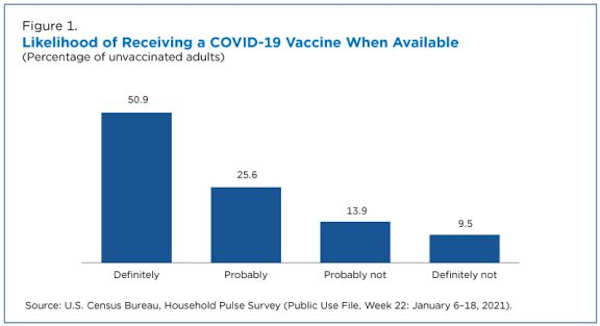
About 8 percent of American adults reported they had received a COVID-19 vaccination and around half of adults who haven’t (51%) indicated they would definitely get a vaccine, while an additional 26 percent said they probably would, according to new U.S. Census Bureau data.
The latest revision to Phase 3 of the Household Pulse Survey was implemented on Jan. 6 and included a new series of questions about COVID-19 vaccinations and attitudes toward the vaccines.
This article is based on analysis of Phase 3 data collected Jan. 6 through Jan. 18, a time period in which the Census Bureau sent invitations to 1,037,972 households and received a total of 68,348 responses.
This content was added in partnership with the Centers for Disease Control and Prevention, or CDC. Based on survey self-reports, these data may differ from other administrative information, particularly those collected during different time periods.
The new vaccination series asks respondents if they had received a COVID-19 vaccination. Those who had are then asked if they plan to receive all required doses.
Adults who have not been vaccinated are asked if they plan to get a vaccine once available. Respondents who express uncertainty are asked the reason(s) for their reluctance.
These data show:
– About 95 percent of the estimated 19 million who reported receiving a COVID-19 vaccination said they had received or plan to receive all required doses.
– Around half (51%) of the approximately 226 million adults yet to receive a vaccination said they “definitely” plan to receive it when available (Figure 1).
– An additional 26 percent of adults yet to be vaccinated reported they would “probably” get a vaccine once available, compared to approximately 14 percent who said they would “probably not,” and 10 percent who said they would “definitely not” get vaccinated. Overall, these results indicate that around a quarter of all unvaccinated adults will probably not, or will definitely not, receive a COVID-19 vaccine once one is available to them.
Age factors
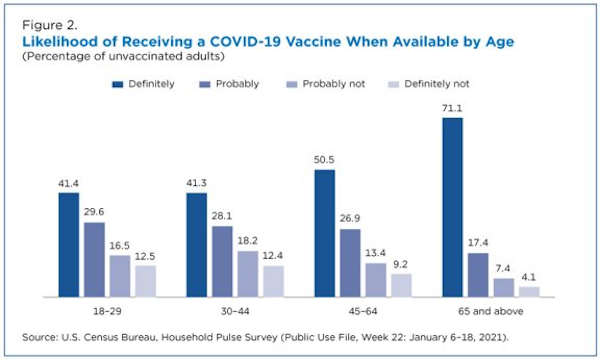
During this initial collection period, the reported likelihood of eventually receiving a COVID-19 vaccination once available varied by age and older adults appear to be more certain they want to get vaccinated.
While about 71 percent of adults ages 65 and over reported they would “definitely” get a vaccine once available, around half (51%) of those ages 45 to 64 said the same (Figure 2).
Meanwhile, among those ages 30-44 and 18-29, only 41 percent indicated they would “definitely” get a vaccine once available (The percentages for these two youngest age groups were not statistically different.)
Racial differences
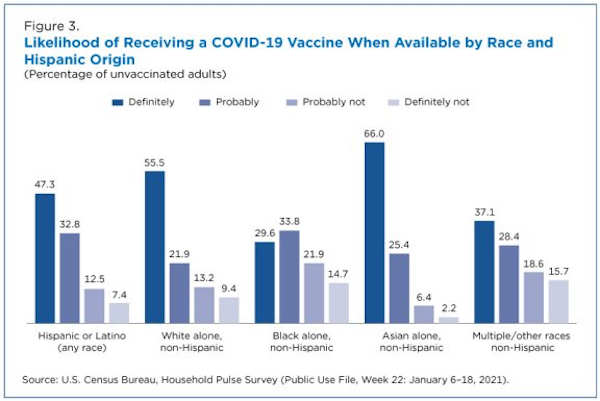
The reported likelihood of receiving a COVID-19 vaccination once available also varied by Hispanic origin and race (Figure 3).
About two-thirds of unvaccinated non-Hispanic Asian adults indicated they would “definitely” get a vaccine once available, compared to around 56 percent of non-Hispanic Whites.
In contrast, only about 47 percent of Hispanics, 37 percent of non-Hispanics of other races or two or more races, and 30 percent of non-Hispanic Blacks said they would “definitely” get a vaccine once available.
Health insurance coverage
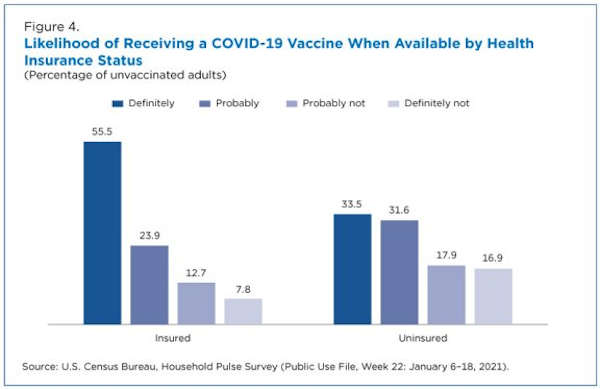
Attitudes about receiving a COVID-19 vaccine also varied according to health insurance status. Those without insurance were less likely to say they would get vaccinated (Figure 4).
Among the unvaccinated, over half (56%) of insured adults and 34 percent of uninsured adults said they would “definitely” get a vaccine when available.
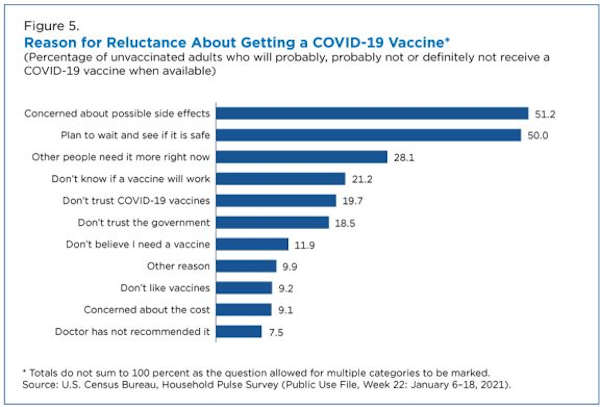
Respondents who indicated uncertainty about receiving a vaccination (49%) were also asked the reason(s) for their reluctance.
The most frequently selected answers included:
– Concern about possible side effects (51%) and plans to wait to see if the vaccines are safe (50%). The percentages for these two reasons were not statistically different.
– Feeling that other people might need the vaccine more right now (28%).
It should be noted that respondents could provide more than one response to this question.
All respondents were also asked whether they had received a positive COVID-19 diagnosis from a medical professional; around 14 percent indicated they had. As more Americans are vaccinated, Household Pulse Survey data will allow for meaningful analysis of demographic differences in vaccination rates and positive COVID-19 diagnoses. Additional information about the number of COVID-19 vaccines administered is available from the CDC.
The estimates in this analysis are based on survey self-reports from a specific time period and may not align with published counts generated from other sources.
For more information, data users are encouraged to explore the Household Pulse Survey tables, Technical Documentation and Public Use File microdata.
Thom File is a sociologist in the Census Bureau’s Social, Economic and Housing Statistics Division. Abinash Mohanty is a statistician in the Census Bureau’s Social, Economic and Housing Statistics Division.
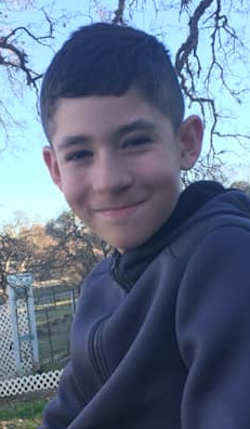
LAKE COUNTY, Calif. – The Lake County Sheriff’s Office said Monday afternoon that a missing south county boy has been found safe.
Austin Maloney, 12, was located nearly 24 hours after he had gone missing on Sunday afternoon.
He had last been seen in the area of Jerusalem Grade Road near Hidden Valley Lake, as Lake County News has reported.
Lt. Corey Paulich of the Lake County Sheriff’s Office said the boy had left his house on Sunday after a disagreement with his family.
The Lake County Sheriff’s Office was notified of his disappearance on Sunday evening and activated its Search and Rescue team, which searched for the child overnight.
Other agencies, including the California Highway Patrol, also were reported to have assisted with the search, as had volunteers from the community.
Paulich said Austin was found safe in the Jerusalem Valley area and returned to his family.
Email Elizabeth Larson at