 How to resolve AdBlock issue?
News
LAKE COUNTY, Calif. – Local officials said that extreme weather that hit parts of the Eastern United States this week has impacted the supply of COVID-19 headed to Lake County.
The Lake County Health Services Department’s Public Health Division began drive-thru vaccination clinics this week.
However, due to the severe weather in other parts of the country, there have been challenges related to the delivery of Lake County’s shipment of the Moderna vaccine.
As a result, Public Health Officer Dr. Gary Pace said the department is canceling all first dose appointments scheduled on Thursday, Feb. 18, and Friday, Feb. 19.
Pace said they are hoping the vaccine supply will arrive in the next few days, so they can resume vaccination clinics on Monday, Feb. 22.
If you had an appointment for a first dose, you should receive a call this afternoon by Thursday morning. Those who had appointments will be placed on the list to reschedule for next week. Do not come to the site this Thursday or Friday if you were scheduled for your first dose, because they will not have a vaccine for you.
Second vaccine doses will continue this week. Four weeks ago, if you had your first dose, you should receive your second dose this week.
The location and the day have changed:
– Thursday, Feb. 18: Those individuals who received their first dose on Jan. 22 at the Clearlake Senior Center will receive a call to schedule their second dose at Redbud Park.
– Friday, Feb. 19: Those individuals who received their first dose on Jan. 23 and 25 at the Clearlake Senior Center will receive a call to schedule their second dose at Redbud Park.
– Monday, Feb. 22: Those individuals who received their first dose on Jan. 26 at the Lake County Fairgrounds will receive a call to schedule their second dose at the Lakeport Auto Movies.
Next week, individuals with canceled second-dose appointments should receive a call in the near future.
If there is a problem, contact Public Health at the MHOAC Team number, 707-263-8174, or emailThis email address is being protected from spambots. You need JavaScript enabled to view it. early next week.
“We apologize for any inconvenience this may have caused and thank you for your understanding in these challenging times,” Pace said.
The Lake County Health Services Department’s Public Health Division began drive-thru vaccination clinics this week.
However, due to the severe weather in other parts of the country, there have been challenges related to the delivery of Lake County’s shipment of the Moderna vaccine.
As a result, Public Health Officer Dr. Gary Pace said the department is canceling all first dose appointments scheduled on Thursday, Feb. 18, and Friday, Feb. 19.
Pace said they are hoping the vaccine supply will arrive in the next few days, so they can resume vaccination clinics on Monday, Feb. 22.
If you had an appointment for a first dose, you should receive a call this afternoon by Thursday morning. Those who had appointments will be placed on the list to reschedule for next week. Do not come to the site this Thursday or Friday if you were scheduled for your first dose, because they will not have a vaccine for you.
Second vaccine doses will continue this week. Four weeks ago, if you had your first dose, you should receive your second dose this week.
The location and the day have changed:
– Thursday, Feb. 18: Those individuals who received their first dose on Jan. 22 at the Clearlake Senior Center will receive a call to schedule their second dose at Redbud Park.
– Friday, Feb. 19: Those individuals who received their first dose on Jan. 23 and 25 at the Clearlake Senior Center will receive a call to schedule their second dose at Redbud Park.
– Monday, Feb. 22: Those individuals who received their first dose on Jan. 26 at the Lake County Fairgrounds will receive a call to schedule their second dose at the Lakeport Auto Movies.
Next week, individuals with canceled second-dose appointments should receive a call in the near future.
If there is a problem, contact Public Health at the MHOAC Team number, 707-263-8174, or email
“We apologize for any inconvenience this may have caused and thank you for your understanding in these challenging times,” Pace said.
Gov. Gavin Newsom, Senate President pro Tempore Toni G. Atkins and Assembly Speaker Anthony Rendon on Wednesday announced that they have reached an agreement on a $9 billion package that includes immediate actions to speed needed relief to individuals, families and businesses suffering the most significant economic hardship from the COVID-19 recession.
The package – which Sen. Mike McGuire, who represents Lake County in the State Senate, said is California's largest economic recovery package in a generation – builds on the initiatives in the governor’s state budget proposal to provide cash relief to lower-income Californians, increase aid to small businesses and provide license renewal fee waivers to businesses impacted by the pandemic.
In addition to these measures, the agreement provides tax relief for businesses, commits additional resources for critical child care services and funds emergency financial aid for community college students.
“As we continue to fight the pandemic and recover, I’m grateful for the Legislature’s partnership to provide urgent relief and support for California families and small businesses where it’s needed most,” said Gov. Newsom. “From child care, relief for small business owners, direct cash support to individuals, financial aid for community college students and more, these actions are critical for millions of Californians who embody the resilience of the California spirit.”
“We’re nearly a year into this pandemic, and millions of Californians continue to feel the impact on their wallets and bottom lines. Businesses are struggling. People are having a hard time making ends meet. This agreement builds on Governor Newsom’s proposal and in many ways, enhances it so that we can provide the kind of immediate emergency relief that families and small businesses desperately need right now,” said Senate President pro Tempore Atkins. “People are hungry and hurting, and businesses our communities have loved for decades are at risk of closing their doors. We are at a critical moment, and I’m proud we were able to come together to get Californians some needed relief.”
“Californians have been hurting. Our response tackles the human and the economic impacts of COVID in a way that echoes President Biden’s American Rescue Plan and will help those who are hurting most. We are building an economic foundation for the recovery of jobs, small businesses and, indeed, our everyday lives,” said Speaker Rendon.
McGuire, a member of the Senate Budget Committee, said he will be supporting this economic stimulus package in committee on Thursday. It will be voted on next week by the full Senate and Assembly before going to the governor for his signature.
“California’s landmark economic recovery package will help benefit millions of working families and seniors along with investing heavily in small business recovery,” McGuire said. “This is California's largest economic recovery package in a generation and it will be a desperately needed shot in the arm for local communities by investing billions in small business grants and advancing PPP loan conformity with state income taxes. The package will put food on the table for families and our most vulnerable neighbors, help them pay their bills, support farmworkers impacted by Covid-19, fund food bank operations and support our colleges by restoring past cuts to the UC and CSU system.”
McGuire said it has been nearly a year since California’s first wave of pandemic-induced business closures, lost jobs, lost dreams, illness and heartache, noting “the realities California families have faced this year have been nearly unbearable.’
He added, “But we will persevere and we will lift each other up in our greatest time of need. That is what we do in California and this economic stimulus is one important step in our collective Golden State recovery.”
Separately, the Governor and legislative leaders said that discussions are continuing on measures for the safe reopening of the state’s K-12 schools, including strategies to address learning loss caused by the pandemic.
Below are key provisions of the Immediate action agreement.
Direct relief to individuals and families
The agreement incorporates the Governor’s Golden State Stimulus plan to assist California households that have borne the disproportionate economic burden of the COVID-19 Recession – those with incomes below $30,000, as well as those unfairly excluded from previous federal stimulus payments.
The agreement provides $600 in one-time relief to households receiving the California EITC for 2020. In addition, the agreement provides a $600 one-time payment to taxpayers with Individual Tax Identification Numbers, or ITINs, who were precluded from receiving the $1,200 per person federal payments issues last spring and the more recent $600 federal payments. The agreement would provide the $600 payments to households with ITINs and income below $75,000. ITIN taxpayers who also qualify for the California EITC would receive a total of $1,200. The payments will be provided to these households shortly after they file their 2020 tax returns.
The agreement broadens this initial plan and now provides direct relief to more lower-income Californians through a $600 one-time grant to households enrolled in the CalWORKS program and recipients of SSI/SSP and Cash Assistance Program for Immigrants, or CAPI. Grant payments for CalWORKS households are expected by mid-April; timing for the delivery of SSI/SSP and CAPI grants is currently under discussion with federal officials.
Combined, the agreement represents a total of 5.7 million payments to low-income Californians.
Immediate relief for small businesses quadrupled
The agreement reflects a four-fold increase – from $500 million to more than $2 billion – for grants up to $25,000 for small businesses impacted by the pandemic, and also allocates $50 million for cultural institutions.
The agreement also partially conforms California tax law to new federal tax treatment for loans provided through the Paycheck Protection Plan, allowing companies to deduct up to $150,000 in expenses covered by the PPP loan. All businesses that took out loans of $150,000 or less would be able to maximize their deduction for state purposes. Larger firms that took out higher loans would still be subject to the same ceiling of $150,000 in deductibility. More than 750,000 PPP loans were taken out by California small businesses. This tax treatment would also extend to the Economic Injury Disaster Loans as well.
Fee waivers for most impacted licensees
The agreement provides for two years of fee relief for roughly 59,000 restaurants and bars licensed through the state’s Department of Alcoholic Beverage Control that can range annually from $455 to $1,235. The agreement also reflects fee relief for more than 600,000 barbering and cosmetology individuals and businesses licensed through the Department of Consumer Affairs.
More resources for critical child care
The agreement adds just over $400 million in new federal funds that will provide stipends of $525 per enrolled child for all state-subsidized child care and preschool providers serving approximately 400,000 children in subsidized care statewide. The new federal resources will extend care for children of essential workers through June of 2022, and funds increased access to subsidized child care for more than 8,000 children of essential workers and at-risk children – who are not currently served in the system – through June of 2022.
Additional aid for individuals and families
The agreement provides an additional $24 million for financial assistance and services through Housing for the Harvest – a program providing support for agricultural workers who have to quarantine due to COVID-19. The agreement also provides a combined $35 million for food banks and diapers.
Emergency financial relief to support community college students
The agreement provides an additional $100 million in emergency financial aid for qualifying low-income students carrying six or more units, with award amounts to be determined locally and made available by early April. The agreement also provides $20 million to reengage students who have either left their community college studies because of the pandemic or to engage students at risk of leaving.
CalFresh student outreach and application assistance
The agreement provides roughly $6 million to support outreach and application assistance to University of California, California State University and California Community College students made newly eligible for CalFresh – the state-administered federal program for supplemental food assistance. The agreement also provides $12 million in state funds to support associated county administrative workload.
In addition, the following provision is included in the agreement:
Restoration of reductions
The agreement restores previously enacted reductions, effective July 1, for the University of California, California State University, the Judicial Branch, Child Support Services and for moderate-income housing.
The package – which Sen. Mike McGuire, who represents Lake County in the State Senate, said is California's largest economic recovery package in a generation – builds on the initiatives in the governor’s state budget proposal to provide cash relief to lower-income Californians, increase aid to small businesses and provide license renewal fee waivers to businesses impacted by the pandemic.
In addition to these measures, the agreement provides tax relief for businesses, commits additional resources for critical child care services and funds emergency financial aid for community college students.
“As we continue to fight the pandemic and recover, I’m grateful for the Legislature’s partnership to provide urgent relief and support for California families and small businesses where it’s needed most,” said Gov. Newsom. “From child care, relief for small business owners, direct cash support to individuals, financial aid for community college students and more, these actions are critical for millions of Californians who embody the resilience of the California spirit.”
“We’re nearly a year into this pandemic, and millions of Californians continue to feel the impact on their wallets and bottom lines. Businesses are struggling. People are having a hard time making ends meet. This agreement builds on Governor Newsom’s proposal and in many ways, enhances it so that we can provide the kind of immediate emergency relief that families and small businesses desperately need right now,” said Senate President pro Tempore Atkins. “People are hungry and hurting, and businesses our communities have loved for decades are at risk of closing their doors. We are at a critical moment, and I’m proud we were able to come together to get Californians some needed relief.”
“Californians have been hurting. Our response tackles the human and the economic impacts of COVID in a way that echoes President Biden’s American Rescue Plan and will help those who are hurting most. We are building an economic foundation for the recovery of jobs, small businesses and, indeed, our everyday lives,” said Speaker Rendon.
McGuire, a member of the Senate Budget Committee, said he will be supporting this economic stimulus package in committee on Thursday. It will be voted on next week by the full Senate and Assembly before going to the governor for his signature.
“California’s landmark economic recovery package will help benefit millions of working families and seniors along with investing heavily in small business recovery,” McGuire said. “This is California's largest economic recovery package in a generation and it will be a desperately needed shot in the arm for local communities by investing billions in small business grants and advancing PPP loan conformity with state income taxes. The package will put food on the table for families and our most vulnerable neighbors, help them pay their bills, support farmworkers impacted by Covid-19, fund food bank operations and support our colleges by restoring past cuts to the UC and CSU system.”
McGuire said it has been nearly a year since California’s first wave of pandemic-induced business closures, lost jobs, lost dreams, illness and heartache, noting “the realities California families have faced this year have been nearly unbearable.’
He added, “But we will persevere and we will lift each other up in our greatest time of need. That is what we do in California and this economic stimulus is one important step in our collective Golden State recovery.”
Separately, the Governor and legislative leaders said that discussions are continuing on measures for the safe reopening of the state’s K-12 schools, including strategies to address learning loss caused by the pandemic.
Below are key provisions of the Immediate action agreement.
Direct relief to individuals and families
The agreement incorporates the Governor’s Golden State Stimulus plan to assist California households that have borne the disproportionate economic burden of the COVID-19 Recession – those with incomes below $30,000, as well as those unfairly excluded from previous federal stimulus payments.
The agreement provides $600 in one-time relief to households receiving the California EITC for 2020. In addition, the agreement provides a $600 one-time payment to taxpayers with Individual Tax Identification Numbers, or ITINs, who were precluded from receiving the $1,200 per person federal payments issues last spring and the more recent $600 federal payments. The agreement would provide the $600 payments to households with ITINs and income below $75,000. ITIN taxpayers who also qualify for the California EITC would receive a total of $1,200. The payments will be provided to these households shortly after they file their 2020 tax returns.
The agreement broadens this initial plan and now provides direct relief to more lower-income Californians through a $600 one-time grant to households enrolled in the CalWORKS program and recipients of SSI/SSP and Cash Assistance Program for Immigrants, or CAPI. Grant payments for CalWORKS households are expected by mid-April; timing for the delivery of SSI/SSP and CAPI grants is currently under discussion with federal officials.
Combined, the agreement represents a total of 5.7 million payments to low-income Californians.
Immediate relief for small businesses quadrupled
The agreement reflects a four-fold increase – from $500 million to more than $2 billion – for grants up to $25,000 for small businesses impacted by the pandemic, and also allocates $50 million for cultural institutions.
The agreement also partially conforms California tax law to new federal tax treatment for loans provided through the Paycheck Protection Plan, allowing companies to deduct up to $150,000 in expenses covered by the PPP loan. All businesses that took out loans of $150,000 or less would be able to maximize their deduction for state purposes. Larger firms that took out higher loans would still be subject to the same ceiling of $150,000 in deductibility. More than 750,000 PPP loans were taken out by California small businesses. This tax treatment would also extend to the Economic Injury Disaster Loans as well.
Fee waivers for most impacted licensees
The agreement provides for two years of fee relief for roughly 59,000 restaurants and bars licensed through the state’s Department of Alcoholic Beverage Control that can range annually from $455 to $1,235. The agreement also reflects fee relief for more than 600,000 barbering and cosmetology individuals and businesses licensed through the Department of Consumer Affairs.
More resources for critical child care
The agreement adds just over $400 million in new federal funds that will provide stipends of $525 per enrolled child for all state-subsidized child care and preschool providers serving approximately 400,000 children in subsidized care statewide. The new federal resources will extend care for children of essential workers through June of 2022, and funds increased access to subsidized child care for more than 8,000 children of essential workers and at-risk children – who are not currently served in the system – through June of 2022.
Additional aid for individuals and families
The agreement provides an additional $24 million for financial assistance and services through Housing for the Harvest – a program providing support for agricultural workers who have to quarantine due to COVID-19. The agreement also provides a combined $35 million for food banks and diapers.
Emergency financial relief to support community college students
The agreement provides an additional $100 million in emergency financial aid for qualifying low-income students carrying six or more units, with award amounts to be determined locally and made available by early April. The agreement also provides $20 million to reengage students who have either left their community college studies because of the pandemic or to engage students at risk of leaving.
CalFresh student outreach and application assistance
The agreement provides roughly $6 million to support outreach and application assistance to University of California, California State University and California Community College students made newly eligible for CalFresh – the state-administered federal program for supplemental food assistance. The agreement also provides $12 million in state funds to support associated county administrative workload.
In addition, the following provision is included in the agreement:
Restoration of reductions
The agreement restores previously enacted reductions, effective July 1, for the University of California, California State University, the Judicial Branch, Child Support Services and for moderate-income housing.
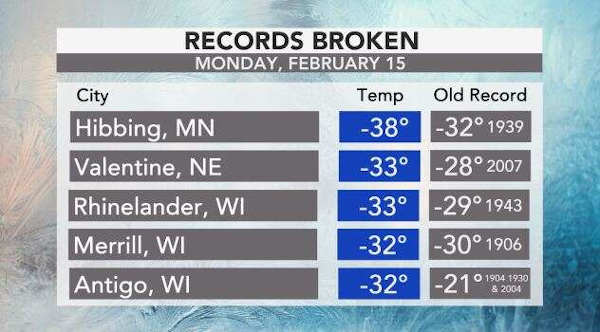
Temperatures typically reserved for the harsh winters in Siberia have inundated portions of the central United States, shattering temperature records, creating travel nightmares and drastically increasing energy demand.
The polar vortex dug deep into the United States earlier this week, dragging with it Arctic air from northern Canada into the central and southern Plains of the U.S.
Some of the lowest temperatures measured in the United States this week have occurred in International Falls, Minnesota, which has earned the nickname as the Ice Box of the nation and for good reason. It sits along the northernmost part of Minnesota and, on average, records more than 100 days with a high temperature at or below 32 F each year.
This week, the temperature extremes were nothing short of remarkable and downright dangerous. Low temperatures bottomed out at 42, 35 and 39 degrees below zero Fahrenheit on Saturday, Sunday and Monday, respectively.
However, the bitter cold was not limited to the northern tier of the U.S. Arctic air plunged all the way to the Gulf Coast and froze citrus crops in parts of Texas. Temperatures plummeted to extreme levels across parts of Nebraska this week, too.
On Monday, the low temperature dropped to 37 degrees below zero in Broken Bow, Nebraska. The mercury then dropped to -37 again in the state on Tuesday morning, but this time in Hebron. Normal low temperatures for both cities in the middle of February are 15-18 degrees.
Meanwhile, in Siberia, the vast region in eastern Russia notorious for some of the lowest temperature readings on Earth, some villages' temperatures at times were higher than some of the lowest readings in the U.S.
The city of Yakutsk, home to more than 280,000, recorded a low temperature of 33 degrees below zero F on Tuesday morning, local time, the lowest reading so far this week. The Russian town started out on a much warmer note this week with low temperatures of 9 and 16 degrees below zero F on Sunday and Monday, respectively.
On Feb. 13, Yakutsk recorded a high temperature of 1 F, the first time the temperature in the village climbed above zero degrees since the middle of November 2020.
The average low temperature during the middle of February in Yakutsk is around 20 degrees below zero F, but it is quickly climbing as spring approaches and the hours of daily sunlight increase.
Villages in Siberia made headlines earlier in the year when high and low temperatures struggled to climb above 50 degrees below zero F. The temperature in Delyankir, a small district located about 500 miles to the northeast of Yakutsk, dropped as low as 73 below zero F on Jan. 18.
A few, more remote locations in Siberia did reach temperatures lower than the U.S. earlier this week. Tunguska reached 53 below zero on Sunday, and Strelka hit 50 below zero on Monday.
A little closer to home, Fairbanks, located in central Alaska, reached a low of only 26 degrees below zero F on Monday. However, the town dropped lower than 30 degrees below zero F during the first week of February. Normal low temperatures for Fairbanks in the middle of February are about 11 to 13 degrees below zero.
On average, Fairbanks spends about 46 days with temperatures below zero each year.
Siberia still beats Fairbanks as one of the coldest spots on Earth. The last time Fairbanks dropped below 50 degrees below zero was on Jan. 18, 2017, when the low reached 51 degrees below zero.
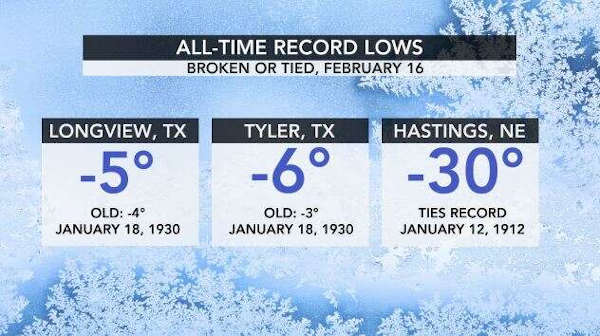
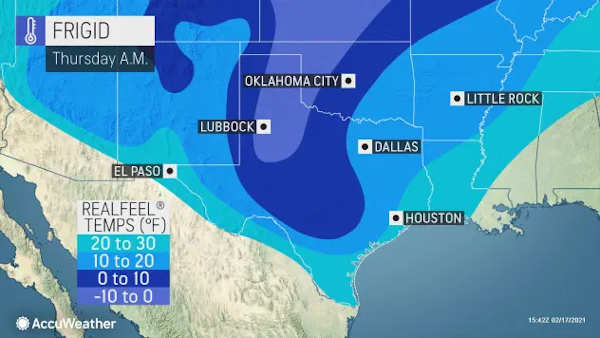
While temperatures in Texas may not have reached "Siberia in the middle of winter" levels this week, the Arctic blast toppled long-standing temperature records and put a heavy burden on the energy infrastructure. In the Lone Star State, millions have been without power for several days now as utility companies and the state's grid operator frantically work to restore power. Record-breaking demand was anticipated by the Electric Reliability Council of Texas earlier this week, causing the agency to implement rolling outages.
Tyler, Texas, dropped to 6 degrees below zero F on Tuesday morning, breaking the all-time record low that was set on Jan. 18, 1930, when the thermometer reached 3 degrees below zero.
The old record set on the same day in Longview was broken on Tuesday when the town reached 5 degrees below zero. The previous record was 4 degrees below zero F.
Dallas and Waco recorded low temperatures below zero on Tuesday morning for the first time in decades – the last time subzero cold was felt in both of those cities was Dec. 23, 1989.
Little change in the weather pattern over the United States is expected as frigid air over the central and southern Plains persists into the second half of the week. However, by the weekend, a major pattern shift will begin, and it could bring welcome relief to the central U.S. that could last through the end of February.
Maura Kelly is an AccuWeather meteorologist.
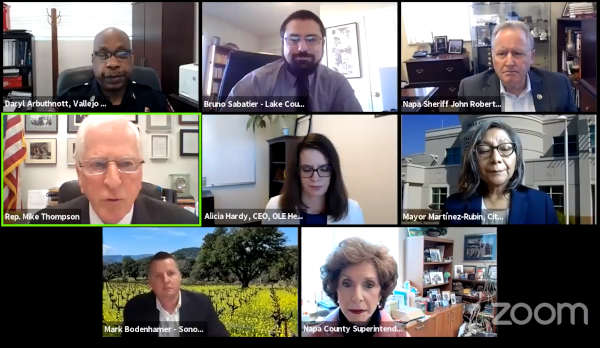
LAKE COUNTY, Calif. – With local governments being the “tip of the spear” in responding to the COVID-19 pandemic’s health and economic challenges, Congressman Mike Thompson and a group of local leaders from around his North Coast district met online on Tuesday afternoon to discuss the American Rescue Plan and the state and local funding it includes.
Video of the discussion can be seen here.
The $1.9 trillion plan, proposed by President Joe Biden, includes $350 billion for the creation of a new State and Local Coronavirus Relief Fund to provide critical support to state, local, tribal and territorial governments that was not included in the previous stimulus and relief packages.
California’s estimated allocation would be $26.2 billion. Thompson said more than half a billion dollars is expected to come to the Fifth Congressional District.
Locally, the county of Lake and its cities could receive $13.9 million, while Contra Costa County and its cities would receive $241.4 million, $47.4 million for Napa County, $117.2 million for Solano County and $142.6 million for Sonoma County.
Thompson’s office said that by replacing lost and decreased state and local revenue, these funds will help state and local governments keep first responders, frontline health workers and other essential service providers on the job safe; continue to roll out vaccines; and start to rebuild and support small businesses hurt by this pandemic.
During Tuesday’s discussion, Thompson was joined by Lake County Board of Supervisors Chair Bruno Sabatier, Pinole Mayor Norma Martinez-Rubin, Napa County Sheriff John Robertson, Vallejo Fire Chief Daryl Arbuthnott, Napa County Superintendent of Public Schools Barbara Nemko, Sonoma Valley Chamber of Commerce CEO Mark Bodenhamer and Ole Health CEO Alicia Hardy.
Thompson said he brought the local leaders together to explain why this funding is so vital to keep first responders on the job, support teachers and make sure businesses can stay open.
Nearly 490,000 Americans have died from the virus, with millions more who have been sick, Thompson said.
“Businesses are closed, some of them sadly, forever,” with nearly one milion people filing for unemployment every week and children out of school, he said.
“We need a strong federal response, and we need to respond quickly,” said Thompson, explaining that the relief the package offers “addresses both the health and the economic sides of this pandemic.”
The plan includes $23 billion for vaccine manufacturing and distribution, another $1,400 in stimulus checks for individuals, $30 billion in rental assistance, expansion of emergency unemployment insurance through September and $15 billion in grants for the hardest hit small businesses, Thompson said.
All of that is in addition to the $350 billion in direct assistance for state and local governments.
“State and local governments are doing so much,” said Thompson. “Our cities and counties are essential public services.”
Local leaders share challenges
“All aspects of our communities have been impacted by COVID-19 and we must continue to act,” said Sabatier.
One of the key differences between the American Rescue Plan and the CARES Act, the relief bill passed last year, is that it offers communities of under 500,000 residents direct access to the funds rather than having them allocated through the state, Sabatier said.
He said funds can help with a variety of things such as public health, testing and contact tracing. “Even as a surge wanes it is more important than ever to isolate these new cases.”
Sabatier said the vaccine rollout is critical, and requires acting efficiently and equitably. Two facilities are now serving Lake County’s homeless, a very vulnerable demographic, and he said those services should be continued throughout the pandemic and beyond.
There also has been an increased need in Behavioral Health services, with Lake County experiencing a 500-percent increase in substance abuse calls compared to last year, Sabatier said.
Other critical services Sabatier said require funding are the senior centers’ Meals on Wheels programs and the increased safety protocols put in place at the Lake County Jail, where an outbreak occurred.
Vallejo Fire Chief Daryl Arbuthnott said fire personnel, like medical workers, have continued working through the pandemic with no break.
The city of Vallejo has had to dip into its reserves and retirement to make ends meet, with Arbuthnott noting the pandemic has created unexpected expenses and challenges for small government. On top of that, there were last year’s wildland fires and the summertime protests.
Arbuthnott said the package “will do wonders” for small governments and fire departments.
“Nobody has been hit harder than kids,” said Napa County Superintendent of Schools Barbara Nemko, who explained that schools there have been in a hybrid model since October, with children only in school in person about two and a half days a week.
The children also need a lot of social and emotional support in addition to a great deal of academic interventions, Nemko said.
For every month a child is out of school, it translates to financial loss in their later careers, she said.
Nemko also noted a vaccine shortage is impacting their schools. She said 950 school staffers were vaccinated a month ago but they don’t yet have enough vaccine for the second doses.
“Our businesses have been hit incredibly hard by this pandemic,” said Mark Bodenhamer, the Sonoma Valley Chamber of Commerce CEO.
He said he’s hopeful for the vaccine, but cautioned that the pandemic’s economic damage will take years to overcome.
The pandemic has shown how interconnected businesses and the government are. “Our economy truly is like an ecosystem,” Bodenhamer said.
While the chamber doesn’t usually advocate for government funding, Bodenhamer said this is an extraordinary circumstance and every effort needs to be made to keep the economy and community intact.
“The CARES Act really did save the American economy,” Thompson said of last year’s help from the government.
Alicia Hardy, CEO of OLE Health of Napa and Sonoma counties, also pointed to the need for additional funding for testing and vaccinations, and the American Rescue Plan’s one-time direct funding for community centers to cover things like vaccine administration and recovering lost revenue.
She said they also have seen a 200-percent increase in demand for mental health services and are struggling to meet that demand.
Economic recovery concerns and the Lake County process
Lake County News asked Thompson about the assumptions behind the legislation, and whether or not the plan’s monetary infusion will carry the country through the year – if a majority of Americans take the vaccine and more sectors start to reopen by fall – or if there is an anticipation that more aid may be needed as a bridge into next year should some sectors still be lagging.
Thompson said most major economists have said the biggest danger isn’t spending too much, it’s spending not enough.
He said Biden has increased the available vaccine by 57 percent and earlier in the day it was announced that 13.6 million doses a week will be made available to the states, up from 11 million. Thompson said he’s hopeful that everyone can be vaccinated by the end of summer.
“All the economists told us this from day No. 1, it’s not like throwing the light switch, it’s not like the economy’s off or the economy’s on, even when we get back to operating in a safe environment, there’s going to be some struggles,” Thompson said, pointing out that some businesses will never open again.
Recovery is going to be slow going, and while Thompson said he would love it if this is the last go-around needed in terms of funding, “If the American people need help after September, we need to be there to give them help.”
Lake County News also asked Sabatier about what the process for determining the use of the funds would look like if the plan passes and the county of Lake receives the anticipated amount of money.
Sabatier said it would be similar to how the Board of Supervisors dealt with the CARES Act funding last year. They had a committee review the programs and services being stretched thin because of COVID-19 and then came back to the board for a public discussion on how to allocate it.
He said they also would need to look at the situation, which is going to last “a little longer than any of us anticipated” and make sure critical government services don’t decrease, while also considering all of the needs important to the community.
“I will continue to work to pass this bill as soon as possible and look forward to the president signing it into law, so we can get this relief to our communities as fast as possible,” Thompson said in a followup statement on Tuesday.
Email Elizabeth Larson at
LAKE COUNTY, Calif. – On Tuesday night, the Lakeport City Council voted unanimously to extend its contract with a retail recruitment firm and honored a city resident who spent nearly a decade serving on the Lakeport Planning Commission.
City Manager Kevin Ingram asked the council to approve an amendment to extend the professional services agreement with The Retail Coach, which the city hired in 2019 to assess the Lakeport area, assist with bringing new retailers to the city and work with existing businesses.
Ingram said the company was able to do analysis and baseline data that the city had been missing for years.
That analysis found that while Lakeport has a population of about 5,000 people, its daytime population – made up of visitors who come for reasons including employment, shopping and medical appointments – actually swells to 50,000.
That information was “a game changer,” as Ingram said it allowed the city to approach retailers that might otherwise have not considered the city because of its small population base.
The Retail Coach’s staff visited Lakeport to meet with local businesses. Ingram said one of the reasons the city hired the company is that it works with existing businesses in the community.
However, the work was delayed due to the COVID-19 pandemic.
Ingram said the Retail Coach’s proposal to the city included these eight phases:
1. Analyzing the market.
2. Determining retail opportunities.
3. Identifying development and redevelopment opportunities.
4. Identifying retailers and developers for recruitment.
5. Marketing and branding.
6. Recruiting retailers and developers.
7. Downtown revitalization.
8. Retail recruitment coaching.
The delays began after step five, Ingram said.
He said The Retail Coach put together a best fit retail list and started the process of soliciting new retailers but, due to COVID-19, no retailers wanted to take the step to locate here, although he added no one was saying no exactly.
The Retail Coach understood that 2020 was a “flop” year, and Ingram said they were gracious in negotiating an extension with the city that will pick up with 2021 being year two of the contract and reducing the contract price by $5,000 to $25,000.
While retail trade shows were canceled in 2020, The Retail Coach’s staff members were on the phone and working hard on behalf of the city, making sure retailers know Lakeport exists, he said.
Ingram said retailers are seeing the dynamics have changed and that it will be a tougher market.
The city’s main priority for The Retail Coach is filling the old Kmart building and then continuing to engage the city’s small businesses, Ingram said.
He said the company wants to come out and meet again with local retail businesses to help them identify some entrepreneurial openings in the city’s gap and opportunity analysis.
During the discussion, Ingram explained that the best fit retail list consists of businesses expanding in the region and those that have supply chains here.
Ingram also noted that the city has had conversations with The Retail Coach about what the retail industry will look like in the coming years and whether companies will expand or contract their space.
He said that one of the conclusions is that there have been big losers but also some really big winners. The companies that already were having trouble prior to COVID-19 have had continued problems and the pandemic is helping them out the door. On the other side, businesses utilizing new technologies have flourished.
There appears to be a trend for smaller footprints rather than giant big box store developments, Ingram said, which is a positive for Lakeport. However, retail companies pursuing smaller spaces are focusing more on entering urban areas instead of rural ones.
Ingram said the Retail Coach will work on showing retailers that Lakeport’s numbers are a sure bet, especially for things like clothing and home goods, which the city’s data shows offers good opportunities.
While there are certainly still challenges ahead, Ingram said there also is an optimistic forecast as well.
Mayor Pro Tem Stacey Mattina moved to approve the contract amendment, which was seconded by Councilman Michael Green and approved 5-0.
Council honors Wicks for service
The council took time on Tuesday to present a proclamation honoring Ken Wicks Jr., who left the Lakeport Planning Commission in December after nine and a half years of service – with about five of those years spent as commission chair.
The proclamation noted that Wicks was instrumental in the updating, review and implementation of the 2014 and 2020 Housing Element updates, adoption of the Forbes Creek Neighborhood Study, Eleventh Street Corridor Study, the Lakefront Revitalization Plan, as well as several zoning amendments such as the cannabis and telecommunication ordinances.
Wicks “provided a vast knowledge of construction project management that provided invaluable insight and perspective to project phasing and was a benefit to the decision-making process of
the Planning Commission,” the proclamation said.
Councilmembers Michael Froio and Michael Green both served on the commission with Wicks and lauded his service.
“He was always well prepared, professional, thoughtful and conscientious,” said Froio, adding that Wicks was the rudder that gently steered the planning commission and made sure it was doing what it was supposed to do.
Green said Wicks encouraged him to run for city council, and he credited Wicks with teaching him how to run a meeting, read staff reports and appreciate the general plan.
“You were a great asset to the city and I do appreciate the time I spent with you on the planning commission,” Green said.
George Spurr, who stepped down from the city council at the end of 2020, also served with Wicks on the planning commission, and thanked him for his help, noting the wealth of knowledge he has about the city.
“Enjoy this wonderful city knowing you were a big part of it,” said Spurr.
Ingram said that when he joined the city as Community Development director six years ago, they had some “doozy” projects that led to packed council chambers. During that time, Wicks kept the commission on the ball and in tune with their mission, while staying professional.
“You’re going to be missed,” Ingram said.
Mayor Kenny Parlet said Wicks knows the regulations. “I don’t think you will be easily replaced ever, at least not soon.”
Parlet said there are few people who have the decorum, experience, knowledge and class Wicks has.
Mattina also congratulated Wicks on his recent marriage. Wicks said he and his wife, Yvonne, are very happy.
Wicks thanked the councils past and present and the public for allowing him to serve. He said Lakeport is a great town with great people, and he was glad to do something to advance the city.
Also during Tuesday’s two-and-a-half-hour-long meeting, the council received the traffic safety biannual review and got the police statistics and training summary report for 2020 from Police Chief Brad Rasmussen.
The council also voted to direct staff to initiate a text amendment to the zoning ordinance to address microenterprise home kitchen operations, which are allowed in a pilot program that continues through July.
As part of the vote, the council directed city staff to work with county staff so that the text amendment would be in effect if the county proposes to continue with a permanent program after the pilot program ends on July 1.
Email Elizabeth Larson atThis email address is being protected from spambots. You need JavaScript enabled to view it. . Follow her on Twitter, @ERLarson, or Lake County News, @LakeCoNews.
City Manager Kevin Ingram asked the council to approve an amendment to extend the professional services agreement with The Retail Coach, which the city hired in 2019 to assess the Lakeport area, assist with bringing new retailers to the city and work with existing businesses.
Ingram said the company was able to do analysis and baseline data that the city had been missing for years.
That analysis found that while Lakeport has a population of about 5,000 people, its daytime population – made up of visitors who come for reasons including employment, shopping and medical appointments – actually swells to 50,000.
That information was “a game changer,” as Ingram said it allowed the city to approach retailers that might otherwise have not considered the city because of its small population base.
The Retail Coach’s staff visited Lakeport to meet with local businesses. Ingram said one of the reasons the city hired the company is that it works with existing businesses in the community.
However, the work was delayed due to the COVID-19 pandemic.
Ingram said the Retail Coach’s proposal to the city included these eight phases:
1. Analyzing the market.
2. Determining retail opportunities.
3. Identifying development and redevelopment opportunities.
4. Identifying retailers and developers for recruitment.
5. Marketing and branding.
6. Recruiting retailers and developers.
7. Downtown revitalization.
8. Retail recruitment coaching.
The delays began after step five, Ingram said.
He said The Retail Coach put together a best fit retail list and started the process of soliciting new retailers but, due to COVID-19, no retailers wanted to take the step to locate here, although he added no one was saying no exactly.
The Retail Coach understood that 2020 was a “flop” year, and Ingram said they were gracious in negotiating an extension with the city that will pick up with 2021 being year two of the contract and reducing the contract price by $5,000 to $25,000.
While retail trade shows were canceled in 2020, The Retail Coach’s staff members were on the phone and working hard on behalf of the city, making sure retailers know Lakeport exists, he said.
Ingram said retailers are seeing the dynamics have changed and that it will be a tougher market.
The city’s main priority for The Retail Coach is filling the old Kmart building and then continuing to engage the city’s small businesses, Ingram said.
He said the company wants to come out and meet again with local retail businesses to help them identify some entrepreneurial openings in the city’s gap and opportunity analysis.
During the discussion, Ingram explained that the best fit retail list consists of businesses expanding in the region and those that have supply chains here.
Ingram also noted that the city has had conversations with The Retail Coach about what the retail industry will look like in the coming years and whether companies will expand or contract their space.
He said that one of the conclusions is that there have been big losers but also some really big winners. The companies that already were having trouble prior to COVID-19 have had continued problems and the pandemic is helping them out the door. On the other side, businesses utilizing new technologies have flourished.
There appears to be a trend for smaller footprints rather than giant big box store developments, Ingram said, which is a positive for Lakeport. However, retail companies pursuing smaller spaces are focusing more on entering urban areas instead of rural ones.
Ingram said the Retail Coach will work on showing retailers that Lakeport’s numbers are a sure bet, especially for things like clothing and home goods, which the city’s data shows offers good opportunities.
While there are certainly still challenges ahead, Ingram said there also is an optimistic forecast as well.
Mayor Pro Tem Stacey Mattina moved to approve the contract amendment, which was seconded by Councilman Michael Green and approved 5-0.
Council honors Wicks for service
The council took time on Tuesday to present a proclamation honoring Ken Wicks Jr., who left the Lakeport Planning Commission in December after nine and a half years of service – with about five of those years spent as commission chair.
The proclamation noted that Wicks was instrumental in the updating, review and implementation of the 2014 and 2020 Housing Element updates, adoption of the Forbes Creek Neighborhood Study, Eleventh Street Corridor Study, the Lakefront Revitalization Plan, as well as several zoning amendments such as the cannabis and telecommunication ordinances.
Wicks “provided a vast knowledge of construction project management that provided invaluable insight and perspective to project phasing and was a benefit to the decision-making process of
the Planning Commission,” the proclamation said.
Councilmembers Michael Froio and Michael Green both served on the commission with Wicks and lauded his service.
“He was always well prepared, professional, thoughtful and conscientious,” said Froio, adding that Wicks was the rudder that gently steered the planning commission and made sure it was doing what it was supposed to do.
Green said Wicks encouraged him to run for city council, and he credited Wicks with teaching him how to run a meeting, read staff reports and appreciate the general plan.
“You were a great asset to the city and I do appreciate the time I spent with you on the planning commission,” Green said.
George Spurr, who stepped down from the city council at the end of 2020, also served with Wicks on the planning commission, and thanked him for his help, noting the wealth of knowledge he has about the city.
“Enjoy this wonderful city knowing you were a big part of it,” said Spurr.
Ingram said that when he joined the city as Community Development director six years ago, they had some “doozy” projects that led to packed council chambers. During that time, Wicks kept the commission on the ball and in tune with their mission, while staying professional.
“You’re going to be missed,” Ingram said.
Mayor Kenny Parlet said Wicks knows the regulations. “I don’t think you will be easily replaced ever, at least not soon.”
Parlet said there are few people who have the decorum, experience, knowledge and class Wicks has.
Mattina also congratulated Wicks on his recent marriage. Wicks said he and his wife, Yvonne, are very happy.
Wicks thanked the councils past and present and the public for allowing him to serve. He said Lakeport is a great town with great people, and he was glad to do something to advance the city.
Also during Tuesday’s two-and-a-half-hour-long meeting, the council received the traffic safety biannual review and got the police statistics and training summary report for 2020 from Police Chief Brad Rasmussen.
The council also voted to direct staff to initiate a text amendment to the zoning ordinance to address microenterprise home kitchen operations, which are allowed in a pilot program that continues through July.
As part of the vote, the council directed city staff to work with county staff so that the text amendment would be in effect if the county proposes to continue with a permanent program after the pilot program ends on July 1.
Email Elizabeth Larson at
LOWER LAKE, Calif. – A restoration project at Anderson Marsh State Historic Park is set to get underway this week with a prescribed burn.
California State Parks in cooperation with the Lake County Fire Protection District are planning the prescribed burn in the park on Saturday, Feb. 20, Weather permitting.
This effort will be carried out in cooperation with other partner agencies.
The burn is the first step in a new project that the Anderson Marsh Interpretive Association will undertake, in cooperation with State Parks, to restore the park’s three-acre entrance meadow, which burned in the 2016 Clayton fire.
AMIA has received a $9,026 grant from the California State Parks Foundation’s Wildfire Resiliency and Prevention Fund to conduct the work, as Lake County News reported this week.
State Parks said such burns are part of the prescribed fire program for vegetation management, hazardous fuel load reduction, wildlife habitat improvement, and other ecological benefits.
This treatment will enhance the health of the park by removing diseased materials, restoring essential nutrients to the soil, and reducing the chance of a catastrophic wildfire.
In grassland and scrub areas, fire will be reintroduced as a component of the ecosystem on a rotational basis. The prescribed burns will also help in reducing dangerous fuel loads throughout wildland areas.
All burning depends on weather and air quality conditions that are favorable for smoke dispersal. If the conditions, such as weather or vegetation are not conducive for burning, the burns will be rescheduled.
Some public trails near the burn area will be closed the day of the burn. People traveling near the fire burn areas may see smoke from 8 a.m. to 4 p.m. on the day of the burn.
In the unlikely event you smell smoke, Lake County officials urge you to take precautions and use common sense to reduce any harmful health effects by limiting outdoor activities. Prescribed burns produce significantly less smoke than a wildfire does.
If you see or smell smoke in your surroundings, officials recommend avoiding strenuous outdoor activity and remaining indoors as much as possible. These precautions are especially important for children, the elderly, and people with respiratory and heart conditions.
Please use extreme caution while driving near prescribed fire operations due to fire personnel and equipment in the area.
California State Parks and Lake County Fire Protection District are adhering to the safety protocols set by public health officials and have made accommodations to limit exposure among first responders and field crews to protect staff from COVID-19 during prescribed burns.
California State Parks in cooperation with the Lake County Fire Protection District are planning the prescribed burn in the park on Saturday, Feb. 20, Weather permitting.
This effort will be carried out in cooperation with other partner agencies.
The burn is the first step in a new project that the Anderson Marsh Interpretive Association will undertake, in cooperation with State Parks, to restore the park’s three-acre entrance meadow, which burned in the 2016 Clayton fire.
AMIA has received a $9,026 grant from the California State Parks Foundation’s Wildfire Resiliency and Prevention Fund to conduct the work, as Lake County News reported this week.
State Parks said such burns are part of the prescribed fire program for vegetation management, hazardous fuel load reduction, wildlife habitat improvement, and other ecological benefits.
This treatment will enhance the health of the park by removing diseased materials, restoring essential nutrients to the soil, and reducing the chance of a catastrophic wildfire.
In grassland and scrub areas, fire will be reintroduced as a component of the ecosystem on a rotational basis. The prescribed burns will also help in reducing dangerous fuel loads throughout wildland areas.
All burning depends on weather and air quality conditions that are favorable for smoke dispersal. If the conditions, such as weather or vegetation are not conducive for burning, the burns will be rescheduled.
Some public trails near the burn area will be closed the day of the burn. People traveling near the fire burn areas may see smoke from 8 a.m. to 4 p.m. on the day of the burn.
In the unlikely event you smell smoke, Lake County officials urge you to take precautions and use common sense to reduce any harmful health effects by limiting outdoor activities. Prescribed burns produce significantly less smoke than a wildfire does.
If you see or smell smoke in your surroundings, officials recommend avoiding strenuous outdoor activity and remaining indoors as much as possible. These precautions are especially important for children, the elderly, and people with respiratory and heart conditions.
Please use extreme caution while driving near prescribed fire operations due to fire personnel and equipment in the area.
California State Parks and Lake County Fire Protection District are adhering to the safety protocols set by public health officials and have made accommodations to limit exposure among first responders and field crews to protect staff from COVID-19 during prescribed burns.