 How to resolve AdBlock issue?
News
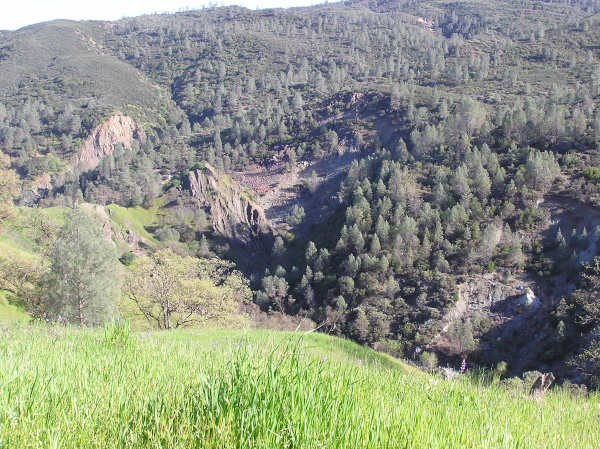
NORTHERN CALIFORNIA – In the early 20th century, grand theories like relativity and quantum mechanics triumphed and came to define science so much that plant ecology felt it needed one of its own to be taken seriously as science.
Frederic Clements helpfully provided one.
His monoclimax theory claimed all vegetation in a climate zone converged to a particular kind called the climatic climax. It seemed to make sense because in its natural state eastern North America it was largely covered by forests from Quebec to Florida and from the Atlantic to eastern Oklahoma.
In the theory, exceptions like abandoned farms, wetlands and rock outcrops were constantly pushed by succession to be covered by forest as well: the region’s climatic climax.
Further west, in a drier climate, a band of nearly treeless grassland that extended from Canada south well into Mexico was the site of dramatic history as cattle were driven north through it from Texas to railroads in Kansas, and eventually to new pastures in Montana as described in “Lonesome Dove.”
Much of what we know as the wild west took place there in the single 1870’s decade from Wyatt Earp’s taming Dodge City to Custer’s defeat at the Little Big Horn. It’s climatic monoclimax, of course, was grassland.
When Clements saw California’s Central Valley, its plains reminded him so much of those in his Nebraska home state, he concluded it must have the same climate.
Consequently, in his climatic climax map, that valley is colored the same yellow as the great plains. And since his theory demanded the same plants in the same climate, he found a few bunch grasses in California related to those in Nebraska and declared them the valley’s original vegetation his theory demanded; even though John Muir 50 years earlier found the still largely undisturbed valley covered with spring and fall wildflowers and very little grass. Despite that, Clements’ bunch grass theory was widely and dogmatically believed until quite recently.
Another plant ecologist W. S. Cooper knew the Central Valley’s climate was nothing like Nebraska but still believed fervently in monoclimaxes. He decided California’s unique climate deserved its own unique climax vegetation and found it in uniquely Californian chaparral shrublands.
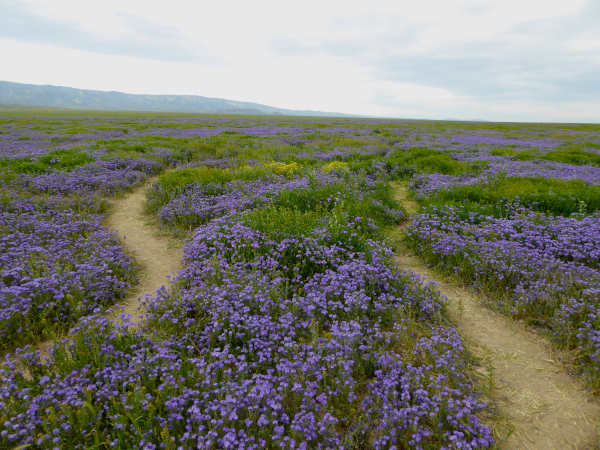
And good theorist that he was, Cooper believed chaparral had to be the monoclimax that covered all of California’s distinctive climate zone including the Central Valley, even though no one who had actually been there had ever found anything like that.
But despite scant evidence for Clements’ conclusion about central California and none for Cooper’s, both had their advocates in academic plant ecology throughout the twentieth century since it often practiced what jurists call stare decisis, standing by what’s decided.
Monoclimax was never accepted much in Europe or the rest of the world outside the United States and for good reason. For one, climate is among the least stable of environmental features; hardly one likely to drag vegetation on more stable things like rocks to a monoclimax.
Still, it was significant 50 years ago at UC Davis when a young and soon to be great plant ecology professor Mike Barbour, who tragically passed away late last year, chose the text An Island Called California by an observant amateur Elna Bakker for his classes rather than one by an academic.
Unobstructed by stare decisis Bakker described a previously unnoticed elephant in the room: California has no single “monoclimax” but is a mosaic of many kinds of vegetation that shifts across landscapes as environmental conditions change.
The reason for this mosaic is quite simple but little discussed or noticed. In California’s Mediterranean type climate rain falls when it’s too cold for much plant growth so water is stored underground for a few months until temperatures warm.
Those months cause underground conditions to be much more important here than east of the Rockies, where monoclimax theory was invented and rain falls when plants are ready to grow.
The greater dependence of vegetation in California on its diverse soils and geology during the months they store water increases its botanical diversity and may even increase its resilience to climate change.
This tale is dedicated to Dr. Michael Barbour, friend and mentor who will be remembered always.
Dr. Glen Holstein is a retired senior scientist from Zentner and Zentner, a Northern California biological consulting company and the Chapter Botanist for the Sacramento Valley Chapter of the California Native Plant Society. He is also on the Board of Tuleyome, a Woodland based nonprofit conservation organization.
Public Health Officer Dr. Gary Pace said that as of Thursday afternoon, the state reported most orders of Moderna vaccine placed “since mid to late last week [had] not yet shipped.”
This is due to severe weather disrupting work at a key distribution hub. A “back log of orders,” has resulted, “that will need to get out once weather conditions improve,” officials reported.
Pace said most shipments are expected to arrive next week.
He said the county had used up the last of its vaccine supply by Friday afternoon, after completing the second doses administered this week.
Until the county receives a shipment, Pace said all further clinics will be cancelled.
Once the vaccine arrives, the county will set up the next clinics as soon as possible, and post links for appointment scheduling at http://health.co.lake.ca.us/Coronavirus/Vaccines.htm. If you, or someone connected to you, is eligible to be vaccinated, Pace said to visit this webpage often to see if appointments are available. Information on who is eligible is also posted there.
“Once we receive our shipments of vaccine, we are anticipating ramping up our numbers significantly, so we can get back on track,” Pace said.
While the issues with the vaccine rollout continues, Pace said there continue to be positive signs new COVID-19 infections are diminishing in Lake County.
But he cautioned, “It is important to remember, though, COVID-19 remains widespread in Lake County’s communities, and many of our friends and neighbors are highly vulnerable to severe complications. In just the past week, four Lake County residents have died of COVID-related illness, bringing our total to 40. Each of these is a tragic reminder we must remain vigilant to continue recent positive trends, and keep our communities safe.”
Pace said the county’s testing positivity rate is 6.9 percent. “In the last fully reported period, ending Jan. 31, we documented 88 new infections. This is remarkably down from our peak of 292, in the weekly period ending Jan. 3.”
Lake County’s daily case rate now sits at 20 per 100,000. Pace said the county’s data must meet all criteria for the red tier – with a daily case rate from 4.0 to 7.0 per 100,000 and testing positivity of 8 percent or lower – for two consecutive weeks prior to advancing to the less restrictive red tier. That would enable reintroduction of some business services, including limited indoor dining at restaurants.
“Considering recent trends, this can be achievable in the relatively near-term,” said Pace.
Actualización de COVID-19: Continúan las demoras en el envío de la vacuna Moderna debido al clima severo
Para obtener información sobre vacunas, visite http://health.co.lake.ca.us/Coronavirus/Vaccines.htm
Condado de Lake, CA (Febrero 19, 2021) - Sigue habiendo señales positivas de que las nuevas infecciones por COVID-19 están disminuyendo en el condado de Lake. Nuestra tasa de positividad de las pruebas es del 6,9%. En el último período informado en su totalidad, que finalizó el 31 de enero, documentamos 88 nuevas infecciones. Esto está notablemente por debajo de nuestro pico de 292, en el período semanal que finalizó el 3 de enero.
La tasa diaria de casos del condado de Lake ahora se sitúa en 20 / 100.000. Nuestros datos deben cumplir con todos los criterios para el nivel rojo (tasa diaria de casos de 4.0 a 7.0 / 100,000 Y prueba de positividad del 8% o menos) durante dos semanas consecutivas antes de avanzar al nivel rojo menos restrictivo. Eso permitiría la reintroducción de algunos servicios comerciales, incluido el comedor interior limitado en los restaurantes. Teniendo en cuenta las tendencias recientes, esto se puede lograr en un plazo relativamente cercano.
Sin embargo, es importante recordar que COVID-19 sigue estando muy extendido en las comunidades del condado de Lake y muchos de nuestros amigos y vecinos son muy vulnerables a complicaciones graves. En la última semana, 4 residentes del condado de Lake han muerto de enfermedades relacionadas con COVID, lo que eleva nuestro total a 40. Cada uno de estos es un recordatorio trágico de que debemos permanecer alerta para continuar las tendencias positivas recientes y mantener seguras nuestras comunidades.
Actualización de distribución de vacunas
Hasta ayer por la tarde, el Estado informó que la mayoría de los pedidos de la vacuna Moderna realizados "desde mediados o finales de la semana pasada aún no se habían enviado". Esto se debe al clima severo que interrumpe el trabajo en un centro de distribución clave. Un "registro de pedidos atrasados", ha resultado, "que deberán salir una vez que mejoren las condiciones climáticas". Se espera que la mayoría de los envíos lleguen la próxima semana.
Habremos agotado lo último de nuestro suministro de vacunas para el viernes por la tarde, después de completar las segundas dosis administradas esta semana.
Hasta que recibamos un envío, todas las clínicas adicionales serán canceladas. Una vez que llegue la vacuna, estableceremos las próximas clínicas lo antes posible y publicaremos enlaces para registrar citas en http://health.co.lake.ca.us/Coronavirus/Vaccines.htm. Si usted o alguien relacionado con usted es elegible para vacunarse, visite esta página web con frecuencia para ver si hay citas disponibles. La información sobre quién es elegible también se publica allí.
Una vez que recibamos nuestros envíos de vacunas, estamos anticipando un aumento significativo en nuestros números, para que podamos volver a encarrilarnos. ¡Estamos listos!
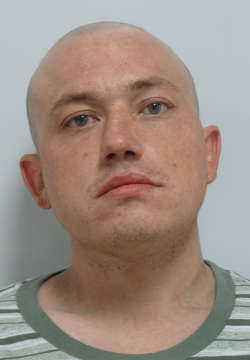
LAKE COUNTY, Calif. – Teamwork between the county’s two police departments led to the arrest of a Lakeport man who had been released a day earlier from the Lake County Jail.
The Clearlake Police Department said it arrested Austin Anthony Schweitzer, 28, on Feb. 17 for possession of a large quantity of suspected methamphetamine and for being under the influence of narcotics. He was booked into the Lake County Jail but soon released.
On Feb. 18, after Schweitzer’s release from custody, police said he is believed to have stolen a vehicle that was left running to warm up in Lakeport. The vehicle contained several credit cards in the vehicle owner’s name.
Police said Schweitzer then drove the vehicle to Clearlake and parked it. He attempted to use the stolen victim’s credit cards at a gas station but was unsuccessful.
Lakeport Police officers learned of the credit card usage and alerted Clearlake Police officers of the situation, according to the report.
Police said the vehicle was quickly located near the gas station by a community service officer along with evidence linking Schweitzer to the vehicle. The vehicle was returned to the owner.
A short time later, police said Schweitzer returned to the gas station where an employee spotted him, but now associated with another vehicle, and notified police.
An alert Clearlake Police officer spotted the vehicle at Walmart and Schweitzer was taken into custody without incident, authorities said.
Police said Schweitzer was found to be in possession of the stolen credit cards, the stolen vehicle’s keys and other property from the stolen vehicle.
He was transported and booked back into the Lake County Jail, where he remains in custody on misdemeanors related to the credit card theft, and felonies for taking the vehicle, being in possession of a stolen vehicle and first-degree burglary.
“We are grateful for the collaboration between the agencies and the community that resulted in the return of the vehicle and apprehension of the suspect,” the Clearlake Police Department said.
Morales pleaded guilty in December to two counts of felony bribery and was sentenced on Friday to four years in prison, which is suspended pending successful completion of a two-year probation term.
The terms of probation include one year of home detention with electronic monitoring and monthly $500 restitution payments to Caltrans.
Morales will also forfeit any CalPERS benefits he accrued between August 2010 and January 2015, when the crimes were committed.
“When you violate the public’s trust, you will be held accountable,” said Becerra. “As public servants, we are held to a higher standard. There is no place for this kind of criminal behavior in our state or state government. At the California Department of Justice, we’re always ready to go to bat for the people of California.”
Morales was employed as an Americans with Disabilities Act, or ADA, coordinator for Caltrans, a role which involves making Caltrans systems, including bridges and public walkways, ADA compliant.
The California Department of Justice arrested Morales in 2015 after a nine-month investigation. Following a preliminary hearing in 2017, a judge held Morales to answer on 39 counts of bribery.
At trial in 2019, the jury acquitted Morales on two counts and deadlocked on the remaining counts.
A new trial was scheduled for 2021, but Morales pleaded guilty in December 2020 to accepting multiple bribes over the course of approximately five years.
The bribes were made in cash payments ranging from $1,875 to $12,000 and included the acceptance of a new white Ford Expedition.
Married clients in second marriages with prior children often have to balance the future wellbeing of their spouse with that of their own children.
In California, a community property state, a resident can bequeath (leave) one-hundred percent of their separate property assets and one-half of their community property assets.
A resident may only bequeath the entirety of a community property asset to someone other than their spouse with their spouse’s consent or acquiescence.
Let’s discuss.
First, does the client’s spouse even need support? Sometimes not. If not, then the client usually leaves his or separate property assets directly to his or her own children.
Nonetheless, as the surviving spouse remains an heir of the client, the client’s will and/or trust must acknowledge the marriage and say that that the spouse is not inheriting.
Otherwise, the surviving spouse as heir may be entitled either to a one-half or one-third share in the decedent’s separate property and all of the couple’s community property assets.
The surviving spouse would inherit if the client died intestate (with no will or trust) or the client died with an old trust or will she signed prior to the marriage that omitted her spouse.
If the spouse needs support then then consider the assets and family relationships involved. Are the client’s assets her separate property either from prior to marriage or from inheritance while married? Do the client’s spouse and children get along? Are the spouse and client’s children close in age? Is it possible for the beneficiaries to inherit separate assets?
If the client's spouse and children often disagree and/or are close in age, and separate assets can go to each party, then perhaps they should inherit separate assets outright and part ways.
Otherwise entanglement occurs when the spouse is the lifetime beneficiary and children are death beneficiaries of a trust. Perhaps the client’s house goes to her children and her retirement plan goes to her spouse (who takes required minimum distributions over his lifetime).
If it is neither possible nor necessary to disentangle the spouse and children then consider making the spouse a lifetime beneficiary of a trust that owns some or all of the client’s assets. Such a trust requires careful drafting.
When and to what extent is the spouse allowed to invade the trust principal (in addition to receiving the income)? Is the spouse only allowed if the spouse’s own income and resources are first exhausted? Who will be the trustee that balances the competing interests of the spouse and children?
Next, do the children need support? If so, what support? Do the children receive SSI or Medi-Cal? Are the children able to manage an outright inheritance? Perhaps either a special needs or a support trust is needed and appropriate. Alternatively, consider delayed gifting using an annuity to prolong the benefits.
Next, what if the client wants to leave her home to her children but the community property estate has an interest in the residence? That is, perhaps community property money was used to pay down the mortgage.
For example, the client owned a home prior to marriage and continued paying off the mortgage with her own earnings while married. If so, the community property estate receives an ownership interest in the home to the extent either spouse’s earnings while married paid off the mortgage or improved the home.
Nevertheless, the client’s estate plan may still leave the home to her children but offsetting assets (like brokerage accounts) to compensate the spouse for his interest in the home. This is a “forced election”: Either the surviving spouse enforces their community property rights (in the home) or the spouse receives other assets (brokerage accounts) left him or her by the deceased spouse.
The foregoing is a brief and limited foray into a much broader and more complex subject. It is no substitute for consulting a competent estate planning attorney.
Dennis A. Fordham, attorney, is a State Bar-Certified Specialist in estate planning, probate and trust law. His office is at 870 S. Main St., Lakeport, Calif. He can be reached at
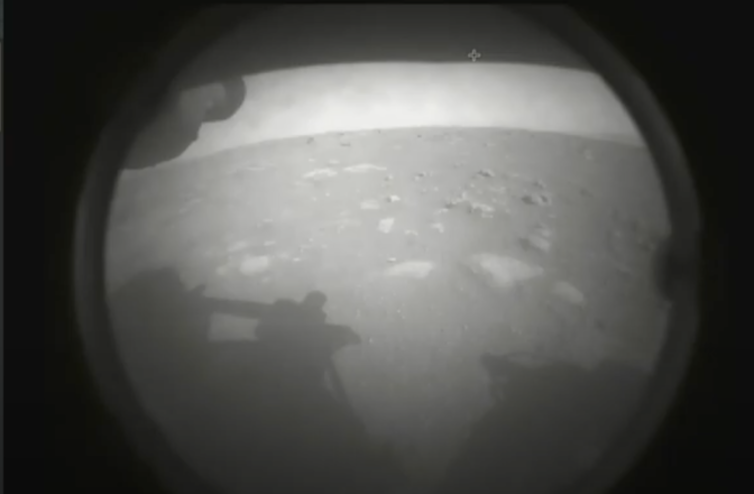
Editor’s note: On Feb. 18, NASA’s Mars 2020 mission arrived at the red planet and successfully landed the Perseverance Rover on the surface. Jim Bell is a professor in the School of Earth and Space Exploration at Arizona State University and has worked on a number of Mars missions. He is the primary investigator leading a team in charge of one of the camera systems on Perseverance. We spoke with him in late January for The Conversation’s new podcast, The Conversation Weekly.
Below are excerpts from our conversation that have been edited for length and clarity.
What’s the goal of this mission?
What we’re looking for is evidence of past life, either direct chemical or organic signs in the composition and the chemistry of rocks, or textural evidence in the rock record. The environment of Mars is extremely harsh compared to the Earth, so we’re not really looking for evidence of current life. Unless something actually gets up and walks in front of the cameras, we’re really not going to find that.
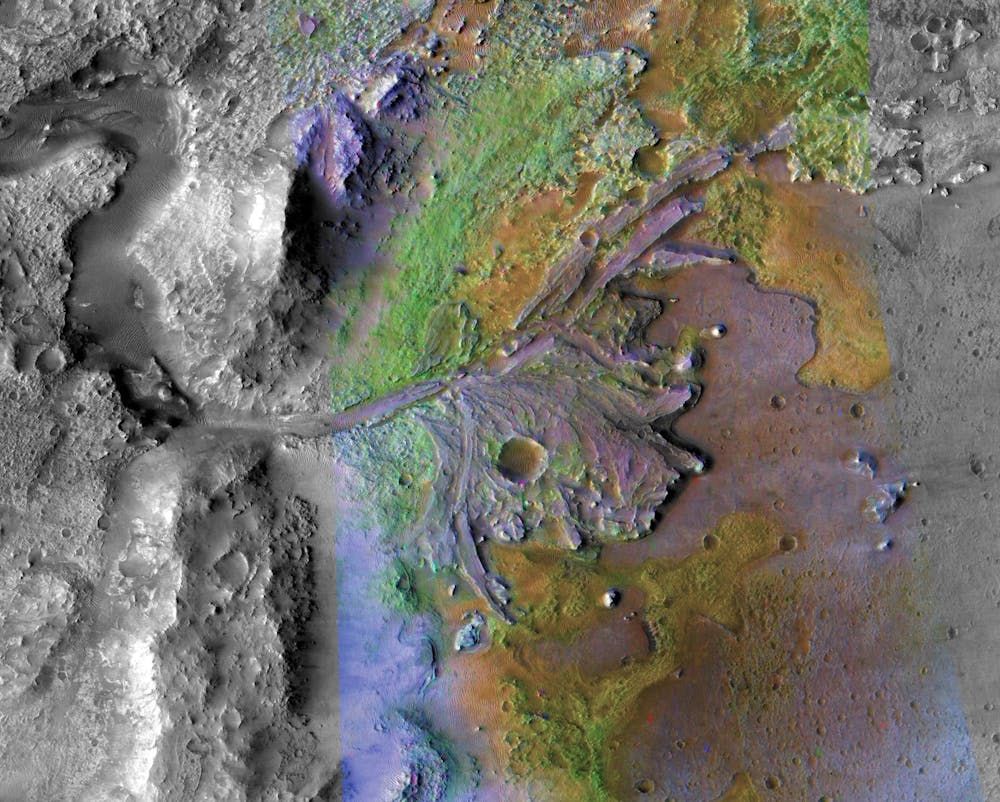

Where is the Perseverance Rover landing to look for ancient life?
There was a three- or four-year process that involved the entire global community of Mars and planetary science researchers to figure out where to send this rover. We chose a crater called Jezero. Jezero has a beautiful river delta in it, preserved from an ancient river that flowed down into that crater and deposited sediments. This is kind of like the delta at the end of the Mississippi River in Louisiana which is depositing sediments very gently into the Gulf of Mexico.
On Earth, this shallow water is a very gentle environment where organic molecules and fossils can actually be gently buried and preserved in very fine-grained mudstones. If a Martian delta operates the same way, then it’s a great environment for preserving evidence of things that were flowing in that water that came from the ancient highlands above the crater.
There’s lots of things we don’t know, but there was liquid water there. There were heat sources – there were active volcanoes 2, 3, 4 billion years ago on Mars – and there are impact craters from asteroids and comets dumping lots of heat into the ground as well as organic molecules. It’s a very short list of places in the solar system that meet those constraints, and Jezero is one of those places. It’s one of the best places that we think to go to do this search for life.
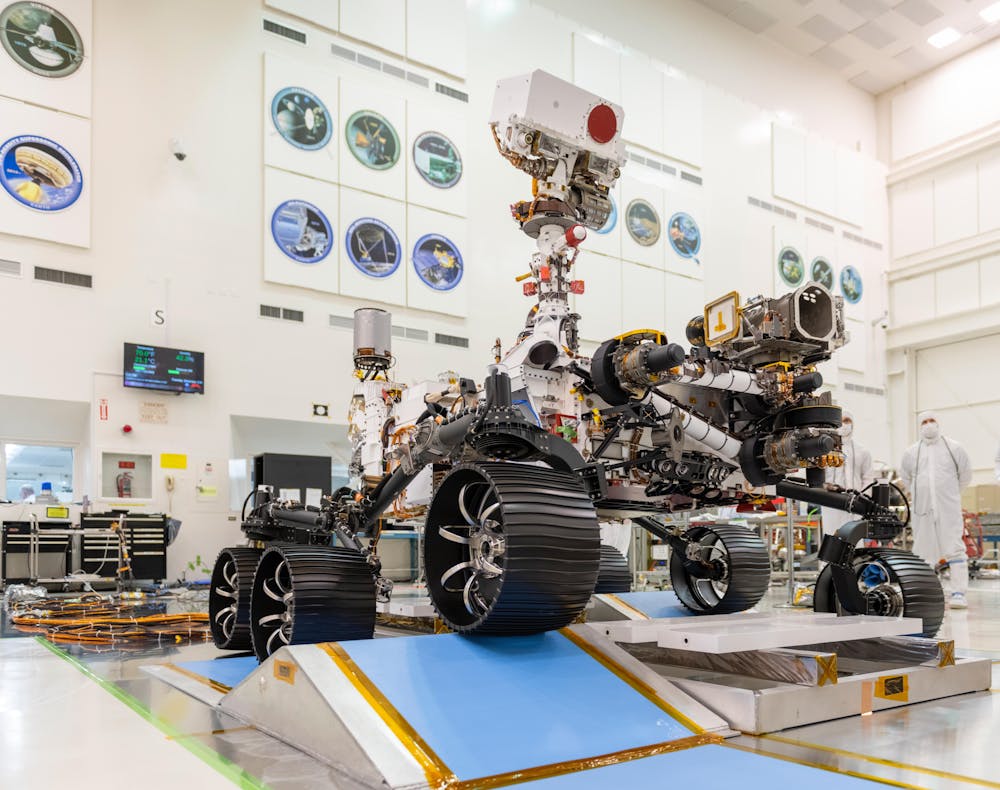
#/media/File:PIA23499-Mars2020Rover-FirstTestDrive-20191217a.jpg)
What scientific tools is Perseverance carrying?
The Perseverance Rover looks a lot like Curiosity on the outside because it’s made from something like 90% spare parts from Curiosity – that’s how NASA could afford this mission. Curiosity has a pair of cameras – one wide angle, one telephoto.

In Perseverance, we’re sending similar cameras, but with zoom technology so we can zoom from wide angle to telephoto with both cameras – the “Z” in Mastcam-Z stands for zoom. This allows us to get great stereo images. Just like our left eye and our right eye build a three-dimensional image in our brain, the zoom cameras on Perserverance are a left eye and a right eye. With this, we can build a three-dimensional image back on Earth when we get those images.
3D images allow us to do a whole range of things scientifically. We want to understand the topography of Mars in much more detail than we’ve been able to in the past. We want to put the pieces of the delta geology story together not just with two-dimensional, spatial information, but with height as well as texture. And we want to make 3D maps of the landing site.
Our engineering and driving colleagues really need that information too. These 3D images will help them decide where to drive by helping to identify obstacles and slopes and trenches and rocks and stuff like that, allowing them to drive the rover much deeper into places than they would have been able to otherwise.
And finally, we’re going to make really cool 3D views of our landing site to share with the public, including movies and flyovers.

What else is different about this mission?
Perseverance is intended to be the first part of a robotic sample return mission from Mars. So instead of just drilling into the surface like the Curiosity Rover does, Perseverance will drill and core into the surface and cache those little cores into tubes about the size of a dry-erase marker. It will then put those tubes onto the surface for a future mission later this decade to pick up and then bring back to the Earth.
Perseverance won’t come back to the Earth, but the plan is to bring the samples that we collect back.
In the meantime, we’ll be doing all of the science that any great rover mission would do. We are going to characterize the site, explore the geology and measure the atmospheric and weather properties.
[Deep knowledge, daily. Sign up for The Conversation’s newsletter.]
How will you get those samples back to Earth?
This is where it gets a little less certain, because these are all ideas and missions in the works. NASA and the European Space Agency are collaborating on a concept to build and launch a lander that will send a little fetch rover that goes and gets the little tubes, picks them up and brings them back to the lander. Waiting on the lander would be a small rocket called a Mars Ascent Vehicle, or MAV. Once the samples are loaded into the MAV, it launches them into Mars orbit.
Then you’ve got this grapefruit- to soccer-ball-sized canister up there, and NASA and the Europeans are collaborating on an orbiter that will search for that canister, capture it and then rocket it back to the Earth, where it will land in the Utah desert. What could possibly go wrong?
If successful, that’ll be the first time we’ve done that from Mars. The scientific tools on the rovers are good, but nothing like the labs back on Earth. Bringing those samples back is going to be absolutely critical to getting the most out of the samples.
This is an updated version of an article originally published on Feb. 4. The editor’s note was updated to reflect the successful landing of the Perseverance Rover on Mars.
Jim Bell, Professor of Earth and Space Exploration, Arizona State University
This article is republished from The Conversation under a Creative Commons license. Read the original article.