 How to resolve AdBlock issue?
News
On May 22, the agencies took part in a statewide underage drinking enforcement operation, referred to as a “shoulder tap.”
A shoulder tap is a covert operation in which an undercover minor decoy volunteer solicits adults to purchase alcohol for them.
The minor decoy makes it clear to the adult that they are a minor and they have money to purchase the alcohol but cannot because of their age.
If an adult purchases the minor alcohol they are placed under arrest and either booked at the county jail or released on a citation at the scene.
During the operation, the team visited six separate businesses that sell alcohol. The minor decoy asked 28 adults to purchase alcohol for them.
At approximately 1:10 p.m. May 22, the minor decoy asked and was provided alcohol by Donald Johnson of Sunnyvale.
The team contacted Johnson and subsequently placed him under arrest for providing alcohol to a minor. Jonson was released with a citation at the scene.
The penalty for furnishing alcohol to a minor is a minimum $1,000 fine and 24 hours of community service. The program is intended to reduce the availability of alcohol to minors.
The Lakeport Police Department said it is committed to enforcing alcohol-related laws and keeping alcohol out of the possession of minors.
This project is part of the Department of Alcoholic Beverage Control’s Alcohol Policing Partnership and was funded through grant funds the Lakeport Police Department was awarded through that program.
Spring is traditionally a time of more activity in the market and we are seeing that again this year.
Compared to March, active listings are up slightly in April — March had 128 listings compared to April’s 136.
Sales quickly follow — March had 73, April had 96 — as many homes are selling as soon as they hit the market.
Here is a snapshot of the Lake County real estate market for April 2021 compared to April 2020.
Active listings throughout Lake County were 136, which is down 51.1% from April 2020.
That breaks down as follows:
— Lakeport: 21, down 19.2%.
— Kelseyville: 25, down 63.8%.
— Hidden Valley Lake: 17, down 63%. That’s notably up from March, when active listings in Hidden Valley Lake only totaled nine.
— Clearlake: 26, down 42.2%.
Existing home sales throughout Lake County totaled 96 in April 2021, up 57.4% from April 2020.
By community, those sales are divided this way:
— Lakeport: 11.
— Kelseyville: 19, up 18.8%
— Hidden Valley Lake: 24, 200% over last year. This could be due to lack of sales in that area due to COVID-19 restrictions.
— Clearlake: 17, up 54.5%.
The existing home median price throughout Lake County for April 2021 was $325,000, up 19.5% from April 2020.
Prices by community are:
— Lakeport: $385,000, up 2.7%.
— Kelseyville: $330,000, up 21.8%.
— Hidden Valley Lake: $361,000, up 8.9%.
— Clearlake: $220,000, up 5.3%.
Throughout Lake County, for April 2021, median days on the market were 17.
In Lakeport, days on market were 12; Kelseyville, 31; Hidden Valley Lake, 16; and Clearlake, 13.
Throughout Lake County, for April 2021, sales to list price was 100%, showing homes are
priced correctly are selling.
In Clearlake, Hidden Valley Lake and Lakeport, sales to list price also was 100%, while in Kelseyville it was 98.2%.
Throughout Lake County for April, 20.6% of active listings had price reductions, showing that even in a market with low inventory and homes selling quickly pricing correctly is crucial
for selling.
In Lakeport, 33.3% of active listings had price reductions, while in Kelseyville it was 24%, Hidden Valley Lake, 5.9%, and Clearlake, 3.8%.
It is always interesting to see how the market continues to change. Will we continue to see such low inventory and quick sales?
Tune in next month to see how May's statistics compare.
Tama Prokopowich is president-elect of the Lake County Association of Realtors.

Shortly before 9:45 p.m. Sunday deputies and firefighters were dispatched to a home in the 3300 block of Ogden Road on the report of a gunshot victim.
Firefighters requested an air ambulance to respond to Sutter Lakeside Hospital, according to radio traffic.
Scanner traffic indicated that it took nearly an hour for an air ambulance to get to Sutter Lakeside’s helipad, with no other helicopters available.
Lt. Corey Paulich confirmed to Lake County News on Monday that the sheriff’s office is investigating the shooting.
Paulich said the shooting victim was flown to an out-of-area hospital and is in stable condition.
No arrest has been made as detectives continue to investigate the circumstances surrounding the shooting, Paulich said.
Anyone with information is asked to contact Lake County Sheriff’s detectives at 707-262-4238.
Email Elizabeth Larson at
The council will meet at 6 p.m. Tuesday, June 1.
The agenda can be found here.
To speak on an agenda item, access the meeting remotely here or join by phone by calling toll-free 669-900-9128 or 346-248-7799. The webinar ID is 973 6820 1787, access code is 477973; the audio pin will be shown after joining the webinar. Those phoning in without using the web link will be in “listen mode” only and will not be able to participate or comment.
Comments can be submitted by email to
Indicate in the email subject line "for public comment" and list the item number of the agenda item that is the topic of the comment. Comments that read to the council will be subject to the three minute time limitation (approximately 350 words). Written comments that are only to be provided to the council and not read at the meeting will be distributed to the council prior to the meeting.
On Tuesday, Utilities Superintendent Paul Harris will ask the council to authorize City Manager Kevin Ingram entering into a Shared Habitat Alliance for Recreational Enhancement, or SHARE, agreement with the California Department of Fish and Wildlife to address wild pigs on the City of Lakeport Municipal Sewer District property.
The district, or CLMSD, has 700 acres at the city’s southwest corner, from Linda Lane South to Highway 175.
“The bulk of this land is used for the disposal of treated wastewater. Numerous sprinkler fields apply water to the grass lands in which the cattle then graze. A lease agreement is in place to provide feed and water for cattle grazing,” Harris said in his written report.
“Over the past several months there has been a noticeable increase in the population of wild pigs. Numerous pigs regularly roam the property where large areas of grass are being destroyed by rooting. This creates issues with disposal efficiency and significantly decreases the feed for the cattle. We have also received complaints from neighboring properties asking if we can mitigate this issue,” Harris’ report continued.
He said the city has contacted the California Department of Fish and Wildlife to discuss ways to deal with the pigs, and the agency recommended the city consider the SHARE program, which allows public access for property designated by the owner for controlled hunting purposes as regulated by CDFW.
Harris said CDFW will be on hand at Tuesday night’s meeting to discuss the program and answer questions.
In other business, with the city of Lakeport planning to resume its annual July 4 celebration this summer, on Tuesday the council will be asked to approve event Application 2021-016, with staff recommendations, for the July 4 fireworks display.
Ingram’s report on the discussion explains that the council, at its April 20 meeting, directed staff to move forward with the July 4 event, with COVID-19 mitigation measures, and to enter into a contract for a fireworks display.
At that time, Ingram said the council asked city staff to reassess a lighting discharge area for fireworks and bring it back for review.
Ingram said the plan includes a discharge area for safe and sane fireworks that is being expanded to include Fourth Street and a large portion of the parking lot between Fourth and Fifth streets.
“This will not only provide adequate space for social distancing but also encourage the discharge in a secure, fire-safe, legal area,” Ingram said.
In addition to that change, he said staff are recommending mitigation measures including moving the fireworks barges to a location visible from the Natural High and Dutch Harbor areas and Library Park; allowing the public to view displays from Natural High and Dutch Harbor in order to spread attendees over a larger area; prohibiting alcohol sales or use; collaborating with Lake County Public Health on a COVID mitigation plan which includes noticing participants via signage and other means of the most current requirements on masking and social distancing; and using radio, social media, website and other outlets to communicate “broadly and frequently” with the public on the COVID mitigation plans.
“Staff believes that with these measures in place, the event can take place safely and requests approval,” Ingram said in his report.
Also on Tuesday, the council will hold a workshop to review the recommended FY 2021-22 budget, consider adopting a resolution approving revisions to the City’s Classification System and get a report from Ed Robey on the Public, Educational and Governmental cable television channel.
On the consent agenda — items usually accepted as a slate on one vote — are ordinances, minutes of the regular council meeting on May 18 and the special meeting on May 25; approval of event application 2021-015, with staff recommendations, for the 2021 Sponsoring Survivorship Fun Walk/Run on Oct. 2; approval of event application 2021-017, with staff recommendations, for the Summer Concert Series to be held Fridays in Library Park from July 16 through Aug. 20; approval of event application 2021-018, with staff recommendations, for the 2021 Rhythm and Brews event on June 26; approval of side letter agreement for the City of Lakeport Police Officers Association amending insurance provisions of the memorandum of understanding.
Email Elizabeth Larson at
The virtual town hall will take place from noon to 1:30 p.m.
Click here to join.
To attend by phone, dial in to 866-501-6088; the conference ID is 2735534.
To access the virtual safety town hall or view recordings of past wildfire safety webinars, you can also visit www.pge.com/firesafetywebinars.
PG&E representatives will discuss plans for reducing wildfire risks throughout the service territory.
Topics will include PG&E’s wildfire prevention activities, public Safety Power Shutoff events and resources to help prepare for this wildfire season.
During this town hall, customers will have a chance to ask questions and share feedback with the PG&E team.
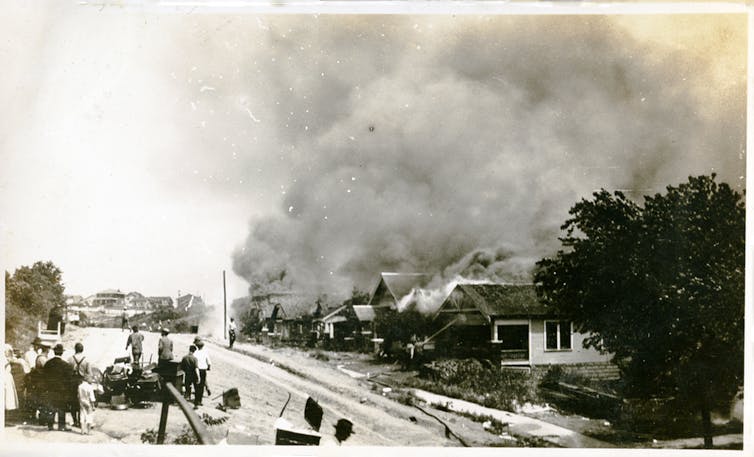
When Viola Fletcher, 107, appeared before Congress in May 2021, she called for the nation to officially acknowledge the Tulsa race riot of 1921.
I know that place and year well. As is the case with Fletcher – who is one of the last living survivors of the massacre, which took place when she was 7 – the terror of the Tulsa race riot is something that has been with me for almost as long as I can remember. My grandfather, Robert Fairchild, told the story nearly a quarter-century ago to several newspapers.
Here’s how The Washington Post recounted his story in 1996:
“At 92 years old, Robert Fairchild is losing his hearing, but he can still make out the distant shouts of angry white men firing guns late into the night 75 years ago. His eyes are not what they used to be, but he has no trouble seeing the dense, gray smoke swallowing his neighbors’ houses as he walked home from a graduation rehearsal, a frightened boy of 17.
His has since been a life of middle-class comfort, a good job working for the city, a warm family life. But he has never forgotten his mother’s anguish in 1921 as she fled toward the railroad tracks to escape the mobs and fires tearing through the vibrant Black neighborhood of Greenwood in north Tulsa.”
“There was just nothing left,” Fairchild told the newspaper.
The Washington Post article said the Tulsa race riots of 1921 were among the “worst race riots in the nation’s history.” It reported: “The death toll during the 12-hour rampage is still in dispute, but estimates have put it as high as 250. More than 1,000 businesses and homes were burned to the ground, scores of Black families were herded into cattle pens at the fairgrounds, and one of the largest and most prosperous Black communities in the United States was turned to ashes.”
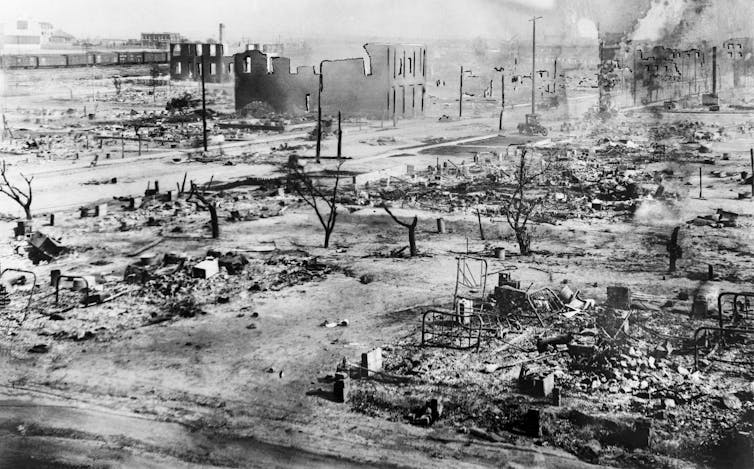
Riots began after a white mob attempted to lynch a teenager falsely accused of assaulting a white woman. Black residents came to his defense, some armed. The groups traded shots, and mob violence followed. My family eventually returned to a decimated street. Miraculously their home on Latimer Avenue was spared.
Disturbing history
Hearing about these experiences at the family table was troubling enough. Reading a newspaper account of your ancestors’ fleeing for their lives is a surreal pain. There’s recognition of your family’s terror, and relief in knowing your family survived what “60 Minutes” once called “one of the worst race massacres in American history.”
In spite of my grandfather’s witness, this same event didn’t merit inclusion in any of my assigned history texts, either in high school or college. On the occasions I’ve mentioned this history to my colleagues, they’ve been astonished.
In 1996, at the 75th anniversary of the massacre, the city of Tulsa finally acknowledged what had happened. Community leaders from different backgrounds publicly recognized the devastation wrought by the riots. They gathered in a church that had been torched in the riot and since rebuilt. My grandfather told The New York Times then that he was “extremely pleased that Tulsa has taken this occasion seriously.”
“A mistake has been made,” he told the paper, “and this is a way to really look at it, then look toward the future and try to make sure it never happens again.”
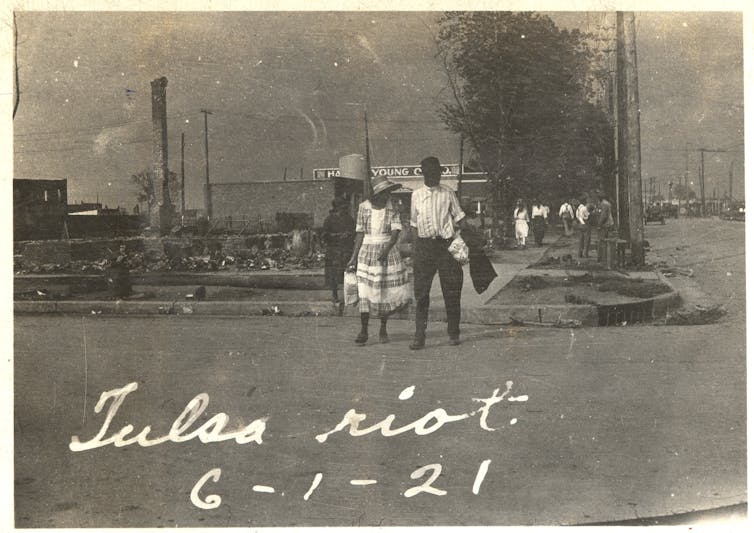
That it took so long for the city to acknowledge what took place shows how selective society can be when it comes to which historical events it chooses to remember – and which ones to overlook. The history that society colludes to avoid publicly is necessarily remembered privately.
Economically vibrant
Even with massive destruction, the area of North Tulsa, known as Greenwood, became known for its economic vitality. On the blocks surrounding the corner of Archer Street and Greenwood Avenue in the 1930s, a thriving business district flourished with retail shops, entertainment venues and high-end services. One of these businesses was the Oklahoma Eagle, a Black-owned newspaper. As a teenager in the early 1940s, my father had his first job delivering the paper.
Without knowing the history, it would be a surprise to the casual observer that years earlier everything in this neighborhood had been razed to the ground. The Black Wall Street Memorial, a black marble monolith, sits outside the Greenwood Cultural Center. The memorial is dedicated to the entrepreneurs and pioneers who made Greenwood Avenue what it was both before and after it was destroyed in the 1921 riot.
Although I grew up on military bases across the world, I would visit Greenwood many times over the years. As I grew into my teenage years in the 1970s, I recognized that the former vibrant community was beginning to decline. Some of this was due to the destructive effects of urban renewal and displacement. As with many other Black communities across the country, parts of Greenwood were razed to make way for highways.
Some of the decline was due to the exit of financial institutions, including banks. This contributed to a decrease in opportunities to build wealth, including savings and investment products, loans for homes and businesses, and funding to help build health clinics and affordable housing.
And at least some was due to the diminished loyalty of residents to Black-owned businesses and institutions. During the civil rights movement, downtown Tulsa businesses began to allow Black people into their doors as customers. As a result, Black residents spent less money in their community.
Historical lessons
At the end of my father’s military career in the 1970s, he became a community development banker in Virginia. His work involved bringing together institutions – investors, financial institutions, philanthropists, local governments – to develop innovative development solutions for areas like Greenwood. For me, there are lessons in the experiences of three generations – my grandfather’s, father’s and mine – that influence my scholarly work today.
On the one hand, I study how years after the end of legal segregation Americans remain racially separate in our neighborhoods, schools and workplaces and at alarmingly high levels. My research has shown how segregation depresses economic and social outcomes. In short, segregation creates closed markets that stunt economic activity, especially in the Black community.
On the other hand, I focus on solutions. One avenue of work involves examining the business models of Community Development Financial Institutions, or CDFIs, and Minority Depository Institutions, or MDIs. These are financial institutions that are committed to economic development – banks, credit unions, loan funds, equity funds – that operate in low- and moderate-income neighborhoods. They offer what was sorely needed in North Tulsa, and many other neighborhoods across the nation – locally attuned financial institutions that understand the unique challenges families and businesses face in minority communities.
Righting historical wrongs
There are interventions we can take, locally and nationally, that recognize centuries of financial and social constraint. Initiatives like the 2020 decision by the Small Business Administration and U.S. Treasury to allocate US$10 billion to lenders that focus funds on disadvantaged areas are a start. These types of programs are needed even when there aren’t full-scale economic and social crises are taking place, like the COVID-19 epidemic or protesters in the street. Years of institutional barriers and racial wealth gaps cannot be redressed unless there’s a recognition that capital matters.
The 1921 Tulsa race riot began on May 31, only weeks before the annual celebration of Juneteenth, which is observed on June 19. As communities across the country begin recognizing Juneteenth and leading corporations move to celebrate it, it’s important to remember the story behind Juneteenth – slaves weren’t informed that they were emancipated.
After the celebrations, there’s hard work ahead. From my grandfather’s memory of the riot’s devastation to my own work addressing low-income communities’ economic challenges, I have come to see that change requires harnessing economic, governmental and nonprofit solutions that recognize and speak openly about the significant residential, educational and workplace racial segregation that still exists in the United States today.
[You’re smart and curious about the world. So are The Conversation’s authors and editors. You can get our highlights each weekend.]
This is an updated version of an article originally published on May 21, 2020.
Gregory B. Fairchild, Associate Professor of Business Administration, University of Virginia
This article is republished from The Conversation under a Creative Commons license. Read the original article.