How to resolve AdBlock issue?
Refresh this page
How to resolve AdBlock issue?
Refresh this page
Lake County News,California
  • Home
    • Registration Form
  • News
    • Education
    • Veterans
    • Community
      • Obituaries
      • Letters
      • Commentary
    • Police Logs
    • Business
    • Recreation
    • Health
    • Religion
    • Legals
    • Arts & Life
    • Regional
  • Calendar
  • Contact us
    • FAQs
    • Phones, E-Mail
    • Subscribe
  • Advertise Here
  • Login

News

McGuire to host community conversation on hunger Oct. 16

NORTH COAST, Calif. — Sen. Mike McGuire will host a virtual town hall next week to discuss issues related to hunger on the North Coast.

The town hall will take place beginning at 6 p.m. Thursday, Oct. 16.

Watch the town hall live here or on Facebook.

McGuire said the town hall will include Allison Goodwin, the president and CEO of Redwood Empire Food Bank; Carly Robbins, executive director at Food for People in Humboldt County; along with Suzanne Morales, President of the California School Nutrition Association. 

McGuire said his expert panelists will address the unprecedented challenges of ensuring access to healthy food in these times, discuss federal funding cuts to food assistance programs and how food banks and public schools are rallying for the most vulnerable kids, families and seniors, and break down how California is fighting back to support food banks and keep universal free meals served in all of California's TK-12 public schools. 

McGuire said the state’s leadership is doubling down on its efforts to make life more affordable for residents. However, there are headwinds on the horizon due to significant federal cuts to food assistance programs. 

More than $187 billion in federal SNAP food benefits have been cut nationwide resulting in a $3 billion to $5 billion cut to California annually. This means food banks across the state are in crisis mode.

RSVP and ask a question for the town hall presenters by clicking here.

Flu season has arrived – and so have updated flu vaccines

The flu vaccine is updated every year to include the strains known to be circulating. Cecilie_Arcurs/E+ via Getty Images

As the autumn’s cool weather settles in, so does flu season – bringing with it the familiar experiences of sniffles, fever and cough.

Every year, influenza – the flu – affects millions of people. Most will experience the infection as a mild to moderate illness – but for some, it can be severe, potentially resulting in hospitalization and even death.

While the start of flu season may feel routine, it’s important to remember that the virus changes every year, making annual vaccination an important part of staying healthy.

What to expect this flu season

Public health experts are closely watching how this year’s flu season unfolds. Early reports suggest that the U.S. may see a moderate level of flu cases, partly because last year’s flu activity was high and it’s uncommon to have two severe flu seasons in a row.

However, the U.S. also uses data from the Southern Hemisphere’s earlier flu season, which lasts from April to October, to help predict what the season might look like. There, the flu season has been more severe than in years past.

Taken together, that means there could be a significant number of flu cases in the U.S., particularly among children, older adults and those with chronic health conditions.

Each year, the flu vaccine is updated to best match the strains of influenza expected to circulate. Because flu viruses mutate frequently, the effectiveness of the flu vaccine can vary each year. However, even when the match between the seasonal flu and the vaccine that is designed around it isn’t perfect, vaccination remains the best protection against severe illness.

In the U.S., all flu vaccines for the 2025-2026 season will be trivalent – which means they are formulated to protect against the three main groups of influenza virus strains. These are an A (H1N1) virus, an A (H3N2) virus and a B/Victoria virus.

A family, mom, dad and two young children all sit in bed together blowing their noses.
The flu vaccine protects against severe illness from an influenza infection. Jacob Wackerhausen/iStock via Getty Images Plus

Vaccine availability

Recent vaccine policy changes have created some confusion, particularly around COVID-19 vaccines. Many people are wondering if getting the flu vaccine has become more complicated. The good news is that flu vaccines remain widely available and accessible. Pharmacies, doctors’ offices, public health clinics and many workplaces are offering the seasonal shot, often at little or no cost.

The 2025-2026 flu vaccine is available now. Manufacturers start shipping vaccines doses in July and August to ensure access by September. While public health experts won’t know the exact effectiveness of the flu vaccine until flu season is over, the flu shot usually cuts your chances of needing to see a doctor for the flu by about half.

Vaccination helps reduce the severity of illness, the likelihood of hospitalization and the spread of infection within our communities.

It’s important to note that you can get the flu shot at the same time as other vaccines, such as the COVID-19 vaccine or the RSV and pneumonia vaccines for older adults, without compromising effectiveness. If you’re unsure which vaccines are right for you, your health care provider or pharmacist can help you decide based on your age and health status.

Who should get the flu shot

The Centers for Disease Control and Prevention recommends that everyone 6 months and older receive the flu vaccine each year, with rare exceptions. That aligns with guidelines from other organizations, such as the American Association of Pediatrics.

The flu vaccine is especially important for:

• Adults 65 and older

• Children under 5 – and particularly those under 2

• Pregnant people

• People with chronic conditions such as asthma, diabetes or heart disease

• Health care workers and caregivers

Even if you’re healthy and rarely get sick, getting vaccinated protects not only you but also those around you who may be more vulnerable.

Practical prevention tips

In addition to vaccination, everyday actions help reduce the spread of flu and other respiratory viruses:

• Wash your hands frequently with soap and water.

• Cover your coughs and sneezes.

• Stay home if you’re feeling unwell.

• Consider wearing a mask in crowded indoor spaces during peak flu activity, particularly if you have a cough.

Even though flu season is part of life, serious illness doesn’t have to be. By staying informed, getting vaccinated and practicing healthy habits, everyone can play a role in keeping their communities safe and healthy.

If you haven’t gotten your flu shot yet, now’s the time to protect yourself, and those you care for, this flu season.The Conversation

Libby Richards, Professor of Nursing, Purdue University

This article is republished from The Conversation under a Creative Commons license. Read the original article.

Space News: What are solar storms and the solar wind? 3 astrophysicists explain how particles coming from the Sun interact with Earth

The Sun occasionally ejects large amounts of energy and particles that can smash into Earth. NASA/GSFC/SDO via WikimediaCommons

Curious Kids is a series for children of all ages. If you have a question you’d like an expert to answer, send it to This email address is being protected from spambots. You need JavaScript enabled to view it..


What is meant by solar storm and solar wind? – Nihal, age 11, Amalapuram, India


Every day on Earth, you experience weather. You feel the wind blowing and see clouds move across the sky. Sometimes there are storms where the wind gets really strong, it might rain, or there might be thunder and lightning.

Did you know that there’s weather in space too? It all starts with the Sun.

The Sun: The bright star in our solar system

The Sun is a very hot, very big ball of gas at the center of our solar system. Its surface can reach a blistering 10,800 degrees Fahrenheit (6,000 degrees Celsius). That’s nearly five times hotter than lava that spews from volcanoes on Earth, and just like lava, the Sun glows from the heat.

The Sun is made up of what solar physicists like us call plasma.

Normal gases, like the air you breathe on Earth, are made up of atoms bouncing around. Atoms consist of a positively charged bundle of particles called the nucleus and negatively charged particles called electrons. The nucleus and the electrons are tightly stuck together so that atoms are overall neutral – that is, they have no charge.

A gas becomes a plasma when the atoms it’s made of become so hot that their negatively charged electrons split apart from their positively charged nuclei. Now that the charged particles are separated from each other, the plasma can conduct electricity, and magnetic fields may pull the plasma or push it away.

Plasma is made up of charged particles.

Solar wind blows out of the Sun all the time

Sometimes, the Moon lines up with Sun, blocking it from view and turning the sky dark. This phenomenon is called a total solar eclipse. During an eclipse, you can see faint, wispy structures surrounding the Moon that extend across the sky. In that moment, what you are seeing is the Sun’s atmosphere: the corona.

The corona can reach millions of degrees, which is much hotter than the Sun’s surface. In fact, the corona is so hot that the particles shoot out of the Sun, escaping from the Sun’s gravity, engulfing the entire solar system. This stream of plasma is called the solar wind.

The solar wind’s invisible, continuous gust of plasma fills a bubble in space that extends far beyond the orbit of Pluto. It can reach up to 2 million miles per hour (3 million kilometers per hour) – at that speed, the solar wind would take less than a minute to circle the Earth. For comparison, the International Space Station takes 90 minutes to go around the Earth.

While it’s hard to see the solar wind directly in photos once it leaves the corona, we can measure the gas directly with instruments in space. Scientists have recently gotten up close and personal with it by sending missions such as the Parker Solar Probe closer to the Sun than ever before. The Parker Solar Probe flies directly into the solar wind and measures the gas directly just as it escapes the Sun – like a weather station.

The Parker Solar Probe also has a specialized camera that points sideways to see the Sun’s light as it scatters off the solar wind. Light scattering is the same process that makes the sky blue on Earth.

Big solar explosions

The solar wind surrounds and engulfs the Earth and other planets all the time, but most of the time it is safely guided around us by our planet’s magnetic field. However, occasionally the Sun also generates huge explosions that release big clouds of plasma into our solar system, some of which are directed toward Earth. These massive events are called coronal mass ejections.

NASA spacecraft track solar storms from their eruptions on the Sun until their impact on Earth.

Compared to the solar wind, which is always blowing, coronal mass ejections are short-lived but extreme. You can think of them as solar storms. Solar storms also involve one important force that doesn’t really play a role in the weather on Earth: magnetism.

The Sun is like a giant magnet. All magnets create what we call magnetic field lines, which are lines along which charged particles such as plasma have an easy time traveling. The Sun’s magnetic field lines can be very twisted, and the solar wind and coronal mass ejections deform and drag them outward from the Sun.

When these solar storms reach Earth, their coiled magnetic fields can sometimes interact with our planet’s own magnetic field and cause disturbances called space weather.

Space weather is caused by the Sun

The Earth has a magnetic field and a protective bubble: the magnetosphere. The magnetosphere shields us from the Sun’s solar wind and solar storms, acting like a force field to keep living things safe from the energetic particles released by the Sun.

Magnetic reconnection happens when the magnetic field from a coronal mass ejection interacts with Earth’s magnetic field.

Most of the time this protective bubble works so well that you can’t tell that there is anything special happening out in space. During particularly big storms, however, some solar wind plasma can make it down into the Earth’s atmosphere. As coronal mass ejections pass over Earth, their magnetic field can interact with Earth’s magnetic field. The Sun and Earth’s magnetic field lines untangle and rearrange, and for a short while these fields can link together and let the Sun’s plasma in.

When this happens, it can cause big magnetic storms all over the world. This interaction between ejections from the Sun and the Earth is what scientists refer to as space weather.

Green lines of light crossing the night sky, above a snow-covered landscape.
Space weather causes beautiful light shows near the North and South Poles on Earth. AP Photo/Rene Rossignaud, File

Space weather is just like the weather on Earth, generated by its atmosphere. It is important for scientists to understand and predict this space weather, as it can lead to power blackouts, interrupt communication and even cause satellites to prematurely fall down to Earth.

Besides these dangers though, space weather can create beautiful light shows in the sky called Northern Lights, or aurora borealis, and Southern Lights, or aurora australis. You can observe these if you’re near the North or South Poles. If you ever get a chance to see them, remember what you’re seeing is space weather, the result of eruptions and solar wind from the Sun.


Hello, curious kids! Do you have a question you’d like an expert to answer? Ask an adult to send your question to This email address is being protected from spambots. You need JavaScript enabled to view it.. Please tell us your name, age and the city where you live.

And since curiosity has no age limit – adults, let us know what you’re wondering, too. We won’t be able to answer every question, but we will do our best.The Conversation

Yeimy J. Rivera, Researcher in Astrophysics, Smithsonian Institution; Rosa Tatiana Niembro Hernández, Astrophysicist, Smithsonian Astrophysical Observatory, Smithsonian Institution, and Samuel Badman, Researcher in Astrophysics, Smithsonian Institution

This article is republished from The Conversation under a Creative Commons license. Read the original article.

State Water Board to hold scoping meetings on Potter Valley Project decommissioning plan

LAKE COUNTY, Calif. — The State Water Resources Control Board is planning a series of scoping meetings next week as part of its work to prepare environmental documents for the proposed decommissioning of the Potter Valley Project.

The project, located in Lake and Mendocino counties, consists of the Scott Dam and the Cape Horn Dam, both of which are located on the upper main stem of the Eel River, as well as the Potter Valley powerhouse, the 80,000-acre-foot Lake Pillsbury in Lake County, the Van Arsdale Reservoir, a fish passage structure and salmon and steelhead counting station at the Cape Horn Dam, and and 5,600 acres of land.

Pacific Gas and Electric, which has owned the project since 1930, filed the final surrender application and decommissioning plan for the project with the Federal Energy Regulatory Commission, or FERC, in July. 

That’s part of the process that PG&E is following in its effort to remove the dams.

FERC has not yet responded to PG&E’s final license surrender application.

At the same time, the State Water Resources Control Board is preparing an environmental impact report, or EIR, for the project’s proposed surrender and decommissioning.

The State Water Board has planned several public scoping meetings during which it will take public input.

The meetings will take place as follows:

• 6 to 8 p.m. Tuesday, Oct. 14, in-person only, River Lodge Conference Center, 1800 Riverwalk Drive, Fortuna.

• 11:30 a.m. to 1:30 p.m. Wednesday, Oct. 15, in-person only, Ukiah Valley Conference Center, Cabernet 1 and 2 Rooms, 200 South School St., Ukiah.

• 5:30 to 7:30 p.m. Wednesday, Oct. 15, in-person only, North Coast Regional Water Quality Control Board Office, DCJ Hearing Room, 5550 Skylane Boulevard, Suite A, Santa Rosa.

• 12:30 to 2:30 p.m. Friday, Oct. 17, in-person and virtual, CalEPA Building, Byron Sher Auditorium, 1001 I St., second floor, Sacramento. To attend via Zoom: https://waterboards.zoom.us/j/86984608826; call-in number: +1 669 444 9171 US; meeting ID: 869 8460 8826.

The State Water Board said it is seeking comments from trustee agencies, responsible agencies, tribes, and interested persons concerning the scope and content of the environmental information to be included in the EIR. 

Comments concerning the scope and content of the environmental information to be included in the EIR for the proposed project that are not provided at a scoping meeting are due by 4 p.m. Monday, Nov. 3.

Title your comments as “Potter Valley NOP Comments” and send them to This email address is being protected from spambots. You need JavaScript enabled to view it.or mail them to Wilhelmina Chon, Hydroelectric Project Manager, State Water Resources Control Board, Division of Water Rights – Water Quality Certification Program, P.O. Box 2000 Sacramento, CA 95812-2000.

Governor signs bills establishing state snake, state shrub

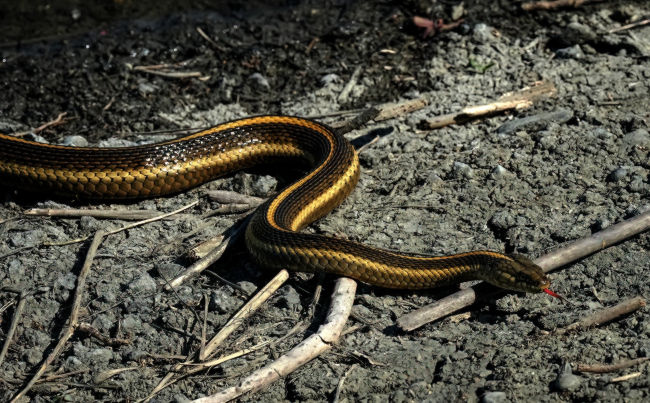
A giant garter snake. Photo by Glenbrooks, CC BY-SA 4.0 , via Wikimedia Commons.

Gov. Gavin Newsom on Thursday announced two new state symbols, signing legislation establishing the bigberry manzanita as the state shrub and the giant garter snake as the state snake.

“Our state symbols celebrate California's uniqueness, especially our distinctive ecosystems. California is a global biodiversity hotspot, with both the highest total number of species and the highest number of endemic species in the United States — including our new state shrub and snake,” Newsom said.
 
Bigberry manzanita

AB 581, by Assemblymember Steve Bennett (D-Ventura), designates the bigberry manzanita (Arctostaphylos glauca) as the official state shrub. 

The bigberry manzanita, a shrub almost exclusively native to California, possesses unique abilities and traits that make it highly adaptable to wildfire-prone land, including rapid regeneration after fire exposure and fire-triggered seed germination. 

The plant’s extensive root system helps resist soil erosion, yet thrives in dry, nutrient-poor soils — a useful tool to prevent mud or landslides, especially in wildfire burn scars.
 
Giant garter snake

SB 765 by Senator Roger Niello (R-Fair Oaks) establishes the giant garter snake (Thamnophis gigas) as the state snake. 

A description of the snake provided by U.S. Fish and Wildlife said its coloration is “olive to brown with a cream, yellow or orange stripe running down its back, and two light colored stripes running along each side.”

The population of the giant garter snake has declined by more than 90% in the last century — it was listed as threatened under the California Endangered Species Act in 1971, and the Federal Endangered Species Act in 1993. 

This species is endemic to California, found only in the Central Valley. 

U.S. Fish and Wildlife reported that the giant garter snake’s current range extends from Butte and Glenn counties in the northern Sacramento Valley to Fresno County in the south. They are found in natural waterways and agriculture wetlands such as canals and rice fields. 

Officials said only about 5% of the giant garter snake’s historical wetland habitat acreage remains available to it.

Clearlake Animal Control: ‘Jupiter’ and the dogs

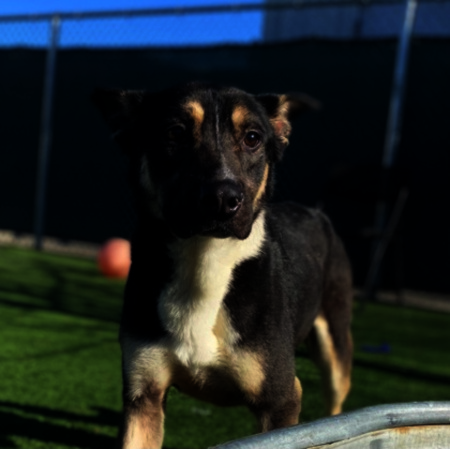
"Jupiter." Photo courtesy of Clearlake Animal Control.

CLEARLAKE, Calif. — Clearlake Animal Control is offering many dogs to loving homes this week.

The shelter has 46 adoptable dogs listed on its website.

This week’s dogs include “Jupiter,” a German shepherd mix who is waiting for the right person to come and love him.

Shelter staff said he is neutered, up to date on his vaccines and microchipped. 

The shelter is located at 6820 Old Highway 53. It’s open from 9 a.m. to 6 p.m. Tuesday through Saturday. 

For more information, call the shelter at 707-762-6227, email This email address is being protected from spambots. You need JavaScript enabled to view it. or visit Clearlake’s adoptable dogs here.

This week’s adoptable dogs are featured below.

Email Elizabeth Larson at This email address is being protected from spambots. You need JavaScript enabled to view it.. Follow her on Twitter, @ERLarson, and on Bluesky, @erlarson.bsky.social. Find Lake County News on the following platforms: Facebook, @LakeCoNews; X, @LakeCoNews; Threads, @lakeconews, and on Bluesky, @lakeconews.bsky.social. 

  • 87
  • 88
  • 89
  • 90
  • 91
  • 92
  • 93
  • 94
  • 95
  • 96

Community

  • Lake County Wine Alliance offers sponsor update; beneficiary applications open 

  • Mendocino National Forest announces seasonal hiring for upcoming field season

Public Safety

  • Lakeport Police logs: Thursday, Jan. 15

  • Lakeport Police logs: Wednesday, Jan. 14

Education

  • Woodland Community College receives maximum eight-year reaffirmation of accreditation from ACCJC

  • SNHU announces Fall 2025 President's List

Health

  • California ranks 24th in America’s Health Rankings Annual Report from United Health Foundation

  • Healthy blood donors especially vital during active flu season

Business

  • Two Lake County Mediacom employees earn company’s top service awards

  • Redwood Credit Union launches holiday gift and porch-to-pantry food drives

Obituaries

  • Rufino ‘Ray’ Pato

  • Patty Lee Smith

Opinion & Letters

  • The benefits of music for students

  • How to ease the burden of high electric bills

Veterans

  • CalVet and CSU Long Beach team up to improve data collection related to veteran suicides

  • A ‘Big Step Forward’ for Gulf War Veterans

Recreation

  • Wet weather trail closure in effect on Upper Lake Ranger District

  • Mendocino National Forest seeking public input on OHV grant applications

  • State Parks announces 2026 Anderson Marsh nature walk schedule 

  • BLM lifts seasonal fire restrictions in central California

Religion

  • Kelseyville Presbyterian to host Ash Wednesday service and Lenten dinner Feb. 18

  • Kelseyville Presbyterian Church to hold ‘Longest Night’ service Dec. 21

Arts & Life

  • Auditions announced for original musical ‘Even In Shadow’ set for March 21 and 28

  • ‘The Rip’ action heist; ‘Steal’ grounded in a crime thriller

Government & Politics

  • Lake County Democrats issue endorsements in local races for the June California Primary

  • County negotiates money-saving power purchase agreement

Legals

  • March 3 hearing on ordinance amending code for commercial cannabis uses

  • Feb. 12 public hearing on resolution to establish standards for agricultural roads

How to resolve AdBlock issue?
Refresh this page