How to resolve AdBlock issue?
Refresh this page
How to resolve AdBlock issue?
Refresh this page
Lake County News,California
  • Home
    • Registration Form
  • News
    • Education
    • Veterans
    • Community
      • Obituaries
      • Letters
      • Commentary
    • Police Logs
    • Business
    • Recreation
    • Health
    • Religion
    • Legals
    • Arts & Life
    • Regional
  • Calendar
  • Contact us
    • FAQs
    • Phones, E-Mail
    • Subscribe
  • Advertise Here
  • Login

News

Officials reach agreement to provide affordable insulin to Californians

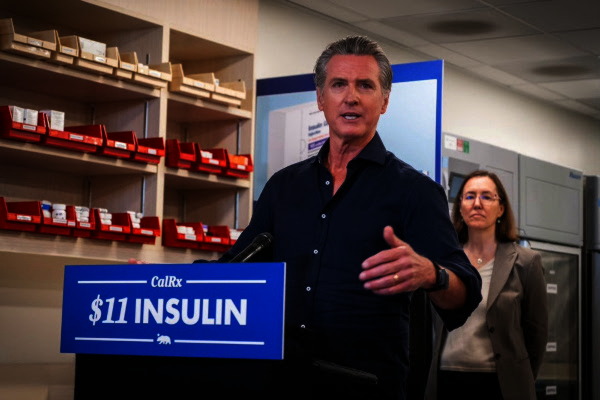
Gov. Gavin Newsom announces the availability of affordable insulin for Californians on Thursday, Oct. 16, 2025. Photo courtesy of the Governor’s Office.

California has become the first and only state to contract for its own affordable insulin.

On Thursday, Gov. Gavin Newsom announced that CalRx biosimilar insulin glargine pens will be available to consumers in California beginning Jan. 1, 2026.

“This launch marks a significant step in the state's ongoing effort to lower prescription drug prices and improve medication access statewide,” Newsom’s office said.

Through an agreement secured by Civica Rx — a nonprofit generic drug manufacturer — with Biocon Biologics, Californians will have access to an interchangeable biosimilar insulin glargine pen offered under the CalRx brand and pricing. 

“California didn’t wait for the pharmaceutical industry to do the right thing — we took matters into our own hands,” said Newsom. “By beginning the process to manufacture our own insulin and pricing it at a maximum cost of $11 a pen in a five-pack, California and Civica are showing the nation what it looks like to put people over profits. No Californian should ever have to ration insulin or go into debt to stay alive — and I won’t stop until health care costs are crushed for everyone.”

Insulin glargine is a long-acting insulin analog used in the management of diabetes. The CalRx insulin glargine pens are interchangeable with Lantus, which officials said will ensure seamless substitution for patients, and will be available to California pharmacies for $45 and to consumers at a suggested retail price of no more than $55 per five-pack of 3 mL pens — a substantial reduction from current retail market prices.

"We are grateful for the support of the state of California for our effort to bring affordable insulin to all Americans," said Ned McCoy, president and CEO of Civica. "The state shares our vision to ensure a sustainable, quality supply of affordable, essential medicines for people who need them."

“Today’s action marks a significant milestone in California’s ongoing efforts to reduce prescription drug costs," said California Health and Human Services Agency Secretary Kim Johnson on Thursday. “Lowering the cost of insulin moves us closer to a California where no one is forced to choose between their health and their financial stability.”

The insulin glargine pen agreement with Biocon Biologics complements Civica Rx’s broader insulin development strategy. 

Civica Rx continues its ongoing efforts to independently produce interchangeable biosimilar versions of insulin glargine and rapid-acting insulin under the CalRx label, further solidifying a reliable and affordable insulin supply for Californians.

“California is taking action to tackle the insulin affordability crisis," said Elizabeth Landsberg, director of the Department of Health Care Access and Information, or HCAI. "We’re committed to transparent pricing, eliminating hidden costs, and ensuring equitable medication access for uninsured, underinsured, and vulnerable residents across our state."

“In a moment where inflation is spiking everyday prices for Californians and our health care system is under attack in the form of Medicaid cuts from H.R. 1, a lower cost insulin will bring much needed relief both to California pocketbooks and our state budget,” said member Chris Noble, Health Access California’s organizing director and member of the CalRx Insulin Patient Advisory Council. “California consumers need relief now, so as a person dependent on insulin to live and a health care advocate, I’m relieved to see CalRx moving quickly to lower insulin costs for the people of California while continuing to pursue other needed prescription drug cost solutions.”

“California’s continued leadership in tackling insulin’s broken market is a promising step forward,” said Allison Hardt, T1 International’s Community Development director and member of the CalRx Advisory Council. “We celebrate progress that puts patients first and secures insulin at a stable, transparent price while encouraging bold next steps toward true public manufacturing — for people, not for profit.”

CalRx initiative

The launch of CalRx-branded insulin is part of a broader strategy of the governor’s first executive order in 2019 to lower prescription drug costs and ensure fair and transparent pricing is accessible to all Californians. 

To date, no other state has taken action to procure its own affordable medication available for purchase to the public to compete with market-priced products.

Thursday’s announcement builds on the successes of the CalRx Naloxone Access Initiative, which has successfully driven down the market price of naloxone, saving consumers money and helping the state purchase more of this life-saving medication to reverse opioid overdoses. 

The CalRx program continues to identify opportunities to make drugs more affordable and accessible in California. 

Newsom recently signed significant legislation advancing health care affordability by lowering the cost of prescription drugs, including:

SB 40, capping consumer cost-sharing for insulin at $35 for a month-long supply. 

SB 41, reducing prescription drug prices by regulating the practices of pharmacy benefit managers (PBMs), which negotiate prices between drug manufacturers, health care insurance providers, and pharmacies.

Since his first executive order in 2019, Governor Newsom has prioritized making health care more affordable to ensure that families do not have to pick between purchasing medications or having food on the table.

For more information on CalRx insulin, visit CalRx Biosimilar Insulin Initiative.

Clearlake Animal Control: ‘Mona Lisa’ and the dogs

“Mona Lisa.” Photo courtesy of Clearlake Animal Control.

CLEARLAKE, Calif. — Clearlake Animal Control has dozens of dogs needing new homes this week.

The shelter has 46 adoptable dogs listed on its website.

This week’s dogs include “Mona Lisa,” a female American pit bull terrier mix with a brown and white coat. 

The shelter is located at 6820 Old Highway 53. It’s open from 9 a.m. to 6 p.m. Tuesday through Saturday. 

For more information, call the shelter at 707-762-6227, email This email address is being protected from spambots. You need JavaScript enabled to view it. or visit Clearlake’s adoptable dogs here.

This week’s adoptable dogs are featured below.

Email Elizabeth Larson at This email address is being protected from spambots. You need JavaScript enabled to view it.. Follow her on Twitter, @ERLarson, and on Bluesky, @erlarson.bsky.social. Find Lake County News on the following platforms: Facebook, @LakeCoNews; X, @LakeCoNews; Threads, @lakeconews, and on Bluesky, @lakeconews.bsky.social. 

Why countries struggle to quit fossil fuels, despite higher costs and 30 years of climate talks and treaties

Renewable energy is expanding, but a fossil fuel phaseout appears to still be far in the future. Hendrik Schmidt/picture alliance via Getty Images

Fossil fuels still power much of the world, even though renewable energy has become cheaper in most places and avoids both pollution and the climate damage caused by burning coal, oil and natural gas.

To understand this paradox, it helps to look at how countries – particularly major greenhouse gas emitters, including the U.S., China and European nations – are balancing the pressures of rising electricity demand with the global need to reduce greenhouse gas emissions that are warming the planet.

US embraces fossil fuels

The United States makes no secret of its fossil fuel ambitions. It has a wealth of fossil fuel reserves and a politically powerful oil and gas industry.

Since President Donald Trump took office in January 2025, his administration has been promoting oil and gas drilling and coal production, pointing to rising electricity demand to justify its moves, particularly to power artificial intelligence data centers.

Reviving the “drill, baby, drill” mantra, the Trump administration has now embraced a “mine, baby, mine” agenda to try to revive U.S. coal production, which fell dramatically over the past two decades as cheaper natural gas and renewable energy rose.

Trump shakes a man's hand. All of the men are wearing hardhats.
U.S. President Donald Trump shakes hands with coal industry employees who were invited to watch him sign legislation in April 2025 promoting fossil fuels. Jabin Botsford/The Washington Post via Getty Images

The Department of Interior on Sept. 29 rolled out a plan to “unleash American coal power” by opening 13 million acres of federal land to mining. The Department of Energy also pledged US$625 million to try to make coal competitive. It includes lowering the royalty rates mining companies pay and extending the operating lifespans of coal-fired power plants.

However, these initiatives further lock communities with coal plants into a carbon-intensive fossil fuel. Coal’s resurgence would also have public health costs. Its pollution is linked to respiratory illness, heart disease and thousands of premature deaths each year from 1999 to 2020 in the United States.

The Trump administration is also ceding the clean energy technology race to China. The administration is ending many renewable energy tax credits and pulling federal support for energy research projects.

I work in the Climate Policy Lab at The Fletcher School of Tufts University, where we maintain a suite of databases for analyzing countries’ energy research budgets. The Trump administration’s 2026 U.S. budget request would slash funding for energy research, development and demonstration to $2.9 billion — just over half the budget allocated in 2025. These energy research investments would fall to levels not seen since the mid-1980s or early 2000s, even when accounting for inflation.

China’s clean energy push – and coal expansion

While the United States is cutting renewable energy funding, China is doubling down on clean energy technologies. Its large government subsidies and manufacturing capacity have helped China dominate global solar panel production and supply chains for wind turbines, batteries and electric vehicles.

Cheaper Chinese-manufactured clean energy technologies have enabled many emerging economies, such as Brazil and South Africa, to reduce fossil fuel use in their power grids. Brazil surged into the global top five for solar generation in 2024, producing 75 terawatt-hours (TWh) of electricity and surpassing Germany’s 71 TWh.

The International Energy Agency now expects global renewable energy capacity to double by 2030, even with a sharp drop expected in U.S. renewable energy growth.

However, while China expands clean energy access around the world, its production and emissions from coal continue to rise: In the first half of 2025, China commissioned 21 gigawatts (GW) of new coal power plants, with projections of over 80 GW for the full year. This would be the largest surge in new coal power capacity in a decade for China. Although China pledged to phase down its coal use between 2026 to 2030, rising energy demand may make the plan difficult to realize.

China’s paradox — leading in clean energy innovations while expanding coal — reflects the tension between ensuring energy security and reducing emissions and climate impact.

Europe’s scramble for reliable energy sources

The European Union is pursuing strategies to reduce its reliance on fossil fuels amid the ongoing geopolitical tensions with Russia.

Russia’s invasion of Ukraine exposed many countries to supply disruptions and geopolitical turmoil, and it triggered a global energy crisis as countries once reliant on Russian oil and gas scrambled to find alternatives.

In June 2025, the European Commission proposed a regulation to phase out Russian fossil fuel imports by the end of 2027, aiming to enhance energy security and stabilize prices. This initiative is part of the broader REPowerEU plan. The plan focuses on increasing clean energy production, improving energy efficiency and diversifying oil and gas supplies away from Russia.

Renewables are now the leading source of electric power in the EU, though natural gas and oil still account for more than half of Europe’s total energy supply.

The EU’s fossil energy phaseout plan also faces challenges. Slovakia and Hungary have expressed resistance to the proposed phaseout, citing concerns over energy affordability and the need for alternative supply sources. Hungarian Prime Minister Victor Orbán said Hungary would continue importing Russian oil and gas. Cutting off these supplies, he asserted, would be an economic “disaster” and immediately reduce Hungary’s economic output by 4%.

The path to reducing Europe’s dependence on fossil fuels thus involves navigating internal disagreements and incentivizing long-run sustainable development. Europe does appear to be gaining in one way from the U.S. pullback from clean energy. Global investment in renewable energy, which hit a record high in the first half of 2025, increased in the EU as it fell in the U.S., according to BloombergNEF’s analysis.

Brazil: Torn on fossil fuels as it hosts climate talks

In November 2025, representatives from countries around the world will gather in Brazil for the annual United Nations climate conference, COP30. The meeting marks three decades of international climate negotiations and a decade since nations signed the Paris Agreement to limit global temperature rise.

The conference’s setting in Belém, a city in the Amazon rainforest, reflects both the stakes and contradictions of climate commitments: a vital ecosystem at risk of collapse as the planet warms, in a nation that pledges climate leadership while expanding oil and gas production and exploring for oil in the Foz do Amazonas region, the mouth of the Amazon River.

Thirty years into global climate talks, the disconnect between promises and practices has never been so clear. The world is not on track to meet the Paris temperature goals, and the persistence of fossil fuels is a major reason why.

Negotiators are expected to debate measures to curb methane emissions and support the transition from fossil fuels. But whether the discussions can eventually translate into a concrete global phaseout plan remains to be seen. Without credible plans to actually reduce fossil fuel dependence, the annual climate talks risk becoming another point of geopolitical tension.The Conversation

Kate Hua-Ke Chi, Doctoral Fellow, The Fletcher School, Tufts University

This article is republished from The Conversation under a Creative Commons license. Read the original article.

Annual Lake County Health & Wellness Expo takes place Oct. 18

LAKEPORT, Calif. — This weekend, organizations and agencies from around Lake County will welcome community members to learn more about health-focused resources and activities available to them.

The annual Lake County Health & Wellness Expo takes place from 10 a.m. to 3 p.m. Saturday, Oct. 18.

The event, formerly known as the Heroes of Health and Safety Fair, will be held at Xabatin Community Park, 800 Main St. in Lakeport.

The festival is a free, family friendly event that organizers said will include many health-focused activities, demonstrations and resources for people of all ages.

On hand will be booths with information on nutrition, fitness, mental health, senior services, and preventative care, among other offerings.

Participants will have the chance to receive free health screenings, participate in wellness workshops and fitness demonstrations. There also will be activities for children.

The day also will include a variety of local vendors, as well as food trucks and live entertainment.

For more information, visit the event’s Facebook page.

Governor signs McGuire bill to increase access to maternal care in rural communities

Across the state, women in rural communities face a growing health care crisis due to the lack of maternity care options. 

Last week, Gov. Gavin Newsom signed Senate President pro Tempore Mike McGuire’s (D-North Coast) bill, SB 669, to increase access to perinatal care in rural communities through a first-of-its-kind pilot project. 

Due to hospitals shutting maternity wards in rural parts of the state, lower birth rates and workforce challenges, thousands of women in rural areas or across the Golden State face maternity care deserts when having their baby, which is a dangerous situation. 

Since 2014, more than 50 hospitals have stopped delivering babies. In 2024 alone, seven hospitals shut down maternity units.

SB 669 creates an innovative pilot program to authorize up to five rural hospitals throughout the state to partner with licensed birth centers to provide perinatal services in rural communities. 

These birthing centers can now open up in rural towns and provide prenatal care for mothers prior to birth and birthing assistance at the time of delivery. 

“Expecting moms and their families in rural California deserve better. Childbirth is one of the most joyful and stressful experiences in life and no one should have to drive for hours while experiencing labor pains or terrifying pregnancy complications,” Pro Tem McGuire said. “SB 669 will provide women with a choice to deliver their babies close to home, the way it should be. Hospital-affiliated birthing centers can now offer maternal care which is a game changer. This new law gives women the ability to have their babies in their hometown and it restores maternity care in communities that are currently maternity deserts. The majority of other states already have this practice in place, and we know this will lead to better outcomes for moms and babies in rural California.”

Research has shown that women who received maternity care through birthing centers were more likely to be satisfied with their delivery and birthing experience, compared to those who receive care from a standard hospital. 

This has been attributed to developing positive relationships with providers, more personal treatment with patients and receiving comprehensive, culturally competent care.

Under SB 669, hospitals offering perinatal services would be required to meet specific standards regarding patient protection, staffing, training, and equipment. Doctors and staff will be on call 24 hours a day, and able to provide care within 30 minutes of being notified.

McGuire is President pro Tempore of the California Senate. He represents the North Coast of California, which stretches from the Golden Gate Bridge to the Oregon border, including Del Norte, Trinity, Humboldt, Lake, Mendocino, Sonoma, and Marin counties. 

California announces coalition of governors forming new alliance to protect public health from political interference

Gov. Gavin Newsom on Wednesday joined 14 other governors in launching the Governors Public Health Alliance, a new non-partisan hub coordinating public health leadership across the country. 

The alliance is meant to strengthen emergency preparedness, improve communication, share data and expertise, and ensure states and territories can respond quickly and consistently to emerging health threats.

Participating governors include Bob Ferguson (WA), Josh Green (HI), Maura Healey (MA), Kathy Hochul (NY), Tina Kotek (OR), Ned Lamont (CT), Lou Leon Guerrero (GU), Dan McKee (RI), Matt Meyer (DE), Wes Moore (MD), Phil Murphy (NJ), Jared Polis (CO), JB Pritzker (IL), and Josh Stein (NC).

“California is proud to help launch this new alliance because the American people deserve a public health system that puts science before politics,” said Newsom. “As extremists try to weaponize the CDC and spread misinformation, we’re stepping up to coordinate across states, protect communities, and ensure decisions are driven by data, facts, and the health of the American people."
 
This announcement comes in response to what the alliance called the Trump administration’s “dangerous misguidance on vaccine safety and efficacy, and the advancement of policies like the Big Beautiful Bill that strip millions of Americans of critical health care access.”

The alliance’s statement continued, “The federal government’s failing attempts to ‘Make America Healthy Again’ have left yet another leadership gap in our nation's health and science efforts. The Governors Public Health Alliance is necessary to bring leaders and experts from across the country together, quickly, to help protect Americans from disease and injury.”

Building on existing regional leadership

The alliance announced Wednesday builds on California’s existing regional coordination efforts, like the West Coast Health Alliance. 

By bringing together public health groups and regional groups, the Governors Public Health Alliance aims to enhance cross-collaboration and serve as a forum to discuss best practices and common challenges. 

About GovAct
The Governors Public Health Alliance is supported by GovAct, a nonprofit, nonpartisan initiative that supports governors in protecting fundamental freedoms, including public health.

GovAct serves as a centralized platform for collaboration through incubating, launching, and supporting alliances across governors’ offices. These alliances share cutting-edge policy and legal approaches to some of the most challenging and critical issues facing the nation.  

As an initiative of GovAct, the alliance will also be guided by GovAct’s Bipartisan Advisory Board of former governors — Arne Carlson (R), Jim Doyle (D), Deval Patrick (D), Marc Racicot (R), Kathleen Sebelius (D), and Bill Weld (R) — and former senior federal officials Sally Yates and Larry Thompson. 

To learn more, go to www.GovActAlliance.org. 

  • 83
  • 84
  • 85
  • 86
  • 87
  • 88
  • 89
  • 90
  • 91
  • 92

Community

  • Lake County Wine Alliance offers sponsor update; beneficiary applications open 

  • Mendocino National Forest announces seasonal hiring for upcoming field season

Public Safety

  • Lakeport Police logs: Thursday, Jan. 15

  • Lakeport Police logs: Wednesday, Jan. 14

Education

  • Woodland Community College receives maximum eight-year reaffirmation of accreditation from ACCJC

  • SNHU announces Fall 2025 President's List

Health

  • California ranks 24th in America’s Health Rankings Annual Report from United Health Foundation

  • Healthy blood donors especially vital during active flu season

Business

  • Two Lake County Mediacom employees earn company’s top service awards

  • Redwood Credit Union launches holiday gift and porch-to-pantry food drives

Obituaries

  • Rufino ‘Ray’ Pato

  • Patty Lee Smith

Opinion & Letters

  • The benefits of music for students

  • How to ease the burden of high electric bills

Veterans

  • CalVet and CSU Long Beach team up to improve data collection related to veteran suicides

  • A ‘Big Step Forward’ for Gulf War Veterans

Recreation

  • Wet weather trail closure in effect on Upper Lake Ranger District

  • Mendocino National Forest seeking public input on OHV grant applications

  • State Parks announces 2026 Anderson Marsh nature walk schedule 

  • BLM lifts seasonal fire restrictions in central California

Religion

  • Kelseyville Presbyterian to host Ash Wednesday service and Lenten dinner Feb. 18

  • Kelseyville Presbyterian Church to hold ‘Longest Night’ service Dec. 21

Arts & Life

  • Auditions announced for original musical ‘Even In Shadow’ set for March 21 and 28

  • ‘The Rip’ action heist; ‘Steal’ grounded in a crime thriller

Government & Politics

  • Lake County Democrats issue endorsements in local races for the June California Primary

  • County negotiates money-saving power purchase agreement

Legals

  • March 3 hearing on ordinance amending code for commercial cannabis uses

  • Feb. 12 public hearing on resolution to establish standards for agricultural roads

How to resolve AdBlock issue?
Refresh this page