How to resolve AdBlock issue?
Refresh this page
How to resolve AdBlock issue?
Refresh this page
Lake County News,California
  • Home
    • Registration Form
  • News
    • Education
    • Veterans
    • Community
      • Obituaries
      • Letters
      • Commentary
    • Police Logs
    • Business
    • Recreation
    • Health
    • Religion
    • Legals
    • Arts & Life
    • Regional
  • Calendar
  • Contact us
    • FAQs
    • Phones, E-Mail
    • Subscribe
  • Advertise Here
  • Login

News

Trump administration’s layoffs would gut department overseeing special education, eliminating parents’ last resort

A sign marks the outside of the Department of Education headquarters in Washington, D.C. J. David Ake/Getty Images

A federal judge on Oct. 16, 2025, paused the Trump administration’s latest round of layoffs, which targeted more than 4,000 federal workers at a range of agencies, including 466 workers at the Department of Education.

U.S. District Judge Susan Illston said that the administration’s layoffs, which it has justified because of a lapse of funding during the government shutdown, are “both illegal and in excess of authority” and called them “arbitrary and capricious.” The Trump administration is expected to appeal the judge’s decision.

The Trump administration first eliminated about half of the Department of Education’s more than 4,200 positions in March 2025. This latest round of cuts would eliminate almost all of the work of the remaining Department of Education offices, including that of the Office of Special Education Programs. OSEP is responsible for ensuring children with disabilities across the U.S. receive a free, appropriate public education, as required by federal law.

Amy Lieberman, the education editor at The Conversation U.S., spoke with Josh Cowen, a scholar of education policy, to understand how these cuts would hinder the educational opportunities for children with special needs.

A large group of people hold yellow signs in front of a building. Some of the signs say
People rally in front of the Department of Education to protest budget cuts on March 13, 2025. Kayla Bartkowski/Getty Images

What would these cuts mean for parents, children and schools?

With these cuts, we are talking about getting rid of some really important positions. People in these roles serve kids and families across the country. They help them answer questions about how school districts are providing for their children, in the way they are legally required to, if their child has special needs.

Special education is a very broad category. Under the Department of Education, it encompasses everything from dyslexia to a child who is blind. There is no educational need so severe that a child is not entitled to free and adequate education.

When navigating challenges related to your child’s special needs education, you really need an advocate – in the legal sense of the term rather than the political one. You need someone whose job it is to take your call and walk you through options, or just document your call and start an inquiry into your case.

What does the Office of Special Education Programs do?

The Office of Special Education Programs is part of the Department of Education’s Office of Special Education and Rehabilitative Services, which has about 179 employees. The government spent more than US$20 billion on its work from April 2024 through March 2025, making the broader Office of Special Education and Rehabilitation Services the third-largest branch of the Education Department, in terms of spending.

There are very strong federal legal obligations – and often state ones, too – for schools to serve kids with whatever need they have. This office’s main job is to be a resource to parents for their child’s education, particularly if parents feel they are not having these legal obligations met.

Let’s say a child with autism is in school. Their parent does not believe the school district is providing the accommodations that their child is legally entitled to. The school district disagrees and thinks the child is doing well in school. When things get fuzzy about what a child’s needs actually are, or parents feel they are being ignored, OSEP can help parents learn what their options are, and then can even become involved and serve as an arbitrator to figure out the best course of action.

Sometimes, public school districts and state departments of education have very clear, accessible ways for parents to receive information about their rights and obtain instructions for putting together an individualized education plan for their child. If those rights are not met, states may open an investigation into the matter to ensure compliance.

Throughout this process, parents may seek support and guidance from OSEP to make sure state investigations into special education cases are being done and being done well.

What could these investigations result in?

The Department of Education can help hold states and districts accountable and push districts and schools to be more responsive. In the best-case scenario, additional or tailored programming and support – whether it is a teacher’s aide or something else – can come from an OSEP investigation.

An older white woman wears a cream suit and sits at a table, with two men on either side of her.
U.S. Secretary of Education Linda McMahon, center, speaks during a cabinet meeting at the White House on Aug. 26, 2025. Mandel Ngan/AFP via Getty Images

What does your research show about the impact of cutting services like these?

Well, we don’t really know what happens when you gut OSEP because no one has tried to gut OSEP before.

But it’s safe to say that parents will get really frustrated. I have been contacted by parents who have shared heartbreaking examples of the special education system not working over the past couple of years.

Feeling like the education system is really not serving you can push parents to leave the public school system and consider homeschooling or private options. In the long run, this may actually make parents even worse off because those sectors have have no obligation at all to serve students with special needs. So what’s happening at the U.S. Department of Education right now is not only creating more dissatisfaction and distrust in the system as it stands, but it’s also going to leave parents and kids with fewer options to get the support they need.The Conversation

Joshua Cowen, Professor of Education Policy, Michigan State University

This article is republished from The Conversation under a Creative Commons license. Read the original article.

‘No Kings II’ protest fills downtown Lakeport with peaceful demonstrators

Kate Schmidt-Hopper dressed as a suffragist during the No Kings II protest in Lakeport, California, on Saturday, Oct. 18, 2025. Photo by Elizabeth Larson/Lake County News.

LAKEPORT, Calif. — The latest in a series of nationwide pro-democracy protests took place on Saturday, with the Lake County event eclipsing previous protests in size.

The “No Kings II” protest took place from noon to 2 p.m. Saturday in downtown Lakeport.

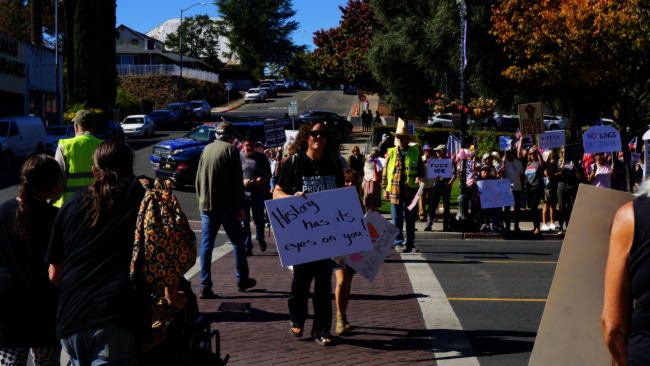
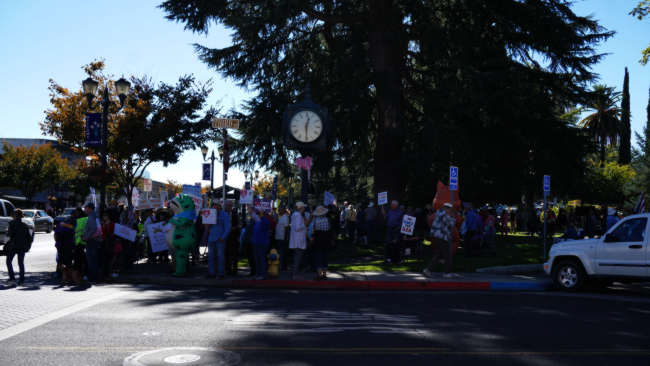
It was centered at Old Courthouse Museum Park on North Main Street, but the number of demonstrators stretched out across the sidewalk on the other side of the park, with small numbers of people also gathered at the corners of Second and Third streets.

A smaller protest also took place at the same time at Middletown Square Park.

The No Kings II protest in Lakeport, California, on Saturday, Oct. 18, 2025. Photo by Elizabeth Larson/Lake County News.


The first No Kings Nationwide rally took place on June 14, and that event in Lakeport was at the same spot. 

Organizers said the June 14 events brought out close to five million people nationwide and an estimated 1,200 in Lakeport.

On Saturday, organizers and media reports put the total number of planned protests at 2700 across all 50 states, with a number of demonstrations also planned in solidarity in Europe. All told, early estimates of total attendance across those events is as many as 7.6 million people.

Some protestors directed criticism toward Congress for its inaction as they demonstrated during the No Kings II protest in Lakeport, California, on Saturday, Oct. 18, 2025. Photo by Gemini Garcia/Third Iris Photography.


In Lakeport, members of Indivisible Lake County, the nonpartisan grassroots organization that organized this and earlier events, told Lake County News that as many as 2,000 people participated. Lake County News’ count of crowd size halfway through the event found about 800 people on site, as the crowd continued to change, with people coming and going on a constant basis.

At the estimated attendance size, it’s believed to be the largest such protest in Lake County history.

Those in attendance included several former county supervisors — Ed Robey, Denise Rushing and Jim Steele — and current District 5 Supervisor Jessica Pyska.

Numerous veterans were among the demonstrators at the No Kings II protest in Lakeport, California, on Saturday, Oct. 18, 2025. Photo by Gemini Garcia/Third Iris Photography.


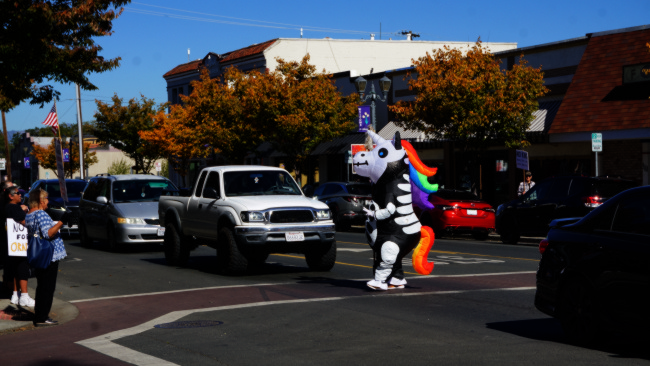
The mood in Lakeport was upbeat. In addition to a few thousand people, many accompanied by their pet dogs, there were a number of people in colorful inflatable costumes — including a few frogs in a homage to the Portland Frog, two unicorns and a squirrel.

There also was music and, as motorists made their way through the area, there was the sound of honking horns from many who wanted to show their support.

Organizers had trained attendants to make sure people were safely crossing the street at the crosswalks. Trained volunteers also quickly responded when a man fainted in the sun. Firefighters were called and treated the man. 

The Epstein files were a frequent topic of signage at the No Kings II protest in Lakeport, California, on Saturday, Oct. 18, 2025. Photo by Gemini Garcia/Third Iris Photography.


Many attendees carried colorful and clever signs with a variety of slogans: 

• Eat the rich, feed the poor.
• A republic, if you can keep it.
• Morons are governing America.
• Freedom not Fuhrer.
• Yes on Prop. 50.
• Democracy can’t be Trumped.
• Crazy cat ladies don’t like autocracies or bullies.
• Make America kind again.
• Your vote is your voice.
• Democracy not autocracy.
• America rejects kings. Get out!
• No troops in American streets. No faux king way!
• Trash Trump’s tariff taxes.
• Dude, where’s my due process?
• Hands off! Imagine hating immigrants more than pedophiles.
• We the people deserve better.
• Where is our Congress?
• Release the Epstein files.
• Too much wrong for one sign.

An inflatable unicorn makes its way to the No Kings II protest in Lakeport, California, on Saturday, Oct. 18, 2025. Photo by Elizabeth Larson/Lake County News.


Among those in costume was Kate Schmidt-Hopper, dressed in a flowing white dress and large hat with a sign that said, “USA: Rejecting tyrants since 1776” on one side and “Your Vote is Your Voice” on the other.

Schmidt-Hopper was dressed as a suffragist — the term she prefers to suffragette — who fought for women’s right to vote at the turn of the 20th century. Some of them were treated brutally, suffering jail time and forced feeding in response to hunger strikes. 

Asked if she happened to have the costume handy, she responded, “I did just happen to have it,” as she had purchased it to wear for July 4.

“It seemed appropriate for the moment,” said Schmidt-Hopper, who said she’s particularly concerned about women’s voting rights being eroded due to the Safeguard American Voter Eligibility, or SAVE, Act, which would create barriers to voting for women who have changed their name.

“I’m actually pretty concerned about that,” she said, adding, “Young women really need to look at where this is going.”

Protest participants cross Main Street during the No Kings II protest in Lakeport, California, on Saturday, Oct. 18, 2025. Photo by Elizabeth Larson/Lake County News.


Down at the corner of Second and Main streets, Terri Paulsen of Lakeport carried a sign that said “Pat Paulsen for President.”

It featured an image of her father, late comedian Pat Paulsen, who ran a number of satirical presidential campaigns between 1968 and 1996 and actually managed to get on the ballot for state primaries including New Hampshire and North Dakota.

Pat Paulsen lived in Sonoma County and at one point proclaimed himself the mayor of the town of Asti, near where he owned and operated a vineyard and winery.

Terri Paulsen, who grew up in Cloverdale, has lived in Lakeport for four years.

Of her decision to take part in the protest, she said, “I didn’t wake up to be angry or anything,” but that when she woke up Saturday, she thought it would be fun to come down and participate. 

Email Elizabeth Larson at This email address is being protected from spambots. You need JavaScript enabled to view it.. Follow her on Twitter, @ERLarson, and on Bluesky, @erlarson.bsky.social. Find Lake County News on the following platforms: Facebook, @LakeCoNews; X, @LakeCoNews; Threads, @lakeconews, and on Bluesky, @lakeconews.bsky.social. 

Terri Paulsen holds a poster of her late father, comedian and satirist Pat Paulsen, during the No Kings II protest in Lakeport, California, on Saturday, Oct. 18, 2025. Photo by Elizabeth Larson/Lake County News.


Helping Paws: More new dogs and puppies

LAKE COUNTY, Calif. — Lake County Animal Care and Control has a big group of canines needing new homes.

The dogs available for adoption this week include mixes of Australian shepherd, bulldog, cattle dog, chow, Chihuahua, German shepherd, Labrador Retriever, pit bull terrier, terrier and shepherd.

Dogs that are adopted from Lake County Animal Care and Control are either neutered or spayed, microchipped and, if old enough, given a rabies shot and county license before being released to their new owner. License fees do not apply to residents of the cities of Lakeport or Clearlake.

Those animals shown on this page at the Lake County Animal Care and Control shelter have been cleared for adoption.

Call Lake County Animal Care and Control at 707-263-0278 or visit the shelter online for information on visiting or adopting.

The shelter is located at 4949 Helbush in Lakeport.

Email Elizabeth Larson at This email address is being protected from spambots. You need JavaScript enabled to view it.. Follow her on Twitter, @ERLarson, and on Bluesky, @erlarson.bsky.social. Find Lake County News on the following platforms: Facebook, @LakeCoNews; X, @LakeCoNews; Threads, @lakeconews, and on Bluesky, @lakeconews.bsky.social. 

Kennel#18 Eva 's preview photo
Kennel#18 Eva

Kennel#11 Celina's preview photo
Kennel#11 Celina

Kennel#13 Stalone's preview photo
Kennel#13 Stalone
Kennel#7 Lulu's preview photo
Kennel#7 Lulu

 Kennel#9 Landon's preview photo
Kennel#9 Landon

Kennel#8 Lilly's preview photo
Kennel#8 Lilly

 Kennel#2 Lee's preview photo
Kennel#2 Lee

Kennel#15 Dino's preview photo
Kennel#15 Dino

Kennel#24 Teeter's preview photo
Kennel#24 Teeter
 Kennel#3 Modie's preview photo
Kennel#3 Modie
 
Kennel#29 Max's preview photo
Kennel#29 Max

Kennel#14a Tina's preview photo
Kennel#14a Tina

Kennel#14b Tamra's preview photo
Kennel#14b Tamra


Kennel#19 Frances's preview photo
Kennel#19 Frances

Kennel#21 Winston's preview photo
Kennel#21 Winston

Kennel#28(Tessa)'s preview photo
Kennel#28(Tessa)
 
Kennel#26 Enyo's preview photo
Kennel#26 Enyo

Kennel#4 Amore's preview photo
Kennel#4 Amore

Kennel#23 Kal's preview photo
Kennel#23 Kal

Kennel#22 Azula's preview photo
Kennel#22 Azula

Kennel#6 Athena's preview photo
Kennel#6 Athena

Kennel#17 Trina's preview photo
Kennel#17 Trina

Kennel#31 Milky Way's preview photo
Kennel#31 Milky Way

Kennel#10a Van's preview photo
Kennel#10a Van

Kennel#10b Nikey's preview photo
Kennel#10b Nikey

Kennel#10c Hoka's preview photo
Kennel#10c Hoka
Kennel#32 Hugo's preview photo
Kennel#32 Hugo

Kennel#33 Oreo's preview photo
Kennel#33 Oreo

Kennel#16's preview photo
Kennel#16

Kennel#12 Kora's preview photo
Kennel#12 Kora

Kennel#30a's preview photo
Kennel#30a

Kennel#27's preview photo
Kennel#27
B#11's preview photo
B#11
Kennel#25's preview photo
Kennel#25


Lake County man arrested in connection to organized retail theft fencing operation

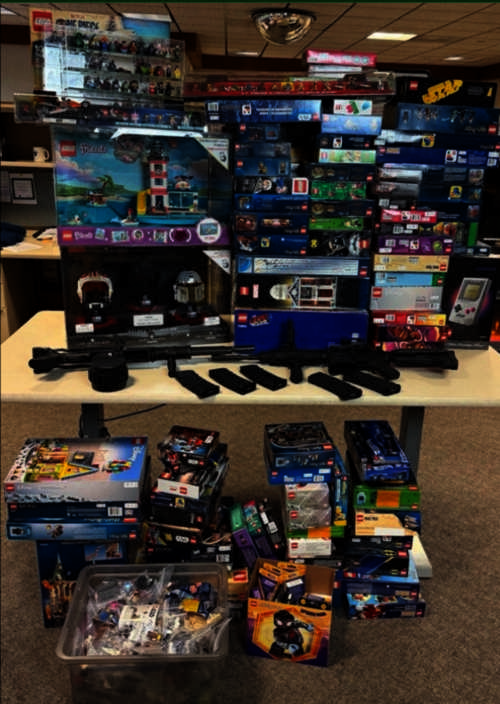
Police found hundreds of disassembled LEGO minifigures whose bodies were separated from their heads, which were neatly organized by facial expression, during a search of Robert Lopez’s home in Hidden Valley Lake, California, on Monday, Oct. 13, 2025. Photo courtesy of the Santa Rosa Police Department.

NORTH COAST, Calif. — A Lake County man has been arrested for his involvement in what the Santa Rosa Police Department said is a fencing operation for retail theft.

Robert Lopez, 39, of Hidden Valley Lake was arrested as a result of the investigation.

In a post on its Facebook page, the Santa Rosa Police Department reported that in September, detectives with its Property Crimes Investigations Team, or PCI, began a complex investigation into an organized retail theft fencing operation involving Lopez.

Detectives learned Lopez was directing others to steal expensive LEGO sets and purchasing the stolen property at a reduced price to turn around and resell the sets or individual mini figurines at inflated prices.

PCI detectives reviewed digital evidence, conducted surveillance, and collaborated with organized retail theft investigators from both Target and Walmart as they conducted this investigation. 

Police said the investigation uncovered additional evidence that Lopez was actively involved in organized retail theft, specifically targeting LEGO sets and communicating with local retail thieves to commit thefts of specified items at his direction. 

On Oct. 13, detectives served a search warrant at Lopez’s residence in the 18000 block of Spyglass Road in Hidden Valley Lake.

During the service of a search warrant at the residence, detectives discovered tens of thousands of LEGO pieces spread throughout the home, indicating a large-scale operation involving the collectible items.

The living room was filled with tubs, bins and desks covered in loose LEGO pieces, along with numerous unopened boxes of new LEGO sets. 

In the kitchen, thousands more pieces were scattered, and hundreds of disassembled LEGO minifigures were found with bodies separated from heads, which were neatly organized by facial expression.

Unopened LEGO boxes lined the hallway floor, and the garage contained approximately 100 assembled mini figures displayed on shelves, along with more unopened sets, large tubs of loose pieces, and broken-down packaging. 

Police said the scene suggested systematic sorting and potential resale activity, consistent with fencing operations involving high-demand collectible items. Detectives also located numerous mini figurines individually packaged in small plastic baggies. 

The sale of stolen LEGO collectible figurines is a growing concern due to their high resale value, popularity among collectors, and ease of concealment. Police said these items are often targeted because they’re small, untraceable, and in high demand, making them ideal for quick resale through online marketplaces or informal channels.

Located in a safe was ammunition, high-capacity magazines, and two firearms: a pump-action pistol grip shotgun with a collapsible stock loaded with a drum-style magazine, and an assault rifle with a loaded high-capacity magazine inserted into it. A loaded handgun was also located in a lockbox in Lopez’s bedroom dresser. 

Lopez, a convicted felon, is prohibited from owning or possessing firearms and/or ammunition, police said.

Lopez was arrested and booked into Sonoma County jail for organized retail theft and receiving stolen property, organizing or directing retail theft, conspiracy to commit a felony, three counts of a felon in possession of a firearm, a felon in possession of ammunition and possession of an assault rifle.

It is believed that over $6,000 in stolen LEGOs were recovered during the service of the search warrant. Digital evidence was also located during the search warrant that indicates Lopez was directing other individuals to steal merchandise for him to purchase later. 

“Although the investigation is largely complete, PCI detectives are continuing to investigate this incident to identify any additional suspects and attempt to determine what retail establishments the seized LEGOs were stolen from,” police reported.

Organized retail theft is a serious and growing issue that involves the coordinated theft, trafficking, and resale of stolen goods — often through seemingly legitimate channels such as online marketplaces, pawn shops, flea markets or informal street-level transactions.

“These investigations are complex and resource-intensive, frequently involving multiple suspects, digital evidence, and the need to trace stolen property across jurisdictions. The impact of these crimes extends beyond retailers, harming consumers who may unknowingly purchase stolen items and face financial loss or legal complications,” the police department said.

“The Santa Rosa Police Department remains committed to identifying and dismantling organized retail theft networks to protect businesses, consumers, and the integrity of our local economy,” the report explained. 

“This operation was made possible through our valued partnership with the Loss Prevention Agents and Asset Protection for the Target and Walmart corporations, committed to protecting their customers and combating organized retail theft,” the report said. “Their collaboration and dedication to public safety have been instrumental in the success of this investigation, and we are deeply grateful for their continued support.”

Guns and items that police said were stolen property were recovered during a search of Robert Lopez’s home in Hidden Valley Lake, California, on Monday, Oct. 13, 2025. Photo courtesy of the Santa Rosa Police Department.

Antioxidants help stave off a host of health problems – but figuring out how much you’re getting can be tricky

Many fruits and vegetables are high in antioxidants. istetiana/Moment via Getty Images

When it comes to describing what an antioxidant is, it’s all in the name: Antioxidants counter oxidants.

And that’s a good thing. Oxidants can damage the structure and function of the chemicals in your body critical to life – like the proteins and lipids within your cells, and your DNA, which stores genetic information. A special class of oxidants, free radicals, are even more reactive and dangerous.

As an assistant professor of nutrition, I’ve studied the long-standing research showing how the imbalances in antioxidants and oxidants lead to oxidative stress, which is linked to cancer, diabetes, cardiovascular disease and dementia and Alzheimer’s disease. In fact, a primary cause of aging is the damage accumulated across of a lifetime of oxidative stress.

Simply put: To help prevent oxidative stress, people need to eat foods with antioxidants and limit their exposure to oxidants, particularly free radicals.

The research: Food, not supplements

There’s no way for any of us to avoid some oxidative stress. Just metabolism – the processes in your body that keep you alive, such as breathing, digestion and maintaining body temperature – are a source of oxidants and free radicals. Inflammation, pollution and radiation are other sources.

As a result, everyone needs antioxidants. There are many different types: enzymes, minerals, vitamins and phytochemicals.

Two types of phytochemicals deserve special mention: carotenoids and flavonoids. Carotenoids are pigments, with the colors yellow, orange and red; they contain the antioxidants beta-carotene, lycopene and lutein. Some flavonoids, called anthocyanins, are pigments that give foods a blue, red or purple color.

Although your body produces some of these antioxidants, you can get them from the foods you eat, and they’re better for you than supplements.

In fact, researchers found that antioxidant supplements did not reduce deaths, and some supplements in excessive amounts contribute to oxidative stress, and may even increase the risk of dying.

It should be pointed out that in most of these studies, only one or two antioxidants were given, and often in amounts far greater than the recommended daily value. One study, for example, gave participants only vitamin A, and at an amount more than 60 times an adult’s recommended intake.

A synopsis of the study that measured the antioxidant content of more than 3,000 foods.

Foods rich in antioxidants

In contrast, increased antioxidant intake from whole foods is related to decreased risk of death. And although antioxidant supplementation didn’t reduce cancer rates in smokers, the antioxidants in whole foods did.

But measuring antioxidants in foods is complicated. Extensive laboratory testing is required, and too many foods exist to test them all anyway. Even individual food items that are the same exact variety of food – such as two Gala apples – can have different amounts of antioxidants. Where the food was grown and harvested, how it was processed and how it was stored during transportation and while in the supermarket are factors. The variety of the food also matters – the many different types of apples, for instance, can have different amounts of antioxidants.

Nonetheless, in 2018, researchers quantified the antioxidant content of more than 3,100 foods – the first antioxidant database. Each food’s antioxidant capacity was determined by the amount of oxidants neutralized by a given amount of food. The researchers measured this capacity in millimoles per 100 grams, or about 4 ounces.

For fruits easily found in the grocery store, the database shows blueberries have the most antioxidants – just over 9 millimoles per 4 ounces. The same serving of pomegranates and blackberries each have about 6.5 millimoles.

For common vegetables, cooked artichoke has 4.54 millimoles per 4 ounces; red kale, 4.09 millimoles; cooked red cabbage, 2.15; and orange bell pepper, 1.94.

Coffee has 2.5 millimoles per 4 ounces; green tea has 1.5; whole walnuts, just over 13; whole pecans, about 9.7; and sunflower seeds, just over 5. Herbs and spices have a lot: clove has 465 millimoles per 4 ounces; rosemary has 67; and thyme, about 64. But keep in mind that those enormous numbers are based on a quarter-pound. Still, just a normal sprinkle packs a powerful nutritional punch.

A young woman picks up a package of fresh produce at the supermarket.
The antioxidant levels of a food can be affected by its storage time in the supermarket. d3sign/Moment via Getty Images

Other tips

Other ways to choose antioxidant-rich foods: Read the nutrition facts label and look for antioxidant vitamins and minerals – vitamins A, C, E, D, B2, B3 and B9, and the minerals selenium, zinc and manganese.

Just know the label has a drawback. Food producers and manufacturers are not required to list every nutrient of the food on the label. In fact, the only vitamins and minerals required by law are sodium, potassium, calcium, iron and vitamin D.

Also, focus on eating the rainbow. Colorful foods are often higher in antioxidants, like blue corn. Many darker foods are rich in antioxidants, too, like dark chocolate, black barley and dark leafy vegetables, such as kale and Swiss chard.

Although heat can degrade oxidants, that mostly occurs during the storage and transportation of the food. In some cases, cooking may increase the food’s antioxidant capacity, as with leafy green vegetables.

Keep in mind that while blueberries, red kale and pecans are great, their antioxidant profile will be different than that of other fruits, vegetables and nuts. That’s why diversity is the key: To increase the power of antioxidants, choose a variety of fresh, flavorful, colorful and, ideally, local foods.The Conversation

Nathaniel Johnson, Assistant Professor of Nutrition and Dietetics, University of North Dakota

This article is republished from The Conversation under a Creative Commons license. Read the original article.

Space News: ‘Space tornadoes’ could cause geomagnetic storms – but these phenomena, spun off ejections from the Sun, aren’t easy to study

Flux ropes (simulated, right) are structures made up of magnetic field lines wrapping around each other like a rope, that look similar to tornadoes on Earth. NOAA, Mojtaba Akhavan-Tafti and Chip Manchester

Weather forecasting is a powerful tool. During hurricane season, for instance, meteorologists create computer simulations to forecast how these destructive storms form and where they might travel, which helps prevent damage to coastal communities. When you’re trying to forecast space weather, rather than storms on Earth, creating these simulations gets a little more complex. To simulate space weather, you would need to fit the Sun, the planets and the vast empty space between them in a virtual environment, also known as a simulation box, where all the calculations would take place.

Space weather is very different from the storms you see on Earth. These events come from the Sun, which ejects eruptions of charged particles and magnetic fields from its surface. The most powerful of these events are called interplanetary coronal mass ejections, or CMEs, which travel at speeds approaching 1,800 miles per second (2,897 kilometers per second).

To put that in perspective, a single CME could move a mass of material equivalent to all the Great Lakes from New York City to Los Angeles in just under two seconds – almost faster than it takes to say “space weather.”

When these CMEs hit Earth, they can cause geomagnetic storms, which manifest in the sky as beautiful auroras. These storms can also damage key technological infrastructure, such as by interfering with the flow of electricity in the power grid and causing transformers to overheat and fail.

Bands of colorful light in the night sky above a snowy ridge.
Geomagnetic storms, caused by space weather, produce beautiful light shows, but they can also damage satellites. Frank Olsen, Norway/Moment via Getty Images

To better understand how these storms can wreak so much havoc, our research team created simulations to show how storms interact with Earth’s natural magnetic shield and trigger the dangerous geomagnetic activity that can shut down electric grids.

In a study published in October 2025 in the Astrophysical Journal, we modeled one of the sources of these geomagnetic storms: small, tornado-like vortices spun off of an ejection from the Sun. These vortices are called flux ropes, and satellites had previously observed small flux ropes – but our work helped uncover how they are generated.

The challenge

Our team started this research in summer 2023, when one of us, a space weather expert, spotted inconsistencies in space weather observations. This work had found geomagnetic storms occurring during periods when no solar eruptions were predicted to hit Earth.

Bewildered, the space weather expert wanted to know if there could be space weather events that were smaller than coronal mass ejections and did not originate directly from solar eruptions. He predicted that such events might form in the space between the Sun and Earth, instead of in the Sun’s atmosphere.

One example of such smaller space weather events is a magnetic flux rope – bundles of magnetic fields wrapped around each other like a rope. Its detection in computer simulations of solar eruptions would hint to where these space weather events may be forming. Unlike satellite observations, in simulations you can turn back the clock or track an event upstream to see where they originate.

Sometimes the Sun ejects masses of plasma and magnetic field lines, called coronal mass ejections.

So he asked the other author, a leading simulation expert. It turned out that finding smaller space weather events was not as simple as simulating a big solar eruption and letting the computer model run long enough for the eruption to reach Earth. Current computer simulations are not meant to resolve these smaller events. Instead, they are designed to focus on the large solar eruptions because these have the most effects on infrastructure on Earth.

This shortfall was quite disappointing. It was like trying to forecast a hurricane with a simulation that only shows you global weather patterns. Because you can’t see a hurricane at that scale, you would completely miss it.

These larger-scale simulations are known as global simulations. They study how solar eruptions form on the Sun’s surface and travel through space. These simulations treat streams of charged particles and magnetic fields floating through space as fluids to reduce the computational cost, compared with modeling every charged particle independently. It’s like measuring the overall temperature of water in a bottle, instead of tracking every single water molecule individually.

Because these simulations are computational phenomena that happen across such a vast space, they can’t resolve every detail. To affordably resolve the vast space between the Sun and the planets, researchers divide the space into large cubes – analogous to two-dimensional pixels in a camera. In the simulation, these cubes each represent an area 1 million miles (1.6 million kilometers) wide, tall and across. That distance is equivalent to about 1% of the distance from Earth to the Sun.

The search begins

Our search began with what felt like hunting for a needle in a haystack. We were looking into old global simulations, searching for a tiny, transient blob – which would signify a flux rope – within an area of space hundreds of times wider than the Sun itself. Our initial search did not yield anything.

We then shifted our focus to the simulations of the May 2024 solar eruption event. This time, we specifically looked at the region where the solar eruption collided into a quiet flow of charged particles and magnetic fields, called the solar wind, ahead of it.

There it was: a distinct system of magnetic flux ropes.

However, our excitement was short-lived. We could not tell where these flux ropes came from. The modeled flux ropes were also too small to survive, eventually fizzling out because they became too small to resolve with our simulation grid.

But that was the type of clue we needed – the presence of flux ropes at the location where the solar eruption collided with the solar wind.

To settle the issue, we decided to bridge this gap and create a computer model with a finer grid size than those previous global simulations used. Since increasing the resolution across the entire simulation space would have been prohibitively expensive, we decided to only increase the simulation resolution along the trajectory of the flux ropes.

The new simulations could now resolve features that spanned distances six times Earth’s 8,000-mile (or 128,000-kilometer) diameter down to tens of thousands of miles – nearly 100 times better than previous simulations.

A comparison of low and enhanced simulation grid sizes. We identified one flux rope in the original, low-resolution simulation, but it soon fizzled out. When we improved the simulation grid, we could see multiple flux ropes. CC BY-NC-ND

Making the discovery

Once we designed and tested the simulation grid, it was time to simulate that same solar eruption that led to the formation of those flux ropes in the less fine-grained model. We wanted to study the formation of those flux ropes and how they grew, changed shape and possibly terminated in the narrow wedge encompassing the space between the Sun and Earth. The results were astonishing.

The high-resolution view revealed that the flux ropes formed when the solar eruption slammed into the slower solar wind ahead of it. The new structures possessed incredible complexity and strength that persisted far longer than we expected. In meteorological terms, it was like watching a hurricane spawn a cluster of tornadoes.

We found that the magnetic fields in these vortices were strong enough to trigger a significant geomagnetic storm and cause some real trouble here on Earth. But most importantly, the simulations confirmed that there are indeed space weather events that form locally in the space between the Sun and Earth. Our next step is to simulate how such tornado-like features in the solar wind may impact our planet and infrastructure.

This two-dimensional cut of the simulation box shows a solar eruption that moves toward Earth quickly. The eruption slams into the slower solar wind ahead of it, causing the formation of a constellation of magnetic flux ropes. The magnetic flux ropes appear as islands in the simulation box. The solid lines represent magnetic field lines, and the color bar shows the number of charged particles. Flux ropes move toward Earth upon formation in the solar wind. The video also shows how the Space Weather Investigation Frontier space mission, or SWIFT, a constellation of four satellites forming a tetrahedron configuration, could examine the formation and growth of these structures in the solar wind.

Watching these flux ropes in the simulation form so quickly and move toward Earth was exciting, but concerning. It was exciting because this discovery could help us better plan for future extreme space weather events. It was at the same time concerning because these flux ropes would only appear as a small blip in today’s space weather monitors.

We would need multiple satellites to directly see these flux ropes in greater detail so that scientists can more reliably predict whether, when and in what orientation they may affect our planet and what the outcome may be. The good news is that scientists and engineers are developing the next-generation space missions that could address this.The Conversation

Mojtaba Akhavan-Tafti, Associate Research Scientist, University of Michigan and Ward B. (Chip) Manchester, Research Professor of Climate and Space Sciences Engineering, University of Michigan

This article is republished from The Conversation under a Creative Commons license. Read the original article.

  • 81
  • 82
  • 83
  • 84
  • 85
  • 86
  • 87
  • 88
  • 89
  • 90

Community

  • Lake County Wine Alliance offers sponsor update; beneficiary applications open 

  • Mendocino National Forest announces seasonal hiring for upcoming field season

Public Safety

  • Lakeport Police logs: Thursday, Jan. 15

  • Lakeport Police logs: Wednesday, Jan. 14

Education

  • Woodland Community College receives maximum eight-year reaffirmation of accreditation from ACCJC

  • SNHU announces Fall 2025 President's List

Health

  • California ranks 24th in America’s Health Rankings Annual Report from United Health Foundation

  • Healthy blood donors especially vital during active flu season

Business

  • Two Lake County Mediacom employees earn company’s top service awards

  • Redwood Credit Union launches holiday gift and porch-to-pantry food drives

Obituaries

  • Rufino ‘Ray’ Pato

  • Patty Lee Smith

Opinion & Letters

  • The benefits of music for students

  • How to ease the burden of high electric bills

Veterans

  • CalVet and CSU Long Beach team up to improve data collection related to veteran suicides

  • A ‘Big Step Forward’ for Gulf War Veterans

Recreation

  • Wet weather trail closure in effect on Upper Lake Ranger District

  • Mendocino National Forest seeking public input on OHV grant applications

  • State Parks announces 2026 Anderson Marsh nature walk schedule 

  • BLM lifts seasonal fire restrictions in central California

Religion

  • Kelseyville Presbyterian to host Ash Wednesday service and Lenten dinner Feb. 18

  • Kelseyville Presbyterian Church to hold ‘Longest Night’ service Dec. 21

Arts & Life

  • Auditions announced for original musical ‘Even In Shadow’ set for March 21 and 28

  • ‘The Rip’ action heist; ‘Steal’ grounded in a crime thriller

Government & Politics

  • Lake County Democrats issue endorsements in local races for the June California Primary

  • County negotiates money-saving power purchase agreement

Legals

  • March 3 hearing on ordinance amending code for commercial cannabis uses

  • Feb. 12 public hearing on resolution to establish standards for agricultural roads

How to resolve AdBlock issue?
Refresh this page