How to resolve AdBlock issue?
Refresh this page
How to resolve AdBlock issue?
Refresh this page
Lake County News,California
  • Home
    • Registration Form
  • News
    • Education
    • Veterans
    • Community
      • Obituaries
      • Letters
      • Commentary
    • Police Logs
    • Business
    • Recreation
    • Health
    • Religion
    • Legals
    • Arts & Life
    • Regional
  • Calendar
  • Contact us
    • FAQs
    • Phones, E-Mail
    • Subscribe
  • Advertise Here
  • Login

News

COVID-19 mRNA vaccines could unlock the next revolution in cancer treatment – new research

With a little help, your immune cells can be potent tumor killers. Steve Gschmeissner/Science Photo Library via Getty Images

The COVID-19 mRNA-based vaccines that saved 2.5 million lives globally during the pandemic could help spark the immune system to fight cancer. This is the surprising takeaway of a new study that we and our colleagues published in the journal Nature.

While developing mRNA vaccines for patients with brain tumors in 2016, our team, led by pediatric oncologist Elias Sayour, discovered that mRNA can train immune systems to kill tumors – even if the mRNA is not related to cancer.

Based on this finding, we hypothesized that mRNA vaccines designed to target the SARS-CoV-2 virus that causes COVID-19 might also have antitumor effects.

So we looked at clinical outcomes for more than 1,000 late-stage melanoma and lung cancer patients treated with a type of immunotherapy called immune checkpoint inhibitors. This treatment is a common approach doctors use to train the immune system to kill cancer. It does this by blocking a protein that tumor cells make to turn off immune cells, enabling the immune system to continue killing cancer.

Remarkably, patients who received either the Pfizer or Moderna mRNA-based COVID-19 vaccine within 100 days of starting immunotherapy were more than twice as likely to be alive after three years compared with those who didn’t receive either vaccine. Surprisingly, patients with tumors that don’t typically respond well to immunotherapy also saw very strong benefits, with nearly fivefold improvement in three-year overall survival. This link between improved survival and receiving a COVID-19 mRNA vaccine remained strong even after we controlled for factors like disease severity and co-occurring conditions.

To understand the underlying mechanism, we turned to animal models. We found that COVID-19 mRNA vaccines act like an alarm, triggering the body’s immune system to recognize and kill tumor cells and overcome the cancer’s ability to turn off immune cells. When combined, vaccines and immune checkpoint inhibitors coordinate to unleash the full power of the immune system to kill cancer cells.

University of Florida Health pediatric oncologist Elias Sayour, who led the research, explains that mRNA vaccines that are not specific to a patient’s cancer can ‘wake up the sleeping giant that is the immune system to fight cancer.’

Why it matters

Immunotherapy with immune checkpoint inhibitors has revolutionized cancer treatment over the past decade by producing cures in many patients who were previously considered incurable. However, these therapies are ineffective in patients with “cold” tumors that successfully evade immune detection.

Our findings suggest that mRNA vaccines may provide just the spark the immune system needs to turn these “cold” tumors “hot.” If validated in our upcoming clinical trial, our hope is that this widely available, low-cost intervention could extend the benefits of immunotherapy to millions of patients who otherwise would not benefit from this therapy.

Countless clear vials of liquid with labels reading 'CANCER mRNA vaccine 10 ML' on a table
Combining immunotherapy with mRNA vaccines could allow more patients to benefit from this treatment. Thom Leach/Science Photo Library via Getty Images

What other research is being done

Unlike vaccines for infectious diseases, which are used to prevent an infection, therapeutic cancer vaccines are used to help train the immune systems of cancer patients to better fight tumors.

We and many others are currently working hard to make personalized mRNA vaccines for patients with cancer. This involves taking a small sample of a patient’s tumor and using machine learning algorithms to predict which proteins in the tumor would be the best targets for a vaccine. However, this approach can be costly and difficult to manufacture.

In contrast, COVID-19 mRNA vaccines do not need to be personalized, are already widely available at low or no cost around the globe, and could be administered at any time during a patient’s treatment. Our findings that COVID-19 mRNA vaccines have substantial antitumor effects bring hope that they could help extend the anti-cancer benefits of mRNA vaccines to all.

What’s next

In pursuit of this goal, we are preparing to test this treatment strategy in patients with a nationwide clinical trial in people with lung cancer. People receiving an immune checkpoint inhibitor will be randomized to either receive a COVID-19 mRNA vaccine during treatment or not.

This study will tell us whether COVID-19 mRNA vaccines should be included as part of the standard of care for patients receiving an immune checkpoint inhibitor. Ultimately, we hope that this approach will help many patients who are treated with immune therapy, and especially those who currently lack effective treatment options.

This work exemplifies how a tool born from a global pandemic may provide a new weapon against cancer and rapidly extend the benefits of existing treatments to millions of patients. By harnessing a familiar vaccine in a new way, we hope to extend the lifesaving benefits of immunotherapy to cancer patients who were previously left behind.

The Research Brief is a short take on interesting academic work.The Conversation

Adam Grippin, Physician Scientist in Cancer Immunotherapy, The University of Texas MD Anderson Cancer Center and Christiano Marconi, Ph.D. Candidate in Immunotherapy, University of Florida

This article is republished from The Conversation under a Creative Commons license. Read the original article.
EcoArts among recipients of grants to bring arts to California’s parks

California State Parks, the California Arts Council and Parks California announced Tuesday more than $2.6 million in community grants to organizations statewide as part of their Arts in California Parks partnership, with one of those grants coming to Lake County.

These funds will enable local nonprofit, community and tribal organizations to bring music, dance, storytelling, visual art and cultural programs into parks, transforming them into vibrant spaces that foster creativity, honor cultural heritage and strengthen community connections.

In Lake County, EcoArts of Lake County will lead Rooted in Place, a public art initiative activating four county-managed parks with youth-designed murals and a community-built sculpture at Middletown Trailside Park. 

In collaboration with local tribes, the project honors Indigenous history and resilience following the 2015 Valley Fire.

Managed by Parks California, Arts in California Parks is a four-year, $8 million State Parks grants initiative launched in 2024 to support artists, culture bearers, California Native American tribes and local groups in creating art and cultural experiences in outdoor spaces. 

By expanding access to the arts in nature, the program helps parks remain welcoming, inspiring and inclusive for all Californians. 

This is the second round of grants awarded as part of the program.

“Art brings people closer to the meaning of their parks — not only as places of natural beauty, but as spaces for reflection, healing and shared experience,” said Armando Quintero, California State Parks director. “When creativity meets open space, it deepens understanding of one another and reminds us that parks are for everyone. Through initiatives like Arts in California Parks, we’re celebrating the connection between art, nature and community that defines our state.”

This year, 30 organizations across California were awarded grants ranging from $28,000 to $150,000 from a pool of more than 200 applicants. The specific grant amounts for each organization was not reported on Tuesday.

Projects reflect the diversity of California’s people and landscapes. From large-scale performances to culturally focused installations, each initiative provides opportunities for residents and visitors alike to engage with the arts while deepening their connection to nature and local history.

“At Parks California, we believe that access isn’t just about getting to a park — it’s about feeling a sense of belonging once you’re there,” said Kindley Walsh Lawlor, CEO and president, Parks California. “Arts in California Parks helps make that possible by connecting people, stories and cultures to the landscapes that define our sense of place. These projects reflect our shared vision of public lands as places where creativity thrives, communities gather and every Californian can see themselves represented.”

From murals that celebrate cultural heritage to circus performances in city parks, this new round of grants showcases how creativity and community come together across California. 

In addition to EcoArts, A few of the projects underway include:

In Oakland, Trybe Inc. will launch Roots & Rhythms at Clinton Square Park, year-round art and nature programming for youth and families. Activities range from a cultural heritage mural and youth-led garden to summer camps, multicultural art classes and community showcases that celebrate creativity, sustainability and belonging.

In Merced, the city of Merced will transform General Vang Pao Park into a vibrant space honoring the region’s Hmong community through a memorial plaza, statue and mural. The project blends art, recreation and cultural heritage while creating new outdoor amenities for residents in an underserved area.

Angels Gate Cultural Center in San Pedro will host Sustainers of Life, a contemporary art exhibition featuring new works by Indigenous women artists. Presented alongside the Many Winters Gathering of Elders, the exhibition and public programs will highlight Native women’s leadership and connection to the land through workshops, films and field trips for local students.

In Cathedral City, Hope Rising: Esperanza Park Cultural Celebration will transform a new park in the historically underserved Dream Homes neighborhood, uniting residents through a series of mural-making events, music and family art activities celebrating Hispanic and tribal heritage — turning Esperanza (“hope”) Park into a vibrant symbol of belonging and resilience in the Coachella Valley.

In San Diego, Fern Street Circus will launch its Neighborhood Tour 2025, bringing 16 free circus performances and parades to parks in underserved neighborhoods. The tour blends circus arts, puppetry and community storytelling to spark joy and connection while making high quality arts experiences accessible to all.

“Sustainers of Life honors Indigenous women by sharing multidimensional stories woven within broader historical contexts, creating space for both mourning and celebrating the ongoing resilience of those who nurture and protect life, and sustain our connection to the land,” said Cecelia Caro, director of exhibitions at Angels Gate Cultural Center. “Arts in California Parks makes it possible for us to share these powerful voices in a setting where the community can reflect, learn and grow together.”

To learn more about funded projects and upcoming events, visit ArtsInCaliforniaParks.org. 

Lake County Planning Commission to consider permits for dietary supplement company

LAKEPORT, Calif. — The Lake County Planning Commission this week will hold a public hearing on a cosmetic company’s plans for a facility in Lakeport.

The meeting will begin at 9 a.m. Thursday, Oct. 23, in the board chambers on the first floor of the Lake County Courthouse, 255 N. Forbes St., Lakeport.

The agenda is here.

To participate in real-time, join the Zoom meeting by clicking this link. 

The webinar ID is 994 1760 2765, the pass code is 155982. 

Access the meeting via one tap mobile at +16699006833,,99417602765#,,,,*155982# or dial in at 669-900-6833.

The meeting also can be viewed on the county’s website or Facebook page.

At 9:05 a.m., the commission will hold a public hearing to consider a proposed major use permit and categorical exemption under the California Environmental Quality Act for Esther Formula USA Corp.

The report to the commission explains that the company is seeking to amend an existing major use permit to discontinue the permitted commercial cannabis manufacturing and distribution and commence processing, manufacturing and distribution of dietary supplements at 4615 Work Right Circle in Lakeport.

Esther Formula began in Korea, and the US corporation was established in 2022, according to the company’s five-year business plan included in the agenda packet.

The staff report explained that while the amendment of the major use permit will not include commercial cannabis uses, the company’s plan does include incorporating cannabidiol — or CBD, a nonpsychoactive compound derived from hemp — products within the product line.

“CBD derived from hemp is not regulated by the County of Lake, rather the manufacturers are required to register with the California Department of Public Health for testing and labeling requirements of CBD products,” the staff report explains.

Email Elizabeth Larson at This email address is being protected from spambots. You need JavaScript enabled to view it.. Follow her on Twitter, @ERLarson, and on Bluesky, @erlarson.bsky.social. Find Lake County News on the following platforms: Facebook, @LakeCoNews; X, @LakeCoNews; Threads, @lakeconews, and on Bluesky, @lakeconews.bsky.social. 

Governor, attorney general plan lawsuit if president sends National Guard to San Francisco

As President Trump in recent days said he would send the National Guard into San Francisco, state officials said California will hit back to block what they said is Trump’s illegal use of the military against the civilian population from spreading to the streets of San Francisco. 

Gov. Gavin Newsom and Attorney General Rob Bonta on Tuesday announced the state will file a lawsuit immediately if the president sends federalized members of the military to San Francisco.  

“We’re a nation of laws and accountability — not a nation that turns a blind eye to abuse of power. Donald Trump, himself a convicted felon who pardoned felons convicted of assaulting federal law enforcement officers, is misleading the public with his false narrative that America, and especially California, is some lawless wasteland. But California is proving him wrong — in the courts and on the facts,” said Newsom.

"We don’t bow to kings, and we’re standing up to this wannabe tyrant,” Newsom added. “The notion that the federal government can deploy troops into our cities with no justification grounded in reality, no oversight, no accountability, no respect for state sovereignty — it’s a direct assault on the rule of law. We’re drawing a line: California will always defend the Constitution, our people, and our values from authoritarian overreach.”
 
“There is no basis to send National Guard troops to San Francisco. No emergency. No rebellion. No invasion. Not even unrest,” said Attorney General Bonta. “President Trump has long abandoned any pretenses for the illegal federalization and deployment of California’s National Guard. He does not care about satisfying the conditions of the law; he cares about himself, and he cares about power. Trump has made no secret of his intentions: To use our National Guard as his own Royal Army and our cities as a training ground for the military. This is outrageous, indefensible—and most importantly illegal. San Francisco may be the President’s latest target, but California is no stranger to the President’s political games and unconstitutional tactics. We’re ready to go to court immediately if the President follows through on this latest illegal plan.”
 
Trump states plans to send in the National Guard

In recent weeks, Trump has publicly stated his intention to unlawfully send in the National Guard to San Francisco, including saying on Oct. 19 that “they want us in San Francisco,” and on Oct. 15 “strongly recommending at the request of government officials, which is always nice, that you start looking at San Francisco” to deploy the military.

In fact, the Governor’s Office said community partners and local leaders have vehemently disagreed with the president and have said no to this domestic military intervention in the city — public safety is up and crime is down all because of significant investments and meaningful partnerships between state and local leaders.

“In an apparent senior moment, the president seems to have confused a business leader, who has since completely walked back his comments with government officials,” the Governor’s Office said in the Tuesday statement.

Since the deployment of soldiers to Los Angeles in June, the federal government has shifted their reasoning and broadened their mission, dispatching hundreds of guardsmen beyond Los Angeles to Portland and Chicago.

Ultimately, their presence in other states means that there is truly no need for their federalization in Los Angeles as they are not even around to protect California from any “lawlessness.” The federal government has now renewed these California guardsmembers federalization to at least February 2026.
 
California takes care of its own communities

The Governor’s Office said local officials do not want the National Guard in San Francisco, even if Donald Trump has convinced himself otherwise. 

“The truth is that Donald Trump hates California’s progress,” Newsom’s office said in its statement on the planned lawsuit.

California’s partnership with local communities, especially in San Francisco, has helped reduce crime and increase public safety by seizing illicit drugs and firearms off the streets. 

California has invested $1.7 billion since 2019 to fight crime, help local governments hire more police, and improve public safety. In 2023, as part of California’s Public Safety Plan, the governor announced the largest-ever investment to combat organized retail crime in state history, an annual 310% increase in proactive operations targeting organized retail crime, and special operations across the state to fight crime and improve public safety.

In August, Gov. Newsom signed into law the most significant bipartisan legislation to crack down on property crime in modern California history. These bipartisan bills offer new tools to bolster ongoing efforts to hold criminals accountable for smash-and-grab robberies, property crime, retail theft, and auto burglaries. While California’s crime rate remains at near-historic lows, these laws help California adapt to evolving criminal tactics to ensure perpetrators are effectively held accountable.
 
Violent crime down across major California cities

According to the Major Cities Chiefs Association, overall violent crime in major California cities is down 12.5% in 2025 compared to 2024. The largest overall declines in violent crime were reported by the police departments in Oakland (30%) and San Francisco (22%). 

According to another data set released by the California Department of Justice, nearly every major crime category, including violent crime and homicides, dropped in 2024. 

The results in California’s major Bay Area cities cross over into overall success for the state as California’s 2024 homicide rate is now the second lowest it has been since at least 1966. 

And when comparing crime rates in San Francisco before the COVID-induced crime surge, between 2019 and 2025, there has been a 45% decrease in homicides and 40% decrease in robberies.
 
Update on cross-country legal actions

While the litigation is ongoing — and the Ninth Circuit will hear arguments on Wednesday in an appeal from the trial judge’s order blocking the federalization and deployment of the Guard. 

California: Following a bench trial, a federal judge ruled in August 2025 that President Trump's deployment of the California National Guard in Los Angeles violated the Posse Comitatus Act. This law restricts the military's involvement in domestic law enforcement and was central to a lawsuit filed by Governor Gavin Newsom and the state of California against the Trump administration regarding the federalization and deployment of these troops. That ruling is on hold pending the federal government’s appeal.
 
Illinois: In October 2025, a federal district court issued a temporary restraining order to block the deployment of federalized troops, including the Texas National Guard, to Chicago. This action followed a lawsuit filed by state and city leaders against the Trump administration to prevent such a deployment. While a federal appeals court later permitted the troops to remain federalized and mustered, it upheld the prohibition against their deployment within Illinois. The Trump administration has since appealed this decision to the Supreme Court. Four judges, including two appointed by Republicans, have already ruled against President Trump and found that no facts supported his deployment of the National Guard to Chicago. On Monday, California filed an amicus brief in the United States Supreme Court in support of Illinois’ position in Trump v. Illinois. 
 
Oregon: A federal lawsuit was filed by Oregon and Portland, and later joined by California, to block the deployment of National Guard troops to Portland. A district court judge initially blocked the federalization and deployment in early October 2025, but the U.S. Court of Appeals for the 9th Circuit later “stayed” that restraining order to the extent it would de-federalize the Guard troops. The order blocking deployment of Guard troops in Oregon remains in effect for now.  Litigation is ongoing in that case. 

Trump’s federalization of Los Angeles 

On June 7, for the first time in our country’s history, the President invoked 10 U.S.C. § 12406 to federalize a state’s National Guard over the objections of California.  

President Trump and Department of Defense Secretary Hegseth transferred 4,000 members of California’s National Guard—one in three of the Guard’s total active members—to federal control to serve in a civilian law enforcement role on the streets of Los Angeles and other communities in Southern California.  

California brought suit to challenge that unprecedented action. The litigation is ongoing – with a hearing before the Ninth Circuit Court of Appeals on Wednesday.

Geothermal energy has huge potential to generate clean power – including from used oil and gas wells

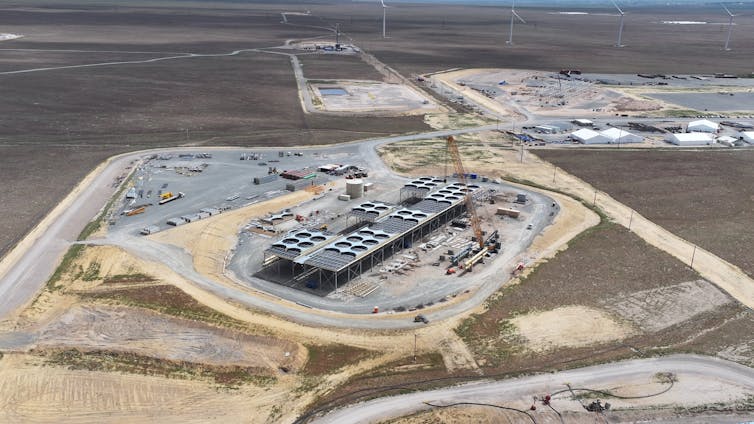
The world’s largest geothermal power station is under construction in Utah. Business Wire via AP

As energy use rises and the planet warms, you might have dreamed of an energy source that works 24/7, rain or shine, quietly powering homes, industries and even entire cities without the ups and downs of solar or wind – and with little contribution to climate change.

The promise of new engineering techniques for geothermal energy – heat from the Earth itself – has attracted rising levels of investment to this reliable, low-emission power source that can provide continuous electricity almost anywhere on the planet. That includes ways to harness geothermal energy from idle or abandoned oil and gas wells. In the first quarter of 2025, North American geothermal installations attracted US$1.7 billion in public funding – compared with $2 billion for all of 2024, which itself was a significant increase from previous years, according to an industry analysis from consulting firm Wood Mackenzie.

As an exploration geophysicist and energy engineer, I’ve studied geothermal systems’ resource potential and operational trade-offs firsthand. From the investment and technological advances I’m seeing, I believe geothermal energy is poised to become a significant contributor to the energy mix in the U.S. and around the world, especially when integrated with other renewable sources.

A May 2025 assessment by the U.S. Geological Survey found that geothermal sources just in the Great Basin, a region that encompasses Nevada and parts of neighboring states, have the potential to meet as much as 10% of the electricity demand of the whole nation – and even more as technology to harness geothermal energy advances. And the International Energy Agency estimates that by 2050, geothermal energy could provide as much as 15% of the world’s electricity needs.

Two people stand near a large container of shucked corn while steam billows from a pool of water behind them.
For generations, Maori people in New Zealand, and other people elsewhere around the world, have made use of the Earth’s heat, as in hot springs, where these people are cooking food in the hot water. Wolfgang Kaehler/LightRocket via Getty Images

Why geothermal energy is unique

Geothermal energy taps into heat beneath the Earth’s surface to generate electricity or provide direct heating. Unlike solar or wind, it never stops. It runs around the clock, providing consistent, reliable power with closed-loop water systems and few emissions.

Geothermal is capable of providing significant quantities of energy. For instance, Fervo Energy’s Cape Station project in Utah is reportedly on track to deliver 100 megawatts of baseload, carbon-free geothermal power by 2026. That’s less than the amount of power generated by the average coal plant in the U.S., but more than the average natural gas plant produces.

But the project, estimated to cost $1.1 billion, is not complete. When complete in 2028, the station is projected to deliver 500 megawatts of electricity. That amount is 100 megawatts more than its original goal without additional drilling, thanks to various technical improvements since the project broke ground.

And geothermal energy is becoming economically competitive. By 2035, according to the International Energy Agency, technical advances could mean energy from enhanced geothermal systems could cost as little as $50 per megawatt-hour, a price competitive with other renewable sources.

Types of geothermal energy

There are several ways to get energy from deep within the Earth.

Hydrothermal systems tap into underground hot water and steam to generate electricity. These resources are concentrated in geologically active areas where heat, water and permeable rock naturally coincide. In the U.S., that’s generally California, Nevada and Utah. Internationally, most hydrothermal energy is in Iceland and the Philippines.

Some hydrothermal facilities, such as Larderello in Italy, have operated for over a century, proving the technology’s long-term viability. Others in New Zealand and the U.S. have been running since the late 1950s and early 1960s.

A large yellow vehicle with a tall tower on it stands in front of a house.
A drilling rig sits outside a home in White Plains, N.Y., where a geothermal heat pump is being installed. AP Photo/Julia Nikhinson

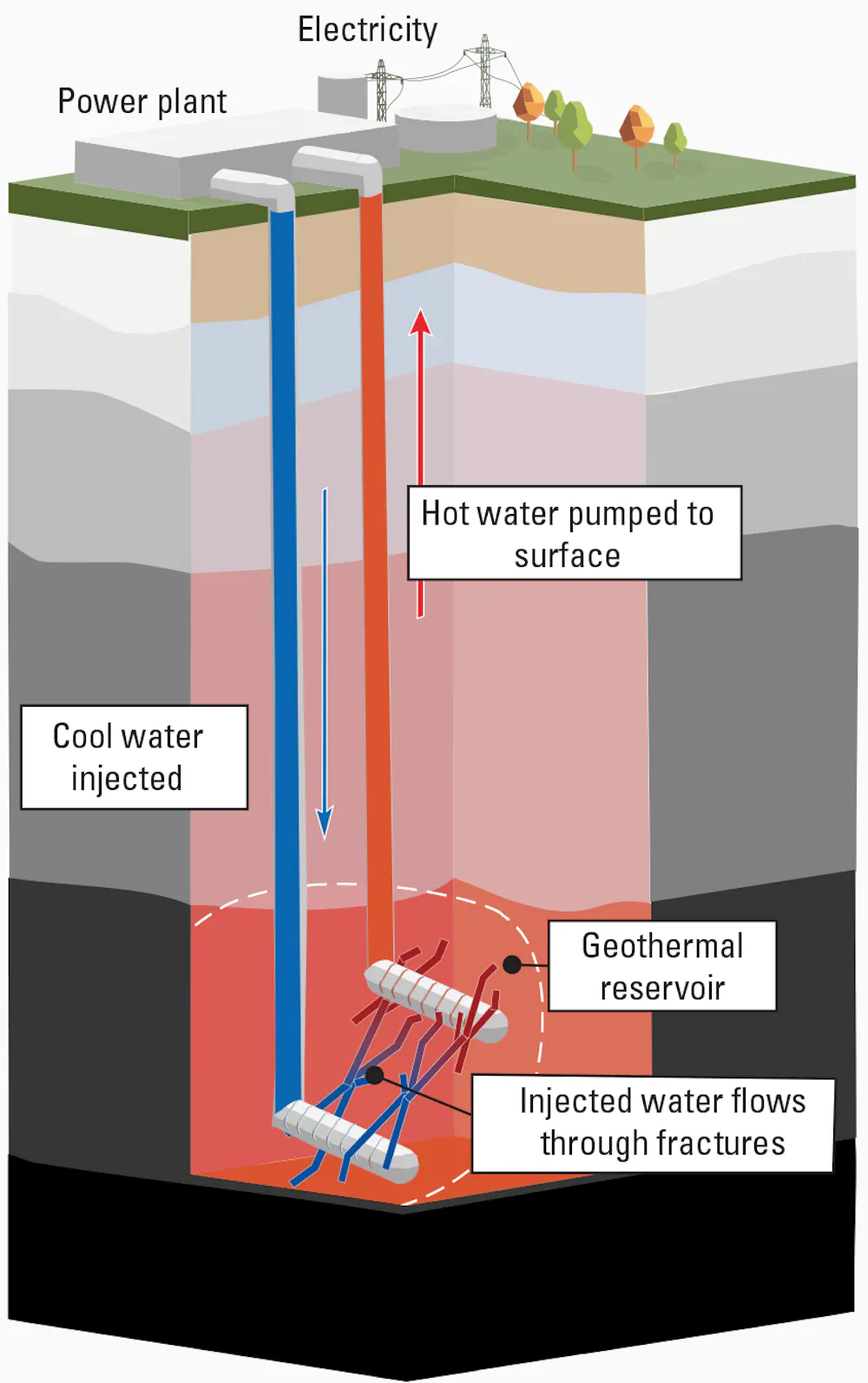
Enhanced geothermal systems effectively create electricity-generating hydrothermal processes just about anywhere on the planet. In places where there is not enough water in the ground or where the rock is too dense to move heat naturally, these installations drill deep holes and inject fluid into the hot rocks, creating new fractures and opening existing ones, much like hydraulic fracturing for oil and gas production.

A system like this uses more than one well. In one, it pumps cold water down, which collects heat from the rocks and then is pumped back up through another well, where the heat drives turbines. In recent years, academic and corporate research has dramatically improved drilling speed and lowered costs.

Ground source heat pumps do not require drilling holes as deep, but instead take advantage of the fact that the Earth’s temperature is relatively stable just below the surface, even just 6 or 8 feet down (1.8 to 2.4 meters) – and it’s hotter hundreds of feet lower.

These systems don’t generate electricity but rather circulate fluid in underground pipes, exchanging heat with the soil, extracting warmth from the ground in winter and transferring warmth to the ground in summer. These systems are similar but more efficient than air-source heat pumps, sometimes called minisplits, which are becoming widespread across the U.S. for heating and cooling. Geothermal heat pump systems can serve individual homes, commercial buildings and even neighborhood or business developments.

Direct-use applications also don’t generate electricity but rather use the geothermal heat directly. Farmers heat greenhouses and dry crops; aquaculture facilities maintain optimal water temperatures; industrial operations use the heat to dehydrate food, cure concrete or other energy-intensive processes. Worldwide, these applications now deliver over 100,000 megawatts of thermal capacity. Some geothermal fluids contain valuable minerals; lithium concentrations in the groundwater of California’s Salton Sea region could potentially supply battery manufacturers. Federal judges are reviewing a proposal to do just that, as well as legal challenges to it.

Researchers are finding new ways to use geothermal resources, too. Some are using underground rock formations to store energy as heat when consumer demand is low and use it to produce electricity when demand rises.

Some geothermal power stations can adjust their output to meet demand, rather than running continuously at maximum capacity.

Geothermal sources are also making other renewable-energy projects more effective. Pairing geothermal energy with solar and wind resources and battery storage are increasing the reliability of above-ground renewable power in Texas, among other places.

And geothermal energy can power clean hydrogen production as well as energy-intensive efforts to physically remove carbon dioxide from the atmosphere, as is happening in Iceland.

A diagram shows pipes extending down from the surface of the ground, pushing cold water into hot rocks below, and drawing hot water back up.
Enhanced geothermal systems can be built almost anywhere and can take advantage of existing wells to save the time and money of drilling new holes deep into the ground. U.S. Geological Survey

Geothermal potential in the US and worldwide

Currently, the U.S. has about 3.9 gigawatts of installed geothermal capacity, mostly in the West. That’s about 0.4% of current U.S. energy production, but the amount of available energy is much larger, according to federal and international engineering assessments.

And converting abandoned oil and gas wells for enhanced geothermal systems could significantly increase the amount of energy available and its geographic spread.

One example is happening in Beaver County, in the southwestern part of Utah. Once a struggling rural community, it now hosts multiple geothermal plants that are being developed to both demonstrate the potential and to supply electricity to customers as far away as California.

Those projects include repurposing idle oil or gas wells, which is relatively straightforward: Engineers identify wells that reach deep, hot rock formations and circulate water or another fluid in a closed loop to capture heat to generate electricity or provide direct heating. This method does not require drilling new wells, which significantly reduces setup costs and environmental disruption and accelerates deployment.

There are as many as 4 million abandoned oil and gas wells across the U.S., some of which could shift from being fossil fuel infrastructure into opportunities for clean energy.

Challenges and trade-offs

Geothermal energy is not without technical, environmental and economic hurdles.

Drilling is expensive, and conventional systems need specific geological conditions. Enhanced systems, using hydraulic fracturing, risk causing earthquakes.

Overall emissions are low from geothermal systems, though the systems can release hydrogen sulfide, a corrosive gas that is toxic to humans and can contribute to respiratory irritation. But modern geothermal plants use abatement systems that can capture up to 99.9% of hydrogen sulfide before it enters the atmosphere.

And the systems do use water, though closed-loop systems can minimize consumption.

Building geothermal power stations does require significant investment, but its ability to deliver energy over the long term can offset many of these costs. Projects like those undertaken by Fervo Energy show that government subsidies are no longer necessary for a project to get funded, built and begin generating energy.

Despite its challenges, geothermal energy’s reliability, low emissions and scalability make it a vital complement to solar and wind – and a cornerstone of a stable, low-carbon energy future.The Conversation

Moones Alamooti, Assistant Professor of Energy and Petroleum Engineering, University of North Dakota

This article is republished from The Conversation under a Creative Commons license. Read the original article.

Lakeport man receives 30-years-to-life sentence for fatal April 2024 drive-by shooting

LAKE COUNTY, Calif. — On Monday, a judge handed down a prison term of 30 years to life to a young Lakeport man who killed a woman during a drive-by shooting in Clearlake in April 2024.

Judge J. David Markham sentenced Nathaniel Ladre Hueners, 22, for the murder of Elizabeth Williams.

Authorities said Williams, 45, was driving a vehicle near Pacific Avenue and Konocti View Road in Clearlake on the night of April 5, 2024, when another vehicle pulled up next to hers and one of the occupants of the second vehicle shot at Williams' vehicle, striking her one time, before fleeing the scene.

Chief Deputy District Attorney Rich Watson and District Attorney Susan Krones told Lake County News in a Monday interview that the shooting was the result of mistaken identity.

“He thought he was shooting somebody else,” said Krones, noting that the situation was believed to have stemmed from a rival gang.

Watson said a man in a silver sedan had threatened Hueners earlier that week. On the night of the shooting, Williams drove by him in a vehicle that looked similar to that silver sedan. Hueners pursued the car, thinking it was the person who had threatened him previously, ultimately shooting into it and hitting Williams.

Krones and Watson said that, while Williams wasn’t the intended victim, it became a matter of “transferred intent,” a legal doctrine which holds that an individual can be held liable for a crime against an unintended victim. 

Hueners was arrested three days after the killing and ahas remained in custody since.

On Sept. 19, Hueners pleaded to second degree murder, which has a 15 years to life sentence. However, that term was doubled to 30 years to life because Hueners also admitted to a January 2022 conviction for assault with a firearm, which is a strike, Watson said.

As a result of his September plea, eight other felony charges were dropped: the attempted murder of Nino Davis; assault with a deadly weapon; assault with a firearm; shooting at an inhabited vehicle; two counts of a convicted felon in possession of a firearm; and two counts of a person prohibited to be in possession of ammunition. A 10th felony count, threatening to commit a crime, was dismissed at his preliminary hearing last year.
   
In California, youth offender status allows people who commit crimes under age 26 to have a separate parole process.

While both Krones and Watson said Hueners would be eligible for youth offender status, Watson said he’s not sure how that will play out or how many credits Hueners might get.

Krones said Hueners was a youthful offender when he got his strike in 2022. “I think that would weigh against him” in terms of being granted parole in that process.

In connection to the shooting, the District Attorney’s Office also charged David Sandoval Jr. with two counts, a felony for concealing the 9 millimeter Glock handgun used in Williams’ killing and a misdemeanor of destroying evidence.

Court records show that his preliminary hearing in that case has been held over numerous times, and he’s set to return to court on Dec. 9 when a new preliminary hearing is due to be set.

Email Elizabeth Larson at This email address is being protected from spambots. You need JavaScript enabled to view it.. Follow her on Twitter, @ERLarson, and on Bluesky, @erlarson.bsky.social. Find Lake County News on the following platforms: Facebook, @LakeCoNews; X, @LakeCoNews; Threads, @lakeconews, and on Bluesky, @lakeconews.bsky.social. 

  • 79
  • 80
  • 81
  • 82
  • 83
  • 84
  • 85
  • 86
  • 87
  • 88

Community

  • Lake County Wine Alliance offers sponsor update; beneficiary applications open 

  • Mendocino National Forest announces seasonal hiring for upcoming field season

Public Safety

  • Lakeport Police logs: Thursday, Jan. 15

  • Lakeport Police logs: Wednesday, Jan. 14

Education

  • Woodland Community College receives maximum eight-year reaffirmation of accreditation from ACCJC

  • SNHU announces Fall 2025 President's List

Health

  • California ranks 24th in America’s Health Rankings Annual Report from United Health Foundation

  • Healthy blood donors especially vital during active flu season

Business

  • Two Lake County Mediacom employees earn company’s top service awards

  • Redwood Credit Union launches holiday gift and porch-to-pantry food drives

Obituaries

  • Rufino ‘Ray’ Pato

  • Patty Lee Smith

Opinion & Letters

  • The benefits of music for students

  • How to ease the burden of high electric bills

Veterans

  • CalVet and CSU Long Beach team up to improve data collection related to veteran suicides

  • A ‘Big Step Forward’ for Gulf War Veterans

Recreation

  • Wet weather trail closure in effect on Upper Lake Ranger District

  • Mendocino National Forest seeking public input on OHV grant applications

  • State Parks announces 2026 Anderson Marsh nature walk schedule 

  • BLM lifts seasonal fire restrictions in central California

Religion

  • Kelseyville Presbyterian to host Ash Wednesday service and Lenten dinner Feb. 18

  • Kelseyville Presbyterian Church to hold ‘Longest Night’ service Dec. 21

Arts & Life

  • Auditions announced for original musical ‘Even In Shadow’ set for March 21 and 28

  • ‘The Rip’ action heist; ‘Steal’ grounded in a crime thriller

Government & Politics

  • Lake County Democrats issue endorsements in local races for the June California Primary

  • County negotiates money-saving power purchase agreement

Legals

  • March 3 hearing on ordinance amending code for commercial cannabis uses

  • Feb. 12 public hearing on resolution to establish standards for agricultural roads

How to resolve AdBlock issue?
Refresh this page