How to resolve AdBlock issue?
Refresh this page
How to resolve AdBlock issue?
Refresh this page
Lake County News,California
  • Home
    • Registration Form
  • News
    • Education
    • Veterans
    • Community
      • Obituaries
      • Letters
      • Commentary
    • Police Logs
    • Business
    • Recreation
    • Health
    • Religion
    • Legals
    • Arts & Life
    • Regional
  • Calendar
  • Contact us
    • FAQs
    • Phones, E-Mail
    • Subscribe
  • Advertise Here
  • Login

News

Local Friends of the Lake County Library celebrated during National Friends of the Library Week

LAKE COUNTY, Calif. — The Lake County Library is proud to observe National Friends of the Library Week, Oct. 19 to 25, 2025, by recognizing the Friends of the Lake County Library, whose dedication and funding make a big difference in the services the library can offer the community.

The Friends of the Lake County Library is a crucial non-profit partner that contributes thousands of dollars every year to enhance and expand library programs and collections. These programs would otherwise not be possible.

Completely run by dedicated local volunteers, the Friends of the Library directs all proceeds from its fundraising efforts, which include book sales and membership dues, directly back into library services.

“The library is supported by a dedicated local property tax, but the Friends provide critical funds for programs, books, and other materials,” said County Librarian Christopher Veach. "We are so thankful for their dedication and support."

The nonprofit's fundraising provides a range of services for Lake County residents. Their support is very important for library programs, funding supplies and refreshments for programs like Storytime, Kids' Crafts and programs for adults. Furthermore, the Friends fund popular events like Wildlife education programs for kids and local author appearances.

Their contributions add new books and materials to the library and support the Summer and Winter Reading Challenges. The Friends also fund makerspace stations for children and cover the complete cost for a full year of online Author Talk Programming.

The Lake County Library extends its deepest gratitude to every volunteer, member, and donor of the Friends of the Lake County Library. Their support is instrumental in ensuring the library remains a vital place of learning, creativity and connection.

To learn more about the Friends of the Lake County Library, visit their official website at www.friendsofthelakecountylibrary.org. 

Visit the Lake County Library Website at http://library.lakecountyca.gov. 

How new foreign worker visa fees might worsen doctor shortages in rural America

Many physicians who aren’t U.S. citizens come to the U.S. to do medical residency programs. SDI Productions/E+ via Getty Images

There are almost 1.1 million licensed physicians in the United States. That may sound like a lot, but the country has struggled for decades to train enough physicians to meet its needs – and, in particular, to provide care in rural and underserved communities.

Foreign-born physicians have long filled that gap, reducing the overall national shortage and signing up to practice in often overlooked regions and specialties. Today, 1 in 5 doctors licensed to practice in the U.S. were born and trained in another country.

But the ability of physicians from other countries to obtain work in the U.S. may be threatened by the Trump administration’s aims of limiting foreign workers. In September, Trump issued a proclamation requiring employers sponsoring foreign-born workers through a type of work visa called an H-1B to pay a fee of US$100,000 to the government. The White House has signaled doctors may be exempt but has not clarified its position.

As a physician and professor who studies the intersection of business and medicine, I believe increasing restrictions on H-1B visas for physicians may exacerbate the physician shortage. To grasp why that is, it’s important to understand how foreign-trained doctors became such an integral part of U.S. health care – and the role they play today.

The roots of today’s physician shortage

The Association of American Medical Colleges, a trade association representing U.S. medical schools, estimates there will be a deficit of about 86,000 physicians in the country by 2036.

The roots of this shortage stretch back more than a century. In 1910, a landmark study called the Flexner Report detailed significant inconsistencies in the quality of education at American medical schools. The report resulted in the closure of over half the country’s medical schools, winnowing their numbers down from 148 to 66 over two decades.

As a result, the number of doctors in the U.S. declined until new training programs emerged. Between 1960 and 1980, 40 new medical schools launched with the help of federal funding. In 1980, a congressionally mandated assessment deemed the problem solved, but by the early 2000s, a physician shortage emerged once more. In 2006, the American Association of Medical Colleges called for raising medical school enrollment by 30%.

Doctor looking at x-rays
Foreign-born doctors have helped the U.S. bridge a physician shortage for decades. stevecoleimages/E+ via Getty Images

Growth in medical school enrollment hit that target in the late 2010s, but even so, the U.S. still lacks enough medical graduates to fill yearslong training programs, called residencies, that early-career physicians must complete to become fully qualified to practice.

Especially lacking are primary care physicians – particularly in rural areas, where there are one-third as many physicians per capita as in urban areas.

Opportunities for foreign-born doctors

Even as the U.S. built up medical school enrollment in the 1960s and 1970s, the government joined other countries such as the U.K. and Canada in creating immigration policies that drew physicians from developing countries to practice in underserved areas. Between 1970 and 1980, their numbers grew sharply, from 57,000 to 97,000.

Foreign-born and -trained physicians have remained a key pillar of the U.S. medical system. In recent years, the majority of those physicians have come from India and Pakistan. Citizens of Canada and Middle Eastern countries have added significantly to that count, as well. Most arrive in the U.S. as trainees in residency programs through one of two main visa programs.

The majority come on J-1 visas, which allow physicians to enter the U.S. for training but require them to return to their home country for at least two years when their training is complete. Those who wish to remain in the U.S. to practice must transition to an H-1B visa.

A small percentage of physicians come to the U.S. on H-1Bs from the start.

H-1B visas are employer-sponsored temporary work permits that allow foreign-born, highly skilled workers to obtain U.S. employment. Employers directly petition the government on behalf of visa applicants, certifying that a foreign worker will be paid a similar wage to U.S. workers and will not adversely affect the working conditions of Americans.

Several programs sponsor H-1B visas for physicians, though the most common requires a three-year commitment to work in an underserved area after completing their training.

Foreign physicians fill a crucial need

In 2025, foreign-trained medical graduates filled 9,700 of the nearly 40,000 training positions. Of those, roughly one-third were actually U.S. citizens who attended medical schools in other countries, with the remainder being foreign citizens seeking more training in the U.S.

After residency, these doctors frequently practice in precisely the geographic areas where the physician shortage is most severe. A nationwide survey of international medical graduates found that two-thirds practice in regions that the federal government has designated as lacking sufficient access to health care.

These doctors also occupy a disproportionate number of primary care positions. In a sample of 15,000 physicians who accepted new jobs in one year, foreign-born doctors were nine times more likely to enter primary care specialties. In 2025, 33.3% of internal medicine, 20.4% of pediatric and 17.6% of family medicine training positions were filled by physicians trained in other countries.

Who will pay?

Approximately 8,000 foreign-born physicians received H-1B visas in 2024. The new requirement of a $100,000 sponsorship fee would hit hardest for hospitals, health systems and clinics in areas of the country most significantly affected by the physician shortage.

These organizations are already under economic strain due to increasing labor costs and Medicare payments that have not kept pace with inflation. Dozens of these hospitals have closed in recent years, and many currently do not make enough money to support their operations.

On Sept. 25, 2025, 57 physician organizations cosigned a letter petitioning Homeland Security Secretary Kristi Noem to waive the new application fee for physicians.

Already, however, the new rule may be having a chilling effect. Despite years of annual growth in the number of foreign-born applicants to U.S. physician training programs, 2025 has seen a nearly 10% drop. If the new H-1B fee is applied to physicians, the number is likely to keep falling.The Conversation

Patrick Aguilar, Managing Director of Health, Washington University in St. Louis

This article is republished from The Conversation under a Creative Commons license. Read the original article.
Mendocino National Forest to begin prescribed fires; favorable weather conditions in place for hazardous fuels reduction work

MENDOCINO NATIONAL FOREST, Calif. — Firefighters on the Mendocino National Forest are planning pile burning operations beginning next week, pending favorable conditions.

On Monday, Oct. 20, firefighters will attempt to burn up to 17 acres of piles at Plaskett Meadows Campground and along Forest Highway 7 in western Glenn County. Also next week, firefighters are looking to complete ten acres of pile burning at Ides Cove Campground in northwestern Tehama County.

Prescribed fire operations including pile burning and understory burning will occur across the forest through the fall and winter season, as conditions allow. Prescribed fires help reduce overgrown vegetation to help protect local communities, infrastructure and natural resources from wildfires.

Prescribed burns planned this fall and winter season include the following.

Grindstone Ranger District

• Plaskett Meadows, Board Tree and FH7 roadside pile burning in western Glenn County.
• Ides Cove pile burning in northwestern Tehama County.
• Kingsley Glade, Three Prong and Sugarfoot Campgrounds pile burning in western Tehama County.
• M-5 Road, Letts Lake and Board Camp Ridge pile burning in western Colusa County.
• Admin sites pile burning at Wilson Camp, Log Springs, Paskenta, Alder Springs, Wells Cabin, Chico Seed Orchard, Red Bluff and Stonyford.

Upper Lake and Covelo Ranger Districts

• Northshore Reforestation and Bartlett Springs pile burning located northeast of Northshore communities Nice, Lucerne and Clearlake Oaks in Lake County.
• Booth Crossing Fuel Break near homes in Pillsbury Ranch north of Lake Pillsbury.
• Road, Upper Deer Valley Road, Horse Mountain and Pine Mountain pile burning in Lake County.
• Howard Mill understory burning off of the M1 Road in Lake County.
• Campground pile burning in eastern Mendocino County.
• Admin sites pile burning at Soda Creek, Little Doe and Deer Valley Campground.
• Westshore and Pillsbury understory near Lake Pillsbury in Lake County.

Residents and visitors are asked to avoid areas where prescribed fires will be conducted. Some smoke may be visible. For more detailed information about air quality, go to AirNow.gov online or download the app.

Fire managers carefully monitor prescribed burns and will plan to conduct activities during the safest possible burn windows. Local fire and government authorities are notified prior to burn days and kept informed throughout prescribed fire operations.

More information about Mendocino National Forest’s prescribed fire operations will be available online at inciweb.wildfire.gov. 

Estate Planning: Unintended — or avoidable — estate planning outcomes

Dennis Fordham. Courtesy photo.
People do not plan to fail, but people often fail to plan. This is the case with unintended estate planning outcomes. Let us discuss some common scenarios.

Do one or more children live at home? If so, what is to come of the children in the event that the parent is disabled or dies? Does the parent’s estate and financial planning provide for the children to have a place to live and the necessities and comforts of life? Failing to plan may result in costly and unintended outcomes. Planning may include a special support trust for the children.

Is there a sole proprietorship (business)? A sole proprietorship may need to be transferred into a business entity for purposes of future transfers to family member(s) or a future sale of the business. Otherwise, it may become more difficult to transfer or to sell the business as a going concern, and value may be lost. 

Are there retirement plans? If so, the participant will want a power of attorney to appoint an agent to manage the plan if the participant became incapacitated, and will also want to name primary and secondary (alternative) death beneficiaries.

Moreover, the participant will want to consider the income tax implications when designating the primary death beneficiaries; that is because depending on who inherits, greater income tax deferral may be possible.  

Are any of the death beneficiaries receiving needs based government benefits? If so, perhaps a special needs trust should be part of the estate planning; that way the inherited assets do not disqualify the recipient from continued benefits (e.g., SSI, Medi-Cal, and food stamps).

Are any of the beneficiaries in serious debt to creditors? If so, then consideration should be given to holding such inheritance in a discretionary spendthrift trust. The trustee is authorized to make distributions to or for the benefit of the beneficiary, considering the creditor implications.

Special (priority) debts, however, such as unpaid child and spousal support can overcome even discretionary spendthrift trust protections.

Are any of the beneficiaries, for any reason, unable to manage their assets? If so, the consideration should be given to holding such inheritance in a support trust with either a mandatory or discretionary distribution standard for the beneficiary’s health, education, maintenance and support.

Are there special (valuable or sentimental) items of personal property (e.g., jewelry, antiques, and vehicles) to be distributed? If so, such gifts should be itemized on a schedule and the schedule included as part of a will or trust, perhaps as an attached memorandum of personal property gifts.

Is there a need to involve additional persons, besides the successor trustee, in the administration of the trust assets?

For example, is there a trusted advisor whose judgment and expertise are important to the investment, management or distribution of trust assets. If so, perhaps a directed trust arrangement should be utilized to appoint the advisor either as a trust director or as a special co-trustee with compartmentalized or segmented authority or trust administration.

Is one or more charities intended as a beneficiary? If so, consideration should be given to how the charitable gift is made; is it given outright without strings or is it managed over time and distributed for special purposes.

Is there a need to update existing estate planning due to life changes that make the planning obsolete. For example, is there a need to change who is the successor trustee? Is there a need to change who inherits? If so, hopefully the person acts while they still have capacity (understanding).

Do designated death beneficiaries on Pay On Death (“POD”) and Transfer on Death (“TOD”) know about their being beneficiaries on these accounts? If not, these accounts may sometimes either be unclaimed or become part of an otherwise unnecessary probate.

The foregoing is not legal advice.  Consult a qualified estate planning attorney for guidance.

Dennis A. Fordham, Attorney, is a State Bar-Certified Specialist in estate planning, probate and trust law. His office is at 870 S. Main St., Lakeport, Calif. He can be reached at This email address is being protected from spambots. You need JavaScript enabled to view it. and 707-263-3235.  

Space News: The Moon is getting slightly farther away from the Earth each year − a physicist explains why

Earth rises over the Moon, as seen by the Apollo 8 astronauts. Bill Anders/NASA
Curious Kids is a series for children of all ages. If you have a question you’d like an expert to answer, send it to This email address is being protected from spambots. You need JavaScript enabled to view it..

Is the Moon getting farther away from Earth? – Judah, 9, Broken Arrow, Oklahoma


The Moon is getting 1½ inches (3.8 centimeters) farther away from the Earth every year.

Scientists measure the distance to the Moon by bouncing lasers off mirrors placed there by space probes and astronauts.

By measuring the amount of time it takes light to travel to the Moon and back, scientists can very precisely measure the distance to the Moon and how the distance changes.

The distance to the Moon actually changes over a single month as it goes around the Earth. The Moon is typically 239,000 miles (385,000 km) away from the Earth, but its orbit is not a perfect circle and changes by about 12,400 miles (20,000 km) as it orbits the Earth. This change is why some full moons are a bit bigger than others; these are called supermoons.

As an astrophysics researcher, I’m interested in the motion and interaction of objects such as planets, stars and galaxies. The motions of the Earth and Moon have many interesting consequences, and studying how they move over time can help researchers better understand how each has changed over the 4½ billion years since the Earth and Moon formed.

Tidal forces

So, why is the Moon getting farther away? It’s all because of tides.

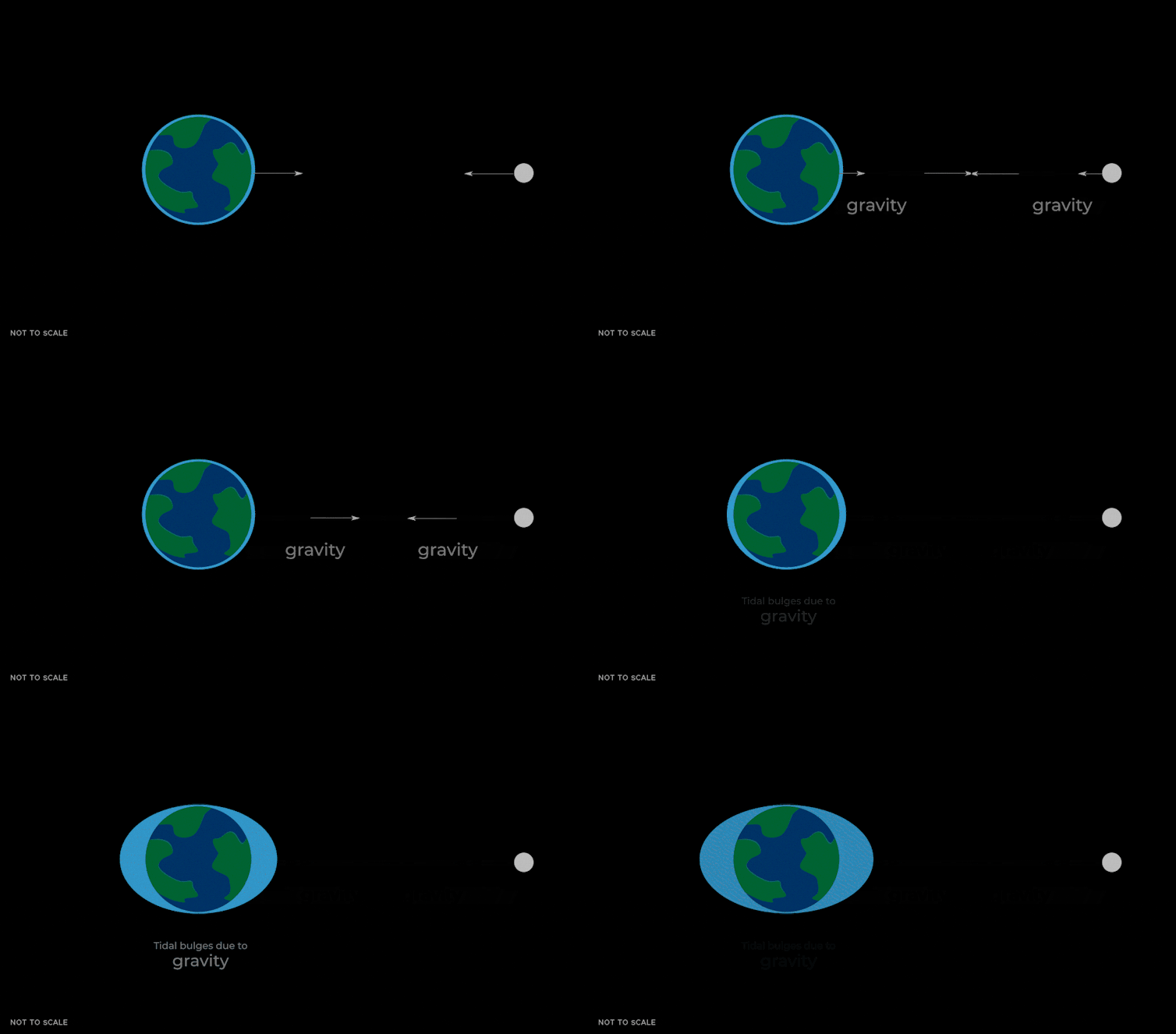
Tides come from a difference in gravity across an object. The force of gravity exerted by the Moon is about 4% stronger on the side of Earth that faces toward the Moon, compared to the opposite side of the Earth facing away, because gravity gets weaker with distance.

This tidal force causes the oceans to slosh around in two bulges that point toward and away from the Moon. They do this because the gravitational force pulling on Earth by the Moon isn’t just an average force that’s the same strength everywhere. The Moon’s gravity is strongest on the closer side of the Earth, creating a bulge of water pointing toward the Moon. It’s weaker on the opposite side of the Earth, which leaves another bulge of water that lags behind the rest of the Earth.

An animation showing the formation of tides
A NASA animation, not to scale, shows how the Moon creates tides on the Earth. The water in the oceans sloshes toward and away from the Moon. NASA/Vi Nguyen

As the Earth rotates, these bulges move around and keep pointing at the Moon because of its gravitational pull. In New York City or Los Angeles, the water level can change by about 5 feet due to these tidal bulges.

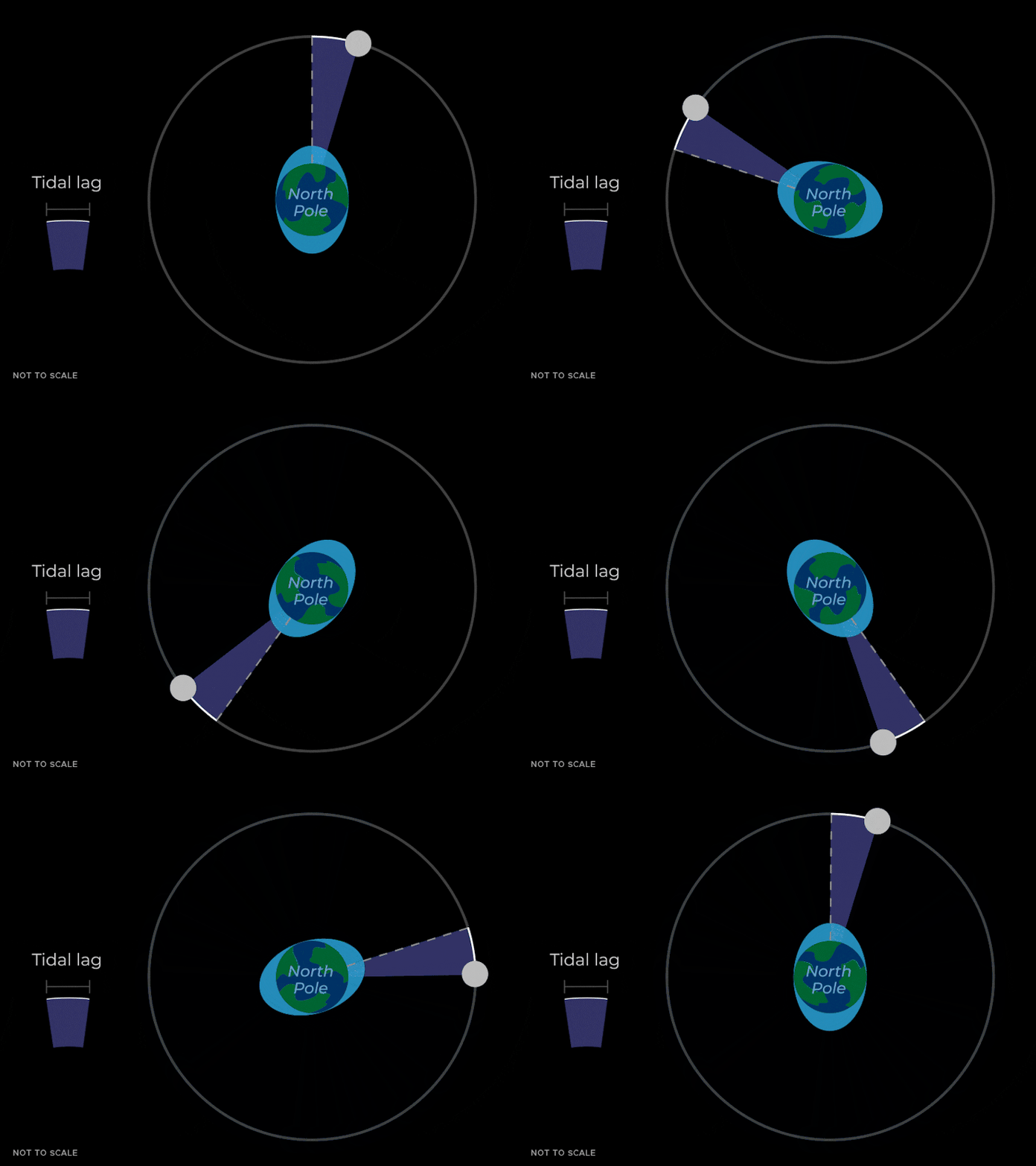
These liquid bulges do not quite line up with the Moon – they “lead” it a little bit because the Earth is rotating and dragging them forward. These bulges also exert a gravitational pull back on the Moon. The bulge closer to the Moon isn’t just pulling the Moon toward the center of the Earth, but also a little bit ahead in its orbit – like the boost a sports car gets as it goes around a curve.

An animation of the moon orbiting the Earth, with two bulges growing and ebbing away
As the Moon orbits the Earth, the tidal bulges do not exactly point toward the Moon, but instead a little bit ahead of it because of friction between the bulges and the rotating Earth. NASA/Vi Nguyen

This forward pull from the closer tidal bulge causes the Moon to speed up, which causes the size of its orbit to increase. Think of a baseball player hitting a home run. If the player hits the ball faster at home plate, it’ll zoom higher up into the sky.

So the bottom line is that the gravity of the closer tidal bulge on the Earth is pulling the Moon forward, which increases the size of the Moon’s orbit. This means that the Moon gets slightly farther away from the Earth. This effect is very gradual and only detectable on average over years.

Does the Moon’s increasing distance affect Earth?

The Moon gains momentum as its orbit gets bigger. Think about spinning a weight attached to a string. The longer the string, the more momentum the weight has, and the harder it is to stop.

Because the Earth is doing the work of increasing the Moon’s momentum, the Earth’s rotation slows down in turn, as its momentum goes to the Moon. To put it another way, as the Moon’s orbital momentum increases, the Earth’s rotational momentum decreases in exchange. This exchange makes a day get very slightly longer.

But don’t worry, these effects are so small: 1.5 inches per year compared to a distance of 239,000 miles (384,000 km) is just 0.00000001% per year. We’ll keep having eclipses, tides and days that last 24 hours for millions of years.

Was the Moon closer to us in the past?

The Earth’s days were shorter in the past.

The Moon probably formed around 4.5 billion years ago, when a young Earth was hit by a Mars-size protoplanet, causing a lot of material to get knocked off into space.

Eventually, that material formed the Moon, and it was initially much closer to the Earth. Back then, you’d see the Moon much bigger in the sky.

A NASA simulation of the collision between early Earth and a now-destroyed protoplanet that likely created the Moon.

By examining fossilized clam shells for material showing their daily growth patterns, paleontologists found evidence that 70 million years ago – near the end of the time of dinosaurs – the day was only 23.5 hours long, just as predicted by astronomical data.

What will happen in the future?

So, will the Moon eventually escape from the Earth’s gravitational pull as it moves away?

If we fast-forward tens of billions of years into the future, eventually the Earth’s rotation could slow down until it is tidally locked with the Moon. That means that it would take just as long for the Earth to rotate as the Moon does to orbit. At this point, the Moon would stop getting more distant, and you would see the Moon only from one side of the Earth.

A NASA video shows how the Sun might appear as a red giant billions of years in the future.

But two things will stop that from happening. First, in a billion years or so, the Sun will get brighter and boil away the oceans. Then, there won’t be large tidal bulges of water to cause the Moon to get more distant. A few billion years later, the Sun will expand into a red giant, probably destroying the Earth and the Moon.

But these events are so far in the future that you don’t need to worry about them. You just get to enjoy tides on the beach, solar eclipses and our beautiful Moon.


Hello, curious kids! Do you have a question you’d like an expert to answer? Ask an adult to send your question to This email address is being protected from spambots. You need JavaScript enabled to view it.. Please tell us your name, age and the city where you live.

And since curiosity has no age limit – adults, let us know what you’re wondering, too. We won’t be able to answer every question, but we will do our best.The Conversation

Stephen DiKerby, Postdoctoral Researcher in Physics and Astronomy, Michigan State University

This article is republished from The Conversation under a Creative Commons license. Read the original article.
Lake County Office of Education to host transfer fair at Woodland Community College Lake County Campus

LAKE COUNTY, Calif. — The Lake County Office of Education is partnering with Woodland Community College’s Lake County Campus to host the Lake County College and Transfer Fair.

The event will take place from 9 to 11 a.m. Friday, Oct. 24, at the campus, 15880 Dam Road Extension in Clearlake.

Current Lake County high school and community college students are invited to learn about opportunities to transfer to other schools.

They also can meet with representatives of colleges and universities including California State University, Chico; Dominican University of California; Cal Poly Humboldt; Jessup University; San Francisco State University; Simpson University; Sonoma State University; Southern Oregon University; University of California, Davis; University of California, Santa Cruz; Woodland Community College; and Mendocino College.

On Oct. 23, ahead of the fair, Woodland Community College will be honored with a Pathway Champion Award by the Campaign for College Opportunity. 

Each year, this organization recognizes California Community Colleges and CSU campuses that are breaking barriers to help more students transfer and graduate with a degree.

This year, WCC is among 40 Pathway Champions statewide and is recognized with an “Excellence in Placement” Award for campuswide growth in transfer-level English success. 

To earn this honor, WCC ranked among the top three California Community Colleges with the highest percentage point growth in students completing a transfer-level English course from the 2022-23 to 2023-24 academic year.

For more information, contact Matt Russell at This email address is being protected from spambots. You need JavaScript enabled to view it. or 707-262-4171 or Christian Villalobos, This email address is being protected from spambots. You need JavaScript enabled to view it. or 707-262-4124.

  • 82
  • 83
  • 84
  • 85
  • 86
  • 87
  • 88
  • 89
  • 90
  • 91

Community

  • Lake County Wine Alliance offers sponsor update; beneficiary applications open 

  • Mendocino National Forest announces seasonal hiring for upcoming field season

Public Safety

  • Lakeport Police logs: Thursday, Jan. 15

  • Lakeport Police logs: Wednesday, Jan. 14

Education

  • Woodland Community College receives maximum eight-year reaffirmation of accreditation from ACCJC

  • SNHU announces Fall 2025 President's List

Health

  • California ranks 24th in America’s Health Rankings Annual Report from United Health Foundation

  • Healthy blood donors especially vital during active flu season

Business

  • Two Lake County Mediacom employees earn company’s top service awards

  • Redwood Credit Union launches holiday gift and porch-to-pantry food drives

Obituaries

  • Rufino ‘Ray’ Pato

  • Patty Lee Smith

Opinion & Letters

  • The benefits of music for students

  • How to ease the burden of high electric bills

Veterans

  • CalVet and CSU Long Beach team up to improve data collection related to veteran suicides

  • A ‘Big Step Forward’ for Gulf War Veterans

Recreation

  • Wet weather trail closure in effect on Upper Lake Ranger District

  • Mendocino National Forest seeking public input on OHV grant applications

  • State Parks announces 2026 Anderson Marsh nature walk schedule 

  • BLM lifts seasonal fire restrictions in central California

Religion

  • Kelseyville Presbyterian to host Ash Wednesday service and Lenten dinner Feb. 18

  • Kelseyville Presbyterian Church to hold ‘Longest Night’ service Dec. 21

Arts & Life

  • Auditions announced for original musical ‘Even In Shadow’ set for March 21 and 28

  • ‘The Rip’ action heist; ‘Steal’ grounded in a crime thriller

Government & Politics

  • Lake County Democrats issue endorsements in local races for the June California Primary

  • County negotiates money-saving power purchase agreement

Legals

  • March 3 hearing on ordinance amending code for commercial cannabis uses

  • Feb. 12 public hearing on resolution to establish standards for agricultural roads

How to resolve AdBlock issue?
Refresh this page