How to resolve AdBlock issue?
Refresh this page
How to resolve AdBlock issue?
Refresh this page
Lake County News,California
  • Home
    • Registration Form
  • News
    • Education
    • Veterans
    • Community
      • Obituaries
      • Letters
      • Commentary
    • Police Logs
    • Business
    • Recreation
    • Health
    • Religion
    • Legals
    • Arts & Life
    • Regional
  • Calendar
  • Contact us
    • FAQs
    • Phones, E-Mail
    • Subscribe
  • Advertise Here
  • Login

News

Stay up to date on vaccines for best protection during the holidays

The California Department of Public Health, or CDPH, is reminding all Californians that vaccines against respiratory viruses like COVID-19, influenza and respiratory syncytial virus are the most effective and safest ways to protect themselves against severe illness this winter.

Last month, CDPH, in coordination with the West Coast Health Alliance, or WCHA, announced its recommendations on winter virus immunizations. 

In response to confusion and a lack of evidence-based changes from the federal government, California updated its state coverage laws to ensure continued access to vaccinations. 

The state’s new Public Health for All website provides clear guidance based on transparent and science-based information from the nation’s most reputable professional medical organizations.

“Prioritizing transparency and a reliance on science continues to be a core value in our mission to provide Californians with the information, guidance, and recommendations they need to protect themselves and their families, especially as we head into fall and winter respiratory virus season,” said Dr. Erica Pan, CDPH director and state Public Health officer. “Vaccines continue to provide the safest and most effective protection against severe illness from these respiratory viruses. We remain committed to making sure Californians can choose and access these vaccines.”

Coverage and availability

CDPH’s recommended vaccines will continue to be covered by health care insurers regulated by the State of California and can be received at your local pharmacy, from your health care provider, or through other authorized vaccine providers at no cost. 

To schedule your vaccine appointment, contact your health care provider, local pharmacy, or visit myturn.ca.gov. 

CDPH immunization recommendations

COVID-19

• Children: All children 6-23 months; All children 2-18 years with risk factors or never vaccinated against COVID-19; All children who are in close contact with others with risk factors; All children who choose protection
• Adults: All adults age 65 years and older; All adults ages 19-64 years with risk factors; All adults who are in close contact with others with risk factors; All adults who choose protection
• Pregnancy: All planning pregnancy, pregnant, postpartum, or lactating

Influenza

• Children: All children 6 months and older
• Adults: All adults 19 years or older
• Pregnancy: All planning pregnancy, pregnant, postpartum, or lactating

Respiratory Syncytial Virus (RSV)

• Children: All children 8 months or younger; All children 8-19 months with risk factors
• Adults: All adults 75 years and older; All adults 50-74 years with risk factors
• Pregnancy: Pregnant between 32-36 weeks gestational age

A list of risk factors is available at CDPH’s Public Health for All webpage.

New dashboards promote clarity and information

In addition to the new Public Health for All webpage, and in alignment with the WCHA’s commitment to transparency and proven science, CDPH has also launched two new interactive dashboards to share the most up-to-date data on respiratory viruses across the state.

The first dashboard is a comprehensive Respiratory Virus Dashboard website. This page provides information on disease activity and severity for COVID-19, Flu, and RSV across the state and includes test positivity, hospitalization and wastewater levels, as well as other more detailed information. This data will be available at the state and regional level.

The second is a comprehensive update to the existing Wastewater Surveillance Dashboard, which now includes additional respiratory virus surveillance data from around California.

For more information on immunization requirements and resources, visit CDPH's Public Health for All webpage. To access both new dashboards, visit CDPH’s Respiratory Viruses page.

Sheriff’s office seeks teen suspect in stabbing incident 

LAKE COUNTY, Calif. — The Lake County Sheriff’s Office is working to locate a teenager who authorities said stabbed another girl this week.

Nova Fabisch, 14, of Nice, is being sought in connection to the assault, which the sheriff’s office said occurred on Wednesday.

Although Fabisch is a juvenile, sheriff’s spokesperson Lauren Berlinn said her name is being released to the public due to Fabisch being wanted for attempted murder and because she has been “definitively identified as the suspect.”

On Wednesday, sheriff’s deputies responded to Sutter Lakeside Hospital after receiving reports of a juvenile who had sustained multiple stab wounds, Berlinn said.

When they arrived at the hospital, deputies spoke with the juvenile victim in the presence of her parents, Berlinn said.

Berlinn said the victim reported that during a physical altercation, the suspect, identified as Fabisch, stabbed her multiple times with a pocket knife. 

The victim was treated for her injuries and is expected to make a full recovery, Berlinn said.

“This appears to be an isolated incident, and there is no ongoing threat to the community,” the statement issued by Berlinn on Thursday said.

Berlinn said an active felony warrant has been issued for Fabisch’s arrest on charges of assault with a deadly weapon, battery causing serious bodily injury and attempted murder.
 
Anyone with information related to this case is urged to contact the Sheriff’s Office Major Crimes Unit at 707-262-4088.

Incoming storm system expected to bring rain, cooler temperatures

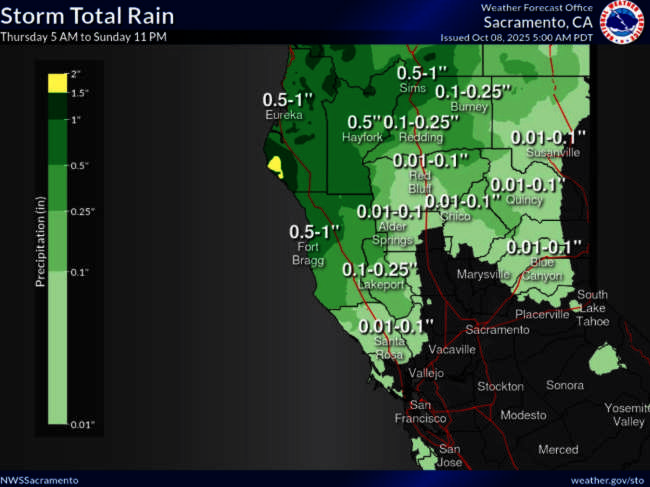
A storm graphic. Image courtesy of the National Weather Service.


LAKE COUNTY, Calif. — The National Weather Service is forecasting several days of rain, with more precipitation and cooler temperatures expected next week.

The agency’s extended forecast explains that an incoming weather system is going to lead to cooling temperatures.

“A colder storm system is forecast early next, and will bring additional rainfall and the potential for some mountain snow,” the National Weather Service said.

Up to a quarter of an inch of rain is in the forecast from Thursday through Sunday.

Forecasters said there were chances of rain overnight and leading into early Thursday morning, with conditions clearing during the rest of the day.

On Friday and Saturday, rain is expected, along with breezy conditions.

Conditions are forecast to clear during the day on Sunday before chances of rain return.

From Monday through Wednesday, the forecast said rain is likely.

Temperatures are expected to continue to cool over the coming week, dropping into the high 50s and low 60s during the day and into the high 40s at night. 

Email Elizabeth Larson at This email address is being protected from spambots. You need JavaScript enabled to view it.. Follow her on Twitter, @ERLarson, and on Bluesky, @erlarson.bsky.social. Find Lake County News on the following platforms: Facebook, @LakeCoNews; X, @LakeCoNews; Threads, @lakeconews, and on Bluesky, @lakeconews.bsky.social. 

State controller publishes 2024 payroll data for special districts

State Controller Malia M. Cohen has published the 2024 self-reported payroll data for California special districts on the Government Compensation in California website.

The data covers 172,854 positions and a total of over $12.66 billion in 2024 wages with over $3.38 billion in health and retirement costs for 3,100 special districts. 

Sixty-eight special districts either did not file or filed a report that was non-compliant.

In Lake County, there are 30 special districts with 437 employees, with wages totaling $14,034,299. All of Lake County’s special districts submitted reports.

The top five special districts in Lake County by employee numbers and wages are as follows:

• Northshore Fire Protection District: 67 employees; total wages, $2,343,983; total retirement and health contributions, $461,539.

• Lake County Fire Protection District: 39 employees; total wages, $2,157,376; total retirement and health contributions, $851,043.

• Kelseyville Fire Protection District: 21 employees; total wages, $1,638,991; total retirement and health contributions, $534,140.

• Lakeport Fire Protection District: 32 employees; total wages, $1,543,800; total retirement and health contributions, $655,920.

• Clearlake Oaks Water District: 22 employees; total wages, $1,360,296; total retirement and health contributions, $323,718.

Special districts are governmental entities created by residents of a local community to deliver specialized services. 

Data for 2024 shows the top 10 districts by total wages are healthcare, transportation, electricity, water and fire districts.

“Fiscal oversight and transparency are central to my responsibility as State Controller. Publishing the 2024 payroll data for California’s special districts allows the public to see how billions in wages and benefits are managed each year,” said Controller Cohen. “The Government Compensation in California website is a critical accountability tool that helps taxpayers, policymakers, and local leaders track spending, evaluate priorities, and ensure that public resources are being used responsibly.”

California law requires cities, counties and special districts to annually report compensation data to the state controller. 

The state controller also maintains and publishes state and California State University salary data. 

The Government Compensation in California site contains pay and benefit information on more than two million government jobs in California, as reported annually by each entity.

Users of the site can:

• View compensation levels on maps and search by region;
• Narrow results by name of the district or by job title; and
• Export raw data or custom reports.

Governor, First Partner mark Latina Equal Pay Day, sign Pay Equity Enforcement Act

On Wednesday, Gov. Gavin Newsom and First Partner Jennifer Siebel Newsom marked Latina Equal Pay Day, recognizing the unique challenges Latina women face in the fight to close the wage gap. 

The date, Oct. 8, symbolizes how far into the next year a Latina must work to earn what a white, non-Hispanic man earned in the previous year.

Governor Newsom signed the “Pay Equity Enforcement Act,” SB 642 by Sen. Monique Limón (D-Santa Barbara), to strengthen California’s Equal Pay Act and to further narrow the wage gap through greater enforcement and transparency. 

Proponents said this measure will empower women seeking jobs and give them additional tools to ensure they are fairly paid. 

“Latinas are the backbone of many communities in California, driving growth in every sector from innovation to education to health care. Through essential legislation such as the Pay Equity Enforcement Act, California is building an economy rooted in fairness, equity, and opportunity for all,” said Gov. Newsom. 

“Latina women give so much of themselves to this state, to their families, their work, and our communities. California’s story is one of perseverance and progress, written in large part by Latina women whose labor has fueled our economy and enriched our culture. Yet they continue to earn far less than their peers for the same work. True equity means rewriting that story – one where every woman is paid fairly and can share fully in California’s promise,” said First Partner Jennifer Siebel Newsom.

“With many families continuing to stretch to make ends meet, we reinforce our commitment to equal pay laws that strengthen the economic security of California families and communities,” said Sen. Limón. “On Latina Equal Pay Day, I am incredibly proud that Governor Newsom is building upon our pay equity legacy here in California. The Pay Equity Enforcement Act will help narrow the wage gap by providing workers with more negotiation power at the start of their career, while also strengthening workers’ rights to recover lost wages — this is a win for workers and an even bigger win for California families.”

“California is home to the nation's largest Latina population, yet Latinas here earn just 49 cents for every dollar paid to white men — a disparity that costs them nearly $1 million over a lifetime. This is not just unfair; it is economically unsustainable and morally unacceptable," said Darcy Totten, executive director of the California Commission on the Status of Women and Girls. "The commission has been proud to stand with First Partner Jennifer Siebel Newsom and state policymakers in advancing pay transparency and equal pay protections, but awareness alone will not close this gap. True economic justice requires structural change, active advocacy, and recognition that our economy is shared...inequality diminishes us all. The Commission's work will not end until every woman in California receives equal pay for equal work."

“The gender wage gap collectively costs Latinas billions in lost wages each year – money that could otherwise go toward rent, groceries, child care, and other essentials that families depend on,” said Jessica Ramey Stender, policy director and deputy legal director of Equal Rights Advocates. “At a time when the federal government is attacking women’s rights and rolling back federal wage protections, California continues to take critical steps to advance pay equity for all. Ensuring Latinas are paid fairly is not only critical for their financial stability, but also for the economic security and well-being of families across the country.”

Equaling the playing field for Latinas

Since the launch of the California Equal Pay Pledge in April 2019, hundreds of California-based companies, organizations, and municipalities have signed, reaching hundreds of thousands of employees. 

Pledge signatories commit to conducting an annual company-wide gender pay analysis, reviewing hiring and promotion processes to reduce unconscious bias, and promoting best practices to help close the pay gap and ensure fundamental equity for all employees.

Building on that progress, the first partner introduced The Equal Pay Playbook last year, a step-by-step guide that helps employers design and implement data-driven strategies for equitable pay. The Playbook demonstrates that fair pay is beneficial for business, as it helps companies attract and retain top talent, boost innovation, and enhance their reputation.

Closing the gap for all

In the last year, it was estimated that there were fewer women in the workforce than in previous years. With fewer working women, there is also a larger impact on the economy. Fair and equal wages help boost GDP as people are able to spend on goods and services, helping fuel local economies. If the gender pay gap were to be addressed, it could lift up the GDP by 20%.

In addition, more people in the workforce means a greater percentage of the population paying taxes to help increase the government’s revenue to fund public goods and services, which in turn spurs more economic growth.

Latinas in the United States earn only 54 cents for every dollar earned by white men, one of the widest wage gaps of any demographic group. That gap translates to a loss of about $28,000 each year. 

If the wage gap were eliminated, on average, a Latina woman would be able to afford: nearly 33 more months of childcare, more than 16 months of mortgage payments, or secure two additional years of rent. These disparities ripple through generations – limiting access to education, housing, and healthcare, and curbing opportunities for wealth-building and entrepreneurship.

Structural barriers

Latinas are overrepresented in some of the lowest-paid industries — such as agriculture, hospitality, care work, and domestic labor — fields that often lack benefits, protections, and advancement pathways. Additionally, Latinas must work nearly an additional 24 hours a week to reach pay equity.

Immigration status can further constrain women’s ability to advocate for fair pay or report workplace violations, while ongoing attacks on immigrant communities have increased economic vulnerability for many Latina workers. Even among college-educated Latinas, pay inequities persist, illustrating that education alone does not close the gap.

Health insurance subsidy standoff pits affordable care for millions against federal budget constraints

Lawmakers limited Affordable Care Act subsidies to a few years, setting the stage for a fight over them in 2025. Ted Eytan/Wikimedia Commons, CC BY-SA
As the federal government entered a shutdown on Oct. 1, 2025, competing narratives quickly emerged about the cause.

Some Republican lawmakers objected to Democrats’ push to include an extension of the expanded Affordable Care Act premium subsidies in a short-term funding bill and cited concerns about long-term spending. Democratic leaders countered that the subsidies are not a new demand but rather the continuation of a program that has helped keep record numbers of Americans insured since the pandemic – and therefore that the issue could not be delayed.

The result is a standoff that blends fiscal and policy disagreements – a hallmark of contemporary budget politics.

As experts in health law, we see this issue as simple but consequential from a legal standpoint. Congress authorized the enhanced subsidies in 2021, originally to cushion the economic fallout from COVID-19 for families, and extended them through 2025 in the Inflation Reduction Act.

Without new legislation, the subsidies revert to pre-2021 levels on Jan. 1, 2026 – which would lead to a jump in the cost of health insurance and would make coverage unaffordable for millions of Americans.

Enhanced subsidies explained

Most Americans under age 65 get insurance through their employers, which the federal government subsidizes by making it tax-free. Medicare, the program for older Americans, and Medicaid, the program that mainly serves low-income Americans, are heavily supported by subsidies too.

But as of 2025, about 1 in 6 people under age 65 do not have access to this coverage, including many small-business owners and tradespeople, as well as part-time workers and those in the gig economy. For them, unsubsidized health insurance can be prohibitively expensive.

To address this affordability problem, the ACA provided for households earning between 100% and 400% of the federal poverty level to receive subsidies for purchasing policies on the ACA marketplace, effectively lowering premiums. The original law limited subsidies only to those making under 400% of the federal poverty level, which is, for a family of four in 2025, around US$128,000 per year. A family making $129,000 a year, however, would have to pay full price.

Family in the kitchen, mom cooks dinner as daughter watches.
If the current ACA subsidies expire, almost 5 million people are likely to lose their health insurance coverage. FG Trade/E+ via Getty Images

The American Rescue Plan temporarily made two major changes in 2021:

  • It removed the 400%-of-poverty eligibility ceiling, extending help to many middle-income families.

  • It capped the maximum household contribution at 8.5% of income for everyone, ensuring affordability regardless of income.

If these reforms expire in 2026, the Internal Revenue Service must revert to the older, less generous formula.

What the subsidies accomplished

The enhanced subsidies drove ACA marketplace participation to historic highs – more than 24 million people selected plans for 2025, up from about 11 million in 2020. The Department of Health and Human Services found disproportionate enrollment gains among Black and Latino Americans, helping to reduce racial disparities in coverage.

For many low-income enrollees, mid-level plans – called silver plans in the ACA marketplace – effectively became free. Middle-income families who previously earned just above the cutoff gained meaningful relief, sometimes saving thousands of dollars a year.

What happens if subsidies expire?

Analysts broadly agree that returning to the pre-2021 rules would mean large cost increases and coverage losses. On average, the premiums that Americans will pay for ACA marketplace plans would more than double. The Kaiser Family Foundation estimates that average annual out-of-pocket premiums for an individual would jump from about $888 in 2025 to $1,900 in 2026.

With these increases, millions of Americans will lose their health insurance coverage. The Urban Institute, a think tank, projects that 7.3 million fewer people would receive subsidized marketplace coverage and 4.8 million more would become uninsured.

This is highly consequential, as research shows that insurance coverage saves lives by ensuring access to care. Knocking nearly 5 million people off insurance may cause as many as 500 additional deaths per year.

Losses would disproportionately impact low- and middle-income families. Free premium plans would disappear. Those making below 250% of the federal poverty level could see their net premiums rise more than fourfold, while those between 250% and 400% would see their premiums double. What’s more, rural Americans, already under pressure from the state of the economy, face higher risks.

The fiscal and policy trade-offs

On the flip side, making the enhanced credits permanent would add about US$350 billion to federal deficits between 2026 and 2035, according to the Congressional Budget Office’s estimates. Proponents argue that the cost is justified by reduced medical debt, fewer uninsured, greater household stability and ultimately saving lives. Short-term savings from cutting the subsidies would also lead to higher health care costs, longer-term. But critics worry it’s a broad and expensive way to support affordability, benefiting some higher-income households that could otherwise afford coverage, even though it would cost more than 8.5% of their income.

Another concern is how the subsidies affect price competition. Under the ACA, the government pays most of the difference between what a household is expected to contribute and the actual cost of a standard benchmark plan. That means if health insurance companies raise their premiums, those who receive subsidies don’t feel the effect of the premium increases, because the federal subsidy simply grows to cover it. That means companies have fewer reasons to compete on price.

Legal and administrative constraints

Because the subsidies are written into the tax code, only Congress can extend them or make them permanent. The question of whether to renew them was already debated strenuously when Congress passed the big tax and spending package that President Donald Trump signed into law on July 4, 2025. By omitting the subsidies, the bill effectively raised health care costs for millions of middle-income Americans. States that run their own marketplaces may add some aid, but few can match the scale of federal support.

Administrative timing matters too. The IRS, health insurers and the online marketplace all need to know how the subsidy amounts will be calculated – in other words, which income limits and premium caps Congress wants to use. These figures determine how much financial help people get when they sign up for coverage. Late or temporary fixes can create confusion for both consumers and administrators.

Options before Congress

Lawmakers have several options, each with different trade-offs.

A permanent extension would provide stability for consumers and insurers – but at the cost of higher long-term federal spending. A short-term renewal of one to four years could soften the immediate jump in premiums while giving Congress time to reassess the policy, but it would continue the cycle of temporary fixes.

Alternatively, a targeted approach might preserve the larger subsidies for lower-income households but gradually reduce assistance for higher earners so that they aren’t guaranteed a cap of 8.5% of their income for insurance. This would make the policy more fiscally restrained but less universal.

Some legislators have also proposed offsetting the cost of ACA subsidies by pairing an extension with savings elsewhere in the health system. Those savings could come from trimming what the government pays insurers to lower patients’ out-of-pocket costs or by reducing Medicare payments to doctors.

Each of these options reflects a different balance among affordability, fiscal responsibility and administrative simplicity. Together, they highlight how difficult it is to design a policy that meets all three goals at once.

A structural challenge

The problem isn’t just political – it’s built into how time-limited programs like the enhanced ACA subsidies are designed. The subsidies have always reflected partisan divides, but their temporary nature makes those divides even sharper. Lawmakers limited them to a few years to keep costs down, but that choice now means Congress has to reopen the same debate every year.

When deadlines for renewing programs collide with larger funding fights, important benefits can lapse, not because lawmakers chose to end them but because the fights over broader spending leave little room for resolution.

In the end, it’s up to Congress to decide not only whether these subsidies continue, but whether big social policies like this should be settled through last-minute budget showdowns. For now, getting the government running and keeping health insurance affordable are part of the same fight.The Conversation

Wendy Netter Epstein, Professor of Law, DePaul University and Christopher Robertson, Professor of Law, Boston University

This article is republished from The Conversation under a Creative Commons license. Read the original article.

  • 88
  • 89
  • 90
  • 91
  • 92
  • 93
  • 94
  • 95
  • 96
  • 97

Community

  • Lake County Wine Alliance offers sponsor update; beneficiary applications open 

  • Mendocino National Forest announces seasonal hiring for upcoming field season

Public Safety

  • Lakeport Police logs: Thursday, Jan. 15

  • Lakeport Police logs: Wednesday, Jan. 14

Education

  • Woodland Community College receives maximum eight-year reaffirmation of accreditation from ACCJC

  • SNHU announces Fall 2025 President's List

Health

  • California ranks 24th in America’s Health Rankings Annual Report from United Health Foundation

  • Healthy blood donors especially vital during active flu season

Business

  • Two Lake County Mediacom employees earn company’s top service awards

  • Redwood Credit Union launches holiday gift and porch-to-pantry food drives

Obituaries

  • Rufino ‘Ray’ Pato

  • Patty Lee Smith

Opinion & Letters

  • The benefits of music for students

  • How to ease the burden of high electric bills

Veterans

  • CalVet and CSU Long Beach team up to improve data collection related to veteran suicides

  • A ‘Big Step Forward’ for Gulf War Veterans

Recreation

  • Wet weather trail closure in effect on Upper Lake Ranger District

  • Mendocino National Forest seeking public input on OHV grant applications

  • State Parks announces 2026 Anderson Marsh nature walk schedule 

  • BLM lifts seasonal fire restrictions in central California

Religion

  • Kelseyville Presbyterian to host Ash Wednesday service and Lenten dinner Feb. 18

  • Kelseyville Presbyterian Church to hold ‘Longest Night’ service Dec. 21

Arts & Life

  • Auditions announced for original musical ‘Even In Shadow’ set for March 21 and 28

  • ‘The Rip’ action heist; ‘Steal’ grounded in a crime thriller

Government & Politics

  • Lake County Democrats issue endorsements in local races for the June California Primary

  • County negotiates money-saving power purchase agreement

Legals

  • March 3 hearing on ordinance amending code for commercial cannabis uses

  • Feb. 12 public hearing on resolution to establish standards for agricultural roads

How to resolve AdBlock issue?
Refresh this page